

Attackers behind the estimated $6.3 billion hack on cryptocurrency exchange Binance continue to wield control over billions of dollars in stolen digital assets, even as token issuers and decentralized protocols race to immobilize the funds. The massive exploit, which began at 8:04 PM UTC on Thursday, has been attributed by crypto investigators to the same state-sponsored North Korean hacking collective implicated in the recent Bitget hack. This sophisticated operation highlights the persistent challenges in securing the vast sums within the digital asset ecosystem and the intricate dance between attackers and custodians.
The perpetrators of the Binance hack immediately initiated a strategy to convert vulnerable assets into more fungible and harder-to-trace cryptocurrencies. Their objective was clear: to transform stablecoins like Tether (USDT) and USD Coin (USDC), which have centralized issuers capable of freezing addresses, into decentralized cryptocurrencies such as Bitcoin (BTC) and Ether (ETH). This maneuver significantly complicates recovery efforts for law enforcement and the affected platforms.
Early indicators of this strategy emerged rapidly. CertiK engineer Dickson Wu meticulously traced approximately $500 million in USDT that was funneled into a single address. Within minutes, by 8:59 PM UTC, a substantial portion of this amount, $325 million, had already been sold to market makers in exchange for ETH, demonstrating the attackers’ swift and decisive execution less than an hour after the breach. This rapid conversion was a direct challenge to the swift response of major stablecoin issuers like Tether and Circle, who were already initiating the process of blacklisting addresses associated with the theft.
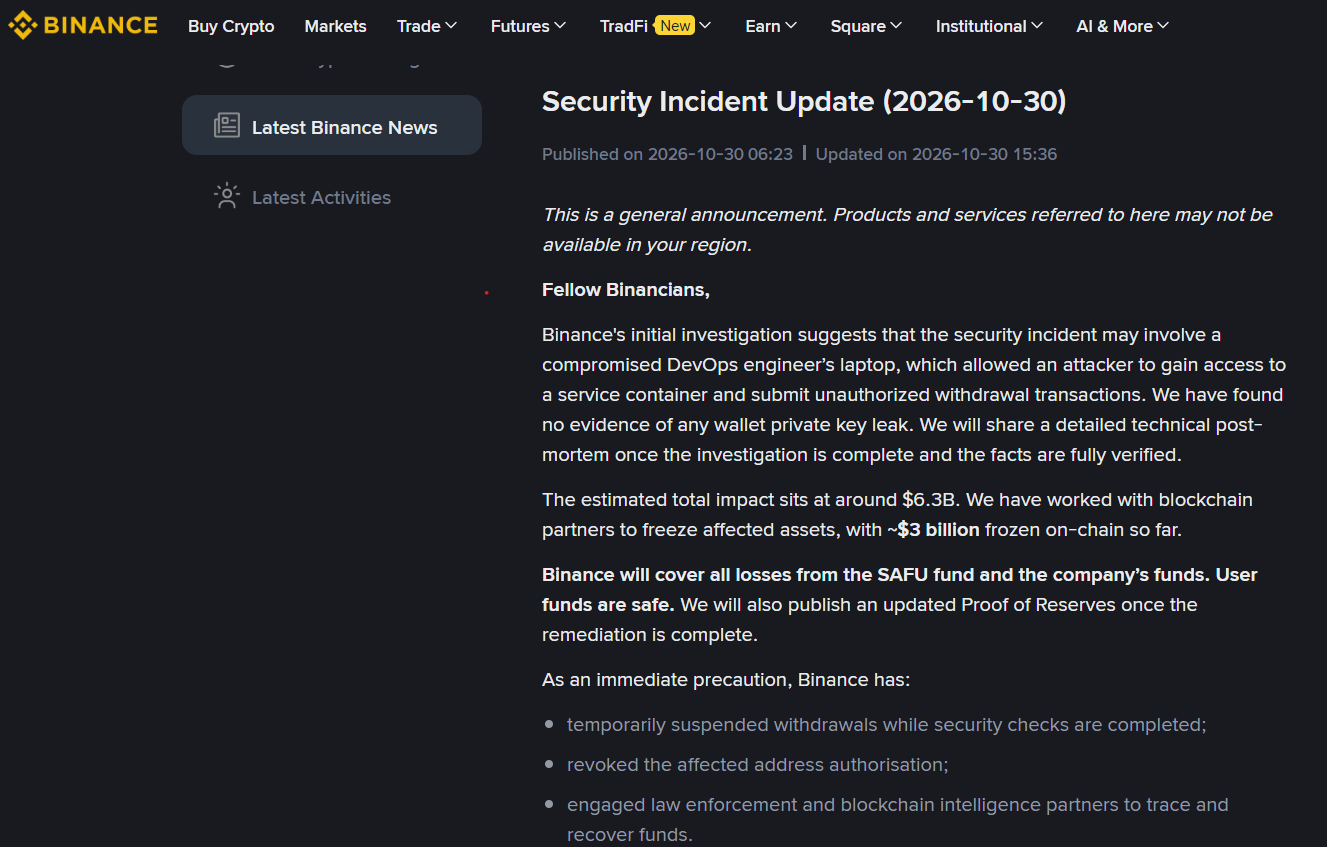
Binance confirmed on Friday that while an estimated $3 billion of the stolen assets had been frozen on-chain, the total value of the hack was approximately $6.3 billion. The exchange stated it was actively collaborating with law enforcement agencies, token issuers, and blockchain analytics firms to trace and recover the remaining funds. The sheer magnitude of this theft, even within the often volatile cryptocurrency landscape, underscores the critical need for enhanced security protocols and rapid response mechanisms. The question remains: how much of this colossal sum can truly be considered irretrievable by the perpetrators?
The Double-Edged Sword of Centralized Stablecoins
Unlike the inherently decentralized nature of Bitcoin and Ether, which lack a single point of control or a governing entity to halt transactions, centralized stablecoins such as Tether’s USDT and Circle’s USDC possess issuers with the authority to freeze tokens held at specific addresses. This capability is a crucial tool in mitigating the impact of hacks, effectively acting as an "off switch" for stolen funds.

Tether, for instance, moved swiftly to freeze approximately $1.567 billion in USDT. The first significant freeze was enacted a mere 37 minutes after the stolen funds arrived at the attackers’ primary Ethereum wallet. This rapid intervention highlights the advantage of centralized control in crisis situations. Circle followed suit, freezing around $823 million in USDC just three minutes after Tether’s action. Other issuers, including Ripple and World Liberty Financial, also implemented freezes on associated addresses, showcasing a coordinated, albeit reactive, effort to stanch the bleeding.
The ability to immobilize crypto assets is not solely confined to stablecoin issuers. Even some decentralized protocols, despite their inherent lack of central authority, have demonstrated the capacity to intervene. The Arbitrum Security Council, for example, moved approximately $30.5 million in ARB and ETH into an intermediary frozen wallet. These funds can only be accessed through further action by the council or a governance vote by the Arbitrum DAO, illustrating a decentralized approach to asset security in emergent situations.
It is crucial to distinguish between frozen and recovered funds. While immobilizing assets effectively prevents suspected attackers from spending them, it does not automatically facilitate their return to the victim exchange or its users. The frozen state represents a temporary containment, not a definitive recovery.
The Aave Complication: Decentralized Finance Under Strain
The involvement of decentralized lending protocol Aave introduced an additional layer of complexity to the recovery efforts. Between 8:58 PM and 9:01 PM UTC, approximately 40 minutes before the first asset freeze, a wallet associated with the attackers deposited $60 million in USDT into Aave V3 on the Ethereum network and subsequently borrowed $44.6 million in wrapped Ether (WETH).
LlamaRisk, an Aave risk service provider, reported in an update at 1:00 AM that the attacker’s position held around $59.9 million in USDT collateral against a $43.8 million debt. Aave confirmed that the position remained overcollateralized, posing no immediate risk to protocol suppliers.
The challenge presented by Aave lies in the nature of decentralized finance. Since the USDT had already been deposited into Aave’s lending pool, a simple blacklisting of the attacker’s external wallet could not automatically retrieve the collateral held by the protocol. As Marc Zeller, founder of the Aave Chan Initiative, explained, "USDT is real money backed by dollars, and the position is criminal but overcollateralized in the eyes of the protocol." This scenario underscores the tension between regulatory intervention and the immutable rules of decentralized smart contracts.
To prevent further exploitation and borrowing against the deposited USDT, Aave temporarily froze markets across its V3 and V4 deployments. This measure allowed existing users to continue withdrawing funds, repaying loans, and liquidating positions while preventing new activity that could potentially be linked to the stolen assets. Aave later lifted this precautionary freeze, stating that its contracts remained unaffected and that all positions were still overcollateralized. This situation prompted Zeller to wryly comment, "Just another day in crypto."
The Lingering Billions: What Remains Untouchable?
By 7:00 AM UTC on Friday, Elliptic estimated that approximately $2.84 billion of the stolen assets had been frozen. This leaves an estimated $3.33 billion in the hands of the attackers, assets that issuers were unable to immobilize through direct address blacklisting.
While the freeze significantly reduced the attackers’ immediate profit potential, the remaining untracked funds present a formidable challenge. Cryptocurrencies like Bitcoin and Ether, lacking centralized issuers, are inherently more resistant to direct freezing. Once stolen assets are converted into these native cryptocurrencies, transactions can be monitored and potentially restricted through complex legal channels, but the act of freezing them directly from an address is significantly more difficult, if not impossible, without protocol-level consensus or sophisticated forensic tracing.
Binance has reiterated its commitment to covering all user losses through its Secure Asset Fund for Users (SAFU) and its own corporate funds, assuring users that their assets remain secure. In an update, Binance CEO Richard Teng stated that the exchange was actively "recovering stolen assets for users." This commitment is vital for maintaining user confidence in the platform and the broader cryptocurrency market, especially in the wake of such a significant security breach.
The Binance hack, the largest in crypto history by financial value, serves as a stark reminder of the evolving threat landscape in the digital asset space. It highlights the continuous cat-and-mouse game between sophisticated hacking groups, often state-sponsored, and the security infrastructure of exchanges and decentralized protocols. The incident underscores the critical need for continued innovation in blockchain security, forensic analysis, and international cooperation to combat cybercrime in the rapidly expanding world of digital finance. The long-term implications of this hack will undoubtedly influence future security strategies and regulatory approaches within the industry.

