
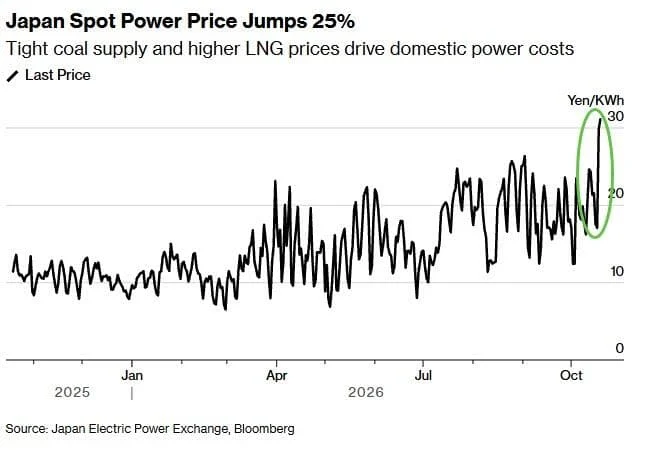
Japan’s average electricity prices have dramatically escalated by over 25% at the start of this week compared to the previous week, a direct consequence of soaring global liquefied natural gas (LNG) and higher coal prices. This significant jump underscores the profound energy security challenges faced by the world’s third-largest economy, heavily reliant on imported fossil fuels. The nationwide power price reached $0.19 (approximately 31.15 Japanese yen) per kilowatt-hour (kWh) on Monday, according to data from the Japan Electric Power Exchange, as reported by Bloomberg. This marks a critical juncture for Japanese households and industries, grappling with the immediate financial implications of an increasingly volatile global energy market.
A Nation’s Vulnerability: The Genesis of Japan’s Energy Predicament
Japan’s current energy crisis is not an isolated event but rather the culmination of historical energy policy shifts and ongoing geopolitical developments. As an island nation with scant domestic fossil fuel reserves, Japan has historically depended heavily on imports for its energy needs. This dependency was acutely magnified following the Fukushima Daiichi nuclear disaster in March 2011. In the aftermath, most of Japan’s nuclear power plants were idled or decommissioned, leading to a substantial increase in reliance on thermal power generation, primarily fueled by LNG and coal. This strategic pivot, while ensuring immediate power supply, inadvertently deepened the nation’s exposure to global commodity price fluctuations and supply chain vulnerabilities.
The summer of the current year already provided a precursor to the present crisis. Even before the latest geopolitical escalations, Japan, one of the world’s biggest LNG importers, had begun to reduce its gas-fired generation in favor of coal. The primary driver for this early shift was the already elevated price of liquefied natural gas, making coal a more economically viable alternative for utility companies striving to manage operational costs. This pragmatic, albeit environmentally challenging, decision highlighted the economic pressures utilities were facing even in a relatively stable period.
Geopolitical Tensions Ignite a Price Avalanche
The recent "war in the Middle East" (referring to the Israel-Hamas conflict and its broader regional destabilizing effects) has acted as a significant accelerant to Japan’s energy woes. The conflict has not only introduced new layers of geopolitical risk but has also directly impacted global energy markets. Key maritime chokepoints, such as the Strait of Hormuz, through which a substantial portion of the world’s oil and LNG passes, have become areas of heightened concern. Fears of supply disruptions, whether real or perceived, have sent commodity prices soaring.
For LNG, the situation is particularly acute. Spot LNG prices in Asia surged to a near four-year high, reflecting intense competition for available cargoes. The average spot LNG price for delivery into north-east Asia in December was assessed at $29.30 per million British thermal units (MMBtu) at the end of last week. This figure represents a sharp increase from the $26.50 per MMBtu recorded in the previous week, and critically, it is the highest spot LNG price for Asia since December 2022. The upward trajectory of LNG prices has made gas-fueled power generation in Japan the most expensive it has been in years, squeezing profit margins for utility providers and inevitably leading to higher consumer costs.
The competition for LNG is further exacerbated by Europe’s persistent demand for winter supply. Still reeling from the energy crisis triggered by the conflict in Ukraine, European nations are aggressively securing LNG cargoes, diverting supplies that might otherwise have headed to Asian markets. This global scramble for limited resources creates an upward pricing spiral, disproportionately affecting import-dependent nations like Japan.
The Costly Shift to Coal and Other Contributing Factors
While the move away from gas to coal was initially seen as a cost-saving measure, it has not been without its own challenges. The increased demand for coal across Asia, coupled with reduced supply from major thermal coal exporters like Indonesia, has driven up coal prices significantly. The Newcastle futures, a global benchmark for coal prices, have jumped by 30% compared to pre-war levels. This means that even the "cheaper" alternative of coal is now substantially more expensive than it was just a few weeks ago, leaving Japanese utilities with few affordable options for thermal power generation. The environmental implications of increased coal burning, particularly for a nation committed to climate goals, also present a complex policy dilemma.
Beyond the commodity price surges, localized factors have also contributed to the recent spike in Japan’s power prices. Scheduled maintenance at several power-generating facilities ahead of the crucial winter season has temporarily reduced available supply. While routine, such maintenance creates a tighter supply-demand balance, making the market more susceptible to price shocks from external factors like rising fuel costs.
Broader Economic Implications and Domestic Impact
The ripple effects of these surging electricity prices extend far beyond utility bills. Japan’s economy, already facing headwinds, is bracing for increased inflationary pressures. The Bank of Japan has recently maintained an ultra-loose monetary policy, but rising energy costs could complicate its inflation outlook and potentially force a reassessment of its stance. Businesses, from small enterprises to large industrial complexes, will face higher operational costs, which could lead to reduced profitability, delayed investments, or even passed-on costs to consumers, further fueling inflation. Industries that are energy-intensive, such as manufacturing and chemicals, will be particularly affected, potentially impacting their global competitiveness.
For Japanese households, the immediate impact is a direct hit to disposable income. Higher electricity bills mean less money for other goods and services, potentially dampening consumer spending and overall economic activity. The burden is likely to be felt most acutely by low-income households, for whom energy costs represent a larger proportion of their monthly expenses.
Furthermore, the persistent weakness of the Japanese Yen against the U.S. dollar exacerbates the problem. Since global energy commodities like LNG and coal are typically priced in U.S. dollars, a weaker yen means that Japanese importers have to pay significantly more in local currency for the same amount of fuel. This currency effect acts as a powerful amplifier to the already rising international commodity prices, making Japan’s import bill considerably heavier.

Government and Industry Responses: Navigating the Crisis
In response to such escalating energy costs, the Japanese government typically explores a multi-pronged approach. Immediate measures often include promoting energy conservation campaigns, urging businesses and households to reduce consumption. Subsidies or rebates on electricity bills, though fiscally challenging, might be considered to cushion the impact on vulnerable populations and key industries.
From a longer-term perspective, the crisis is likely to intensify the government’s push for greater energy independence and diversification. This includes accelerating the restart of viable nuclear power plants that have remained offline since Fukushima, a politically sensitive but economically compelling option. Investments in renewable energy sources, such as solar, wind, and geothermal, are also expected to receive renewed impetus. While renewable energy expansion is a long-term strategy, the current crisis highlights the urgent need to reduce reliance on volatile fossil fuel markets. Japan’s commitment to hydrogen energy as a future fuel source could also see increased attention and investment.
Japanese utility companies, for their part, are constantly optimizing their power generation mix to mitigate costs, balancing the use of LNG, coal, and whatever nuclear capacity is available. They are also likely to be actively engaging in securing long-term LNG supply contracts to hedge against spot market volatility, although such contracts also come with their own pricing mechanisms and geopolitical risks. The utility sector faces the delicate task of balancing reliable power supply with affordable pricing, often caught between consumer demands and escalating fuel costs.
A Regional Trend and the Winter Outlook
Japan is not alone in facing these energy challenges. Other major Asian LNG importers, such as South Korea and, to some extent, China, have also made similar switches from gas to coal, driven by affordability and availability. This collective regional shift further tightens the global coal market and underlines a broader energy security dilemma for industrializing and developed Asian economies. The demand for energy in Asia is projected to continue growing, making the region a critical battleground for global energy supplies.
Looking ahead, the approaching winter season looms large. Colder temperatures will inevitably drive up demand for heating and electricity, placing additional strain on already tight energy markets. Should the geopolitical situation in the Middle East remain unstable or worsen, and if winter proves to be particularly harsh, Japan and other import-dependent nations could face even more significant price increases and potential supply challenges. The current surge in electricity prices serves as a stark warning and a powerful reminder of Japan’s enduring energy vulnerabilities and the critical need for resilient, diversified, and sustainable energy policies in an unpredictable global landscape. The coming months will test the nation’s resolve and strategic foresight in navigating these complex energy headwinds.

