

The landscape of real estate investment is often defined by its regulatory environment, with certain states emerging as more advantageous for property owners. As of 2026, a select group of states have garnered the "landlord-friendly" designation, a classification that can significantly influence an investor’s cash flow and overall return on investment. Understanding the nuances of these labels, and the underlying factors that define them, is crucial for making informed investment decisions in the dynamic US housing market.
Understanding the "Landlord-Friendly" Market Label
A landlord-friendly state is characterized by laws and regulations that generally favor property owners and streamline the management of rental properties. This typically translates to lower entry and operating costs for landlords. However, it is important to emphasize that "landlord-friendly" does not equate to a disregard for tenant rights. All states maintain tenant protection laws that landlords are legally obligated to uphold. A strong landlord-tenant relationship remains a cornerstone of successful property management, and neglecting tenant rights can lead to legal complications and reputational damage.
Instead, landlord-friendly markets often exhibit a combination of factors that support rental property businesses and their owners. These factors are critical for investors seeking to maximize profitability and minimize operational headaches.
Key Characteristics of Landlord-Friendly States
Several core attributes contribute to a state’s landlord-friendly reputation:
Low Property Taxes
Property taxes represent a significant ongoing expense for real estate investors. In 2026, effective property tax rates across the United States typically range from 0.25% to 2% of a property’s assessed value. While property taxes are often deductible, thereby reducing taxable income, higher tax rates in certain states directly impact a landlord’s net operating income and, consequently, their capitalization (cap) rate. Furthermore, real estate taxes are subject to annual increases, meaning landlords in high-tax states may see their expenses rise consistently. Investing in states with lower property taxes can therefore lead to greater retained earnings and a healthier bottom line.
For instance, states with consistently lower property tax burdens allow landlords to allocate more of their rental income towards debt servicing, property maintenance, or reinvestment, ultimately enhancing the long-term viability of their investments.
Absence of Rent Control
Rent control policies, designed to ensure housing affordability and stability for tenants, limit the amount landlords can charge for rent and dictate the frequency and extent of rent increases. While beneficial for renters, these regulations can significantly impede a landlord’s ability to adjust rental income in response to rising operational costs. Expenses such as insurance premiums, property taxes, property management fees, and maintenance and repair costs are subject to inflation. In rent-controlled markets, landlords may be unable to offset these increases through proportional rent hikes. This financial pressure can sometimes lead to deferred maintenance or the postponement of major repairs, which can, in turn, negatively affect the property’s value and future revenue potential. Without robust revenue growth, rent control can become a substantial financial burden for landlords, deterring new investors from these markets.
Low-Barrier Entry for Landlords
Establishing a rental property business often requires obtaining various licenses and permits, the nature and cost of which can vary significantly based on property type, rental strategy (e.g., short-term versus long-term rentals), and geographical location. These can include business licenses, rental permits, occupancy permits, and zoning certifications. Some states impose stringent licensing requirements that can substantially increase initial setup costs for landlords. In contrast, landlord-friendly states typically simplify this process, allowing investors to establish their rental property businesses with fewer bureaucratic hurdles and lower upfront expenditures. This streamlined process is particularly attractive to new investors looking to enter the market with minimal initial investment.
No Caps on Security Deposits
Security deposits serve as a critical financial safeguard for landlords, protecting them against potential losses due to unpaid rent or utilities, property damage beyond normal wear and tear, lease violations, and the costs associated with professional cleaning during tenant turnover. When renter-friendly states impose caps on security deposit amounts, it can create a mismatch between the potential costs a landlord might incur and the available funds for recourse. Damages may exceed the maximum allowable deposit, leaving the landlord to absorb the difference. Furthermore, lower security deposit limits can provide less insight into a prospective tenant’s financial stability. Markets without security deposit caps offer landlords greater protection, though it is generally expected that landlords will set "reasonable" deposit amounts, adhering to state guidelines to avoid disputes.
Minimal Notice-of-Entry Requirements
The ability to access a rental property without lengthy, legally mandated notice periods is vital for various reasons. These include conducting necessary repairs and maintenance, showing the property to prospective tenants or buyers, performing routine inspections, and responding to emergencies. In many landlord-friendly states, the typical notice required for entry is often limited to 24 to 48 hours, allowing landlords to address issues promptly and efficiently. This flexibility is essential for maintaining property condition and minimizing vacancies, thereby protecting the investor’s income stream.
Expedited Eviction Processes
While landlords do not enter into lease agreements with the expectation of eviction, it remains a possibility in the rental property business. Millions of eviction filings occur annually across the United States. The eviction process can be complex, time-consuming, and costly in some jurisdictions. The duration of an eviction, from the initial notice to the final lockout, can range significantly, from as little as three weeks to as long as six months, depending on the state and local laws. During extended eviction proceedings, landlords often continue to bear the property’s operating costs without receiving rent. Furthermore, a prolonged eviction process can sometimes coincide with increased property damage by disgruntled tenants. States with streamlined eviction laws ease this burden on landlords, making the process more manageable and less financially detrimental.

Additional Landlord Rights and Protections
Beyond the aforementioned characteristics, some states offer further incentives and protections for landlords. These can include no limitations on late rent fees, immediate rights to dispose of abandoned property left by tenants, and state preemption laws. State preemption prevents local governments within the state from enacting their own regulations that might contradict or add to state-level landlord-tenant laws. This uniformity simplifies compliance for landlords operating across different municipalities within the same state.
It is important to note that not all landlord-friendly states possess every single one of these characteristics. The designation often arises from a favorable balance of these factors relative to typical state laws. For example, Texas, while offering no rent control and a generally easier eviction process, may present higher property taxes as a trade-off.
Furthermore, the distinction between state and local regulations is crucial. A state might be considered landlord-friendly overall, but specific cities or municipalities within that state may have implemented their own unique ordinances that impact rental property operations. Investors must familiarize themselves with the specific local laws of any city they consider for investment.
The Top 5 Most Landlord-Friendly States in 2026
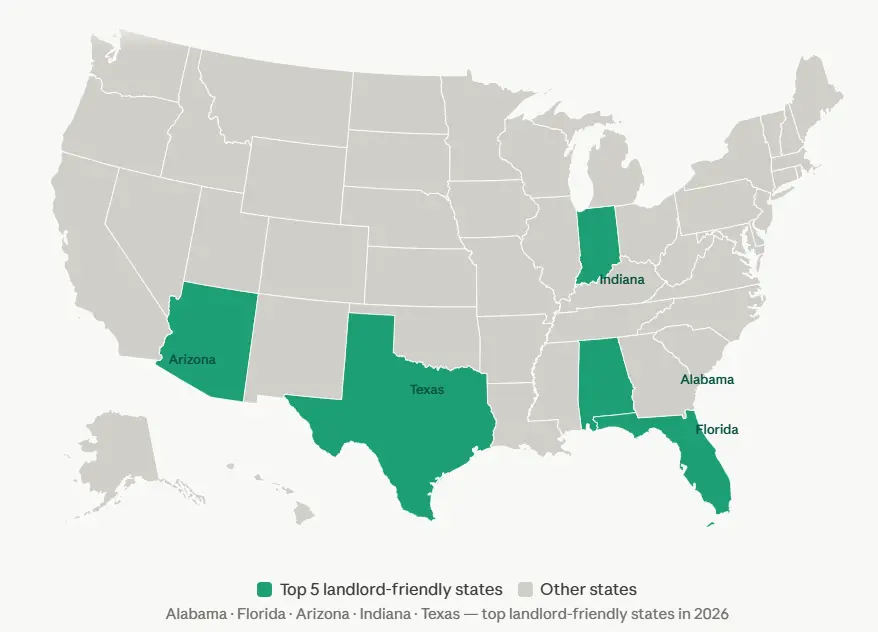
Based on an analysis of regulatory environments and common landlord-tenant laws, the following five states are frequently cited as being among the most landlord-friendly in the US housing market as of 2026:
Alabama
Alabama stands out in 2026 as a state with remarkably few regulations specifically targeting individual landlords. This regulatory sparsity translates into a more permissive environment for property owners.
- Low Property Taxes: Alabama generally boasts competitive property tax rates, contributing to lower ongoing expenses for landlords.
- No Rent Control: The state does not implement statewide rent control measures, allowing landlords to adjust rents based on market conditions.
- Streamlined Eviction Process: Alabama’s legal framework generally supports a relatively efficient eviction process, reducing the time and cost associated with removing non-paying or problematic tenants.
- Limited Security Deposit Restrictions: While reasonable security deposits are expected, Alabama law typically imposes fewer stringent caps compared to other states.
- Minimal Licensing Requirements: The initial setup for becoming a landlord in Alabama often involves fewer mandatory licenses and permits, reducing upfront costs.
Top Landlord-Friendly City with High Average Cap Rate:
- Birmingham: Known for its diverse economy and improving urban core, Birmingham offers attractive investment opportunities with potentially high average cap rates due to its favorable cost of living and rental demand.
- Huntsville: Driven by its strong presence in aerospace and technology, Huntsville presents a stable rental market with potential for solid returns.
Florida
Florida’s appeal to real estate investors, including landlords, is multifaceted, driven by its robust population growth, favorable tax environment, and pro-landlord legal framework.
- No State Income Tax: Florida is one of the few states that does not levy a state income tax, which benefits both individual investors and their rental income.
- No Rent Control: Similar to Alabama, Florida does not have statewide rent control, empowering landlords to set rents competitively.
- Expedited Eviction Process: Florida law is designed to facilitate a relatively quick eviction process, often completed within a few weeks for standard non-payment cases.
- No Caps on Security Deposits: Landlords in Florida are generally permitted to charge security deposits that are deemed reasonable by the market.
- Landlord-Friendly Laws: Florida statutes tend to provide strong protections for landlords regarding lease enforcement and property recovery.
Top Landlord-Friendly City with High Average Cap Rate:
- Jacksonville: As one of the largest cities by land area in the contiguous US, Jacksonville offers a vast rental market with diverse opportunities and competitive cap rates.
- Tampa: Benefiting from a growing economy and desirable lifestyle, Tampa’s rental market is robust, attracting investors seeking steady returns.
Arizona
Arizona has cultivated a reputation as a business-friendly state, and this extends to its real estate investment climate, offering a balanced approach that favors landlords.
- No State Income Tax: Like Florida, Arizona does not impose a state income tax, enhancing the net returns for landlords.
- No Rent Control: Arizona’s legal framework allows landlords flexibility in setting and adjusting rental rates.
- Efficient Eviction Process: The state’s eviction laws are generally considered straightforward and efficient, enabling landlords to resolve tenant disputes promptly.
- Reasonable Security Deposit Laws: While there are guidelines, Arizona’s laws regarding security deposits offer landlords a degree of protection without excessive restrictions.
- State Preemption: Arizona has state preemption laws that prevent local governments from enacting stricter landlord-tenant regulations than those at the state level, providing a consistent operating environment.
Top Landlord-Friendly City with High Average Cap Rate:
- Phoenix: The rapidly growing metropolitan area of Phoenix is a prime investment destination, offering a large tenant pool and a strong rental demand, leading to favorable cap rates.
- Tucson: With a significant student population and a growing economy, Tucson presents a stable rental market with attractive investment potential.
Indiana
Indiana offers a combination of manageable property taxes, a clear legal framework, and an absence of restrictive rent control policies, making it an appealing state for landlords.
- Moderate Property Taxes: Indiana’s property tax rates are generally considered moderate compared to many other states, contributing to lower ownership costs.
- No Rent Control: The state does not enforce rent control measures, allowing for market-driven rent adjustments.
- Straightforward Eviction Process: Indiana’s eviction procedures are designed to be relatively efficient, providing landlords with a clear path to resolve tenant issues.
- No Strict Security Deposit Caps: Landlords have flexibility in determining reasonable security deposit amounts.
- Supportive Business Environment: Indiana’s overall business-friendly approach extends to its landlord-tenant laws, which tend to balance the rights of owners and tenants effectively.
Top Landlord-Friendly City with High Average Cap Rate:
- Indianapolis: As the state capital and largest city, Indianapolis offers a diverse rental market with consistent demand and opportunities for strong cap rates.
- Fort Wayne: Indiana’s second-largest city provides a more affordable entry point for real estate investors, with a stable rental market and potential for good returns.
Texas
Texas is often highlighted for its robust economy and business-friendly environment, which includes a legal framework that generally favors landlords, despite certain trade-offs.
- No Rent Control: Texas explicitly prohibits rent control, granting landlords significant freedom in setting rental rates.
- Efficient Eviction Process: The state has a well-defined and generally efficient eviction process, which can be completed relatively quickly under normal circumstances.
- No Caps on Security Deposits: Landlords in Texas have discretion in setting security deposit amounts, providing a stronger layer of financial protection.
- State Preemption: Texas also benefits from state preemption, limiting the ability of local municipalities to enact overly burdensome rental regulations.
- Trade-off: Higher Property Taxes: It’s important to note that Texas generally has higher property tax rates compared to some other states on this list. Investors must factor this into their calculations, as it can impact overall cash flow and cap rates.
Top Landlord-Friendly City with High Average Cap Rate:
- Dallas: The Dallas-Fort Worth metroplex is a major economic hub, offering a vast and diverse rental market with strong demand and the potential for high cap rates.
- Houston: As the most populous city in Texas, Houston presents a dynamic rental market driven by its diverse industries, offering substantial investment opportunities.
The Broader Investment Landscape: Beyond "Landlord-Friendly" Labels
While the "landlord-friendly" label can be a useful starting point, it is not the sole determinant of a successful real estate investment. The underlying economic fundamentals of a market often play a more significant role. As Daryl Fairweather, Chief Economist at Redfin, points out, "Landlord-friendly and tenant-friendly labels can be helpful, but they can be too broad to guide an investment decision on their own. What matters more is the underlying economics (fundamentals) of a market, like home prices, rent levels, job growth, and long-term demand."
A landlord-friendly market with weak economic fundamentals might underperform a tenant-friendly market experiencing strong population growth and limited housing supply. Therefore, investors should consider the regulatory environment as just one factor among many.
Risks and Considerations in "Landlord-Friendly" Markets
Conversely, "landlord-friendly" does not always equate to low risk. In some of these markets, rapid investor activity can drive up property prices, leading to compressed yields. There is also the potential risk of overbuilding or economic volatility. Favorable regulations do not guarantee investment performance. Investors must prioritize fundamentals such as affordability, migration trends, and local employment.
Investing in Tenant-Friendly Markets: Strategies and Insights
Despite the allure of landlord-friendly states, compelling investment opportunities exist in tenant-friendly markets. For instance, a Redfin report highlighted a significant increase in investor purchases in Milwaukee, Wisconsin, a market with evolving renter-friendly regulations that include slower eviction processes, multiple hearing requirements, and stricter security deposit documentation.
For investors navigating markets with rent control, optimizing cash flow starts with the acquisition price. Buying at a basis that accounts for future rent constraints is paramount. Minimizing tenant turnover and vacancy through diligent property maintenance and fostering positive tenant relationships becomes crucial. Investors may also explore properties where allowable rent increases, such as inflation-based adjustments or capital improvement pass-throughs, can help offset rising costs over time.
When investing in tenant-friendly states, conservative underwriting and professional operations are essential. This includes rigorous tenant screening, setting rents appropriately from the outset, and budgeting for potentially longer resolution timelines for any arising issues. A thorough understanding of local regulations—including notice periods, eviction timelines, and rent increase rules—is vital to avoid surprises. Collaborating with a local property manager or legal expert, especially for first-time investors, is highly recommended.
The Evolving Investment Calculus
The prevailing sentiment among real estate professionals is that investors are increasingly prioritizing market fundamentals over regulatory labels. A market like Milwaukee, despite its tenant-friendly reputation, can remain attractive if it offers affordable entry points and stable rental demand. Conversely, some historically landlord-friendly markets, such as parts of Florida, may be experiencing a cooling due to escalating prices and insurance costs.
Ultimately, the most critical question for an investor in today’s market is: "Does the deal make sense given the local market conditions?" Regulation plays a role, but it is not the sole determinant of investment success. The numbers of the deal, analyzed within the context of broader market dynamics, are the key to achieving profitability and long-term success in real estate investment. Utilizing data and analytical tools to underwrite deals effectively in any market is therefore indispensable.

