

Concerns over the escalating militarization of outer space have reached a critical juncture following public accusations by US officials against Russia, alleging a "deliberately reckless" maneuver by a Russian military satellite near a Finnish-operated commercial imaging satellite. This incident, which transpired days before a heated United Nations debate, has ignited international alarm regarding space safety, the integrity of commercial space assets, and the potential for orbital conflict, particularly given the commercial satellite’s critical intelligence role for Ukraine.
The Incident: A Close Encounter in Low Earth Orbit
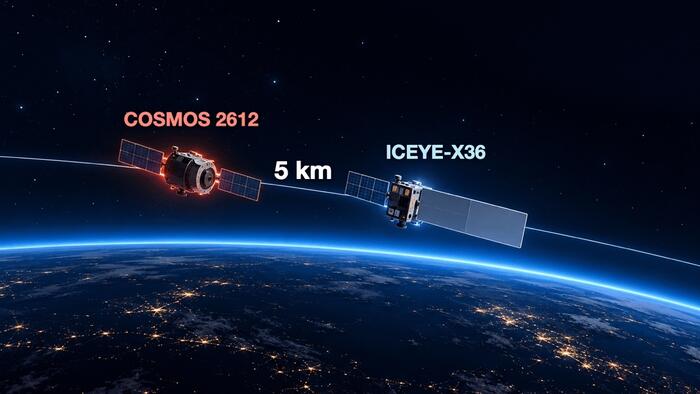
The immediate catalyst for the renewed tensions was the "exceptionally close" approach of a Russian military satellite, Kosmos-2612, to ICEYE-X36, a Synthetic Aperture Radar (SAR) imaging satellite registered in the United States and operated by the Finnish company ICEYE. The Russian satellite reportedly came within an estimated 200 meters of ICEYE-X36, an proximity described by space officials and amateur satellite watchers as highly unusual and dangerous. LeoLabs, a prominent aerospace intelligence company specializing in space situational awareness, confirmed the non-routine nature of the event, stating, "This was not a routine conjunction or ‘fly by.’ The behavior is consistent with sophisticated rendezvous and proximity operations." This assessment strongly suggests an intentional act rather than a coincidental near-miss.
The ICEYE-X36 satellite is a crucial asset in the modern intelligence landscape. Its advanced SAR technology allows it to gather highly detailed terrestrial images regardless of cloud cover or time of day, overcoming limitations inherent in traditional optical imaging. In January, ICEYE signed a significant contract with the Ukrainian Defense Ministry, providing Kyiv with access to its imagery and intelligence capabilities—a strategic advantage in its ongoing conflict. This makes ICEYE-X36 a high-value target or subject of interest for Russian intelligence, transforming the close approach from a mere safety concern into a potential act of intimidation or reconnaissance.
US Denounces Russian Actions at the United Nations
The gravity of the incident was underscored by the forceful condemnation issued by US officials during an October 21 meeting of the UN First Committee in New York, a body dedicated to arms control and disarmament issues. Brian Hardesty, an adviser to the US Delegation to the Conference on Disarmament, explicitly stated that Kosmos-2612 "exhibited threatening behavior by intentionally maneuvering dangerously close to a commercial satellite." Hardesty went further, characterizing these actions as "behaviors consistent with an on-orbit weapons operation," and reiterated that "the decision to conduct these activities was deliberately reckless."
The US position was further amplified by Under Secretary of State Thomas G. DiNanno, who publicly affirmed via social media: "Russia’s COSMOS 2612 military satellite has been exhibiting threatening behavior by intentionally maneuvering dangerously close to a commercial satellite, behaviors consistent with on-orbit weapons operations. This violates long-established safety thresholds in low Earth orbit. The United States will continue to secure and defend American vital national security interests in, from, and to space." This direct and public accusation from a high-ranking US official underscores the seriousness with which Washington views the incident, framing it not merely as a breach of safety but as a potential act of aggression in space.
Russia’s Rebuttal and Counter-Accusations
In response to the accusations, Russia’s representative at the UN debate, who remained unnamed in immediate reports, did not directly address the specific allegations concerning Kosmos-2612. Instead, Russia broadly dismissed the US claims as "absurd" and launched a counter-accusation, accusing Washington of pursuing its own "aggressive military space ambitions." The Russian delegate urged "member states to give the proper response to the aggressive military space ambitions of the United States," attempting to shift the narrative and deflect criticism.
This diplomatic exchange highlights a fundamental divergence in how the two major spacefaring powers perceive and articulate their activities in orbit. Russia has long advocated for a legally binding instrument to prevent the placement of weapons in outer space, often proposing a draft treaty on the Prevention of the Placement of Weapons in Outer Space (PPWT) at the UN. However, Western nations, including the United States, have historically viewed these proposals as insufficient, difficult to verify, and potentially a means for Russia and China to gain a strategic advantage while continuing to develop their own counter-space capabilities, including co-orbital systems that could function as weapons.
The Evolving Landscape of Space Weaponization
The back-and-forth at the UN takes place against a backdrop of increasing transparency—or perhaps, deliberate signaling—regarding the militarization of space. Just weeks prior to the incident, the Secretary of the US Air Force, Troy Meink, delivered a keynote address outside Washington where he made a striking admission. Meink publicly acknowledged that the US has deployed "on-orbit space control weapons capable of defending the Joint Force against hostile adversary action." This statement, confirming the deployment of actual weapons in space, sent a "jolt among policy experts," as it marked a significant departure from previous ambiguity surrounding such capabilities.
While some found the announcement startling, longtime space watchers observed that it merely articulated what had been implicitly understood for years. Mallory Stewart, a former top arms control secretary at the US State Department, succinctly captured this sentiment, writing, "The United States did not suddenly weaponize space by acknowledging that it possesses these capabilities. An arms race in space has been under way for years."
Indeed, the space arms race has deep roots, tracing back to the Cold War with the development of anti-satellite (ASAT) technologies. Russia, China, and the United States have all demonstrated ASAT capabilities, including direct-ascent missiles that destroy satellites, as well as more subtle methods like jamming, dazzling, or cyberattacks. In November 2021, Russia conducted a highly controversial direct-ascent ASAT test against its own defunct Cosmos-1408 satellite, generating thousands of pieces of space debris that threatened the International Space Station and numerous other operational satellites. This event served as a stark reminder of the destructive potential of space warfare and the indiscriminate nature of debris generation, which can impact all space users.
The Strategic Importance of Commercial Satellites
The incident involving ICEYE-X36 underscores the burgeoning strategic importance of commercial satellite constellations in modern military conflicts. Once primarily the domain of government agencies, space-based intelligence, communication, and navigation are now heavily reliant on a rapidly expanding commercial sector. Companies like ICEYE, Maxar, Planet Labs, and Starlink provide services that are integral to military operations, intelligence gathering, and civilian infrastructure.
ICEYE’s contract with the Ukrainian Defense Ministry is a prime example. The high-resolution, all-weather SAR imagery provided by ICEYE-X36 offers Ukraine unparalleled insights into Russian troop movements, equipment staging, and damage assessments, even through heavy cloud cover or at night. This capability is vital for battlefield awareness, targeting, and post-strike analysis, directly impacting Ukraine’s ability to defend itself.
The increasing reliance on commercial satellites creates both opportunities and vulnerabilities. While it democratizes access to space-derived data and reduces costs, it also blurs the lines between military and civilian assets, making commercial satellites potential targets in future conflicts. The close approach of Kosmos-2612 to ICEYE-X36 could be interpreted as a probing action, an attempt to gather intelligence on the commercial satellite’s capabilities or orbital characteristics, or a clear warning shot aimed at disrupting Ukraine’s access to vital intelligence.
Risks to Space Safety and Sustainability
The "deliberately reckless" maneuver of Kosmos-2612 poses significant risks to the safety and long-term sustainability of the space environment. Low Earth Orbit (LEO), where most imaging and communication satellites operate, is becoming increasingly congested. Thousands of active satellites, coupled with hundreds of thousands of pieces of space debris—ranging from defunct spacecraft to tiny fragments from collisions and ASAT tests—create a challenging operational environment.
A collision in LEO, even between a relatively small object and an active satellite, can generate thousands of new pieces of debris, each traveling at orbital velocities of several kilometers per second. This phenomenon, known as the Kessler Syndrome, posits that a cascade of collisions could render entire orbital regimes unusable for generations. The 200-meter proximity of the Russian satellite to ICEYE-X36 was exceptionally close, leaving minimal room for error or unforeseen orbital perturbations. Such a collision could have catastrophic consequences, not only for the involved satellites but for all other users of LEO.
The international community has long sought to establish norms of responsible behavior in space, guided by foundational treaties like the 1967 Outer Space Treaty, which prohibits the placement of weapons of mass destruction in orbit but is largely silent on conventional weapons. However, the lack of a comprehensive, legally binding arms control agreement for outer space leaves a dangerous vacuum. Unilateral actions like Russia’s recent maneuver challenge existing safety thresholds and erode trust, making cooperation on critical issues like space traffic management and debris mitigation increasingly difficult.
International Reactions and the Path Forward
While explicit reactions from all international parties were not immediately available, the US’s public accusations at the UN undoubtedly sent ripples through diplomatic and defense circles. NATO allies would likely view such Russian behavior with concern, aligning with the US assessment of a threat to space safety and stability. Finland, as the operating country of ICEYE, would have a direct national security interest in the incident, potentially prompting diplomatic démarches or increased scrutiny of Russian space activities. Ukraine, as the direct beneficiary of ICEYE’s services, would perceive the maneuver as a hostile act designed to undermine its defense capabilities.
The incident serves as a stark reminder of the urgent need for international dialogue and concrete measures to prevent the weaponization of space and ensure its peaceful and sustainable use. Proposals for "rules of the road" in space, including transparency and confidence-building measures, are crucial. However, geopolitical tensions and differing national security doctrines continue to impede progress on such agreements.
The acknowledgment of "on-orbit space control weapons" by the US, coupled with Russia’s aggressive maneuvering, signals a new, more dangerous phase in the competition for dominance in space. The frontier of outer space is no longer merely a domain for scientific exploration or peaceful communication; it has become an increasingly contested operational domain, directly impacting terrestrial conflicts and global security. The delicate balance between deterrence and escalation in this environment demands prudent statecraft and a renewed commitment to preventing a catastrophic "space war" that would ultimately harm all nations reliant on the critical infrastructure orbiting above.

