
Nvidia CEO Jensen Huang is currently at the center of a burgeoning scandal, facing allegations that an extramarital affair with Chinese businesswoman Alice Huang facilitated billions of dollars in restricted chip shipments to Chinese firms. These claims, first detailed by The Information, have cast a significant shadow over Nvidia, the world’s leading designer of artificial intelligence (AI) chips, raising profound questions about the company’s compliance with stringent U.S. export controls, its corporate governance, and the reliability of its financial disclosures to shareholders. The controversy comes at a precarious time for the AI sector, as market skepticism about the sustainability of massive AI infrastructure spending grows.
Unfolding Allegations: The Information’s Report
The crux of the unfolding crisis stems from a recent report by The Information, which alleges that Jensen Huang’s long-standing affair with Alice Huang played a critical role in enabling Nvidia to continue supplying high-end chips to China, even as U.S. export restrictions tightened. According to the report, this relationship allegedly helped facilitate at least $7.5 billion in Nvidia chip shipments to Chinese entities. The investigation suggests that Alice Huang, along with her husband and sister, established a complex network of companies operating across China and Singapore, specifically designed to acquire Nvidia’s advanced semiconductor products.
Central to this alleged network was Shanghai Century Litong, a Chinese firm reportedly founded in June 2023. Remarkably, within just four months of its inception, Shanghai Century Litong allegedly secured "preferred cloud partner" status with Nvidia. This designation would have granted the company priority access to Nvidia’s highly sought-after chips, a critical advantage in a market constrained by both demand and export regulations.

The report further claims that when U.S. export restrictions began to complicate direct orders, Alice Huang leveraged her purported connections to Nvidia and its distributors to ensure a continued supply chain. Through these channels, an estimated 240,000 H100, H200, and A100 chips—some of Nvidia’s most powerful and strategically sensitive AI accelerators—were allegedly moved into China. These chips are essential for developing advanced AI models and high-performance computing, capabilities the U.S. government has explicitly sought to limit China’s access to, citing national security concerns. The volume of chips cited in the allegations is substantial, far exceeding a "rounding error" and indicating a potentially systemic effort to circumvent controls.
A Timeline of Disclosure and Mounting Pressure
The current crisis has developed rapidly, escalating from a personal matter to a corporate and geopolitical concern within days.
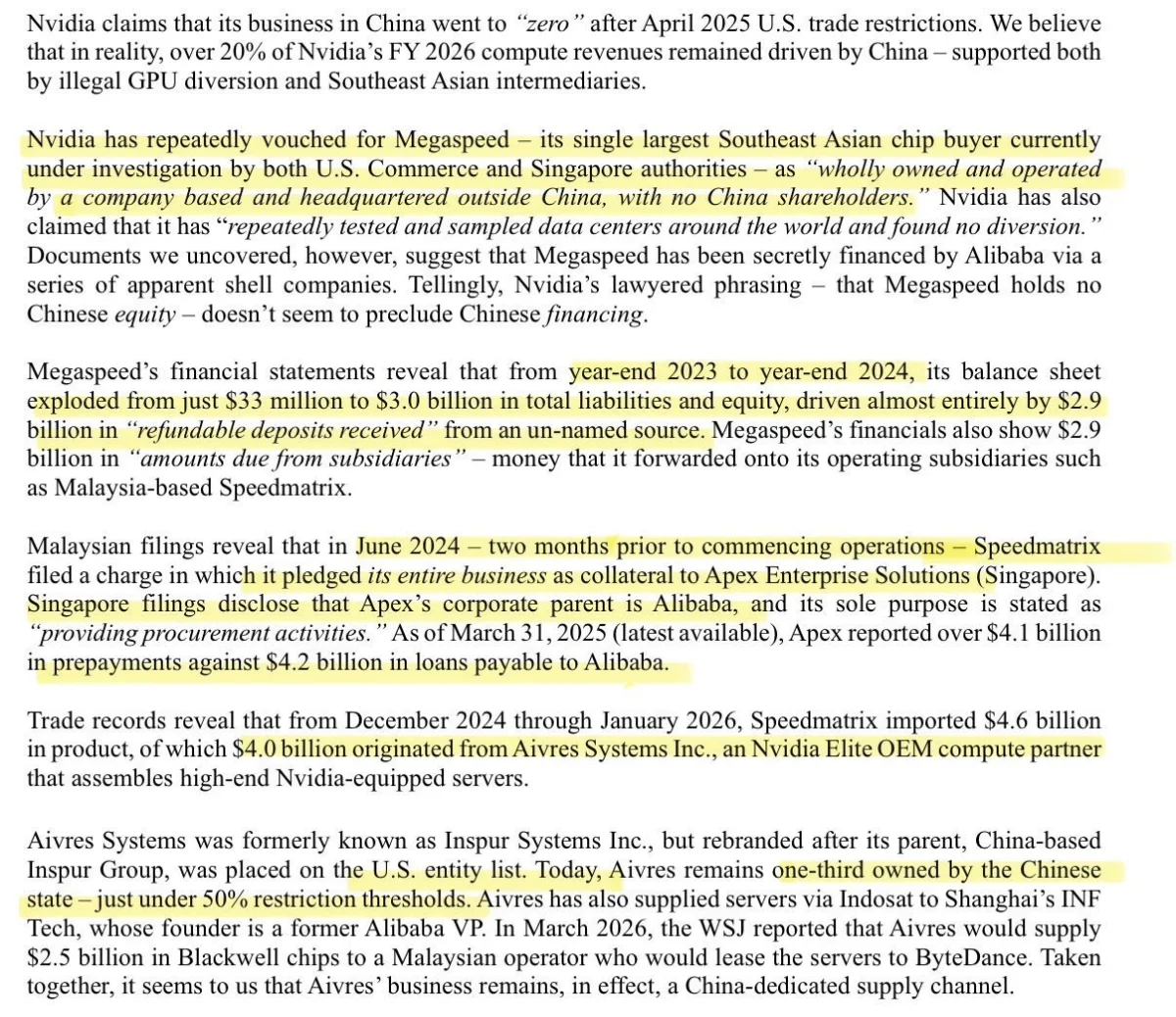
- Prior Warnings: Even before the latest revelations, independent analysts had flagged potential issues. In May, short seller Culper Research published a report raising concerns about Nvidia’s China business. Culper alleged that over 20% of Nvidia’s fiscal year 2026 compute revenue remained driven by Chinese demand, channeled through Southeast Asian intermediaries and illegal GPU diversion. The report questioned Nvidia’s customer due diligence practices, suggested hidden Chinese financing behind major chip purchasers, and warned of a significant revenue hole should China’s domestic semiconductor push succeed. While these allegations were not "conclusively established," today’s reporting lends them considerable new relevance and weight.
- Huang’s Public Admission: The controversy intensified dramatically when Jensen Huang publicly admitted to an extramarital affair with Alice Huang. This admission came just hours after questions about his potential resignation began to surface in financial circles. This confession, initially perceived as a personal matter, quickly became intertwined with the company’s commercial activities and regulatory compliance.
- The Information’s Revelation: The subsequent report by The Information directly linked this personal relationship to alleged commercial transactions involving restricted chips, transforming the narrative from a private indiscretion into a major corporate scandal.
- Market Reaction and Investor Sentiment: In the immediate aftermath, prediction markets began to reflect growing investor unease. The implied odds of Huang’s resignation by March 2027 reportedly climbed to approximately 15%, indicating a noticeable shift in how seriously investors are weighing the possibility of a leadership change. This market movement signals a broader concern about the stability of Nvidia’s leadership and the potential for unforeseen issues to emerge. As one analyst noted, major executive departures often "bring previously concealed problems into the open," suggesting that this situation could be just the beginning of further revelations.
U.S. Export Controls and the Strategic Stakes
To fully grasp the gravity of the allegations, it is crucial to understand the context of U.S. export controls on advanced semiconductors to China. These controls are a cornerstone of the U.S. strategy to limit China’s military modernization, surveillance capabilities, and overall technological advancement, particularly in critical areas like AI.
The U.S. Department of Commerce, through its Bureau of Industry and Security (BIS), has progressively tightened restrictions on the export of high-performance computing chips, equipment, and related software to China. Key measures include:

- October 2022 Rules: These initial rules imposed broad restrictions on the export of certain advanced computing chips, including Nvidia’s A100 and H100 GPUs, to China without a license. The intent was to prevent China from acquiring chips that could be used for supercomputers, advanced AI systems, and weapons development.
- October 2023 Expansion: The restrictions were further expanded in October 2023 to cover more chips, including those designed with specific performance parameters to prevent companies from simply creating slightly downgraded versions to circumvent the rules. This expansion aimed to close loopholes and ensure the controls were more effective.
The chips in question—Nvidia’s H100, H200, and A100—are at the forefront of AI innovation. They are vital for training large language models, developing sophisticated AI applications, and powering data centers essential for both commercial and military AI advancements. Nvidia holds an estimated 80% or more market share in the AI GPU sector, making its products indispensable for any nation aiming for AI leadership. Therefore, any alleged circumvention of these controls carries significant national security implications for the United States and its allies. Violations can lead to severe penalties, including substantial fines, trade restrictions, and even criminal charges for individuals and corporations involved.
Nvidia’s Stated Position vs. Emerging Questions
For years, Nvidia has publicly maintained that U.S. export restrictions have effectively curtailed its high-performance compute business in China. Management has often highlighted the challenges of navigating the complex regulatory landscape and has indicated a shift towards developing "compliant" chips for the Chinese market, which are less powerful and fall below the performance thresholds set by the U.S. government.
However, the allegations from The Information directly challenge these representations. If billions of dollars worth of restricted Nvidia hardware continued to reach Chinese customers through intermediary networks, allegedly aided by someone with a personal relationship with the CEO, it raises fundamental questions about:
- Export-Control Compliance: How robust were Nvidia’s internal compliance mechanisms? Did the company adequately vet its third-party distributors and end-customers in China?
- Integrity of Customer Relationships: Were these intermediary networks legitimate commercial partners, or were they primarily conduits for circumventing sanctions?
- Reliability of Management’s Prior Representations: Did Nvidia’s management fully and accurately inform shareholders about the true extent of its China business and its exposure to export control risks? Were the company’s financial statements accurately reflecting its geographic revenue exposure and underlying demand?
The gap between Nvidia’s public statements regarding its China business and the scale of the alleged circumvention is a central point of concern for investors and regulators alike.

Corporate Governance and Leadership Crisis
Nvidia’s board of directors has publicly expressed confidence in Jensen Huang and has announced the initiation of an independent investigation into the allegations. This is a standard corporate response to such serious claims, aiming to assess the facts impartially. However, the situation presents a significant corporate governance challenge for Nvidia.
The implied odds of Huang’s resignation, while still relatively low, indicate a growing belief in the market that his position may become untenable. The intertwining of a personal affair with alleged commercial misconduct, especially involving national security concerns, puts immense pressure on a CEO. The company’s credibility, reputation, and stock valuation are all at stake.
Should the independent investigation uncover substantial evidence supporting the allegations, or if additional reporting further connects Huang’s personal relationship to commercial decisions involving restricted chips, the pressure for his resignation could become overwhelming. A leadership change, while potentially disruptive in the short term, could also be seen as a necessary step to restore investor confidence and demonstrate a commitment to compliance and transparency.
Broader Implications: Regulatory, Geopolitical, and Financial
The Nvidia scandal carries wide-ranging implications across several domains:

- Regulatory Scrutiny: This situation is ripe for intense scrutiny from various U.S. government agencies. The Department of Commerce’s BIS would likely investigate potential export control violations. The Securities and Exchange Commission (SEC) would examine whether Nvidia made accurate and complete disclosures to investors, particularly regarding its China revenue and compliance risks. The Department of Justice (DOJ) could also become involved if criminal violations are suspected. The fact that Democrats have gained control of Congress and are actively seeking "consequential situations" for investigation suggests that this case could quickly become a high-profile political issue.
- Geopolitical Ramifications: The allegations could further strain already tense U.S.-China relations. If a prominent U.S. tech company is found to have systematically circumvented export controls, it could lead to increased calls for even stricter sanctions, further decoupling of tech supply chains, and potential retaliatory measures from Beijing.
- Financial Impact: For Nvidia, the financial implications could be severe. Beyond potential fines and legal costs, there’s a risk of significant revenue loss if its ability to operate in China is further restricted or if it faces a forced restructuring of its sales channels. Investor confidence could erode, potentially impacting its stock valuation, which has soared on the back of AI enthusiasm. The company’s reported revenue sustainability and underlying end-customer demand will be under intense scrutiny.
- AI Market Sentiment: The scandal could exacerbate existing skepticism surrounding the broader AI trade. Investors are already questioning the sustainability of enormous capital expenditures in AI infrastructure, the actual returns on AI investments, and the often-inflated valuations of companies at the center of the boom. A major controversy involving Nvidia, a foundational player, could dampen enthusiasm and trigger a re-evaluation of the entire sector.
The Road Ahead: Uncertainty for Nvidia and the AI Sector
The Nvidia story, which began with a personal admission from its charismatic CEO, has rapidly evolved into a complex web of corporate governance, national security, and international trade concerns. While Nvidia’s board has initiated an independent investigation, the potential for further revelations remains high. Every journalist and regulatory body is now actively exploring leads, and history suggests that such situations often "get worse before they get better."
Investors face significant uncertainty. The key questions revolve around:
- The extent of Nvidia’s knowledge regarding the alleged circumvention.
- The true proportion of its revenue dependent on Chinese demand.
- The effectiveness of its compliance protocols.
- The veracity of its past financial disclosures.
Until these questions are definitively answered, and the smoke clears, the downside risk for Nvidia’s stock could be considerably greater than many investors appreciate. The outcome of this scandal will not only shape Nvidia’s future but could also send ripple effects through the global semiconductor industry, U.S.-China tech relations, and the trajectory of the booming AI sector. The stakes, both for the company and the broader technological landscape, are extraordinarily high.

