
The past week witnessed an extraordinary convergence of ambition and innovation in Indiana, as major corporations, international energy firms, and the U.S. military unveiled plans for an unprecedented number of advanced nuclear reactors. With Amazon, Canadian nuclear developers, and the U.S. Navy all presenting reactor proposals, the Hoosier State has rapidly ascended to the forefront of the nation’s advanced nuclear energy landscape. This flurry of activity, which saw proposals for as many as 21 reactors floated within a mere two days, marks a pivotal moment for a state that has historically lacked a commercial nuclear power plant and carries the legacy of a significant nuclear project failure.
A State Transformed: Indiana’s Nuclear Pivot
Indiana’s current energy profile has long been dominated by coal, with the state ranking among the top coal-producing and consuming states in the U.S. for decades. However, facing pressures from environmental regulations, aging infrastructure, and a growing demand for clean energy, Indiana has embarked on a strategic pivot. This shift is particularly striking given its past. The state’s most ambitious attempt at commercial nuclear power, Public Service Indiana’s Marble Hill plant, became a cautionary tale, abandoned half-built in 1984 after approximately $2.5 billion (equivalent to over $7 billion today, adjusted for inflation) had been spent. The project’s demise was attributed to a confluence of factors, including spiraling costs, construction delays, management issues, and a softening in electricity demand forecasts. This historical setback left a deep psychological imprint, fostering a cautious, if not skeptical, view of nuclear energy within the state.
However, the current administration, under Governor Mike Braun, who took office in 2025, has actively cultivated an environment conducive to nuclear development. Indiana has enacted a suite of progressive legislation designed to mitigate financial risks for utilities and incentivize advanced nuclear technology. Key among these are laws that allow utilities to recover a significant portion of development costs for small modular reactors (SMRs) even before construction is complete, a mechanism known as "construction work in progress" (CWIP), which spreads financial risk and encourages early investment. Additionally, the state offers a substantial 20% tax credit to companies that choose to manufacture advanced nuclear components within its borders, aiming to establish Indiana as a manufacturing hub for this burgeoning industry.
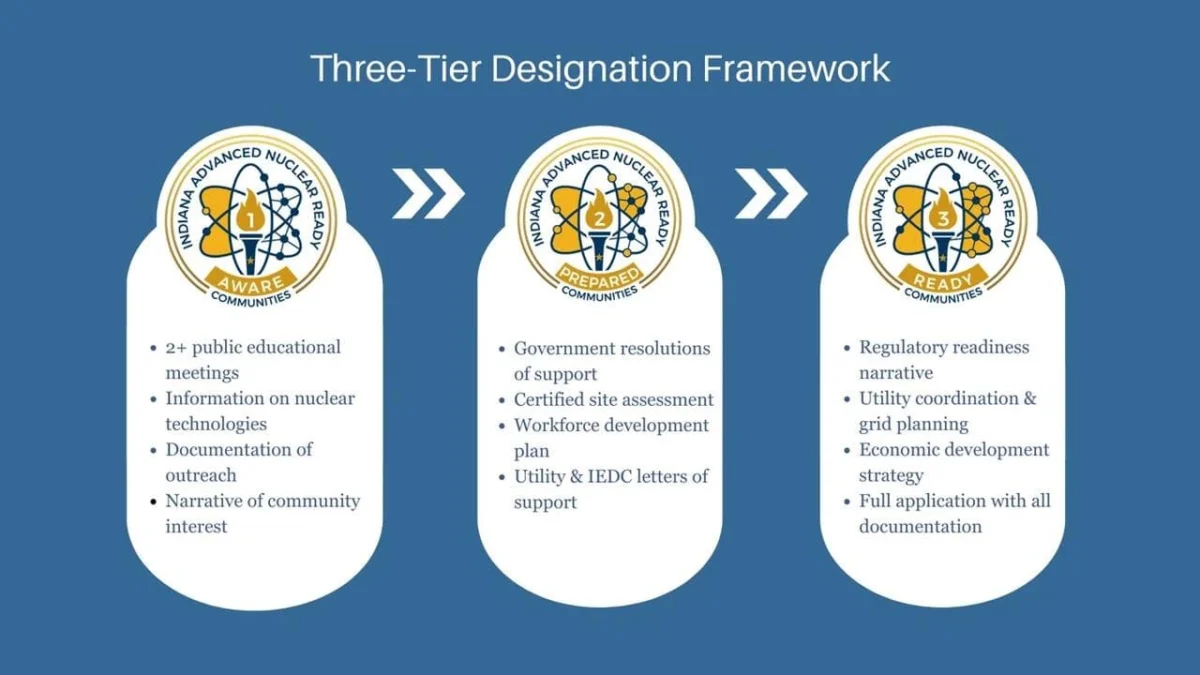
Further demonstrating its commitment, in April, Governor Braun signed a letter of intent with Eli Lilly, the Indianapolis-based pharmaceutical giant, to explore the potential for deploying reactors at Lilly’s operational sites. This partnership highlights the growing interest from energy-intensive industries in securing reliable, carbon-free power sources directly at their facilities. Complementing these initiatives, the state launched an innovative "Nuclear Ready" program this summer, designed to certify communities that meet specific criteria for hosting nuclear facilities, including infrastructure readiness, workforce availability, and local government support. This holistic approach aims to streamline the development process and foster community acceptance. The state’s proactive stance has already yielded tangible results, with First American Nuclear, a reactor startup, relocating its headquarters from Washington state to the Indianapolis area last year, promising over $4 billion in investment and signaling Indiana’s emergence as a significant player in the nuclear supply chain.
Amazon’s Megawatt Mandate: A New Model for Nuclear Finance
A significant driver behind Indiana’s projected energy demand surge, and a crucial player in its nuclear future, is the proliferation of data centers. Indiana Michigan Power, a subsidiary of AEP, anticipates its Indiana peak load to soar from 2,800 MW to more than 7,000 MW by 2030. This monumental increase is largely attributed to new large-scale industrial loads, including Amazon’s colossal $11 billion data center campus currently under development near New Carlisle, along with other major technology investments by companies like Google. The energy demands of these data centers, which operate 24/7 and require highly reliable, resilient, and increasingly decarbonized power, are reshaping the energy landscape.
In a groundbreaking move on Monday, AEP, X-energy, and Amazon unveiled a proposal for a 960 MW nuclear facility in Sullivan County. This ambitious project envisions the deployment of 12 of X-energy’s 80 MW Xe-100 reactors at the former site of the Breed Generating Station, a long-retired coal plant. The selection of a brownfield site is strategically advantageous, leveraging existing transmission infrastructure and potentially easing environmental permitting processes. The Xe-100 is a High-Temperature Gas-cooled Reactor (HTGR) SMR, notable for its use of TRISO fuel, a robust, multi-layered particle fuel designed to safely contain fission products even under extreme conditions. This inherent safety feature, combined with its modular design, offers significant advantages in terms of construction efficiency and operational flexibility, and its helium cooling system eliminates the need for large quantities of cooling water, a critical consideration in many locations.
What truly distinguishes this proposal, however, is Amazon’s unprecedented role. Far too many nascent nuclear projects struggle to secure both a committed buyer and the necessary financing. Amazon steps in as both financier and primary customer, pledging to fund the project’s development and purchase the entirety of its output under a long-term contract. This agreement is structured to "cover the costs of the facility and its operations for the duration of the contract," as stated by AEP. Bill Fehrman, AEP CEO, emphasized that "Our agreements with Amazon and X-energy will provide all necessary capital protections and financial safeguards that we have said are essential for any potential nuclear project to move forward."
This innovative financial model effectively insulates Indiana ratepayers from the substantial upfront capital risks typically associated with nuclear development. Josh Weissman of Amazon reiterated the company’s commitment to "pay our full costs without passing them to others," echoing a promise made when Amazon signed the White House’s Ratepayer Protection Pledge in March. This pledge signifies a broader commitment from major tech companies to decarbonize their operations without burdening consumers. Amazon’s deep involvement extends beyond this project; the company previously led X-energy’s Series C-1 funding round in 2024. This Indiana project marks the second collaboration between Amazon and X-energy, following their partnership on Energy Northwest’s Cascade plant in Washington state, further cementing their alliance in advancing nuclear energy solutions. The success of this model could set a precedent for future industrial-scale nuclear deployments, demonstrating a viable path for private capital to accelerate the clean energy transition.
Canadian Heavy Water Technology Enters the Fray
Adding another layer of international partnership and technological diversity to Indiana’s nuclear ambitions, AtkinsRéalis, a Canadian multinational engineering and construction firm, signed a Memorandum of Understanding (MOU) with the State of Indiana and Hoosier Energy on Monday at Purdue’s nuclear summit in Indianapolis. This agreement outlines plans to evaluate "a campus of up to eight CANDU nuclear reactors," potentially generating as much as 6 GW of carbon-free electricity. Hoosier Energy, a generation and transmission cooperative providing power to 18 rural electric membership cooperatives across central and southern Indiana, represents a significant off-taker for such a large-scale project, indicating the strong demand for reliable baseload power from cooperative utilities.
CANDU (CANada Deuterium Uranium) reactors are a distinct class of pressurized heavy-water reactors (PHWRs) that utilize heavy water (deuterium oxide) as both moderator and coolant. This design allows them to operate on natural uranium fuel, completely bypassing the energy-intensive and costly uranium enrichment process. Another significant operational advantage is their ability to refuel online, meaning new fuel bundles can be loaded into the reactor while it continues to generate power, minimizing downtime and maximizing availability. This technology has a proven track record, with CANDU reactors operating safely and reliably in Canada and several other countries for decades.
The re-emergence of heavy water reactor technology in the U.S. context, particularly in Indiana, is noteworthy. Just weeks prior, news surfaced about Atlas Atomics, a startup co-founded by entrepreneur and former presidential candidate Vivek Ramaswamy, which raised approximately $400 million at a valuation of roughly $1.9 billion. Atlas Atomics is developing an improved heavy water reactor design that also aims to leverage natural uranium and avoid enrichment. This positions AtkinsRéalis, as the exclusive licensee of Canada’s CANDU technology, as Atlas’s most direct and established competitor in this niche. While Atlas Atomics remains largely in stealth mode regarding its specific design, AtkinsRéalis has already initiated the U.S. Nuclear Regulatory Commission (NRC) licensing process for its CANDU technology, providing a tangible pathway toward deployment. The presence of two major players exploring heavy water reactor solutions highlights a growing recognition of the unique benefits these designs offer, particularly in terms of fuel cycle independence and operational flexibility.
The Pentagon’s Inland Power Play: Microreactors for Military Resilience
In a significant move reinforcing the strategic importance of advanced nuclear power, the U.S. Navy selected Radiant Nuclear on Tuesday to design, build, and deliver a microreactor power plant at Naval Weapons Station Crane. Located deep within Indiana, more than 500 miles from the nearest ocean, Crane is the world’s third-largest naval installation by area and a critical hub for naval research, development, and logistics. The Pentagon had previously announced in September that Crane would host the Navy’s first shore-based advanced microreactor, with a target installation date of September 2028. This rapid timeline underscores the military’s urgency in securing resilient, independent power sources for its critical infrastructure.
Radiant’s Kaleidos microreactor is a cutting-edge, factory-built, 1 MW (electrical) unit that features a helium-cooled design. Its compact size, transportability, and ability to operate for up to five years between refuelings make it an ideal solution for remote or critical installations. Crucially, the Kaleidos design requires no cooling water, simplifying site selection and reducing environmental impact, particularly important for inland locations like Crane. The project falls under the Army’s Project Janus program, which aims to accelerate the development and deployment of microreactors. In August, Janus selected Radiant and four other companies, with Radiant securing the program’s largest award, potentially worth up to $750 million for 15 reactors, initially slated for deployment at Fort Benning, Georgia.
Radiant’s success extends beyond the Army and Navy. In April, the U.S. Air Force also selected Radiant for a microreactor deployment at Buckley Space Force Base in Colorado. This makes Radiant the first reactor company to secure partnerships across all three major U.S. military branches simultaneously – Army, Navy, and Air Force. This unprecedented multi-service adoption serves as a powerful validation of Radiant’s technology and its potential to address the military’s urgent need for energy resilience, security, and independence from vulnerable grid infrastructure. The military’s interest in microreactors stems from their ability to provide secure, dispatchable, and long-duration power at forward operating bases and critical domestic installations, reducing reliance on fossil fuels and mitigating risks associated with fuel supply chains.
The Kaleidos reactor itself is currently undergoing testing at Idaho National Laboratory’s DOME test bed, and Radiant has indicated that criticality, the point at which a nuclear chain reaction becomes self-sustaining, could be announced by the end of the year. If the Pentagon adheres to its ambitious 2028 deadline, this 1 MW Navy microreactor at Crane is poised to become Indiana’s first operational nuclear power source, more than four decades after the Marble Hill project’s abandonment. This deployment would likely precede the completion of any larger SMR or CANDU projects, showcasing the rapid deployment potential of microreactors and their role as early adopters of advanced nuclear technology. The military’s successful integration of these units could pave the way for broader commercial adoption, demonstrating their safety, reliability, and economic viability.
The Path Ahead: Opportunities and Obstacles
Indiana’s aggressive pursuit of nuclear energy presents a myriad of opportunities and, naturally, some significant obstacles. On the economic front, the potential for job creation is substantial. Developing, manufacturing, constructing, and operating these advanced reactors will require a highly skilled workforce, from engineers and technicians to construction workers and administrative staff. The state’s tax credits for manufacturing aim to foster an entire supply chain within Indiana, creating a new economic sector and diversifying its industrial base. The multi-billion-dollar investments projected by companies like Amazon, First American Nuclear, and potentially others, signify a massive injection of capital into the state’s economy.
Environmentally, the shift towards nuclear power aligns with global decarbonization efforts. Nuclear energy produces virtually no greenhouse gas emissions during operation, offering a powerful tool to combat climate change and reduce air pollution. For a state historically reliant on coal, embracing nuclear represents a monumental step toward a cleaner energy future. Furthermore, the promise of stable, baseload power from nuclear reactors enhances energy security, reducing reliance on volatile fossil fuel markets and providing reliable electricity for critical infrastructure and burgeoning industrial loads like data centers.
However, the path to becoming a nuclear energy leader is not without its challenges. Regulatory hurdles remain significant, with the NRC’s rigorous licensing process known for its complexity and extensive timelines. While SMRs and microreactors aim to streamline this process through standardized designs, obtaining federal approval will still require substantial time and resources. Public acceptance is another crucial factor. Despite advancements in safety and technology, the legacy of past incidents and a general lack of understanding about modern nuclear designs can foster skepticism. Indiana’s "Nuclear Ready" program aims to address this by engaging communities early and transparently, but sustained public education and outreach will be vital.
Financing, even with innovative models like Amazon’s, remains a critical consideration given the capital-intensive nature of nuclear projects. While SMRs promise lower upfront costs per unit, scaling up to multiple reactors still requires significant investment. Finally, workforce development and supply chain resilience are paramount. Indiana will need to invest heavily in educational programs and vocational training to ensure a steady supply of qualified personnel. Building a robust domestic supply chain for specialized nuclear components will also be essential to mitigate risks and control costs.
In conclusion, Indiana is at the precipice of a profound energy transformation. The rapid succession of major nuclear proposals from diverse players – Amazon’s industrially-backed SMRs, Canada’s heavy water technology, and the U.S. military’s microreactor deployments – underscores a strategic, proactive effort to position the state as a national leader in advanced nuclear energy. While challenges remain, the clear commitment from state leadership, the innovative financial models emerging, and the proven demand from industry suggest that Indiana’s nuclear renaissance is not merely an aspiration but a tangible, rapidly unfolding reality set to redefine its energy future for decades to come.

