
Beijing – China’s external trade sector demonstrated remarkable resilience and accelerated growth in September 2026, with exports expanding by an impressive 36.3% year-on-year. This surge marks the fastest pace recorded since February, significantly outpacing analysts’ expectations and underscoring the enduring strength of the nation’s manufacturing prowess and its strategic pivot towards high-value goods. Simultaneously, imports also saw a substantial increase, climbing by 31%, their quickest rise since June and a notable acceleration from August’s 28.2% growth. Both figures comfortably exceeded estimates from a Reuters poll, which had projected 25.5% growth for exports and 24.5% for imports, signaling a more robust global demand picture than anticipated.
This exceptional performance led to a record monthly trade surplus of $133.5 billion, the highest recorded since January 2025, according to official data released on Wednesday. The robust trade figures arrive amidst a complex global economic landscape, characterized by inflationary pressures, geopolitical shifts, and a burgeoning demand for advanced technological components. "The resulting trade surplus of $133.5 billion, a record monthly high, underscores the continued strength of China’s external sector despite lingering concerns over domestic demand," observed Hao Zhou, head of research and chief economist at Guotai Junan International Holdings, in a detailed note to clients. This sentiment highlights a critical dynamic within the Chinese economy, where export-led growth continues to provide a significant buffer against internal economic headwinds.
Record-Breaking Trade Performance Signals Robust External Sector
The September trade data provides a clear indicator of China’s pivotal role in global supply chains and its ability to adapt to evolving international demand. The 36.3% rise in exports from a year ago not only represents the fastest growth in seven months but also contributes to an overall positive trajectory for the year, building on earlier momentum. In the first three quarters of 2026, China’s exports expanded to nearly every major trading partner tracked by its customs agency, demonstrating broad-based demand for Chinese goods across diverse geographical markets. This widespread growth suggests a global economic recovery, albeit uneven, is fueling demand for manufactured products, from consumer goods to industrial machinery.
The import surge, reaching 31%, also signifies a healthy domestic appetite for foreign goods and raw materials, crucial for China’s vast manufacturing base. This increase was particularly notable given the previous month’s slightly slower pace, indicating a renewed vigor in internal economic activity or strategic procurement. Economists widely agree that the strong import performance is partly attributable to the rising prices of core commodities and, critically, a heightened demand for components necessary to support China’s burgeoning high-tech industries, particularly those related to artificial intelligence.
AI and Advanced Manufacturing Drive Export Boom
A significant driver behind China’s export surge has been the escalating global demand for components essential to power artificial intelligence infrastructure. The value of China’s integrated circuit board exports globally, for instance, surged by an astonishing 136% in September from a year ago. However, a closer examination reveals a nuanced trend: the number of units exported only rose by a modest 1%. This disparity points to a substantial increase in the average unit value of these exported integrated circuit boards, suggesting a shift towards higher-end, more sophisticated, and therefore more expensive, chips and components. This trend aligns with China’s strategic national push to move up the value chain in manufacturing, focusing on advanced technology and innovation rather than merely high-volume production.
This includes specialized parts for data centers – the foundational infrastructure for AI development – such as advanced processors, memory modules, cooling systems, and power management units. As nations and corporations globally invest heavily in AI capabilities, the demand for these critical components has skyrocketed, positioning China as a key supplier in this high-growth sector. Analysts at major financial institutions have noted that China’s supply chain resilience, coupled with its increasing domestic research and development in semiconductor technology, has enabled it to capitalize on this global tech boom. The ability to produce and export increasingly complex integrated circuits underscores China’s ambition to reduce its reliance on foreign technology while simultaneously becoming a crucial node in the global tech ecosystem.
Automotive Sector Accelerates Global Reach
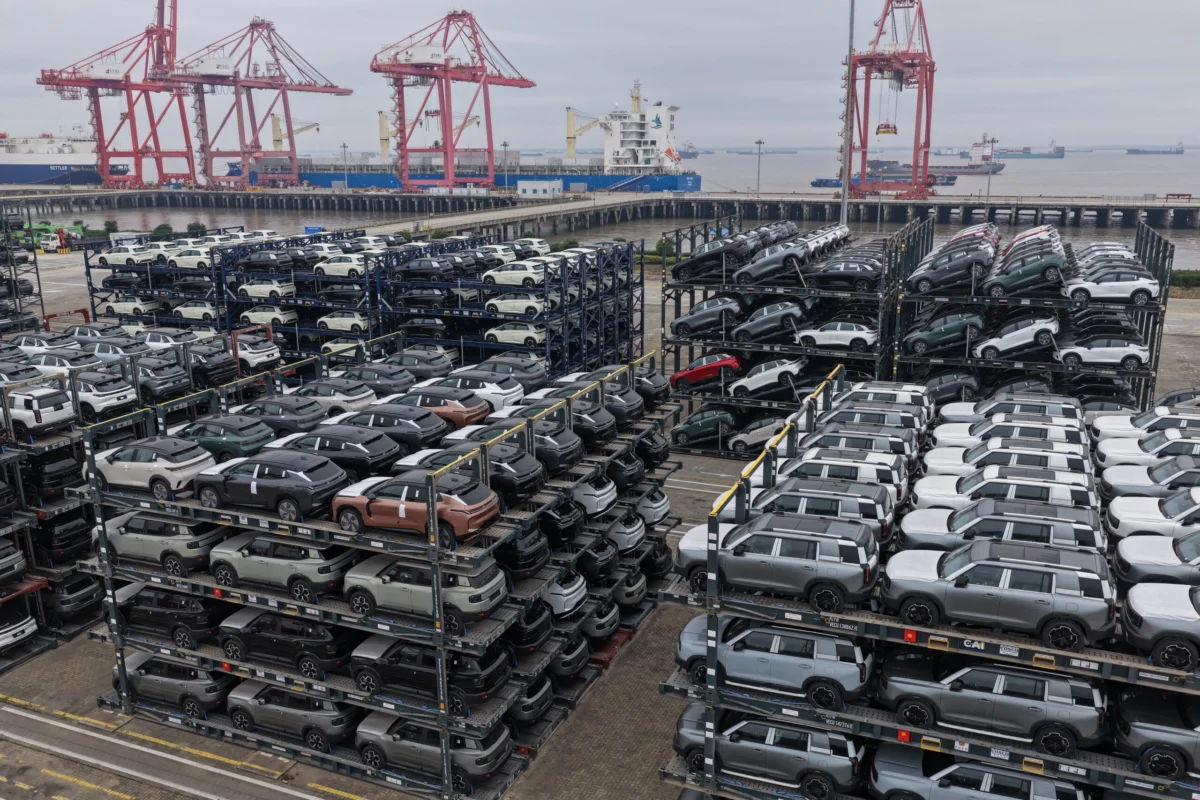
Beyond high-tech components, China’s automotive industry has emerged as a formidable force in global trade. In September, China’s overall car exports surged by a remarkable 56.3% to reach 1.18 million vehicles, with the corresponding value of these exports climbing by an even higher 62%. This explosive growth is largely attributed to China’s rapid advancements in electric vehicles (EVs) and hybrid-powered cars, where its manufacturers have gained a significant competitive edge through technological innovation, efficient production, and competitive pricing. Ports across China, such as the Taicang Port area of Suzhou Port in Jiangsu province, as observed on October 12, 2026, were bustling with Chinese-made cars being loaded onto specialized vehicle racks in preparation for export, illustrating the sheer scale of this outbound automotive flow.
However, the rapid expansion of Chinese automotive exports has not been without its challenges and diplomatic repercussions. The European Union, a critical market for Chinese vehicles, has expressed growing concerns over the potential market distortion caused by the influx of competitively priced Chinese cars, particularly hybrid models. Following high-level trade talks in Beijing last week, China agreed to halve its exports of hybrid-powered cars to the bloc. This agreement signals a proactive attempt by Beijing to de-escalate trade tensions and address concerns raised by European manufacturers regarding fair competition, potentially preventing more stringent protectionist measures from being imposed by the EU. While this agreement might temper growth in a specific segment, the broader trend indicates China’s automotive industry is poised for continued global expansion, albeit with increased scrutiny and calls for managed trade.
Shifting Import Dynamics Reflect Global and Domestic Factors
While exports painted a picture of robust growth, China’s import trends revealed a more complex interplay of global commodity prices, strategic resource management, and evolving domestic demand patterns.
Energy Imports and Strategic Adjustments
The volume of China’s crude oil imports continued its double-digit decline for the sixth consecutive month in September. This consistent reduction in volume, even as their value rose for the first time since May, suggests a multi-faceted approach to energy security and consumption. The rise in value despite falling volume points directly to higher global crude oil prices, impacting China’s import bill. Concurrently, the sustained reduction in volume could be attributed to several factors: China’s strategic stockpiling efforts earlier in the year, a concerted drive towards energy diversification including increased reliance on domestic production and renewable energy sources, and possibly a temporary slowdown in certain energy-intensive industrial sectors. Both crude oil and natural gas imports have seen a decline in volume since the start of the year, reflecting a broader strategy to optimize energy consumption and enhance energy independence.
Targeted Import Declines and Supply Chain Realignments
For the first three quarters of the year, while overall exports grew to most major countries, imports from specific nations presented a contrasting picture. Imports from Malaysia, Germany, and the United Kingdom notably fell during this period. This localized decline could indicate a shift in China’s supply chains, possibly driven by a desire for greater self-sufficiency in certain sectors, diversification of import sources, or the impact of global geopolitical dynamics on trade flows. For instance, the decline in imports from Germany, a traditional supplier of high-end machinery and automotive components, might reflect China’s increasing domestic capacity in these areas or a strategic reallocation of procurement towards other partners. Similarly, changes in demand patterns within China or broader economic adjustments in these exporting nations could also contribute to these trends.
Critical Resource Inflows: Fertilizers and Raw Materials
In a stark contrast to energy and certain manufactured goods, China’s fertilizer imports surged significantly during the first three quarters of the year. This surge is directly linked to China’s overarching focus on food security and ensuring robust agricultural output for its vast population. Global supply chain disruptions and domestic production challenges could have necessitated increased reliance on foreign fertilizer supplies. Simultaneously, reflecting the impact of export controls and strategic stockpiling, the volume of China’s rare earths and fertilizer exports dropped during the same period. Rare earths, critical for high-tech industries, are often subject to strategic management due to their importance and finite supply, while fertilizer export controls might aim to ensure adequate domestic supply for agriculture.
Navigating Geopolitical Headwinds: Tariff Rollbacks and Trade Agreements
The impressive trade figures arrive amid ongoing efforts by China to manage complex geopolitical relationships, particularly with its largest trading partners.
US-China Dialogue Yields Tariff Relief
A significant development occurred last month when the United States and China announced plans to roll back tariffs on $30 billion worth of goods from each country. This move, a tangible outcome of high-level discussions, also included an agreement to extend a broader trade truce by two months, pushing the deadline to January 2027. This de-escalation reflects a mutual desire from both economic superpowers to stabilize trade relations, which have been strained by years of tariff disputes initiated during the previous U.S. administration. For businesses in both countries, this partial tariff rollback offers a measure of relief and predictability, potentially easing operational costs and fostering greater cross-border investment, at least temporarily. Observers suggest this diplomatic overture aims to build confidence and create a more conducive environment for future, more comprehensive trade negotiations.
EU-China Negotiations Address Market Imbalances
Similarly, China engaged in high-stakes trade talks with the European Union, addressing concerns related to its surging exports. The agreement for China to halve its exports of hybrid-powered cars to the EU, announced last week, underscores the proactive steps Beijing is taking to mitigate trade friction. The EU had been scrutinizing China’s industrial subsidies and their impact on European manufacturers, particularly in the rapidly growing EV and hybrid vehicle markets. This agreement is seen as a diplomatic concession designed to prevent the imposition of punitive tariffs or other trade barriers by the EU, which could have significantly impacted China’s automotive industry. It reflects a broader trend of managed trade, where major economic blocs seek to balance market access with protecting domestic industries, prompting China to adjust its export strategies in key sectors.
Broader Economic Implications and Outlook
China’s robust trade performance in September carries significant implications for both its domestic economy and the global trading system.
Balancing External Strength with Domestic Challenges
While the external sector demonstrates exceptional strength, the persistent concerns over "sluggish domestic demand" within China remain a critical consideration for policymakers. Challenges in the property sector, coupled with fluctuating consumer confidence, have prompted calls for further domestic stimulus measures. The strong export performance acts as a significant economic stabilizer, providing foreign exchange earnings and supporting employment in manufacturing sectors, thereby cushioning the impact of internal economic pressures. However, economists caution that an over-reliance on external demand could exacerbate global trade imbalances and potentially invite further protectionist measures from trading partners. The government’s challenge lies in fostering sustainable domestic consumption and investment to achieve a more balanced growth model.
Global Scrutiny and Trade Imbalances
The record-breaking trade surplus of $133.5 billion, while indicative of China’s economic power, also intensifies global scrutiny regarding trade imbalances. Nations with significant trade deficits with China, particularly the US and EU, are likely to reiterate calls for fairer trade practices, greater market access for foreign companies in China, and a reduction in what they perceive as unfair subsidies for Chinese industries. This ongoing dialogue will shape future trade policies and could influence China’s strategic economic decisions, including further opening its markets or adjusting industrial policies to promote more balanced trade flows. The image of Chinese cars being exported at scale encapsulates the visible impact of China’s manufacturing might on global markets.
Expert Perspectives and Future Trajectories
Economists largely agree that China’s September trade figures highlight the nation’s continued centrality to the global economy. "These numbers confirm China’s structural shift towards higher-value exports, particularly in advanced manufacturing and technology," noted a senior analyst at a major investment bank, who wished to remain anonymous due to ongoing client advisories. "However, the underlying domestic demand weakness remains a key risk, and the ability to convert export earnings into sustainable internal growth will be paramount." The outlook for the remainder of 2026 and into 2027 suggests that while global demand for AI-related products and China’s competitively priced manufactured goods will likely remain strong, potential headwinds include a global economic slowdown, persistent geopolitical tensions, and ongoing pressures to rebalance trade. China’s government will likely continue to pursue policies that bolster domestic demand, foster technological innovation, and strategically manage its international trade relationships to navigate these complex dynamics.
Chronology of Key Trade Developments (2025-2027)
- January 2025: China records its previous high for the monthly trade surplus, setting a benchmark for future performance.
- February 2026: China’s exports achieve a significant growth rate, marking the fastest pace in recent history prior to the current September surge.
- Early 2026: Both China’s exports and imports grow at their fastest pace in five years, signaling a strong start to the year for external trade.
- May 2026: The value of China’s crude oil imports last registers a year-on-year increase, preceding a period where volume declines dominate.
- June 2026: China’s imports experience their fastest rate of increase for the year, preceding the robust growth seen in September.
- August 2026: High-level discussions between the US and China lead to an announcement of plans to roll back tariffs on $30 billion worth of goods from each country.
- September 2026: Official data is released showing China’s exports surging by 36.3% and imports by 31%, leading to a record monthly trade surplus.
- Last Week of September 2026: Following high-level trade talks in Beijing, the European Union announces China’s agreement to halve its exports of hybrid-powered cars to the bloc.
- October 12, 2026: Chinese-made cars are photographed at Taicang Port, Jiangsu province, being prepared for loading onto ships for export, visually confirming the massive scale of the automotive trade.
- January 2027: The extended deadline for the US-China trade truce, agreed upon in August 2026, is set to expire, indicating a critical juncture for future trade relations between the two economic powers.

