

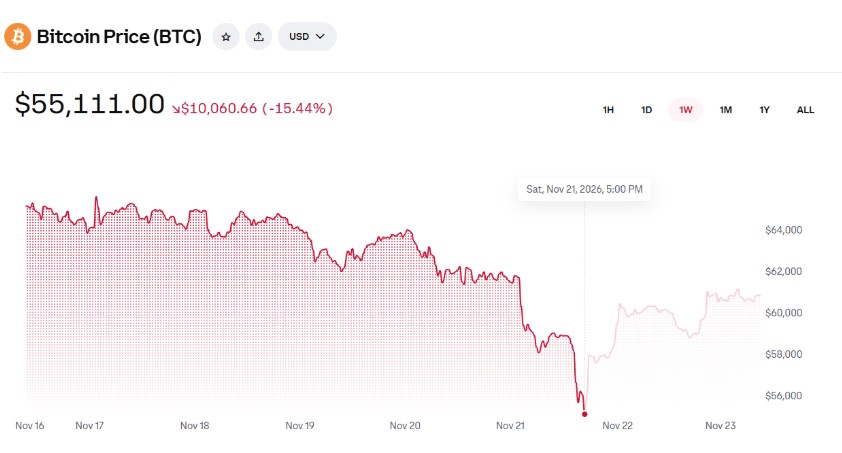
Bitcoin experienced a significant rebound over the weekend, climbing back to $61,034 after touching a cycle low of approximately $55,110 on Coinbase. This 11% recovery comes as broader financial markets grapple with widespread downturns, prompting close examination of Bitcoin’s resilience and the underlying causes of its recent volatility. The cryptocurrency exchange Kraken has issued statements asserting operational normalcy despite witnessing an extreme price anomaly on its Canadian dollar market.
The recent market movements are not isolated to the cryptocurrency sphere. Global financial markets have shown considerable weakness, with the tech-heavy Nasdaq Composite index experiencing a sharp decline. On Friday alone, the Nasdaq fell by 5.3%, bringing its total losses to nearly 20% from its October peak, inching closer to bear market territory. The S&P 500 also saw a substantial drop of 8.6% last week, marking its 12th worst weekly performance since 1952. Even traditional safe-haven assets like gold have not been spared, losing another 4.3% in the past 24 hours and sitting 21.6% down since September, on track for its worst three-month performance since June 2013.
These macroeconomic headwinds appear to be influencing investor sentiment across asset classes. Concerns over the sustainability of debt-financed artificial intelligence (AI) infrastructure build-outs are reportedly contributing to the sell-off in technology stocks. The interconnectedness of these markets means that significant downturns in traditional finance can often spill over into the digital asset space.
At the time of reporting, Bitcoin’s price hovered around $60,750. However, a divergence of opinions exists regarding its future trajectory. Many analysts are drawing parallels to historical Bitcoin four-year cycles, which have historically seen significant bottoms occur in the period following U.S. midterm elections. This cyclical pattern, if repeated, could suggest further downside potential for the cryptocurrency.
Veteran trader Peter Brandt had previously cautioned the market, noting in a statement: "Every bull market phase in BTC’s history has ended with at least a 75% correction of the previous parabolic bull trend. Could this be what’s happening in Bitcoin?" This historical perspective fuels the ongoing debate about whether the current market correction represents a significant downturn or a healthy consolidation within a larger bull trend.

The extreme volatility was starkly illustrated on Kraken’s Canadian dollar markets, where Bitcoin’s price briefly plummeted to an astonishing $17,000 USD equivalent. This represented a 71% disparity compared to its USD market price. Despite the severity of this localized price drop, Kraken promptly issued a statement assuring its users that all operations remained nominal. The exchange confirmed that every order was processed correctly and that its security teams had found no evidence of a breach or compromised accounts. Kraken explicitly stated, "Executed trades stand," indicating that these transactions would be honored, a crucial point for maintaining market integrity during such anomalous events. This incident, while alarming, underscores the potential for technical glitches or market microstructure issues to create temporary, albeit dramatic, price dislocations in even highly liquid markets.
Adding a layer of technical analysis to the current market sentiment, crypto influencer Cryptobull highlighted a metric suggesting potential underlying support for Bitcoin. He pointed to the MVRV (Market Value to Realized Value) ratio, a common on-chain indicator. According to his analysis, this cycle’s MVRV peak only reached 2.29 times above Bitcoin’s cost basis. Extrapolating this to the cycle low, he suggested a potential bottom around 1.03 times the cost basis of $53,700, which would align closely with the recent low of $55,130. This perspective offers a degree of "hopium" by suggesting that based on this specific metric, Bitcoin might be closer to a bottom than some pessimistic forecasts indicate.
However, contrasting this optimistic outlook, cycle theorist Benjamin Cowen offered a more sobering assessment. He noted that during bear markets, Bitcoin typically falls significantly below its realized price and often gravitates towards the "balanced price." Coinglass, a data provider, places this balanced price at approximately $38,700. This projection suggests that if the current market conditions evolve into a prolonged bear phase, Bitcoin could experience a much steeper decline than currently observed. The discrepancy between these analyses underscores the inherent uncertainty and the wide range of potential outcomes in cryptocurrency markets.
Ledger Faces Tampered Device Allegations in Dubai and Germany
In parallel to market volatility, security concerns have surfaced regarding hardware wallets. Ledger, a prominent manufacturer of cryptocurrency hardware wallets, has issued a warning to customers who purchased devices in Berlin since January 2026. The company is investigating reports of tampered devices in both Germany and the United Arab Emirates.
The alert comes after several suspicious devices were reported in Berlin. More alarmingly, two customers in Dubai reported substantial losses, totaling $604,000 in cryptocurrency, which they attribute to compromised devices. Ledger has confirmed that these incidents appear to be linked to the same distribution-channel tampering campaign that was first investigated in Southeast Asia in October. To address these concerns, Ledger is offering physical inspections, including advanced X-ray analysis, at its factory in Vierzon, France, for any customers who suspect their devices may have been compromised. This situation highlights the critical importance of supply chain security in the hardware wallet industry, where a single point of failure can have devastating consequences for users.
Ethereum’s "Glamsterdam" Upgrade Faces Potential Delay to May 2027 Amid Compatibility Scrutiny
The development roadmap for Ethereum, the second-largest cryptocurrency by market capitalization, is also facing potential adjustments. The much-anticipated "Glamsterdam" upgrade, which aims to enhance the network’s security and efficiency, could see its mainnet activation pushed back to May 2027. This potential delay stems from ongoing compatibility concerns and discussions among core developers.
During a recent All Core Devs Call, the timeline for Glamsterdam’s activation was a key topic of discussion. While the current specifications allow for mainnet activation as early as mid-January 2027, the adoption and testing of modifications to the gas pricing Ethereum Improvement Proposals (EIPs) could introduce significant delays. If these proposed changes are adopted and subsequently found to break existing smart contracts, the activation could be postponed to late February, early March, or even April or May of 2027. No definitive decision has been reached yet, with developers continuing to deliberate on the optimal path forward.
Further complicating the upgrade schedule, the possibility of modifying EIPs within the Hegota fork to prioritize post-quantum features was also discussed. However, some developers argued that reducing the upgrade’s scope might offer limited benefits unless it also accelerates the overall rollout timeline. This debate reflects the complex balancing act developers face in implementing advanced security features while ensuring network stability and timely deployment. The potential for delays underscores the intricate nature of large-scale blockchain upgrades and the challenges of coordinating complex technical changes across a decentralized network.
Binance Hacker Moves Nearly $600 Million in ETH, Utilizing Cross-Chain Protocols
In a concerning development for exchange security, wallets linked to the notorious Binance hack have been observed moving a significant portion of the stolen Ether. Over a two-day period, approximately $600 million in ETH was transferred out of these wallets, with blockchain analysts noting the use of cross-chain swap protocols, including THORChain and Chainflip.
On Thursday, attackers moved an estimated $248 million worth of ETH to new wallets, followed by another $346 million ETH on Friday. The routing of these funds through decentralized exchange protocols like THORChain and Chainflip is a common tactic employed by hackers to obscure the trail of illicit funds and facilitate their conversion into other cryptocurrencies or fiat currency.
The increased activity on THORChain, in particular, was evident, with its 24-hour swap volume soaring to $239 million on Friday, leading to protocol earnings of approximately $243,000, according to the protocol’s dashboard. This activity highlights the evolving methods used by malicious actors to launder stolen digital assets and the ongoing cat-and-mouse game between security researchers and cybercriminals. The reliance on cross-chain protocols for these movements underscores the need for enhanced monitoring and security measures across the entire decentralized finance (DeFi) ecosystem.
Anthropic Shares See Strong Retail Interest on Debut, Though Net Buying Lags SpaceX
The initial public offering (IPO) of Anthropic, a leading AI safety and research company, generated significant buzz among retail investors. On its Nasdaq debut, retail investors traded a substantial $772 million in Anthropic shares. However, their net purchases, which measure the excess of purchases over sales, totaled a more modest $60 million. This figure is notably less than the $118 million in net purchases recorded by retail investors on SpaceX’s first day of trading in June.

Despite the lower net buying figure, Anthropic’s first-day retail trading volume surpassed that of SpaceX, reaching $669 million, making it the highest for any market debut recorded by Vanda Research since 2012. While volume reflects the total amount traded, net buying provides a clearer picture of genuine investor demand.
Anthropic’s stock closed its first trading day up 17% from its IPO price. However, this initial surge was short-lived, as the stock fell to just 7% above the IPO price on its second day, a decline attributed to a broader market sell-off that impacted technology and growth stocks. The performance of Anthropic’s IPO, while showing strong initial interest, also reflects the current market sentiment towards speculative technology assets.
Market Performance Overview: Bitcoin, Ethereum, and XRP Face Weekly Declines
The broader cryptocurrency market experienced a challenging week, with major assets showing significant declines. At the end of the week, Bitcoin (BTC) was trading down 6.5% at $60,815. Ethereum (ETH) followed suit, down 5.9% to $1,713, while XRP (XRP) saw a 4.3% decrease, trading at $0.02. The total cryptocurrency market capitalization stood at approximately $2.08 trillion, according to CoinMarketCap.
Within the top 100 cryptocurrencies, several altcoins managed to buck the trend. The top three altcoin winners of the week included Pieverse (PIEVERSE) with an impressive 91.2% gain, Venice Token (VVV) on 28.74%, and Falcon Finance (FF) on 4.1%.
Conversely, the market downturn led to substantial losses for some altcoins. The top three altcoin losers of the week were Sky (SKY), down 22.6%, Artificial Superintelligence Alliance (FET), down 18.4%, and Aptos (APT), down 16.8%. These significant price movements highlight the inherent volatility and speculative nature of the altcoin market.
Expert Predictions: Bitcoin Carry Trades Poised to Outperform Treasury Bills in 2027
Looking ahead, digital asset bank Sygnum has published an outlook for 2027, predicting that Bitcoin carry trades could regain their competitive edge over U.S. Treasury bills. This projection is based on an anticipated recovery in demand for leverage within the market.

Sygnum’s forecast suggests that the annualized premium on three-month Bitcoin futures traded on the Chicago Mercantile Exchange (CME) will average more than 2% above the yields of three-month U.S. Treasury bills next year. Fabian Dori, Chief Investment Officer at Sygnum, explained that these returns could improve as investors become more risk-tolerant and the competition among hedge funds for similar profit opportunities diminishes. Carry trades, which involve profiting from the difference in interest rates between two currencies or assets, have historically been a significant source of return in financial markets, and Sygnum’s prediction indicates a potential resurgence of this strategy within the digital asset space.
Regulatory Watch: IOSCO Warns of Quantum Upgrades Slowing Blockchains and Security Risks
The International Organization of Securities Commissions (IOSCO) has issued a cautionary note regarding the implications of upgrading blockchains to become quantum-resistant. In a report released this week, IOSCO warned that such upgrades could lead to a slowdown in transaction speeds and an increase in associated fees.
According to the report, some quantum-resistant digital signature schemes require significantly more data space than current methods used for transaction authorization. This increased data footprint means that fewer transactions can be included in each block, potentially leading to network congestion, higher transaction fees, and increased storage requirements for network participants. IOSCO cited an experimental test of Solana that demonstrated a roughly 90% reduction in transaction speed when quantum-resistant signatures were implemented. The findings underscore the technical challenges and potential trade-offs involved in preparing blockchain infrastructure for future cryptographic threats.
U.S. Senate Advances Legislation Restricting Prediction Markets with "DEATH BETS Act"
The U.S. Senate has taken a significant step towards regulating prediction markets, passing legislation that would prohibit federally regulated prediction markets from offering contracts tied to sensitive and potentially harmful events. The bill, known as the "DEATH BETS Act," aims to prevent contracts related to war, terrorism, assassination, and events primarily determined by a person’s death.
Introduced by Democratic Senator Adam Schiff in March, the bill passed the Senate by a voice vote after lawmakers adopted an amendment through unanimous consent. The legislation will now proceed to the House of Representatives for further consideration. This move signifies a growing regulatory focus on the ethical and societal implications of prediction markets, particularly concerning their potential to be used for morbid or harmful speculation.
Sky Protocol Faces Scrutiny Over Stablecoin Withdrawals Amid Illicit Fund Claims
Sky Protocol, a platform facilitating stablecoin redemptions, processed over $2 billion in stablecoin withdrawals on Thursday, a day on which a CoinDesk investigation linked $518 million in transactions through the protocol to illicit activities. The significant outflow of funds occurred amidst concerns that Circle, the issuer of USD Coin (USDC), might freeze USDC held by Sky Protocol.

Sky Protocol issued a statement on Friday asserting that its USDS stablecoin maintained its $1 peg throughout the withdrawal period. The company also challenged the CoinDesk investigation, citing a review by Block Analitica that reportedly found the report to be misleading. This situation highlights the complex interplay between regulatory scrutiny, allegations of illicit finance, and the operational stability of decentralized finance protocols. The ability of such platforms to handle large-scale redemptions while addressing security concerns remains a critical factor for trust and adoption.
Top Magazine Features: Bitcoin Price Predictions and DeFi Security Debates
This week’s magazine features delve into prominent discussions within the crypto space. Haseeb Qureshi of Dragonfly, a venture capital firm, expressed skepticism about Bitcoin reaching $1 million by 2030, suggesting a more realistic target of $400,000. He also doubted Bitcoin would reach $100,000 by the end of the current year, citing the downturn in AI stocks as a significant drag on the crypto market.
Another featured article explores the implications of Phylax, a new security tool for Ethereum’s decentralized finance (DeFi) ecosystem. While Phylax aims to enable decentralized protocols to block potentially harmful transactions, the article raises questions about the potential for censorship and the concentration of power within Ethereum’s builder market.
Finally, a piece addressing wealth preservation and fund access during national emergencies offers practical advice for individuals concerned about systemic failures. As geopolitical and technological threats continue to evolve, the article underscores the importance of having strategies in place to safeguard assets and maintain access to funds during periods of crisis.

