
Bitcoin, the premier cryptocurrency, is currently engaged in a delicate balancing act, attempting to find its footing around the significant psychological and technical threshold of $70,000. This period of price discovery for Bitcoin comes at a time when broader financial markets are experiencing considerable turbulence. Escalating crude oil prices and a palpable downturn in global stock markets are casting a long shadow of concern over the future trajectory of inflation in the United States, creating a complex backdrop for investors and digital asset enthusiasts alike.
The cryptocurrency market has witnessed a swift and decisive rejection of Bitcoin’s recent ascent to a range high of $76,000 on Tuesday. Following this sharp pullback, the digital asset experienced a sell-off that pushed its price below the $70,000 mark, triggering apprehension among traders. This price action has amplified concerns that the current market sentiment may not yet reflect a definitive bottom for Bitcoin (BTC), suggesting that further downside could be on the horizon.
Technical Indicators Signal Potential for Further Decline
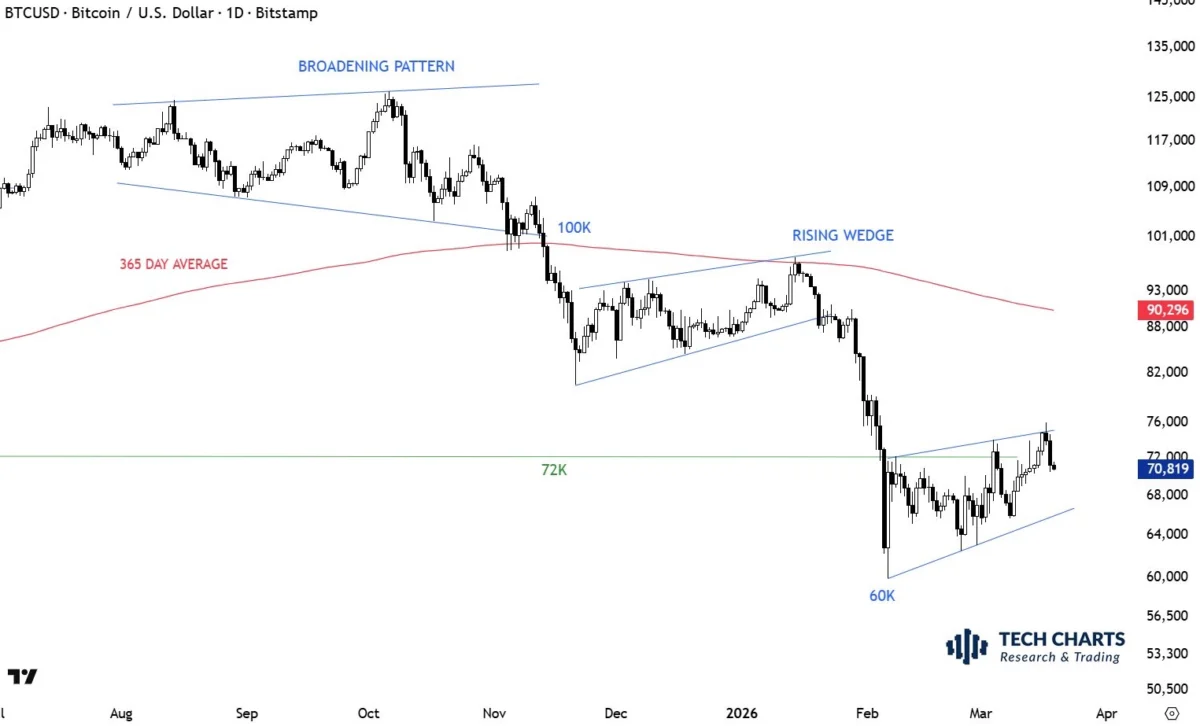
Aksel Kibar, a chartered market technician, has drawn attention to a potential bearish pattern forming on Bitcoin’s price chart. Kibar suggested that a bearish wedge formation, reminiscent of a pattern observed between December 2025 and early January 2026, might be re-emerging. This technical interpretation carries significant weight, as such patterns are often precursors to downward price movements.
In an analysis shared on social media platform X, Kibar elaborated on the implications of this potential bearish wedge. He indicated that a decisive breakdown below the lower boundary of this pattern would serve as a critical signal, potentially initiating a move towards the $52,500 price level. This projection represents a substantial decline from the current trading range, underscoring the gravity of the technical signals being observed.
Further contextualizing his analysis, Kibar referenced a previous post from January 18, 2026. In that earlier commentary, he had highlighted the importance of Bitcoin respecting its year-long average as a crucial component in its ongoing "chop and search for a base" phase. This suggests that while the current price action is concerning, it is also part of a broader, more complex market dynamic. Kibar also noted the possibility of the pattern evolving into a rising wedge, which, in technical analysis, is typically considered bearish, often leading to a test of support areas within the $73,700 to $76,500 range.
Broader Market Instability and the Inflationary Headwind
Bitcoin’s struggle to maintain its upward momentum and its subsequent dip below $70,000 occurred in tandem with significant selling pressure across U.S. stock markets. This correlation highlights the increasing interconnectedness of traditional financial assets and the cryptocurrency market, particularly during periods of heightened macroeconomic uncertainty.
The anxieties driving the sell-off in equities appear to be deeply rooted in a confluence of factors. A primary concern is the sustained rise in crude oil prices. Geopolitical tensions, including the ongoing conflict between Israel and Iran, are contributing to supply-side pressures in the oil market, pushing prices upward. This surge in energy costs has a direct ripple effect on the broader economy, acting as a significant driver of inflation.
The cost of energy is a fundamental input for almost all goods and services, meaning higher oil prices translate into increased transportation costs, manufacturing expenses, and ultimately, higher prices for consumers. This inflationary pressure is eroding consumer purchasing power and dampening overall economic sentiment.
Investor Confidence Erodes Amidst Shifting Monetary Policy Expectations
The escalating inflation fears have prompted a significant reassessments of future monetary policy by the U.S. Federal Reserve. Historically, investors had anticipated a series of interest rate cuts by the Fed throughout 2026, a move generally seen as supportive of asset prices, including cryptocurrencies. However, the current economic climate, characterized by persistent inflation, has dramatically altered these expectations.
Recent market analyses indicate a growing probability of interest rate hikes by the Federal Reserve before the end of 2026. The Kobeissi Letter, a financial commentary service, highlighted this dramatic shift in sentiment, noting that markets now perceive a 50% chance of a U.S. Fed rate hike by year-end. This is a stark contrast to earlier projections that suggested as many as four rate cuts within the same timeframe. Such a reversal in expected monetary policy has profound implications for all asset classes, as higher interest rates generally increase the cost of borrowing and can lead to a deleveraging of financial markets. This environment is often less conducive to speculative assets like Bitcoin.
Glassnode Analysis: Bitcoin Reintegrates Range Amidst Unwound Gamma

Analysts at Glassnode, a prominent blockchain data analytics firm, have also weighed in on Bitcoin’s recent price action. In their BTC Options Weekly report, they concluded that Bitcoin had effectively "reintegrated its range after a short-lived deviation above the $75K level." This observation suggests that the recent surge above $75,000 was not sustained and that the cryptocurrency is now trading within a familiar price channel.
The report further explained that within the options market, Bitcoin’s "short gamma at $75K has been unwound." Gamma refers to the rate of change of an option’s delta with respect to a change in the price of the underlying asset. A high gamma can lead to significant price swings as market makers adjust their hedges. The unwinding of this gamma suggests that the forces that might have amplified the recent upward move have diminished, contributing to the current price consolidation.
Glassnode analysts articulated that "beneath the pullback, the breakout has lost momentum and range conditions are returning." This implies that the bullish momentum that propelled Bitcoin above $70,000 and towards $76,000 has dissipated, and the market is reverting to a period of sideways trading. This return to range conditions, coupled with the broader macroeconomic headwinds, contributes to the prevailing uncertainty surrounding Bitcoin’s near-term price direction.
Underlying Factors and Historical Context
The current market environment for Bitcoin is not occurring in a vacuum. The cryptocurrency’s price has historically shown a degree of correlation with broader risk-on assets, making it susceptible to the same macroeconomic forces that influence traditional markets. The interplay between geopolitical events, commodity prices, and central bank policy is a critical determinant of investor sentiment and capital allocation across all asset classes.
The recent spike in crude oil prices, exacerbated by geopolitical tensions, serves as a potent reminder of the fragility of global supply chains and the interconnectedness of international relations with economic stability. The threat of further escalation in conflicts involving major energy-producing regions can lead to sustained upward pressure on oil prices, thereby feeding into inflationary concerns.
Furthermore, the U.S. Federal Reserve’s mandate includes maintaining price stability. As inflation shows signs of persistent upward pressure, the Fed is compelled to consider measures that can curb it, even if those measures involve tightening monetary policy. This creates a challenging environment for assets that have benefited from a prolonged period of low interest rates and abundant liquidity.
Implications for Investors and the Digital Asset Space
The current market dynamics present a complex scenario for investors in Bitcoin and the broader digital asset ecosystem. The potential for further price declines, as suggested by technical indicators, coupled with the persistent threat of inflation and a hawkish stance from the Federal Reserve, creates a risk-off environment.
For Bitcoin bulls, the defense of the $70,000 level is crucial. A sustained break below this psychological and technical support could indeed signal a deeper correction, as indicated by Kibar’s analysis. Conversely, if Bitcoin can manage to stabilize and find a firm footing above $70,000, it would suggest resilience in the face of adverse market conditions.
The broader implications extend to the entire cryptocurrency market. Bitcoin’s price movements often act as a bellwether for the rest of the digital asset space. A significant downturn in Bitcoin could trigger sell-offs across altcoins, potentially leading to a broader market correction.
Looking Ahead: Navigating Uncertainty
The coming weeks and months will be critical in determining the short-to-medium term trajectory of Bitcoin. Investors will be closely monitoring several key indicators:
- Crude Oil Prices: Continued upward pressure on oil prices will likely sustain inflationary concerns and keep the Federal Reserve on alert.
- U.S. Inflation Data: Key inflation reports, such as the Consumer Price Index (CPI) and Producer Price Index (PPI), will be scrutinized for signs of whether inflation is beginning to moderate or remains stubbornly high.
- Federal Reserve Statements: Any further communication from Federal Reserve officials regarding their monetary policy outlook will be keenly observed for indications of future rate decisions.
- Geopolitical Developments: The ongoing conflict in the Middle East and other geopolitical hotspots will continue to influence commodity prices and overall market sentiment.
- Bitcoin’s Technical Levels: The $70,000 level remains a critical support. A sustained breach could trigger further downside, while holding above it could signal a potential for a rebound.
In conclusion, Bitcoin’s current search for equilibrium at $70,000 is occurring against a backdrop of significant macroeconomic headwinds. Rising crude oil prices and tanking stock markets are fueling investor worries about the future of inflation in the U.S., leading to a reassessment of monetary policy expectations. Technical indicators suggest potential for further downside, while market analysts point to a return to range conditions after a brief upward deviation. The interplay of these factors will shape Bitcoin’s price action and the broader sentiment in the digital asset market in the near future.

