
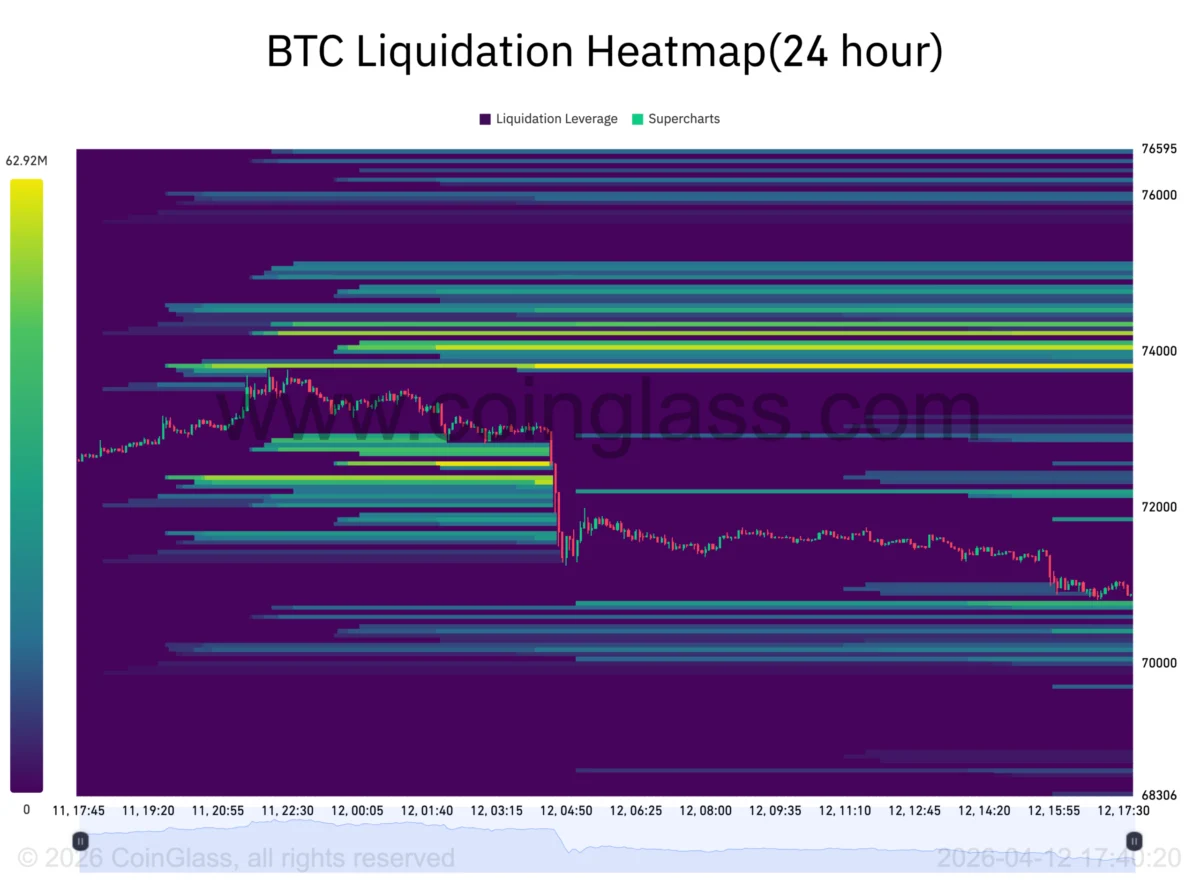
Bitcoin (BTC) experienced a significant price drop of 3%, falling below the crucial $71,000 mark as Sunday approached its weekly close. This downturn in the leading cryptocurrency’s valuation is directly linked to the unexpected breakdown of high-stakes negotiations aimed at de-escalating tensions between the United States and Iran. The collapse of these diplomatic efforts, which were centered on the contentious issue of nuclear weapons, has sent ripples through global financial markets, with Bitcoin, a 24-hour traded asset class, reacting swiftly to the unfolding geopolitical uncertainty.
Geopolitical Tremors Trigger Market Sell-off
The catalyst for Bitcoin’s decline was the abrupt halt in talks between US and Iranian delegations in Islamabad, Pakistan. Reports indicated that the failure to reach an agreement on nuclear weapon proliferation led to the premature departure of both parties. In the aftermath, U.S. President Donald Trump issued a stark warning via his Truth Social platform, declaring that the United States would blockade the Strait of Hormuz and "interdict" any vessels found paying Iran for safe passage.

"No one who pays an illegal toll will have safe passage on the high seas," President Trump stated in a post that was quickly amplified across global news networks. A subsequent post reiterated the demand for Iran to ensure the Strait of Hormuz, a vital artery for global oil transit, is fully operational. This aggressive stance signals a potential escalation in the ongoing standoff, with significant implications for international trade and energy security.
Economic Fallout and Inflationary Pressures
The ramifications of this diplomatic failure extend far beyond the immediate geopolitical theater, casting a shadow over the broader global economy. Analysts and financial commentators have warned that a protracted conflict or sustained closure of the Strait of Hormuz could trigger a new era of economic instability, particularly concerning inflation.
The Kobeissi Letter, a prominent financial analysis firm, articulated these concerns in a recent analysis shared on X (formerly Twitter). "If the path forward is continued war, escalation, and a prolonged closure of the Strait of Hormuz, then the Iran War has just entered a new era," the firm stated. Their models project that U.S. Consumer Price Index (CPI) inflation, which recently saw a notable jump from 2.4% to 3.3%, could surge to over 4.0% if these escalatory scenarios materialize.

This projection is particularly concerning given that the March CPI data, released earlier in the week, had shown a slight downtick in overall inflation despite a significant surge in the oil-price component, marking the largest year-on-year increase in 60 years. The sensitivity of CPI to oil prices means that any disruption to oil supply routes, such as the Strait of Hormuz, could have a direct and potent inflationary effect.
Adding to the uncertainty, initial reports suggest that there are "no plans for additional talks" between the US and Iran, according to Iranian media. This absence of immediate diplomatic recourse leaves the situation precariously balanced, with markets keenly watching President Trump’s next move: whether he opts for further diplomatic pressure or doubles down on military action.
Bitcoin Liquidations Surge Amidst Volatility
As the world’s only continuously traded asset class, Bitcoin and the broader cryptocurrency market were among the first to absorb the shockwaves of the escalating geopolitical tensions. Data from CoinGlass reveals that the price dip below $71,000 triggered a wave of liquidations, primarily affecting leveraged long positions. Over the past 24 hours, Bitcoin liquidations have approached a staggering $350 million, indicating a significant deleveraging event as traders’ positions were forcibly closed due to the adverse price movement.

The volatility observed in Bitcoin’s price reflects its role as a barometer for risk sentiment in financial markets. Traders and analysts have noted that in an environment of heightened geopolitical instability and potential economic contraction, "risk-on" assets like cryptocurrencies are likely to struggle.
Michaël Van de Poppe, a well-known cryptocurrency trader, commented on the situation via X, stating, "Volatility remains high and it’s clear that there won’t be a path forward where risk-on assets will do well if this continues to be the consensus." He further suggested that the looming economic weakness, exacerbated by the potential for renewed conflict, might compel the Federal Reserve to intervene with liquidity injections, even amidst rising inflation concerns.
"On a larger scale, I think that we’re currently in a sufficiently weak economy and the FED has no other option than to start printing again to positively influence the economy," Van de Poppe argued. This perspective aligns with historical patterns where central banks have historically stepped in to support economies during periods of significant geopolitical or economic distress, potentially leading to a devaluation of fiat currencies and a renewed interest in alternative assets.
This sentiment is underscored by recent reports from Cointelegraph, which highlighted the increasing odds of the U.S. entering a recession in the coming years. The interplay between escalating geopolitical risks, potential inflationary pressures, and the possibility of central bank intervention creates a complex and uncertain macroeconomic landscape.

Looking Ahead: Inflation Data and Fed Commentary
The coming week will be crucial for gauging the evolving economic outlook. Key inflation indicators, such as the Producer Price Index (PPI) for March, are scheduled for release, providing further insights into the inflationary pressures facing the U.S. economy. Additionally, several senior Federal Reserve officials are slated to deliver speeches, offering valuable commentary on the economic trajectory and the potential direction of monetary policy. These pronouncements will be closely scrutinized by financial markets for any hints of a shift in the Fed’s stance, particularly in light of the burgeoning geopolitical risks.
The current market environment, characterized by the convergence of geopolitical instability and macroeconomic uncertainty, presents a challenging backdrop for all asset classes. Bitcoin’s immediate reaction underscores its sensitivity to global events, and its future performance will likely be heavily influenced by the de-escalation or intensification of the US-Iran tensions and the subsequent impact on global economic stability and inflation. The delicate balance between potential inflationary surges and the Federal Reserve’s response will be a key determinant of market direction in the weeks and months ahead.
The situation remains fluid, with significant implications for investors, policymakers, and global markets. The breakdown in US-Iran negotiations has served as a stark reminder of the interconnectedness of geopolitics and financial stability, with Bitcoin and other risk assets serving as early indicators of investor sentiment in the face of mounting global uncertainty. The coming days and weeks will reveal the full extent of the impact of these developments on both geopolitical relations and the global economic outlook.

