

Bitcoin (BTC) experienced significant price fluctuations during Thursday’s US trading session, coinciding with a dramatic ascent in the yield of the 10-year US Treasury note, which reached its loftiest point in nearly two decades. The digital asset briefly dipped below the $83,000 mark before mounting a recovery effort, struggling to decisively break past the $84,500 resistance level. In contrast, Ondo Finance (ONDO), a prominent token in the burgeoning real-world asset (RWA) sector, emerged as one of the top-performing altcoins, demonstrating resilience and investor interest in a challenging macroeconomic environment.
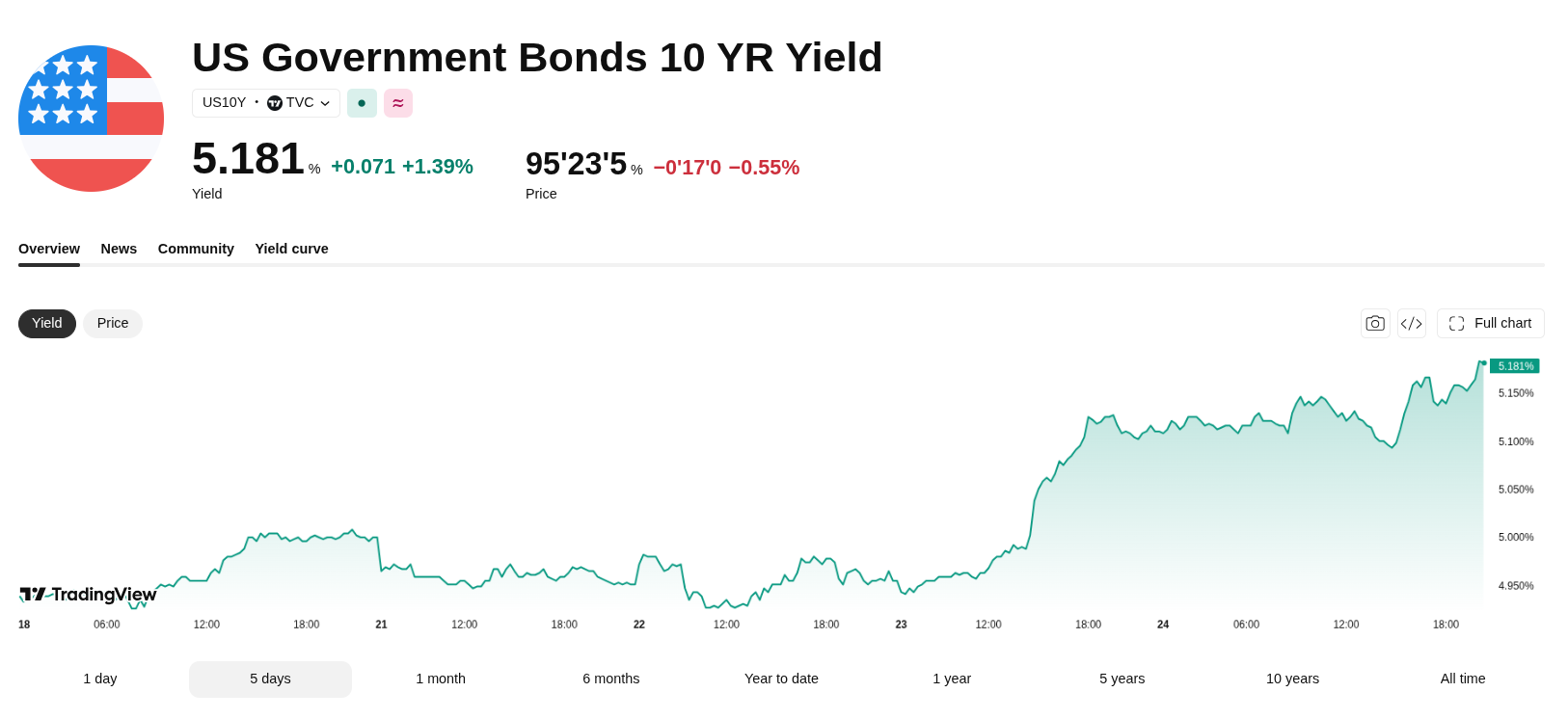
The persistent rise in Treasury yields has become a central narrative in financial markets, drawing considerable attention from investors and analysts alike. On Thursday, the yield on the benchmark 10-year US Treasury note climbed by more than four basis points, settling at 5.18%. This level represents the highest closing figure for the 10-year yield since July 2007, underscoring a significant shift in the fixed-income landscape. The longer-duration 30-year Treasury yield also saw a notable increase, reaching 5.46%, thereby reclaiming levels not observed since 2004. This upward trend signifies a broader recalibration of interest rate expectations and a potential reassessment of risk premiums across asset classes.
The Macroeconomic Undercurrents: A Deep Dive into Treasury Yields
The current surge in US Treasury yields is not an isolated event but rather a culmination of several interconnected economic factors. Inflationary pressures, coupled with robust economic data, have fueled expectations that the Federal Reserve may maintain a higher interest rate environment for a more extended period than initially anticipated. This anticipation directly influences the pricing of government debt. As yields rise, the price of existing bonds falls, making newly issued bonds with higher coupon payments more attractive to investors seeking income.
On Thursday, this dynamic was further amplified by the US Treasury’s scheduled bond buyback operations. The Treasury announced its intention to repurchase up to $6 billion in bonds maturing between approximately 20 and 30 years. This initiative is part of a broader strategy aimed at enhancing liquidity within the long-dated debt markets, a segment that has experienced increased volatility. While intended to stabilize these markets, the increased supply of bonds coming to market, coupled with broader yield-seeking behavior, contributed to the upward pressure on yields.
The ripple effects of these developments extended beyond US shores. International bond markets also exhibited weakness, with yields generally trending higher. The Japanese yen (JPY) came under particular strain, experiencing renewed downward pressure against the US dollar. This weakness in the yen has drawn the attention of financial commentators and policymakers. Mohamed A. El-Erian, president of Queen’s College, Cambridge, and a keen observer of global financial flows, highlighted the growing concern regarding the yen’s depreciation. In a post on X, El-Erian noted, "Flying under many radars for now, but probably not for long: The Japanese Yen has weakened back to 159 per U.S. dollar (CNBC chart), approaching the established FX intervention zone."
El-Erian further elaborated on the potential implications of Japanese currency intervention. He stated, "This matters far beyond Japan for a key reason right now: Japanese foreign exchange intervention typically involves selling US securities to buy Yen, potentially adding yield pressures to an already sensitive Treasury market." This statement underscores a critical mechanism through which global capital flows and central bank actions can directly influence US Treasury yields. If Japan were to intervene by selling its substantial holdings of US Treasuries to support the yen, it would increase the supply of these bonds in the market, potentially exacerbating the upward pressure on yields.

Bitcoin’s Resilience Amidst Rising Yields
The prevailing macroeconomic narrative often posits that higher bond yields create a challenging environment for non-yielding assets like Bitcoin. As government bonds offer increasingly attractive returns, the perceived risk of investing in more speculative assets such as cryptocurrencies can rise. The logic is that investors may reallocate capital away from assets that do not generate immediate income towards those that do, especially when the risk-free rate (represented by Treasury yields) is climbing.
Despite this prevailing wisdom, Bitcoin has demonstrated a remarkable degree of resilience. The cryptocurrency has managed to extend its August rally, defying some bearish predictions that were tied to Bitcoin’s historical four-year cycle patterns. This resilience suggests that the market dynamics for Bitcoin may be evolving, with factors beyond traditional interest rate sensitivity playing an increasingly significant role. Institutional adoption, ongoing technological developments within the Bitcoin ecosystem, and its growing narrative as a potential store of value or inflation hedge could be contributing to its ability to weather the storm of rising yields.
The price action on Thursday reflected this ongoing tug-of-war. Bitcoin’s struggle to reclaim the $84,500 level after dipping below $83,000 indicates the significant selling pressure and uncertainty that higher yields can impose. However, the fact that it did not experience a more substantial collapse suggests underlying buying interest and a conviction among some investors that Bitcoin’s long-term prospects remain intact. The $83,000 and $84,500 levels are likely to be closely watched by traders and analysts in the coming days as indicators of short-term sentiment.
Ondo Finance Leads the Pack in the Tokenized Asset Space
While Bitcoin navigates these macroeconomic headwinds, the altcoin market has presented pockets of strength, with Ondo Finance (ONDO) standing out as a notable performer. The token, representing a real-world asset (RWA) on the blockchain, has experienced a significant surge in value, reclaiming the psychologically important $0.50 level. This performance comes amidst a broader push towards tokenizing traditional financial assets, a trend that has gained considerable momentum in recent months.
The success of ONDO is particularly noteworthy given recent legislative developments in the United States. The CLARITY Act, a piece of legislation that could have significant implications for the digital asset industry, recently failed to pass a procedural vote in the US Senate. Despite this setback, which some might have anticipated as a dampener on sentiment, ONDO managed to reach a price level not seen since December 2025. This suggests that the underlying fundamentals and investor appetite for tokenized real-world assets are proving to be more robust than immediate legislative outcomes might imply.
BlackRock’s Entry into Tokenized Portfolios Fuels RWA Growth
A significant catalyst for ONDO’s recent surge appears to be the launch of BlackRock-backed Ondo Intelligent Portfolios. Introduced on Thursday, this new offering marks a significant endorsement from a major global asset manager, signaling a maturing of the RWA market. While many existing RWA products focus on tokenizing individual stocks or commodities, Ondo’s new platform offers a more diversified approach. It allows non-US users to invest in tokenized shares of diversified investment portfolios, mirroring strategies developed by BlackRock.
The tokenized portfolios are now live on both the Ethereum and BNB Chain networks, with settlement processes facilitated by the CoW Protocol. CoW DAO, a key player in this ecosystem, confirmed the deployment on X, highlighting the collaborative nature of these advancements. The initial three tokens represent distinct investment strategies: BLKHIon (High Income), BLKDIGon (Diversified Growth), and BLKGRWon (High Growth). This move by BlackRock not only provides a significant boost to Ondo Finance but also serves as a broader validation of the tokenized asset class, potentially paving the way for wider institutional adoption and product innovation.
The implications of BlackRock’s involvement are far-reaching. It signifies that tokenized real-world assets are transitioning from a niche concept to a mainstream investment product. The ability to access diversified portfolios through tokenized formats offers greater accessibility, potential for improved efficiency, and new avenues for investment. This development could attract a new wave of investors to the crypto space, particularly those who have been hesitant due to the perceived complexity or volatility of traditional cryptocurrencies.
Broader Market Implications and Future Outlook
The interplay between rising Treasury yields and the performance of digital assets like Bitcoin and tokenized assets like ONDO highlights the evolving landscape of financial markets. While traditional correlations between risk-on and risk-off assets remain influential, the crypto market is increasingly exhibiting its own unique drivers. Factors such as technological innovation, regulatory developments, and the growing demand for alternative investment vehicles are shaping its trajectory.
The continued rise in Treasury yields presents a persistent challenge for riskier assets. Investors will be closely monitoring future inflation data, Federal Reserve commentary, and geopolitical events for clues on the future path of interest rates. A sustained period of high yields could lead to a broader reevaluation of asset allocations across all markets.
However, the strong performance of ONDO and the growing interest in tokenized real-world assets suggest that innovation within the digital asset space can create opportunities even in challenging macroeconomic conditions. The successful integration of traditional finance with blockchain technology, exemplified by BlackRock’s foray into tokenized portfolios, could unlock significant value and attract new capital.
The cryptocurrency market, therefore, appears to be at a critical juncture. While macroeconomic pressures remain a significant factor, the ongoing development of infrastructure, the increasing sophistication of products, and the growing acceptance of blockchain technology suggest a complex and dynamic future. Investors are tasked with navigating these competing forces, balancing the risks associated with rising interest rates against the potential rewards offered by innovative digital assets and tokenized real-world investments. The coming months will likely provide further clarity on which of these forces will ultimately dictate market direction.

