
BEIJING – With just two days remaining before Chinese President Xi Jinping is slated to arrive in the United States, a veil of uncertainty continues to shroud the composition of the high-profile Chinese business delegation expected to accompany him. This lack of transparency has intensified speculation among analysts and business leaders alike, casting a spotlight on the delicate balance of economic engagement and geopolitical tension that defines contemporary U.S.-China relations. While the U.S. side has begun to reveal names of prominent American executives scheduled to attend a crucial dinner in Washington, D.C., the absence of official confirmation from Beijing regarding its accompanying business leaders underscores the highly sensitive nature of the visit.
China’s Ministry of Foreign Affairs, despite confirming President Xi’s trip to the U.S. from Wednesday to Friday late on Monday, remained unresponsive to a CNBC request for comment on Tuesday morning regarding the specifics of the business contingent. This silence is particularly notable given the customary practice of high-level state visits to showcase robust economic ties through the presence of leading industry figures. The stakes for this summit are exceptionally high, as both nations navigate a complex landscape marked by trade disputes, technological rivalry, and strategic competition. The composition of the delegation, or indeed its very existence, will be meticulously scrutinized for insights into China’s current economic priorities and its approach to engagement with the United States.
The Diplomatic Tightrope: Context of U.S.-China Relations
The impending visit occurs at a critical juncture in U.S.-China relations, which have been characterized by increasing volatility and strategic competition over the past several years. Tensions have escalated across multiple fronts, including trade, technology, human rights, and geopolitical influence in regions like the South China Sea and over Taiwan. Both governments have increasingly utilized economic tools, such as tariffs, export controls, and "blacklists," to assert their interests, leading to significant disruptions for businesses operating in both economies. The U.S. has imposed restrictions on a growing number of Chinese companies and technologies, citing national security concerns, while Beijing has retaliated with its own measures, albeit often less publicly disclosed.
Despite these frictions, the economic interdependence between the world’s two largest economies remains profound. Bilateral trade volumes, while fluctuating, consistently rank among the highest globally, with U.S. companies having significant investments and market presence in China, and vice versa. This intricate web of economic ties means that diplomatic engagements, particularly at the presidential level, are not merely symbolic; they are vital opportunities to manage crises, establish communication channels, and, ideally, de-escalate tensions that could otherwise spill over into broader global instability. The presence of key business leaders at such summits is typically intended to reinforce the economic pillars of the relationship, signal confidence, and explore avenues for cooperation, even amidst political disagreements.
A Look Back: The Trump-Xi Summit Precedent (May 2026)
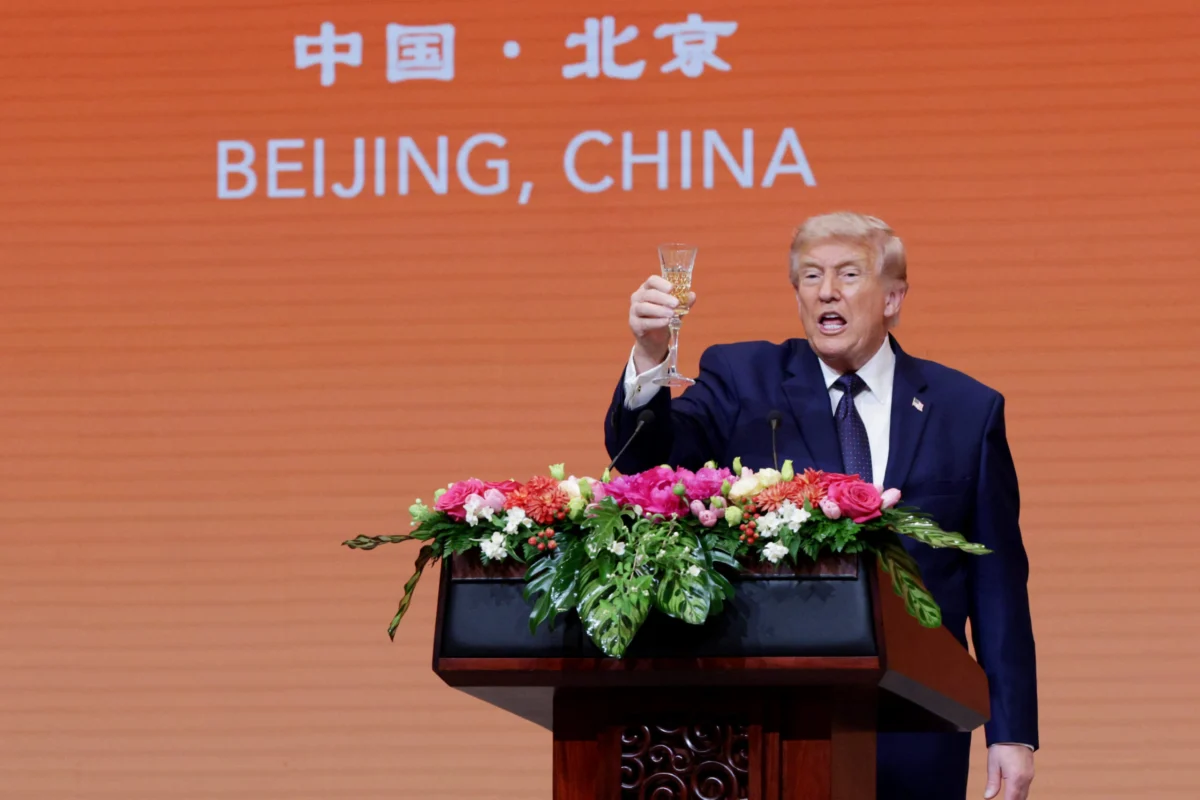
To understand the current anticipation, it is useful to recall past high-level interactions. A notable precedent for such business engagement alongside a presidential summit was the state banquet hosted by Chinese President Xi Jinping for then-U.S. President Donald Trump at the Great Hall of the People on May 14, 2026, in Beijing. That summit was a grand affair, designed to project stability and cooperation, even as underlying tensions persisted. Photographs from the event, such as President Trump making a toast, captured the ceremonial grandeur typical of such diplomatic exchanges.
Accompanying that summit were significant business interactions. For instance, Boeing CEO Kelly Orthberg was photographed joining U.S. executives in a meeting with Chinese Premier Li Qiang on May 14, 2026, underscoring the vital role of the aviation sector in U.S.-China trade. Similarly, Nvidia CEO Jensen Huang and Apple CEO Tim Cook were also present at meetings between Premier Li Qiang and U.S. business representatives in Beijing on the same date. The presence of such titans of industry at previous summits highlights the expectation that economic dialogue and potential deal-making are integral components of these presidential visits. The absence of similar, publicly confirmed Chinese business representation ahead of President Xi’s upcoming U.S. trip therefore stands in stark contrast to past practices and raises questions about China’s strategy.
Who’s Coming (and Who Isn’t)? The U.S. Delegation
On the American side, information regarding executive attendees for the upcoming dinner in Washington, D.C., expected on Thursday, has begun to surface. Microsoft CEO Satya Nadella has been confirmed as one of the executives who will attend, according to a source familiar with the arrangements. This confirmation is significant, as Microsoft is a global technology giant with extensive operations and interests in China, spanning software, cloud computing, and artificial intelligence. Nadella’s presence would signal the continued importance of engagement for American tech firms, despite increasing calls for decoupling and supply chain diversification. Microsoft and the White House, however, did not immediately respond to CNBC’s request for comment on the matter.
Beyond Nadella, senior U.S. officials have shared names of other prominent executives who are expected to join the discussions. While a full list is pending, images from the prior May 2026 summit in Beijing serve as a strong indicator of the caliber of U.S. business leaders typically involved in such high-level diplomatic engagements. Nvidia CEO Jensen Huang, a pivotal figure in the semiconductor industry, and Apple CEO Tim Cook, leading one of the world’s largest consumer electronics companies with deep supply chain ties to China, have been consistent attendees at past U.S.-China business dialogues. The inclusion of figures like Kelly Orthberg, CEO of Boeing, further underscores the strategic importance of traditional sectors like aerospace, which represents significant export value for the U.S. and a major procurement area for China. The collective presence of these executives would represent a cross-section of American economic power and its vested interests in the Chinese market, spanning high-tech, manufacturing, and consumer goods. Their attendance provides a crucial channel for direct communication with Chinese leadership on issues ranging from market access to intellectual property protection.
The Elusive Chinese Business Contingent
In stark contrast to the partial clarity on the U.S. side, the list of Chinese executives accompanying President Xi remains officially unconfirmed, fueling considerable speculation. Reuters reported last week that business representatives under consideration for the trip included executives from several strategically important Chinese companies. These potential attendees span a wide array of high-growth and state-backed sectors, reflecting China’s economic ambitions and its global industrial footprint.
Among the names reportedly under consideration are leaders from electric car giant BYD, which has rapidly become a global leader in EV production, surpassing even Tesla in some metrics. Smartphone behemoth Xiaomi, a major player in the global consumer electronics market, was also mentioned. The list further included battery manufacturers CATL and Gotion, both critical to the global electric vehicle supply chain and a sector where China holds a dominant position. Consumer electronics manufacturer Hisense, automotive parts company Wanxiang, state-owned financial institution Bank of China, and agricultural conglomerate COFCO Group rounded out the potential delegation.
The inclusion of these companies, if confirmed, would highlight China’s focus on advanced manufacturing, renewable energy, digital technology, financial services, and food security – all key pillars of its economic strategy. However, BYD had no comment when contacted by CNBC, and the other Chinese companies did not immediately respond to requests for comment. This collective silence from Chinese firms and the government creates an air of mystery. Analysts suggest this could be due to ongoing internal deliberations, strategic ambiguity aimed at maximizing leverage, or a cautious approach given the sensitive nature of U.S.-China business interactions in the current climate. Some speculate that the final list might be deliberately kept small or released at the last minute to manage expectations or avoid potential U.S. scrutiny or pressure on specific companies.
The Economic Imperative Amidst Geopolitical Strain
The significance of the business delegation, or its perceived absence, cannot be overstated in the context of the vast economic relationship between the U.S. and China. In 2025, bilateral trade in goods and services between the two nations still exceeded $700 billion, despite tariffs and other restrictions. U.S. foreign direct investment in China totaled over $120 billion, with Chinese investment in the U.S. also significant, though impacted by increased regulatory scrutiny. These figures underscore the deep integration of the two economies and the immense implications of any disruptions.
The "blacklists" mentioned in the original article refer to a range of U.S. government actions, including the Commerce Department’s Entity List, which restricts access to U.S. technology for designated companies; the Treasury Department’s Non-SDN Chinese Military-Industrial Complex Companies (NS-CMIC) list, which prohibits U.S. investment in certain firms; and the Uyghur Forced Labor Prevention Act (UFLPA), which presumes goods manufactured in Xinjiang are made with forced labor and bans their import. China has, in turn, implemented its own "unreliable entity list" and anti-foreign sanctions law, though these have been applied less frequently.
These measures have forced companies to re-evaluate their supply chains, investment strategies, and market access, leading to a complex environment for business. The presence of executives from companies like CATL and Gotion would be particularly noteworthy, as the U.S. has been actively working to onshore and nearshore critical supply chains, particularly for electric vehicle batteries, to reduce reliance on China. Their attendance could signal a willingness to discuss cooperation or at least manage competition in this critical sector. Similarly, the participation of companies like BYD and Xiaomi, major competitors to U.S. firms, would highlight the enduring global market competition.
Statements, Silence, and Strategic Ambiguity
The official responses, or lack thereof, from both sides paint a picture of carefully managed expectations and strategic maneuvering. The Chinese Ministry of Foreign Affairs’ confirmation of President Xi’s trip without detailing the business delegation can be interpreted as a deliberate strategy. It allows Beijing flexibility, potentially to finalize a list that sends a specific message, or to maintain an element of control over the narrative until the last possible moment. In Chinese diplomacy, the composition of such a delegation is never accidental; it is a meticulously curated signal of intent.
On the U.S. side, the White House’s selective release of U.S. executive names, coupled with their non-committal stance on immediate comment, suggests a desire to project openness and a willingness for economic dialogue. However, it also highlights the challenge of engaging with a Chinese counterpart that operates with a different degree of transparency. The "no comment" from specific companies, both U.S. and Chinese, is standard practice in politically sensitive situations, allowing them to avoid premature commitments or unintended political statements.
Implications for Global Commerce and Technology
The outcomes of this visit, particularly concerning the business component, will have far-reaching implications for global commerce and technology. If a robust Chinese business delegation does materialize, it could signal Beijing’s intent to stabilize economic relations, reassure foreign investors, and potentially seek avenues for cooperation or de-escalation of trade disputes. Conversely, a minimalist or absent delegation could be interpreted as a more inward-looking approach by China, or a signal that the focus of the summit is purely on geopolitical issues, with economic reconciliation taking a back seat.
For the technology sector, the discussions are paramount. With U.S. export controls aimed at restricting China’s access to advanced semiconductors and AI technology, and China’s push for technological self-reliance, the dialogue between U.S. tech giants and Chinese leadership will be crucial. The presence of Microsoft’s Nadella, and the potential presence of figures like Nvidia’s Huang and Apple’s Cook, underscores the ongoing necessity for these companies to engage directly to navigate the complex regulatory environment and protect their global market interests.
Furthermore, the visit will be closely watched for any signals regarding supply chain resilience and diversification. Both countries are increasingly focused on securing critical supply chains, from rare earth minerals to advanced manufacturing components. Discussions, even informal ones among business leaders, could shed light on future trends in global manufacturing and trade flows.
Conclusion
As President Xi Jinping prepares for his high-stakes visit to the United States, the mystery surrounding his accompanying business delegation remains a central point of intrigue. This visit is not merely a diplomatic formality; it is a critical opportunity for the world’s two largest economies to manage their complex relationship. The eventual revelation of who, if anyone, joins President Xi from China’s business elite will provide invaluable insights into Beijing’s strategic priorities, its willingness to engage economically, and the potential trajectory of U.S.-China relations in the coming years. The global business community, already grappling with geopolitical uncertainties, awaits these signals with bated breath, understanding that the delicate balance between cooperation and competition hinges significantly on the dialogue that will unfold in Washington, D.C., this week.
—CNBC’s Jordan Novet and Ashlee Trujillo contributed to this report.

