

As the crisp autumn air signals the end of summer in the United States, a familiar, and for many, unwelcome, season begins: tax season. For cryptocurrency investors, this year’s filing period for 2025 returns is proving particularly challenging, largely due to new reporting requirements implemented by the Internal Revenue Service (IRS). While the agency now possesses a more comprehensive view of digital asset transactions, many taxpayers are finding that this increased oversight has not translated into a simpler filing process, and in some cases, has created significant confusion and additional burdens.
The Shifting Landscape of Crypto Taxation
The core of the current tax season’s complexity lies in the IRS’s evolving approach to tracking cryptocurrency. Historically, reporting cryptocurrency gains and losses has been a significant pain point for both investors and the tax authority. The decentralized and pseudonymous nature of many digital assets, coupled with the rapid pace of trading across numerous platforms, made it difficult for the IRS to obtain accurate and complete data. Recognizing this, the U.S. government has been steadily increasing its efforts to bring digital assets into the traditional tax framework.
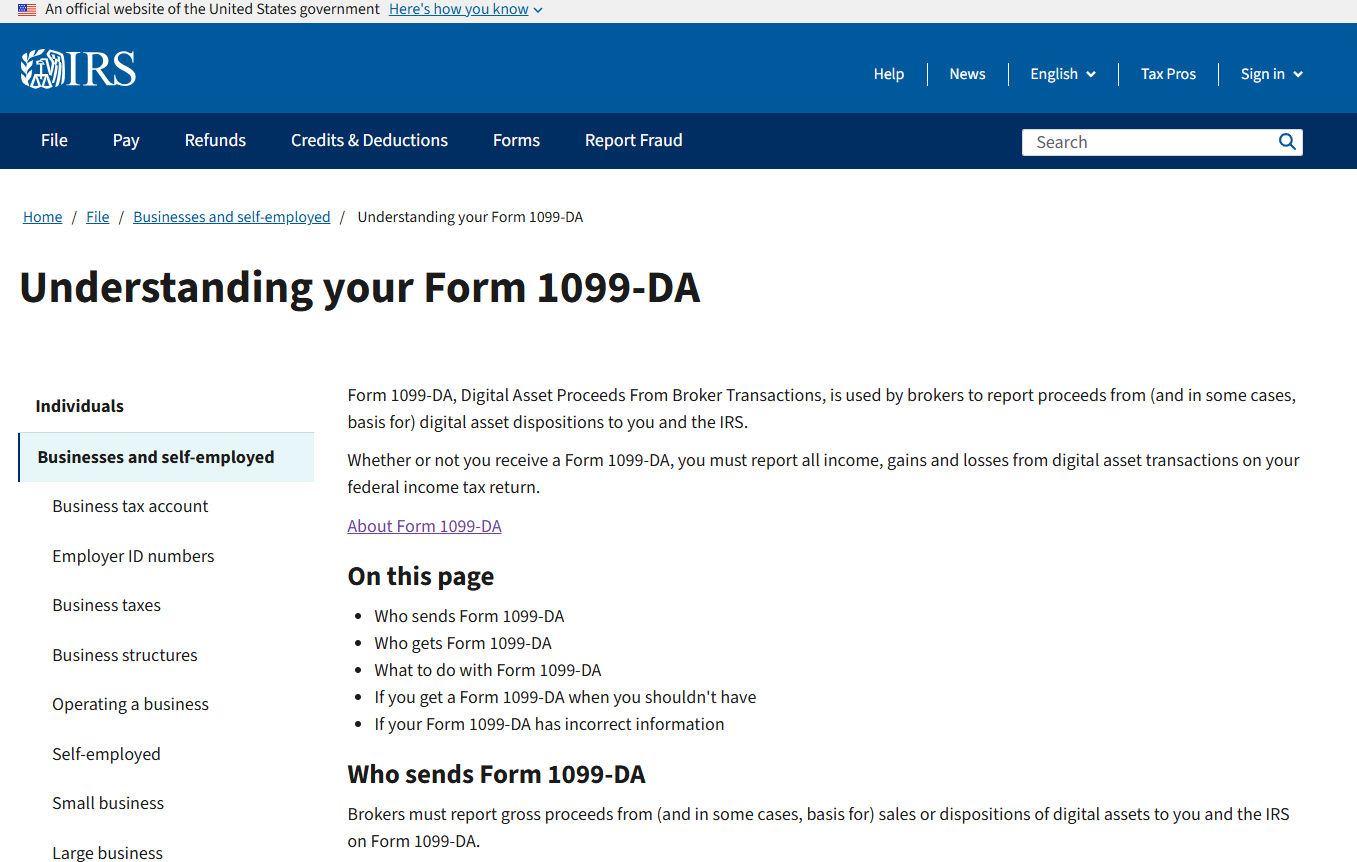
The most recent development, affecting the 2025 tax year, mandates that cryptocurrency brokers report gross proceeds from certain digital asset sales to the IRS. This information is typically conveyed to taxpayers via Form 1099-DA. The intention behind this rule was to provide the IRS with a clearer picture of taxable events and to encourage greater compliance among crypto investors. However, the implementation has revealed several critical shortcomings, leaving many individuals struggling to accurately file their returns.
A Survey Reveals Widespread Issues with New Reporting Forms
A survey conducted in August by Awaken Tax, which polled 1,000 U.S. crypto investors, highlighted the extent of the problems. A significant 21% of respondents who had filed or planned to file an extension indicated they were still awaiting crucial information from their cryptocurrency exchanges or platforms. This delay in receiving necessary documentation directly impedes their ability to complete their tax filings accurately and on time.
Adding to the confusion, a further one in five respondents reported that their Form 1099-DA was either incomplete or they were uncertain about its accuracy in reflecting their actual transactions. This uncertainty stems from a fundamental aspect of the new reporting rule: brokers are generally required to report the gross proceeds (the sale price) of digital asset transactions, but not the cost basis (the original purchase price).

The Cost Basis Conundrum: A Major Hurdle for Taxpayers
The absence of cost basis information on the 1099-DA is proving to be the primary obstacle for many crypto investors. Calculating capital gains or losses requires subtracting the cost basis from the sale proceeds. Without the cost basis readily available, taxpayers are compelled to meticulously track and calculate this figure themselves.
Chris Herbst, managing director of CountDeFi tax reporting, explained the challenge: "For an active trader, that number [gross proceeds] can be many times their real gain, because each sale is counted at full value with no cost against it." This means that a 1099-DA might show a large sum of money received from sales, but without the corresponding purchase price, it becomes impossible for the taxpayer to determine their actual profit or loss. The IRS can see the sale, but the taxpayer is left to piece together the profitability of that transaction.
This situation is particularly burdensome for active traders who engage in frequent transactions. For a simple, single trade, calculating the gain might be manageable. For instance, if an investor bought Bitcoin for $9,000 and sold it for $10,000, the taxable gain is $1,000. However, a 2025 1099-DA would only report the $10,000 in proceeds, leaving the investor to recall or find evidence of the $9,000 cost basis. For individuals with hundreds or even thousands of transactions across multiple assets and exchanges, this becomes an incredibly time-consuming and complex undertaking.
Discrepancies and Delays Plague the First Filing Season Under New Rules
Tax professionals are already encountering significant issues as clients attempt to reconcile the new 1099-DA forms with their personal transaction records. Sharon Yip, founder of Crypto Tax Advisors, noted that her firm has identified discrepancies between the 1099-DAs received by clients and the comprehensive crypto tax reports they had previously prepared.
"Some forms did not include all the trades clients made during 2025," Yip stated, adding that exchanges have also adopted varying formats for their customer statements. She further highlighted inconsistencies in how exchanges reported cost basis, with some including it for certain trades and not others, despite reporting basis not being mandatory for this tax year. "It’s very confusing for recipients to understand how to reconcile their 1099-DAs when compared to the crypto tax report they should use to file their tax return."
Yip provided a stark example involving stablecoin transactions. One of her firm’s clients reported over $300,000 in stablecoin trades on an exchange in 2025. However, the exchange’s corresponding 1099-DA form listed less than $100,000 in total stablecoin proceeds. Such significant discrepancies raise serious concerns about the accuracy and completeness of the information being provided by exchanges.
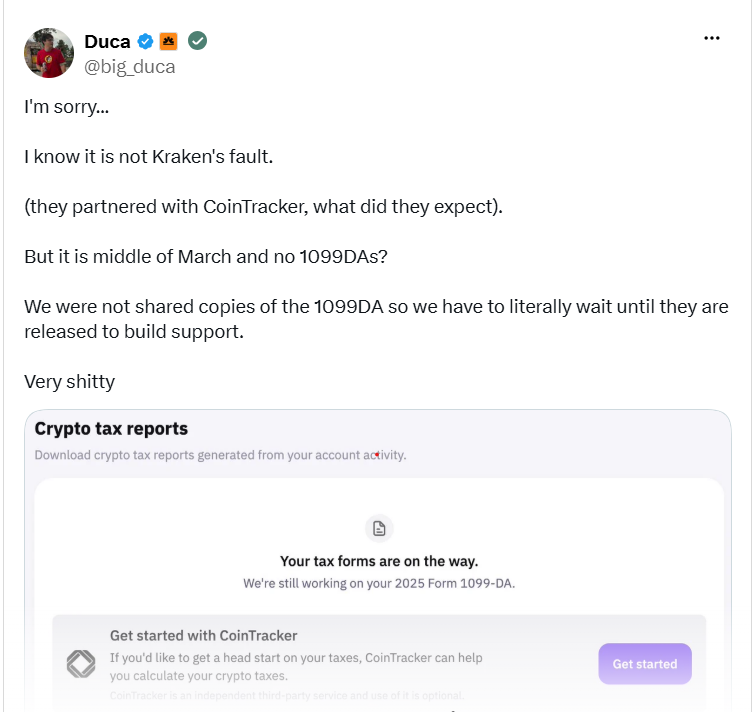
The issues extend to the timing of form distribution as well. Andrew Duca, founder of Awaken Tax, reported that his firm observed clients receiving their 1099-DAs relatively late in the filing season. "Because this regulation is new, a lot of exchanges are still trying to figure it out," Duca explained. He pointed to instances where exchanges, such as Kraken, did not issue any forms to users until a mere two weeks before the April 15th tax deadline. This delay leaves little room for error correction or for taxpayers to seek professional assistance, exacerbating the stress and complexity of tax preparation. Duca also cited an example of a Kraken 1099-DA from that period that contained no reported transaction information at all. Kraken did not respond to requests for comment regarding these issues.
The Crucial Need for Comprehensive Record-Keeping
It is imperative to understand that the new 1099-DA forms were never intended to be a complete substitute for a taxpayer’s own meticulous record-keeping. The IRS explicitly states that individuals are responsible for reporting all digital asset income and gains or losses, regardless of whether they receive a 1099-DA. When cost basis is not reported on the form, taxpayers are obligated to use their own records to accurately complete their tax returns.
This reliance on personal records becomes particularly challenging in the complex world of cryptocurrency trading. Assets are frequently moved between different exchanges, private wallets, and decentralized finance (DeFi) platforms. A common scenario involves purchasing an asset on one exchange, transferring it to a personal wallet for safekeeping or further trading, then moving it to a second exchange to sell. In such cases, the second exchange will likely not have the original purchase information, creating a critical gap in the cost basis calculation.
"The full transaction history from the day the account opened" is what taxpayers need from exchanges, according to Herbst. This includes details on all trades, fees incurred, deposits, withdrawals, and crucial transaction identifiers such as the specific wallets involved in transfers. The cost basis of an asset follows it as it moves between platforms. Therefore, a single missing piece of transaction history can have a cascading effect, potentially impacting the accuracy of gains calculated years later on a different platform.
Implications for Taxpayers and the Future of Crypto Taxation
The current situation raises concerns about the practical implications of the IRS’s increased data collection. While the agency now has more visibility into cryptocurrency sales, this visibility is incomplete without corresponding cost basis data. This creates what tax professionals refer to as the "zero-basis problem," where the IRS sees proceeds but lacks the information to accurately assess the taxable gain.
Andrew Gordon, executive director of Digital Asset Tax Action, noted that taxpayers are "constantly" struggling to reconcile 1099-DAs with their own records during the 2025 filing season. He pointed out that most cryptocurrency tax software currently lacks robust tools to import and reconcile 1099-DA information. Even for the few programs that offer such features, manual data entry is often still required because brokers have not been providing the 2025 forms in a machine-readable format.
For active traders, the manual input of hundreds of individual transaction entries can be an overwhelming task. Gordon advocates for brokers to provide machine-readable files alongside every 1099-DA to facilitate direct integration with tax software. He also emphasizes the critical need for exchanges to maintain complete and accessible transaction histories for their users, including acquisition dates, purchase amounts, fees, and transfer details.
Gordon’s primary concern is that the IRS’s enhanced visibility does not automatically translate into accurate tax calculations for the taxpayer. "The 1099-DAs only reported proceeds in 2025, and proceeds reporting gives the IRS visibility it did not previously have; however, visibility without basis produces the zero-basis problem," he stated.
Taxpayers are strongly advised against blindly copying the figures from a 1099-DA onto their tax returns. Duca offers a crucial piece of advice: "The IRS expects your return to reflect your actual gains and losses, not necessarily what’s printed on a form that the exchange may have worked out incorrectly." It is essential for individuals to cross-reference the information on the 1099-DA with their comprehensive transaction history.
Looking Ahead: A Glimmer of Hope for 2026
While the 2025 tax season presents significant hurdles for crypto investors, there are indications of potential improvements for the future. Starting with the 2026 tax year, brokers will generally be required to report the cost basis for "covered" digital assets. This change is expected to provide taxpayers with more complete information, simplifying the calculation of gains and losses.
However, even with this forthcoming change, complexities will likely persist. Assets transferred to a broker from another exchange or wallet may still fall outside the mandatory cost basis reporting requirements, meaning that gaps in transaction history could continue to be an issue.
In conclusion, as the IRS continues to enhance its oversight of cryptocurrency transactions, the burden of accurate tax reporting remains largely on the shoulders of the individual investor. The current tax season serves as a stark reminder that while the government may be gaining more data, taxpayers must remain vigilant in maintaining their own comprehensive financial records. The adage "keep your receipts" has never been more relevant for those navigating the evolving landscape of digital asset taxation.

