

The global financial landscape has witnessed a remarkable surge in recent years, particularly within the United States stock market. The S&P 500 index, a benchmark for large-cap U.S. equities where a significant portion of retirement savings is often allocated through index funds, has demonstrated extraordinary growth. In just the past two years, its value has climbed by approximately 57%, and over the last five years, it has more than doubled. This substantial appreciation has had a profound impact on individual wealth, potentially propelling many investors past their retirement goals much sooner than anticipated. For instance, an individual who felt only halfway to retirement during the COVID-era market lows might now find themselves financially independent. Those already in retirement might find themselves with newfound liquidity, prompting considerations for significant asset purchases or a re-evaluation of financial strategies.

This rapid market expansion naturally raises critical questions regarding its underlying sustainability: Is this growth a reflection of genuine economic strength and technological advancement, or does it signal an impending bubble, a financial illusion poised for correction? The sentiment among some investors reflects this uncertainty. As one market observer recently queried, "The market seems to be in a huge bubble right now due to all sorts of hype around Artificial Intelligence. Does this make it more vulnerable to a huge crash in the future, and will it affect my retirement?" Addressing this pertinent concern requires a comprehensive examination of the current financial environment and the foundational principles of stock market valuation.
Understanding Stock Valuations: The Business of Ownership
To accurately assess the current market, it is essential to revisit the fundamental nature of a stock. At its core, a stock represents a share of ownership in a business. This ownership entitles the holder to a portion of the company’s earnings, making it conceptually similar to owning a rental property. When one owns a rental house, the primary financial benefit is the rent collected. After deducting expenses such as maintenance, taxes, and insurance, the remaining amount constitutes profit. The market value of that house, while appearing to increase on paper, only translates to tangible gain upon sale. Even then, selling one property at a higher price often means acquiring another at an equally inflated cost, leaving the actual income stream unchanged unless the underlying business (the rental operation) becomes more profitable. Strategies to enhance profitability might include significant renovations, optimizing expenses, or expanding rental capacity.

The price an investor is willing to pay for this rental property, or any business, is fundamentally tied to its future income stream. For instance, a house generating $2,000 per month ($24,000 annually) might sell for $240,000, yielding a price-to-earnings (P/E) ratio of 10 (purchase price divided by annual earnings). This ratio indicates that the buyer is paying 10 times the annual earnings for the asset. However, if market speculation drives the price to $480,000 for the same income, the P/E ratio doubles to 20. While this is advantageous for the seller, it implies a less favorable future return for the buyer, as their investment yields a smaller percentage of the property’s income.
Applying this logic to the stock market, consider an investment of $100,000 in a broad market index in 2019, with dividends reinvested. By 2025, this investment could have grown to approximately $256,960, representing a remarkable 157% gain. Yet, over the same period, the share of company earnings attributable to that $100,000 investment only increased from roughly $5,290 to $7,540, a more modest 42% gain. This divergence indicates a significant rise in the aggregate P/E ratio of the market. According to financial analysis sites like multpl.com, the market’s P/E ratio has moved from approximately 20 in 2019 to about 30 today. This scenario mirrors the rental property example: stock investors are paying substantially more for a relatively smaller increase in underlying earnings, suggesting that future returns as a percentage of portfolio value may be lower than historical averages, assuming a reversion to the mean.

The "Magnificent Seven" and the AI Revolution’s Epicenter
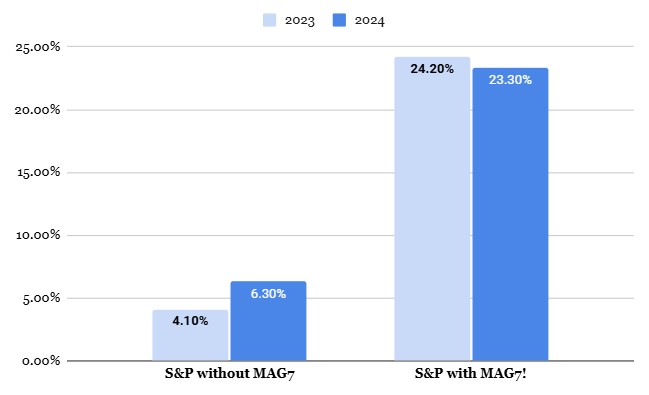
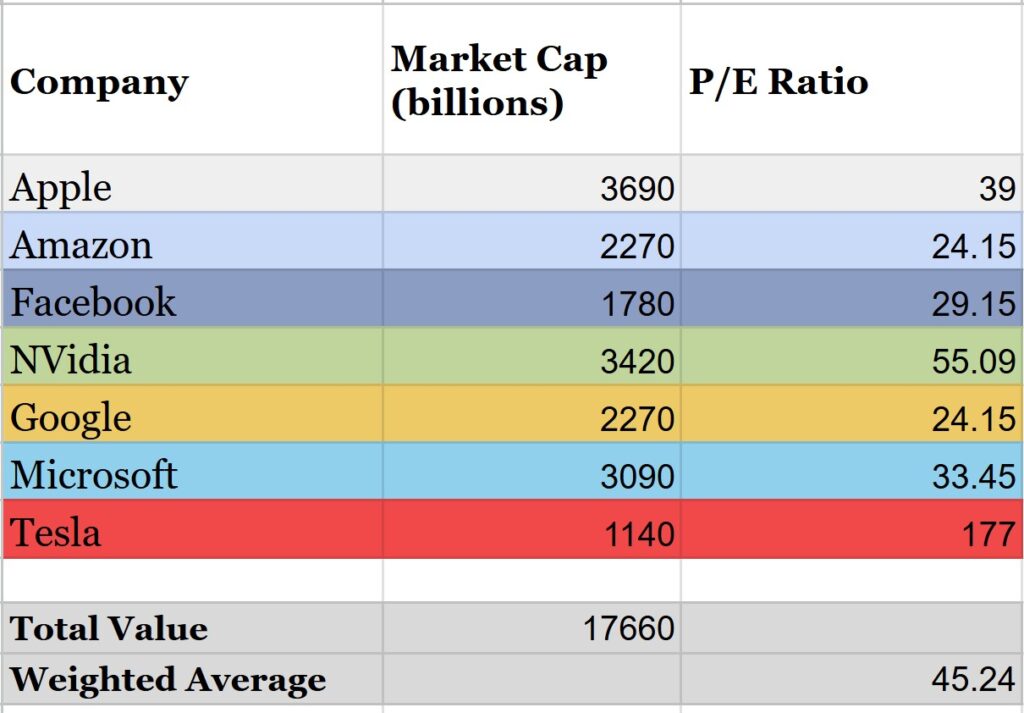
A closer inspection reveals that the recent market euphoria is not evenly distributed across the economy. A disproportionate share of the S&P 500’s recent growth – approximately three-quarters – has been driven by just seven mega-cap technology companies, collectively dubbed the "Magnificent Seven": Apple, Nvidia, Microsoft, Amazon, Google (Alphabet), Meta Platforms (Facebook), and at times, Tesla. These companies, characterized by their immense profitability and perceived growth potential, have seen their share prices aggressively bid up by investors fueled by optimism for future expansion.
Collectively, these seven entities command over 25% of the S&P 500’s total market capitalization, representing an astounding $17.66 trillion. Their weighted average P/E ratio, hovering around 45, starkly contrasts with the P/E ratio of the remaining 493 companies in the S&P 500, which stands at a more modest 20. This indicates that while the broader U.S. economy is expected to maintain a healthy trajectory, investors are placing significantly higher bets on the accelerated growth of these tech giants.
The common thread weaving through the narrative of these high-flying companies, and indeed the broader market’s enthusiasm, is the rapid advancement of Artificial Intelligence (AI). Recent breakthroughs, particularly in large language models and generative AI, have enabled software to exhibit human-like reasoning across an expanding array of applications, igniting a frenzy of investment and speculation across the business world. Six of the Magnificent Seven are channeling hundreds of billions into constructing vast data centers brimming with advanced supercomputers, critical for training and deploying AI models. The lucky seventh, Nvidia, directly benefits by being the primary manufacturer of the specialized graphics processing units (GPUs) that power this AI infrastructure. The insatiable demand for these components allows Nvidia to command premium prices and ship units by the trainload, making it a pivotal player in the AI ecosystem.
This "AI Infrastructure" boom is merely the first layer. The pervasive belief is that AI will usher in a new era of unprecedented productivity across all industries. From analyzing complex legal documents and identifying loopholes to debugging intricate code, diagnosing medical conditions with higher accuracy, accelerating drug discovery thousands of times faster than traditional methods, and powering autonomous vehicles and humanoid robots capable of performing complex physical tasks, AI’s potential applications are vast. The vision is one of an infinite workforce of highly intelligent AI "employees" working at virtually no cost, effectively removing the historical constraints of finite intelligence and labor that have long limited human endeavor. This anticipated leap in productivity is a key driver behind the elevated valuations of these leading tech companies.
The Dual Edge of AI: Promise, Peril, and Unforeseen Consequences
While the transformative potential of AI is widely acknowledged, the path to realizing these forecasted profits is fraught with uncertainties. The critical question for investors is whether the projected earnings of these companies will materialize at the levels currently priced into their stocks. Potential challenges include unforeseen cost overruns in AI development and deployment, intensified competition as more players enter the field—potentially commoditizing certain AI services—and unexpected technical or ethical dilemmas as increasingly sophisticated AI systems become more autonomous. The sheer scale of investment in AI infrastructure, exemplified by multi-billion-dollar projects like Microsoft and OpenAI’s proposed "Stargate" supercomputer, highlights both the ambition and the financial risk involved.
Beyond corporate profitability, the broader societal implications of advanced AI present a complex picture. The prospect of widespread job displacement due to automation raises concerns about massive unemployment and potential social upheaval, particularly in sectors heavily reliant on routine cognitive or manual labor. If a significant portion of human labor becomes redundant, questions arise about wealth distribution, economic stability, and the very structure of society. The concentration of immense wealth and power in the hands of a few AI pioneers, as humorously (but pointedly) suggested by the image of a single individual amassing $100 trillion, underscores a potential dystopian outcome that warrants serious consideration from policymakers and regulators globally. Ethical concerns regarding AI bias, privacy violations, and the potential for misuse also loom large, requiring robust governance frameworks yet to be fully developed.

Historical Context and Future Projections: A Reality Check
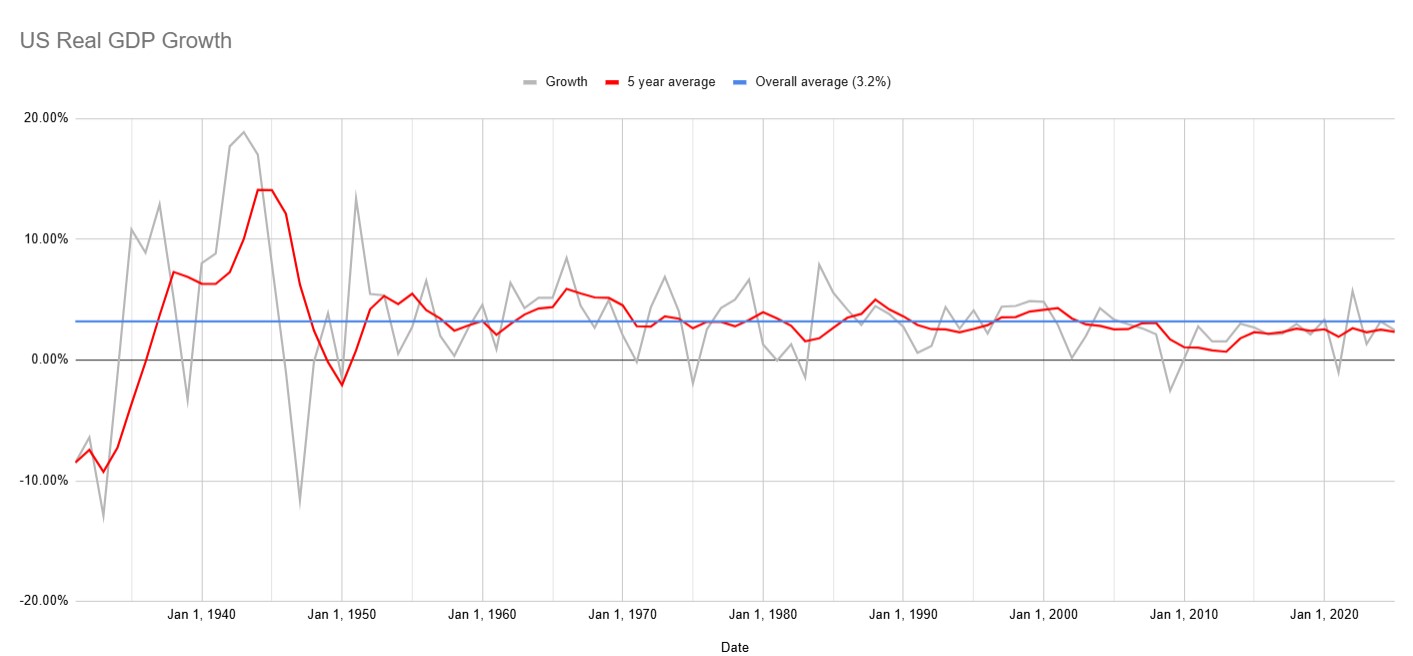
History serves as a valuable, albeit imperfect, guide in evaluating market phenomena. Over the long term, U.S. economic growth, as measured by real GDP, has demonstrated a surprisingly consistent average of about 3% annually after inflation, decade after decade. While specific innovations and economic cycles cause fluctuations, the underlying trend of growth remains remarkably stable. Interestingly, recent decades have shown a slight deceleration in this average growth rate, which, when juxtaposed with the current elevated stock market valuations, presents a conundrum for traditional economic models. The current market’s P/E ratio of approximately 30 for the S&P 500 is significantly higher than the historical average, which often hovers between 15 and 20. This suggests that future returns might be compressed if valuations revert to their historical mean, a phenomenon observed after previous periods of market exuberance, such as the dot-com bubble of the late 1990s.
Navigating the Current Climate: Expert Perspectives and Strategies
Given the prevailing market conditions, what course of action should investors consider? The consensus among long-term investment principles remains consistent: attempting to time the market by selling assets now in anticipation of a future crash, hoping to buy back in at lower prices, is generally a losing strategy. Market corrections and downturns are inevitable, but their timing and severity are unpredictable.
Financial institutions and seasoned investors offer guidance based on their analyses:
- Vanguard’s Outlook: Vanguard, a titan in the index fund industry, issues annual 10-year annualized return forecasts. Their most recent projections suggest that international stocks and even bonds are expected to outperform U.S. stocks in the coming decade. This forecast is underpinned by the lower P/E ratios of international markets (e.g., the Vanguard FTSE All-World ex-US Index Fund (VXUS), representing international equities, has a P/E of around 15.9), making them appear "on sale" compared to the highly valued U.S. market. However, it is noteworthy that Vanguard has made similar predictions in previous years, and the U.S. market, particularly driven by the AI boom, has continued its outperformance. This highlights the inherent difficulty in forecasting and the unique dynamics currently at play in the U.S. tech sector. Vanguard’s perspective emphasizes diversification as a hedge against concentrated risk.
- Warren Buffett’s Prudence: The "Oracle of Omaha," Warren Buffett, through Berkshire Hathaway, has signaled caution in the current environment. Berkshire Hathaway is holding an unprecedented $334 billion in uninvested cash, a clear indication that Buffett and his team find attractive investment opportunities scarce. Even repurchasing Berkshire’s own shares, which he would typically do if they were undervalued, is deemed slightly overvalued at its current P/E ratio of approximately 21. This stance from a proponent of value investing underscores the perceived overvaluation in the broader market and a disciplined approach to capital allocation.
- Diversification through Robo-Advisors: Strategies like investing through robo-advisors such as Betterment, which allocate funds across various asset classes beyond just U.S. stocks (including international equities and bonds) and automatically rebalance, offer a diversified approach. The aim is to achieve slightly higher risk-adjusted returns with lower volatility and potential tax advantages. While a U.S.-only portfolio has historically outperformed in recent years, a diversified portfolio like Betterment’s core offering, with a weighted average P/E of about 22, still offers a more balanced exposure, potentially positioning it well if global markets rebalance.
- Real Estate and Debt Management: The decision to pay off a mortgage versus investing surplus cash into index funds traditionally favors the latter due to historical stock market returns. However, with elevated market valuations potentially leading to lower expected stock returns and higher current interest rates (e.g., a 7% mortgage), the calculus becomes more nuanced. Paying off a mortgage can be viewed as securing a guaranteed 7% return (the interest saved), which is highly attractive compared to uncertain future stock market gains. Beyond the financial mechanics, the psychological benefit of being mortgage-free is a significant factor for many individuals, offering peace of mind and reduced financial obligation. This decision often depends on individual risk tolerance and financial goals.
The Final Word on Investing and Life
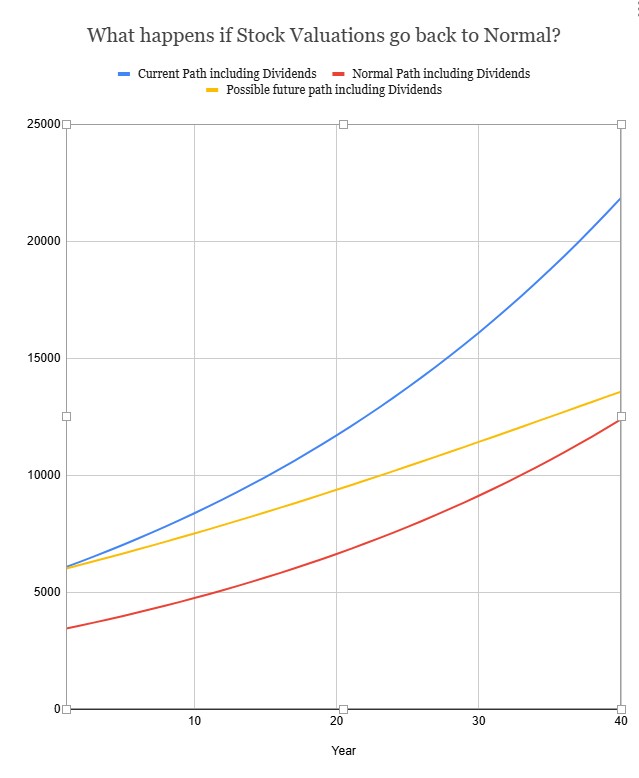
Ultimately, the core tenets of sound long-term investing remain unchanged: maintain a consistent investment strategy, diversify appropriately, and resist the temptation to react impulsively to daily market fluctuations or sensational headlines. While understanding market dynamics and economic forecasts is valuable, attempting to precisely time market peaks and troughs is an endeavor that consistently proves futile for most investors. The blue line, representing continued aggressive growth, is enticing, but a yellow line, depicting more modest but still positive returns as valuations normalize, is a far more probable and acceptable long-term outcome.
Instead, the wise counsel often echoes a philosophy of balance: invest diligently for the long term, but equally important, dedicate time and energy to pursuits that offer guaranteed, enriching returns. Engaging in physical activity, fostering relationships, and experiencing the natural world provide tangible benefits that transcend financial metrics. These "investments" in personal well-being and quality of life yield dividends that are not subject to market volatility or the whims of a rapidly evolving technological landscape. The true wealth lies not just in accumulated assets, but in a life well-lived, supported by a disciplined yet unburdened financial approach.
The ongoing dialogue about the stock market boom, potential crashes, and the profound implications of Artificial Intelligence will undoubtedly continue to shape economic discourse. While financial publications like The Economist offer valuable insights into global economic trends, the fundamental advice for individual investors remains: stay informed, stay diversified, and above all, stay focused on a long-term plan that prioritizes both financial security and personal fulfillment.

In the Comments: What are your thoughts on the current stock market boom, future crashes and busts, and the role of Artificial Intelligence in our future?

