
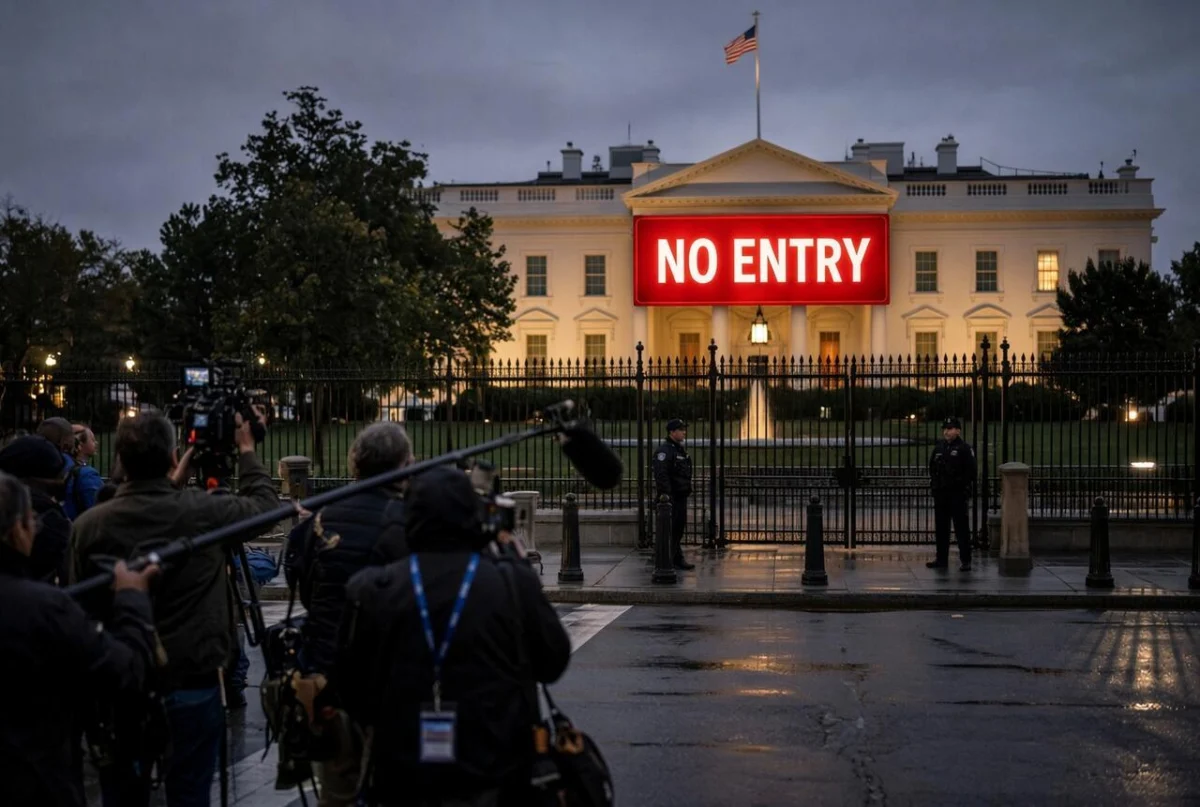
President Donald Trump announced on September 18, 2026, his decision to immediately ban three prominent news organizations – CNN, MSNOW, and Politico – from accessing the White House. The unprecedented move, communicated via his Truth Social platform, cited what the President described as their "constant ‘reporting’ FAKE NEWS!" This declaration marks a significant escalation in the ongoing contentious relationship between the Trump administration and segments of the American press, raising immediate concerns about press freedom, transparency, and the public’s access to information.
President’s Justification and Escalating Rhetoric
In his initial Truth Social post, President Trump unequivocally stated, "effective immediately, banning CNN, MS Now, and Politico from the White House as a result of their constant ‘reporting’ FAKE NEWS!" He further elaborated on his rationale, asserting, "Media Outlets shouldn’t be able to constantly write or report FICTION and LIES when they’re covering the President of the United States, the Trump Administration, or the United States of America. Other Fake News Media Outlets to follow." This statement not only outlined the immediate bans but also signaled potential future restrictions on other media organizations deemed critical or untruthful by the administration.
Following his social media declaration, President Trump reiterated and expanded upon his criticisms during a subsequent press conference. He directly challenged the integrity of the banned outlets, stating, "What I do ask is just a semblance of truth. CNN is fake news. MSNOW is fake news. They’re fake news. They know it. They’re putting there for a reason." He also made a specific claim regarding Politico, alleging, "Politico was bailed out by our government from going out of business." The President concluded his remarks by asserting, "I don’t want them in my office," and threatening legal action, stating, "we’ll be suing these people too." The President’s remarks underscore a deep-seated conviction that these outlets deliberately disseminate misinformation, necessitating their exclusion from the nation’s highest executive offices.
Immediate Reactions and Lack of Comment
As of the immediate aftermath of the President’s announcement, MSNOW and Politico did not provide an immediate response to requests for comment. CNN also could not be reached for a statement regarding the ban. The White House itself offered no immediate further details or clarification regarding which specific stories or posts from the banned outlets prompted the President’s latest action. This silence from the affected organizations and the White House leaves many questions unanswered regarding the specifics of the ban’s implementation and the precise nature of the alleged "fake news."
However, the broader journalistic community and press freedom advocates are expected to react strongly to this development. Organizations such as the Committee to Protect Journalists and the Reporters Committee for Freedom of the Press typically condemn any actions that restrict access for credentialed journalists, viewing them as impediments to the public’s right to know and foundational challenges to the role of a free press in a democratic society. Such bans are frequently characterized as attempts to control narratives and punish critical reporting rather than addressing factual inaccuracies through conventional means.
Historical Context: A Pattern of Media Confrontation
President Trump’s current actions are not isolated incidents but rather fit into a recurring pattern of confrontation with media outlets throughout his political career. His consistent use of the term "fake news" to describe reporting he deems unfavorable or inaccurate has been a hallmark of his public communication strategy. This rhetoric has fostered an environment of distrust between a significant portion of the public and traditional media institutions.
The White House press corps, a body of journalists specifically tasked with covering the President and the executive branch, has long operated under a system of access that, while not unlimited, is generally considered vital for accountability and transparency. Presidents have historically maintained varying relationships with the press, from adversarial to cooperative, but outright bans of major news organizations from the White House complex are rare and highly controversial. The rationale behind such bans often centers on national security or disruptions to official proceedings, rather than the content or perceived bias of reporting.
The Precedent: The Associated Press Ban and Legal Challenges
This latest ban evokes strong parallels with a previous incident involving The Associated Press (AP) during the Trump administration. In a notable instance, President Trump previously banned The Associated Press from the Oval Office and other restricted spaces. This earlier ban stemmed from the outlet’s refusal to change its stylebook to reflect the President’s preferred renaming of the "Gulf of Mexico" to the "Gulf of America."
The AP ban quickly became the subject of a significant legal challenge, arguing that it violated the U.S. Constitution’s First Amendment, particularly due to its discriminatory nature based on the news organization’s viewpoint. A federal judge subsequently entered an injunction against the ban, agreeing that it indeed violated the First Amendment by imposing viewpoint-based discrimination on a media outlet. This initial ruling underscored the judiciary’s role in protecting press freedom and ensuring equitable access for journalists.
However, the legal battle did not end there. In mid-2025, an appeals court partially stayed the injunction, introducing a nuanced distinction regarding White House access. The appellate ruling allowed President Trump to ban The Associated Press from the Oval Office, Air Force One, and certain other highly restricted presidential spaces. The court’s reasoning was crucial: it concluded that "these restricted presidential spaces are not First Amendment fora opened for private speech and discussion" and that the White House "therefore retains discretion to determine, including on the basis of viewpoint, which journalists will be admitted." This portion of the ruling acknowledged a degree of executive discretion over deeply personal or operational spaces.
Crucially, the appeals court also ruled that President Trump could not ban reporters from the White House’s East Room. The majority opinion stated, "The identified harms are less clear with respect to the East Room, which does not share the hallmarks of spaces like the Oval Office." This distinction highlights that not all areas within the White House complex are treated equally under First Amendment jurisprudence regarding press access. Public-facing areas, or those historically used for broader press engagement, are more likely to be considered "public fora" where viewpoint discrimination is impermissible. The East Room, often used for larger press conferences and public events, falls into this latter category. This legal precedent sets a complex stage for the current bans, implying that while access to certain private presidential spaces might be defensible in court, broader bans affecting general press areas would likely face significant legal hurdles.
Legal and Constitutional Implications
The current ban on CNN, MSNOW, and Politico immediately thrusts the issue of White House press credentials and First Amendment rights back into the legal and public spotlight. The First Amendment protects freedom of the press, and courts have historically interpreted this to mean that the government cannot discriminate against journalists based on the content or viewpoint of their reporting, especially when it comes to access to public officials and spaces.

Legal scholars often distinguish between different types of government property: traditional public forums (like parks and streets), designated public forums (like school facilities opened for public use), and non-public forums (like military bases or the interior of the Oval Office). The key legal question in these cases revolves around whether parts of the White House complex constitute a "public forum" for the purposes of press access. If a space is deemed a public forum, the government’s ability to restrict speech (or journalistic access) is severely limited, requiring compelling governmental interest and narrowly tailored restrictions. If it’s a non-public forum, the government has more discretion, but even then, restrictions cannot be arbitrary or based on viewpoint discrimination, unless there’s a specific, compelling reason directly related to the function of that space.
The appeals court ruling in the AP case provided a precedent by distinguishing between the Oval Office (a non-public forum where viewpoint discrimination might be allowed for access) and the East Room (more akin to a public forum where it is not). The practical implications for CNN, MSNOW, and Politico will depend on the specific areas from which they are barred. If the ban extends to press briefing rooms, the East Room, or other common areas traditionally accessible to the entire press corps, it would likely face robust legal challenges based on viewpoint discrimination, echoing the initial injunction against the AP ban. President Trump’s threat to "sue these people too" adds another layer of legal complexity, suggesting a potential expansion of his administration’s confrontational approach.
Operational Impact on White House Coverage
Beyond the legal ramifications, the ban has immediate operational impacts on White House coverage. The White House press corps operates through a system of "pool rotations," where a small group of journalists representing various news outlets covers events that cannot accommodate the entire press corps. This ensures that information from high-level, restricted events is shared broadly. If CNN, MSNOW, and Politico are removed from these presidential and vice-presidential pool rotations, it would significantly alter the landscape of White House reporting. These outlets are major newsgathering organizations, and their exclusion from pool duties would limit the diversity of journalistic perspectives physically present at key events.
The article also notes a disruption in "usual press briefings" and the absence of a White House press secretary. This context is critical. In the absence of regular, formal press briefings and a dedicated spokesperson, the President’s direct communications, often via social media or impromptu remarks, become even more central. Restricting access for specific outlets in such an environment means that a substantial portion of the American public, which relies on these networks for news, might receive information filtered through fewer, potentially more favorable, channels, or directly from the administration without the immediate scrutiny of a diverse press corps. This could diminish the traditional role of the press as a critical intermediary between the government and the populace.
Broader Implications for Press Freedom and Transparency
The banning of major news organizations from the White House, particularly on the grounds of "fake news," carries profound implications for press freedom and governmental transparency in the United States. It signals an administration willing to directly punish media outlets for their reporting, rather than engaging with criticisms through traditional press interactions or public statements.
Such actions can create a "chilling effect" on other journalists, potentially discouraging critical reporting for fear of losing access. This, in turn, can undermine the ability of the press to hold power accountable, a cornerstone of democratic governance. When the executive branch restricts access based on perceived viewpoint, it raises fundamental questions about the government’s commitment to a free and open exchange of information. The public’s right to receive information from a variety of sources, including those critical of the government, is paramount. Limiting access for certain outlets, especially those with significant viewership, can be seen as an attempt to shape public discourse by controlling the flow of information at its source.
The President’s concluding remark that "there may be other media outlet bans to follow" suggests a potential for a widening circle of restrictions, further exacerbating tensions and challenges to press freedom. The ongoing legal battles and public discourse surrounding these bans will undoubtedly continue to define the relationship between the presidency and the press, with long-term consequences for media access, government accountability, and the health of American democracy. The judiciary will likely once again be called upon to delineate the precise boundaries of executive power versus First Amendment protections in the unique context of the White House press corps.

