
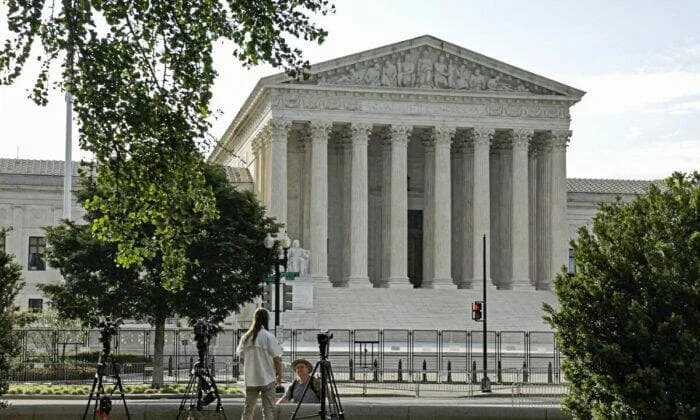
The United States Supreme Court has issued an order requiring New York City to respond to a petition for a writ of certiorari in the case of Calce v. New York, a significant development that signals potential interest from the nation’s highest court in reviewing the city’s long-standing ban on stun guns. This directive, coming as the Court prepares for its crucial October term, places Calce alongside two other major Second Amendment cases already on the docket, hinting at what could become one of the most impactful terms for gun rights jurisprudence in decades.
The Genesis of Calce v. New York
The case, Calce v. New York, challenges New York City’s prohibition on the possession and use of stun guns, which are non-lethal electronic devices designed for self-defense. The challenge was spearheaded by prominent Second Amendment advocacy groups, including the Firearms Policy Coalition (FPC) and the Second Amendment Foundation (SAF), alongside individual plaintiffs. Their central argument posits that "electronic arms," encompassing devices like stun guns and tasers, are protected under the Second Amendment, much like traditional firearms. They contend that these weapons, which function by delivering electrical pulses to temporarily incapacitate a target rather than firing a projectile, serve a legitimate self-defense purpose and fall squarely within the scope of constitutionally protected arms.
New York City, historically a bastion of stringent gun control measures, has maintained that its ban on stun guns is a necessary component of its public safety efforts, citing concerns over potential misuse and the city’s broader interest in regulating weapons. The legal battle has traversed the lower federal courts, with the District Court and subsequently the Second Circuit Court of Appeals upholding the ban. Both courts concluded that the challengers had failed to provide sufficient evidence demonstrating that stun guns and tasers are in "common use" for self-defense, a standard often applied in Second Amendment cases. This interpretation, however, has drawn scrutiny from legal scholars and Second Amendment advocates, who argue it may conflict with established Supreme Court precedent.
A Precedent-Setting Roadmap: Caetano v. Massachusetts
The current legal landscape for "electronic arms" is heavily influenced by the Supreme Court’s 2016 per curiam opinion in Caetano v. Commonwealth of Massachusetts. In Caetano, the Court considered a challenge to a similar stun gun ban in Massachusetts. The First Circuit Court of Appeals had upheld the Massachusetts ban, partly on the grounds that stun guns were not in common use at the time the Second Amendment was adopted. The Supreme Court decisively rejected this line of reasoning, sending the case back to the First Circuit.
The Caetano ruling explicitly reiterated and reinforced principles established in District of Columbia v. Heller (2008), where the Court affirmed that the Second Amendment protects an individual’s right to possess firearms for traditionally lawful purposes, such as self-defense in the home. Crucially, in Caetano, the Court clarified that the Second Amendment’s protection "extends… to… arms… that were not in existence at the time of the founding." This seminal statement directly countered the First Circuit’s anachronistic interpretation and underscored that the Second Amendment is not limited to 18th-century weaponry. The Court also rejected two other rationales presented by the First Circuit.
Following the Caetano decision, Massachusetts opted to amend its law, effectively legalizing stun guns for self-defense, thereby avoiding further litigation and a likely unfavorable ruling from the Supreme Court. This strategic concession by Massachusetts highlights a distinct difference in approach compared to New York City, which has remained steadfast in its prohibition, seemingly undeterred by the Supreme Court’s clear guidance in Caetano. This divergence sets the stage for Calce to potentially become a direct test of New York City’s adherence to the principles articulated in Caetano and Heller.
The Journey Through Lower Courts: A Contested "Common Use" Standard
The legal journey of Calce v. New York through the federal judiciary reveals a persistent point of contention regarding the "common use" standard. Both the District Court and the Second Circuit Court of Appeals upheld New York City’s ban, primarily asserting that the challengers failed to provide adequate evidence that stun guns and tasers are in "common use." This reasoning strikes many legal observers as remarkably similar to the logic that the Supreme Court explicitly repudiated in Caetano.
The concept of "common use" is a cornerstone of modern Second Amendment jurisprudence. In Heller, the Court stated that the Second Amendment protects arms "typically possessed by law-abiding citizens for lawful purposes," rejecting a focus on whether a weapon was common at the time of the founding. Caetano further refined this by stating that even novel weapons, not existing at the founding, could be protected if they are "in common use" today for lawful purposes.
Critics of the lower courts’ rulings in Calce argue that their interpretation of "common use" places an unduly heavy burden of proof on plaintiffs. They contend that stun guns are indeed widely available and commonly used across the United States for self-defense. According to data from various sources, stun guns are legal for civilian ownership in 48 states and are carried by millions of Americans as a non-lethal option for personal protection. The fact that New York City and a handful of other jurisdictions ban them does not, in this view, negate their "common use" nationally. A Supreme Court review of Calce could provide much-needed clarity on the definition and application of the "common use" element, as well as the burden of proof required from challengers in Second Amendment cases. It could also address whether the Second Circuit’s ruling aligns with the spirit and letter of Caetano, especially in light of last year’s decision in Wolford v. Lopez, which rejected Hawaii’s restrictive "Vampire law" limiting where lawful weapons could be carried.
The Road to Certiorari: A Critical Juncture

The Supreme Court’s order for New York City to file a response by October 8 is a crucial procedural step in the certiorari process. While not a guarantee that the Court will ultimately grant review, it signifies that at least some justices view the petition with enough interest to warrant a formal reply from the defending party. The Court is expected to consider the case for review at its October 15 conference.
For a case to be granted certiorari, at least four of the nine justices must agree to hear it. The Court typically grants only a small fraction of the thousands of petitions it receives each year. An order for a response often indicates that the issues presented are substantial, potentially involving a conflict among lower courts, a departure from Supreme Court precedent, or an issue of significant national importance. In Calce, the apparent conflict with Caetano and the broader implications for Second Amendment rights nationwide certainly qualify as substantial issues.
A Potentially Transformative Second Amendment Term
If Calce v. New York is granted certiorari, it will join an already formidable Second Amendment docket for the upcoming Supreme Court term. The Court is scheduled to hear arguments in two other highly anticipated cases: Viramontes v. Cook County and Grant v. Higgins. Both of these cases directly challenge bans on AR-15 style rifles and other semi-automatic weapons, including popular models like the Glock 9mm, which have been enacted in various "blue states" and localities.
The addition of Calce to this docket would make the upcoming term exceptionally significant for Second Amendment jurisprudence. While Viramontes and Grant focus on the legality of certain categories of firearms, Calce delves into the protection of non-lethal electronic arms, expanding the scope of the Court’s inquiry into the definition of "arms" under the Second Amendment. A ruling in Calce could establish whether the right to bear arms extends to modern, non-projectile-based self-defense tools, further shaping the contours of individual gun rights in the 21st century.
This confluence of cases underscores a recurring pattern: jurisdictions with strict gun control policies, often "blue states" and major metropolitan areas, frequently find themselves at the forefront of Second Amendment litigation. Legal experts, including Jonathan Turley, have observed that these jurisdictions consistently "feed the Court with Second Amendment cases" that, ironically, often result in rulings that reinforce the very rights they are attempting to limit. This pattern suggests a strategic miscalculation by some local governments, whose "poorly conceived and poorly drafted measures" often provide fertile ground for constitutional challenges, leading to lasting, self-inflicted wounds to their gun control efforts.
Implications for Electronic Arms and Self-Defense
A Supreme Court decision in Calce could have far-reaching implications for the regulation of electronic arms and the broader landscape of self-defense options. If the Court sides with the challengers, it would likely invalidate New York City’s stun gun ban and similar prohibitions in the few remaining jurisdictions that still maintain them. This would effectively recognize stun guns as constitutionally protected arms, expanding the types of defensive tools available to law-abiding citizens.
Such a ruling would also likely compel states and municipalities to reconsider their approaches to regulating other non-lethal self-defense tools, potentially paving the way for challenges against bans on items like pepper spray or other less-than-lethal devices, depending on their classification as "arms." It would further solidify the principle that the Second Amendment is not static but applies to modern innovations in self-defense technology.
Moreover, the case could influence how lower courts evaluate future Second Amendment challenges, particularly concerning the "common use" standard and the burden of proof. By clarifying these elements, Calce could streamline future litigation and provide a clearer framework for assessing the constitutionality of various weapon bans. For instance, if the Court affirms that stun guns are in common use nationally, it could implicitly lower the bar for plaintiffs demonstrating common use for other widely available self-defense items, even if those items are banned in a few outlier jurisdictions.
Expert Legal Analysis and Anticipation
The legal community is closely watching Calce v. New York, recognizing its potential to be a truly stunning Second Amendment case. Constitutional scholars and Second Amendment litigators alike anticipate that the Court’s engagement with the specifics of stun gun technology will offer novel insights into how the Second Amendment’s protections apply to arms that deviate from traditional firearms. The case presents a unique opportunity for the Court to articulate principles that could govern the constitutional status of emerging self-defense technologies.
The ongoing tension between states’ efforts to regulate weapons for public safety and individual constitutional rights is a defining feature of American legal and political discourse. Calce, particularly when viewed in conjunction with Viramontes and Grant, represents a critical moment in this enduring debate. The Supreme Court’s decisions in these cases will not only reshape Second Amendment jurisprudence but also influence legislative strategies and public safety policies across the nation for years to come. The October 8 response deadline and the subsequent October 15 conference are therefore pivotal dates for those following the evolving landscape of gun rights in America.

