
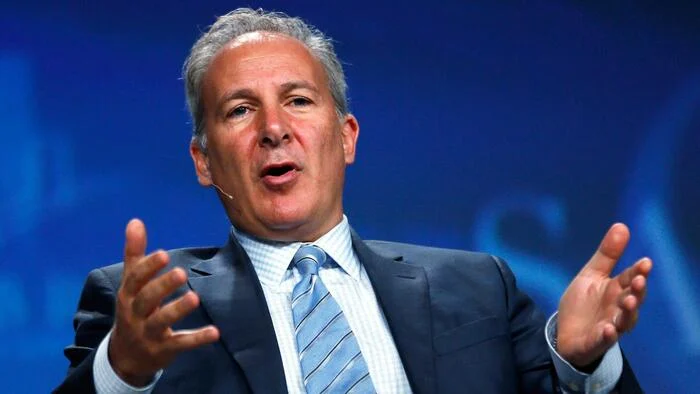
In a recent appearance on CapitalCosm, prominent economist and financial commentator Peter Schiff engaged in a comprehensive discussion with host Danny, meticulously dissecting the escalating vulnerabilities within the United States debt market. Schiff’s analysis extended beyond immediate economic indicators, drawing critical connections between the precarious state of U.S. sovereign debt, the future trajectory of the U.S. dollar, the volatile global oil market, and the intricate political dynamics poised to unfold leading up to the 2026 midterm elections. His commentary underscored a profound skepticism regarding conventional economic narratives and official policy responses, painting a stark picture of an economy increasingly reliant on unsustainable practices.
The Alarming State of US Treasury Demand and Inflation Risk
Schiff began his discourse by spotlighting what he perceived as a critical, yet largely underreported, sign of distress: the lackluster demand observed in recent U.S. Treasury auctions. He noted that despite the sheer volume of debt being issued by the U.S. government, the market’s response often barely registers a ripple, indicating a dwindling appetite among investors for American sovereign bonds. This trend, he argued, is particularly concerning given the foundational role U.S. Treasuries play as a benchmark for global financial markets and as a traditional safe haven asset.
Historically, U.S. Treasury bonds have been considered among the safest investments globally, attracting a broad spectrum of domestic and international buyers, including central banks, institutional investors, and sovereign wealth funds. Their liquidity and perceived low risk have made them indispensable components of global portfolios. However, Schiff contended that this perception is increasingly at odds with economic reality. He asserted that the yields currently offered on long-term U.S. Treasuries—such as 10-year or 30-year bonds—are fundamentally inadequate to compensate investors for the inherent inflation risk over their extended maturities.
To illustrate, Schiff pointed out that while a 4.85% yield might appear high when compared to the near-zero interest rate environment that persisted in the aftermath of the 2008 global financial crisis, it is far from historically robust. Prior to 2008, when the U.S. national debt was a mere fraction of its current colossal sum, similar or even lower yields were considered more reasonable in a less inflationary and less indebted environment. Today, with the national debt having surged past $34 trillion and continuing its relentless ascent, the economic landscape has fundamentally shifted. The risk of future inflation eroding the real value of bond principal and interest payments is significantly higher. Investors, therefore, demand a greater "inflation risk premium"—an additional return to offset the anticipated loss of purchasing power. Schiff’s core argument is that the market is failing to provide this necessary premium, signaling a potential crisis of confidence in the long-term value of the dollar and U.S. government solvency. The Federal Reserve’s persistent monetary expansion and the government’s expansive fiscal policies have contributed to an environment where investors are increasingly wary of holding long-duration, fixed-income assets that offer insufficient real returns.
The Precarious Yen Carry Trade and Global Contagion Risk
Shifting his focus to international markets, Schiff articulated a grave concern regarding the fragility of the yen carry trade, a pivotal mechanism in global finance. This sophisticated trading strategy involves borrowing in a low-interest-rate currency (like the Japanese yen, which has experienced decades of ultra-loose monetary policy and near-zero or negative interest rates) and investing the proceeds in higher-yielding assets elsewhere, often U.S. dollar-denominated assets such as Treasuries or equities. The difference in interest rates, known as the "carry," generates profit for the investor, assuming stable exchange rates.
Schiff highlighted the extreme volatility of the yen against major currencies, particularly the U.S. dollar, as a direct threat to this intricate financial architecture. The Japanese yen has experienced significant depreciation in recent years, largely driven by the Bank of Japan’s steadfast commitment to an ultra-accommodative monetary policy, a stark contrast to the tightening cycles seen in the U.S. and Europe. This divergence in monetary policy has widened interest rate differentials, making the yen an attractive funding currency for carry trades.
However, Schiff described a "dangerous feedback loop" that could trigger a cascade of Treasury selling, regardless of the yen’s direction. If the yen continues its downward trajectory against the dollar, it puts immense pressure on Japan’s own financial institutions and the Japanese government. To stem the depreciation and support the domestic currency, Japanese entities might be compelled to sell off their substantial holdings of U.S. Treasuries to acquire yen. Such a move, if large enough, could flood the market with U.S. government bonds, pushing yields higher and potentially destabilizing global fixed-income markets.
Conversely, if the yen were to suddenly strengthen significantly, the carry trade itself would be threatened. A strengthening yen increases the cost of repaying yen-denominated loans for those who borrowed in yen and invested in other currencies. This scenario would force investors to unwind their carry trade positions, which typically involves selling the higher-yielding assets (like U.S. Treasuries or other dollar assets) to buy back yen for repayment. The mass unwinding of these positions could trigger a broad sell-off of U.S. dollar assets, further exacerbating market instability and potentially leading to a liquidity crunch. The interconnectedness of global financial markets means that disruptions in one major funding trade can have far-reaching consequences, potentially impacting asset prices and financial stability worldwide. The sheer scale of the yen carry trade means its unraveling could send shockwaves through sovereign debt markets and beyond.
The Illusion of "Growing Our Way Out of Debt"
Zooming out from the intricate mechanics of bond markets and currency trades, Schiff critically addressed what he termed the "political fantasy" that the United States can simply expand its way out of its formidable debt burden. This notion posits that robust economic growth, driven by innovation, productivity gains, and increased tax revenues, will eventually outpace the growth of national debt, thereby reducing the debt-to-GDP ratio to sustainable levels without the need for politically unpopular austerity measures or painful economic adjustments.
Schiff emphatically dismissed this as a recycled promise, noting that this narrative has been peddled by politicians across the spectrum for 40 or 50 years, yet the problem has only grown more acute. The U.S. national debt has ballooned from less than $1 trillion in the early 1980s to over $34 trillion today, consistently growing faster than the underlying economy for decades. This persistent imbalance is a testament to the failure of the "grow our way out" strategy in practice.
The latest iteration of this hope, Schiff observed, rests on the potential for artificial intelligence (AI) to deliver an economic miracle. Proponents argue that AI could unleash unprecedented productivity gains, spurring an economic boom akin to the industrial revolution or the dot-com era, thereby generating the necessary growth to outpace debt accumulation. While AI indeed holds transformative potential, Schiff’s skepticism stems from the historical precedent of debt consistently outstripping economic expansion, even during periods of significant technological advancement. He argued that the fundamental structural issues, primarily unchecked government spending and monetary policies that favor debt expansion, render even revolutionary technologies insufficient to reverse the trend. Without a genuine commitment to fiscal discipline and a reining in of government expenditures, any growth spurt would likely be met with even greater borrowing, perpetuating the cycle. The long-term implications of this sustained imbalance include increased interest payments consuming a larger portion of the federal budget, potential crowding out of private investment, and a diminished capacity for future fiscal responses to economic crises.
Inflation’s Shifting Political Landscape: The 2026 Midterms
Schiff then pivoted to the domestic political ramifications of persistent inflation, offering a provocative prediction for the 2026 midterm elections. He posited that the narrative surrounding the cost of living crisis, which heavily favored Republicans in the 2024 election cycle as they largely pinned the blame on President Biden and the Democrats, is set to undergo a significant reversal.
The 2024 elections saw inflation emerge as a dominant voter concern, with many consumers directly linking rising prices for essentials like groceries, fuel, and housing to the policies of the incumbent Democratic administration. However, Schiff argued that by 2026, if Republicans control the White House and potentially Congress, they will "own the economy" and, by extension, the ongoing price increases.
This shift in political accountability, according to Schiff, will be facilitated by several factors. Should a Republican administration implement protectionist trade policies, such as tariffs, or engage in geopolitical conflicts, such as a potential "Iran war" (as referenced in the original context), these actions could directly contribute to supply chain disruptions and increased import costs, further fueling inflation. Democrats, he suggested, would then have a credible basis to point to these specific Republican policies as direct contributors to the cost of living crisis, effectively flipping the script. This dynamic underscores how economic realities, particularly the persistent erosion of purchasing power through inflation, can profoundly reshape political narratives and electoral outcomes, forcing the party in power to bear the brunt of public discontent. The challenge for any administration is to demonstrate effective control over economic levers, a task made increasingly difficult by global supply chains, geopolitical tensions, and the deeply entrenched inflationary impulses of modern monetary systems.
The Looming Energy Price Surge and Dollar Depreciation
Turning to commodity markets, Schiff presented a stark forecast for energy prices, specifically predicting a substantial rise in oil prices in the coming years, primarily driven by a weakening U.S. dollar. The dollar’s status as the world’s primary reserve currency and the denomination currency for most global commodity trades means that its value has a direct and inverse relationship with commodity prices. When the dollar weakens, it takes more dollars to buy a fixed amount of a commodity like oil, effectively making oil more expensive for dollar holders. Conversely, for holders of other currencies, a weaker dollar makes dollar-denominated commodities cheaper, potentially increasing demand.
Schiff projected that oil prices could realistically reach $200 a barrel in the next few years. To contextualize this prediction, he referenced historical oil price spikes: oil hit $100 a barrel in 2008 and surged to $140 a barrel in 2011. Given that current prices are still significantly below these historical peaks, and considering the underlying inflationary pressures he identified, Schiff sees ample room for further appreciation.
His analysis hinges on the premise that the U.S. dollar is poised for a significant depreciation. This weakening, he argued, would be a direct consequence of the persistent fiscal deficits, the ballooning national debt, and the Federal Reserve’s long-term accommodative monetary stance. A sustained decline in the dollar’s value would not only make imported goods more expensive for American consumers but would also provide a substantial tailwind for commodity prices. The implications of $200 oil are far-reaching, including increased transportation costs, higher manufacturing expenses, and inflationary pressures across various sectors of the economy, disproportionately impacting lower-income households and potentially triggering broader economic slowdowns.
The Federal Reserve’s Enduring Inflationary Playbook
Schiff concluded his discussion by addressing the perennial speculation surrounding the appointment of the next Federal Reserve chair. His contention was that, irrespective of the individual who assumes this powerful role, the fundamental incentives and underlying political economy dictate that the outcome will invariably be the same: a continuation of inflationary policies.
He asserted that inflation is not an accidental byproduct of economic forces but rather a deliberate policy choice, implicitly or explicitly made by every Fed chair since Alan Greenspan. The Federal Reserve’s dual mandate ostensibly includes maintaining price stability and achieving maximum employment. However, Schiff argued that in practice, the Fed consistently prioritizes avoiding the short-term pain of economic contraction and potential recession—which would inevitably result from truly tightening monetary policy to rein in inflation—over the long-term erosion of purchasing power.
The alternative to inflationary policies, Schiff explained, would involve allowing interest rates to rise significantly, shrinking the money supply, and permitting asset prices to fall to more sustainable levels. Such actions, while potentially necessary to restore genuine price stability and fiscal health, would inevitably trigger a painful economic adjustment, including higher unemployment, decreased consumer spending, and potentially a severe recession. This "biting the bullet" scenario, according to Schiff, is deemed "political suicide" by policymakers and central bankers alike. The political pressure to maintain economic growth and avoid downturns, combined with the government’s reliance on monetary expansion to finance its burgeoning debt, creates an irresistible gravitational pull toward an inflationary playbook.
Therefore, Schiff argued that any incoming Fed chair, facing the same political and economic constraints, will ultimately make the "same choice" as their predecessors. This systemic inclination towards inflation implies that the purchasing power of the dollar will continue to diminish over time, a hidden tax on savers and a boon for debtors, fundamentally altering the economic landscape for generations to come. This perspective challenges the conventional understanding of Fed independence, suggesting that political expediency and the imperative to manage an ever-growing national debt are paramount drivers of monetary policy, often overshadowing the stated goal of price stability.
Broader Implications and Outlook
Peter Schiff’s comprehensive analysis paints a sobering picture of an interconnected global economy teetering on the brink of significant financial and political upheaval. The deepening cracks in the U.S. debt market, evidenced by lukewarm Treasury demand and insufficient yields, suggest a growing skepticism among investors regarding the nation’s fiscal trajectory. This internal vulnerability is compounded by external risks, particularly the precarious state of the yen carry trade, which poses a substantial threat of global contagion should currency volatility trigger a mass unwinding of positions.
The persistent reliance on the "grow our way out of debt" fantasy, even with the advent of transformative technologies like AI, underscores a fundamental unwillingness among policymakers to confront the structural issues of excessive spending and burgeoning national debt. This avoidance, Schiff argues, ensures the continuation of inflationary pressures, which are poised to not only erode consumer purchasing power but also redefine the political landscape, shifting blame and potentially fueling social discontent.
Furthermore, the predicted surge in oil prices to unprecedented levels, driven by a weakening dollar, would have profound implications for global energy markets, supply chains, and the cost of living for billions worldwide. This, coupled with the Federal Reserve’s entrenched inflationary playbook, suggests a future where the erosion of currency value is not merely an unfortunate side effect but a deliberate, albeit unacknowledged, policy choice to avoid more painful economic adjustments.
The interconnectedness of these challenges—from sovereign debt and currency volatility to inflation and political accountability—demands a comprehensive and candid assessment from policymakers. Schiff’s insights serve as a potent warning, urging a critical re-evaluation of current economic policies and a recognition of the long-term consequences of prioritizing short-term political expediency over fiscal and monetary discipline. The path forward, if his analysis holds true, necessitates difficult choices that have historically been sidestepped, raising questions about the resilience of global financial systems and the future prosperity of ordinary citizens.

