

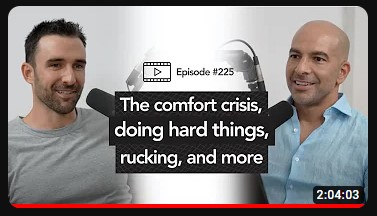
The contemporary Western world, often characterized by unprecedented levels of material wealth and technological convenience, faces a paradoxical challenge: the "Comfort Crisis." This concept, popularized by author Michael Easter in his seminal book, posits that an excess of ease and a deliberate avoidance of discomfort are actively detrimental to human physical and mental well-being. The discussion around this critical societal issue gained significant traction following an in-depth interview with Easter on Dr. Peter Attia’s widely influential podcast, "The Drive," prompting a broader re-evaluation of modern lifestyles and the subtle damages inflicted by relentless convenience.
The Genesis of a Crucial Concept

Michael Easter, a former writer for Men’s Health magazine, brings a unique perspective to this discussion, rooted in his personal battle with alcohol addiction. His experience with overindulgence and the pursuit of hollow comforts provides a compelling backdrop to his broader thesis on the societal addiction to ease. The book, "The Comfort Crisis: Embrace Discomfort to Reclaim Your Wild, Happy, Healthy Self," intertwines a gripping narrative of Easter’s own arduous caribou hunting expedition in the remote Alaskan wilderness with rigorous scientific research and psychological insights. This dual approach allows readers to digest complex ideas through the lens of lived, extreme experience, making the lessons on resilience, adaptation, and the value of hardship profoundly resonant.
For over a decade, similar sentiments have echoed within movements advocating for intentional living and financial independence, often referred to as "Mustachianism" or FIRE (Financial Independence, Retire Early). These philosophies frequently highlight that many widely perceived "crises" – such as personal debt or declining public health – are, in fact, symptoms of an underlying issue: an ingrained societal tendency towards excessive indulgence and a widespread failure to recognize the insidious damage this easiness inflicts. While mainstream headlines often lament the difficulties of modern life, Easter’s work, and allied perspectives, argue the inverse: that life has become too easy, diminishing our capacity for resilience, genuine happiness, and robust health.
The Psychology of Problem-Seeking in a Comfortable World

One of the book’s most startling revelations addresses the human brain’s inherent tendency to perpetually scan its environment for problems, irrespective of how safe or optimized that environment truly is. This phenomenon, supported by psychological research, suggests that as external stressors diminish, our threshold for what constitutes a "problem" correspondingly lowers. Studies cited by Easter illustrate that when individuals are tasked with identifying threats in progressively safer environments, they do not become more satisfied. Instead, they begin to perceive a wider range of innocuous stimuli as problematic, often unconsciously.
This adaptive trait, once vital for survival in harsh ancestral environments, now manifests in highly comfortable societies as a source of incessant, often trivial, complaint. This mechanism helps explain the often-observed phenomenon of "first-world problems," where minor inconveniences escalate into significant grievances. Societally, this psychological predisposition can be exploited, leading to political polarization over manufactured "wedge issues" or the magnification of minor cultural differences into significant conflicts. The strength of a society, the book implicitly argues, lies not in its ability to eliminate all problems, but in its collective capacity to discern genuine threats from invented ones and to resist the urge to descend into trivial bickering.
Conversely, individuals exposed to genuinely challenging environments often exhibit greater resilience and a reduced propensity for complaint. Interviews with people living in war zones, for instance, have shown surprisingly high self-reported levels of safety, illustrating a profound adaptation to extreme circumstances. This "adaptation principle" also sheds light on the trajectory of immigrant families: first-generation immigrants, accustomed to harsher conditions, often exhibit heightened drive and wealth accumulation, while subsequent generations, growing up in relative comfort, may struggle with complacency. The contrast highlights how a baseline of perceived "normal" conditions shapes an individual’s outlook and drive.
Nature’s Prescription: Reconnecting with the Wild
Beyond the pitfalls of excessive comfort, "The Comfort Crisis" also delves into the profound benefits of engaging with nature. It elucidates why spending time outdoors significantly boosts mental and physical health, contrasting this with the draining effects of artificial environments like cubicles and vehicle interiors. The human biological wiring, honed over millennia in natural settings, responds powerfully and instantaneously to natural stimuli in ways that cannot be replicated elsewhere.
Scientific research consistently supports these claims. Studies on "forest bathing" (Shinrin-yyoku), a Japanese practice of spending time in forested areas, have demonstrated measurable improvements in immune function, reduced stress hormones, lower blood pressure, and improved mood. Even minor interventions, such as placing a single plant in a hospital room, have been shown to accelerate patient recovery. The implication is clear: regular, sustained immersion in natural environments offers a potent, accessible form of medicine, far exceeding the benefits of occasional, passive exposure. The book encourages readers to consider the cumulative health benefits of spending not just hours, but days, in a living forest, engaging with its myriad sensory inputs.

The Effort-Reward Dynamic and the Aversion to Exertion
A central tenet of the book is the direct correlation between effort and satisfaction. It underscores the psychological truth that the harder one works for something, the greater the happiness derived from its attainment. This principle stands in stark contrast to a society increasingly geared towards instantaneous gratification and minimal exertion.
The pervasive aversion to physical exertion is another critical theme. Easter highlights a striking statistic: only 2% of people choose the stairs when an escalator is also available. This seemingly innocuous preference for ease comes at an enormous cost to public health. Sedentary lifestyles are now recognized as a leading contributor to chronic diseases worldwide, including obesity, type 2 diabetes, cardiovascular disease, and certain cancers. The World Health Organization (WHO) reports that insufficient physical activity is one of the ten leading risk factors for global mortality, contributing to 3.2 million deaths annually.

Conversely, even moderate physical activity yields enormous benefits, reducing the probability and severity of almost all diseases. The book advocates for far more than moderate activity, posing the transformative potential of several hours of daily physical movement in natural environments, incorporating heavy load-bearing and periods of intense exertion. These practices are not speculative alternative medicines but are scientifically validated, reproducible methods for enhancing physical and mental health.
The persistent societal trend of prolonged sitting, extensive driving, and passive entertainment (e.g., watching Netflix), coupled with reliance on highly processed foods, sugars, and alcohol, represents a profound misalignment with fundamental human biological needs. This lifestyle often precedes a cascade of health issues, leading individuals to seek increasingly exotic and complex medical interventions without addressing the foundational deficits. The book strongly argues for prioritizing essential, discomfort-inducing practices: maximizing outdoor time, engaging in heavy exertion (including strength training), minimizing sedentary behavior, and drastically reducing intake of junk food, sugar, and alcohol. These are presented as the primary levers for holistic well-being, suggesting that more specialized treatments should only be considered after these fundamental human requirements are met.
Real-World Application and Transformative Journeys

The principles outlined in "The Comfort Crisis" are not merely theoretical; they offer a practical framework for personal transformation. The original article’s author, for example, recounted a journey of "Carpentourism" in the mountains of Southwestern Colorado. This experience, involving solo travel, manual labor in challenging conditions, and limited amenities, served as a direct application of Easter’s philosophy. Despite initial minor setbacks—such as weather challenges and vehicle damage—the author found that embracing these "miniature challenges" fostered a sense of resilience rather than stress.
Days spent in a high-desert environment, characterized by intense heat, physical demands, careful water rationing, and basic sleeping arrangements, led not to depression but to an invigorated sense of self and an enhanced appreciation for life’s simpler aspects. Such experiences underscore the book’s message: that purposeful hardship, even when self-imposed and relatively mild by historical standards, can profoundly enhance one’s sense of vitality and capability. Disconnecting from digital conveniences and embracing the raw elements of nature, such as paddleboarding on a remote reservoir without phones, further amplified this sense of freedom and presence, burning vivid memories into consciousness more effectively than photographs could.
The journey culminated in a heightened appreciation for basic comforts, exemplified by a simple meal becoming "the most delicious meal of my life" after days of purposeful hunger. This reinforces another core idea: that constant satiety is neither natural nor healthy, and that periodic, controlled deprivation can amplify the pleasure and appreciation derived from sustenance.

Purposeful Hardship vs. Purposeful Spending: A Modern Dilemma
The "Comfort Crisis" offers a crucial counterpoint to contemporary discussions surrounding financial independence and consumer habits. While there is a valid argument for "purposeful spending" – allocating resources towards enriching experiences, personal growth, generosity, and positive global impact – it is equally vital to guard against the insidious creep of comfort. The distinction lies in intention: Are expenditures genuinely enhancing life and fostering growth, or merely making life easier to the point of stagnation and diminished resilience?
The challenge for individuals in affluent societies is to discern between beneficial investments and expenditures that merely deepen the "comfort trap." The book encourages a proactive approach: actively seeking out and embracing challenges, even as other aspects of life are upgraded. The mantra "buy yourself better tools, not softer chairs" encapsulates this philosophy, advocating for investments that empower capability and engagement rather than promoting passive ease.

In essence, "The Comfort Crisis" serves as a concentrated guide for robust living, echoing and expanding upon principles of intentionality, resilience, and engagement with the natural world. It challenges readers to consciously step away from the seductive allure of constant comfort and rediscover the profound well-being that emerges from embracing purposeful hardship, ultimately leading to a more vibrant, appreciative, and healthier existence.

