
Accurate and up-to-date short-term rental (STR) data is no longer a luxury but a fundamental necessity for profitability within the dynamic real estate industry. Investors, property managers, emerging PropTech startups, established marketplaces, and sophisticated analytics platforms all grapple with a shared challenge: the consistent and scalable access to reliable Airbnb performance insights. The platform itself offers limited public access to its detailed analytics, compelling businesses to seek out third-party providers for actionable intelligence, often delivered through specialized Airbnb data APIs.
In this competitive landscape, developers building advanced STR analytics platforms, real estate startups launching innovative investment tools, and data teams dedicated to powering rental property analysis must meticulously evaluate a multitude of providers. The goal is to identify the solution that best aligns with their specific use cases. This comprehensive analysis compares the leading Airbnb data API providers in 2026, examining their strengths and weaknesses based on critical factors such as endpoint diversity, data accuracy, market coverage, and pricing models. Our objective is to provide a clear understanding of which platform best suits your operational and strategic needs.
Understanding the Power of an Airbnb Data API
At its core, an Airbnb data API functions as a sophisticated software interface. It empowers platforms, applications, and analytics tools to programmatically access structured short-term rental data. This automation bypasses the time-consuming and often inefficient process of manual data collection. Instead, businesses can effortlessly retrieve key performance metrics, analyze emerging market trends, glean pricing insights, and conduct in-depth property analytics through a real estate data API specifically engineered for scalable integration.
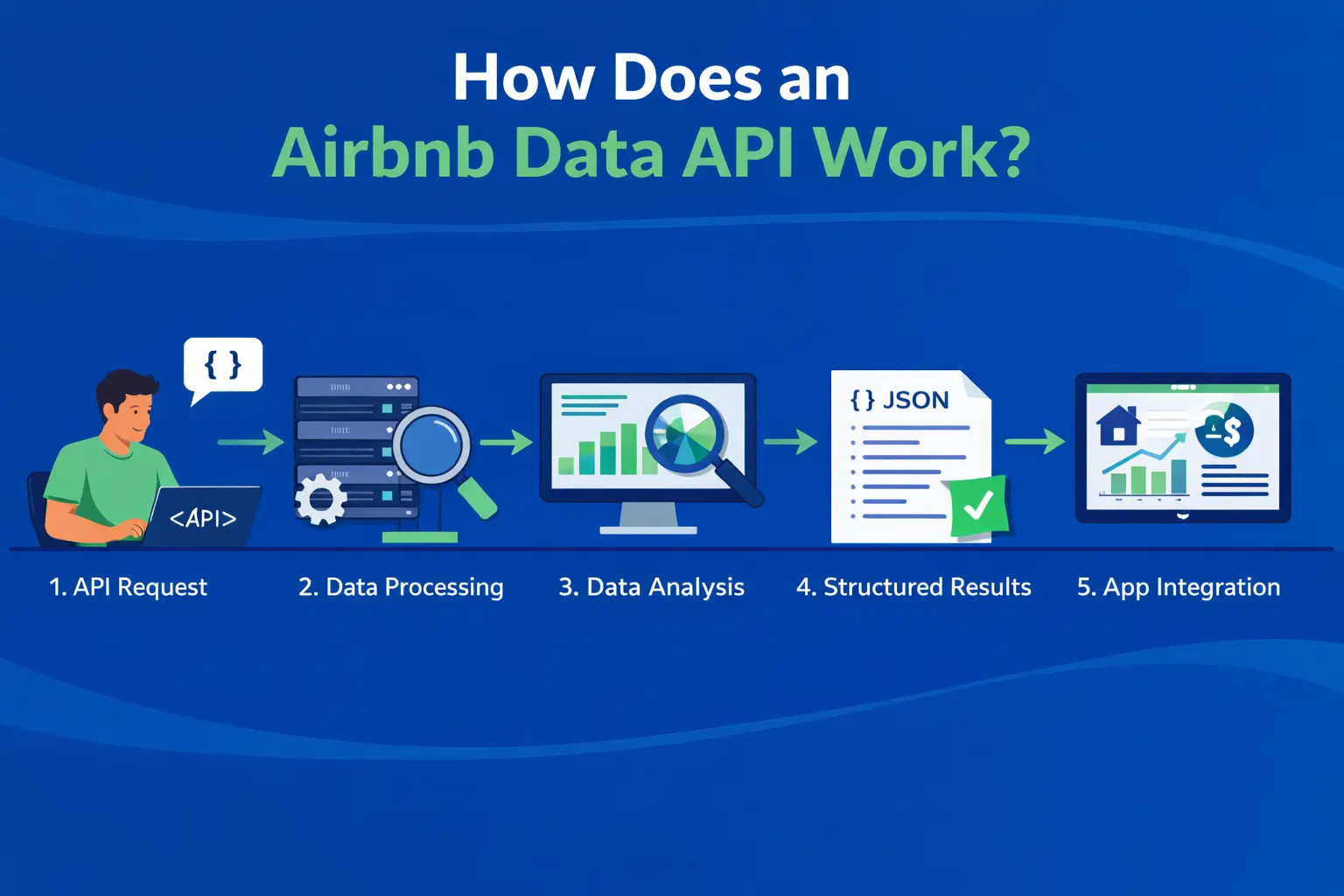
The operational mechanism of an Airbnb data API involves a seamless connection between applications and data providers. This connection is facilitated through automated requests and responses. The typical workflow involves an application sending a structured request to the API endpoint. The API then processes this request, querying its vast databases for the relevant information. Finally, it returns the requested data in a standardized format, most commonly JSON, which the application can then parse and utilize. This direct integration allows businesses to embed vacation rental data API capabilities directly into their existing workflows, eliminating the need to develop and maintain complex, in-house data collection pipelines.
Who Benefits Most from Airbnb Data APIs?
The demand for reliable Airbnb data APIs spans a broad spectrum of market participants. Key players in the real estate sector who critically depend on this data include:
- Real Estate Investors: To identify high-yield investment opportunities, forecast returns, and understand market saturation.
- Property Managers: To optimize pricing strategies, manage occupancy rates, and benchmark performance against competitors.
- PropTech Startups: To build innovative platforms offering automated investment analysis, property valuation, and rental management solutions.
- Marketplaces: To provide users with comprehensive market data, competitive insights, and pricing tools.
- Data Analytics Firms: To develop sophisticated models for market forecasting, trend analysis, and investment risk assessment.
- Real Estate Developers: To assess market viability for new short-term rental projects and understand local demand dynamics.
In essence, Airbnb data APIs transform fragmented short-term rental market information into actionable intelligence. This intelligence is invaluable for both seasoned investment professionals and technically adept teams. A thorough understanding of how these APIs function is paramount for evaluating which provider offers the most robust combination of analytics, comprehensive coverage, and user-friendly integration.
Identifying the Top Airbnb Data API in 2026
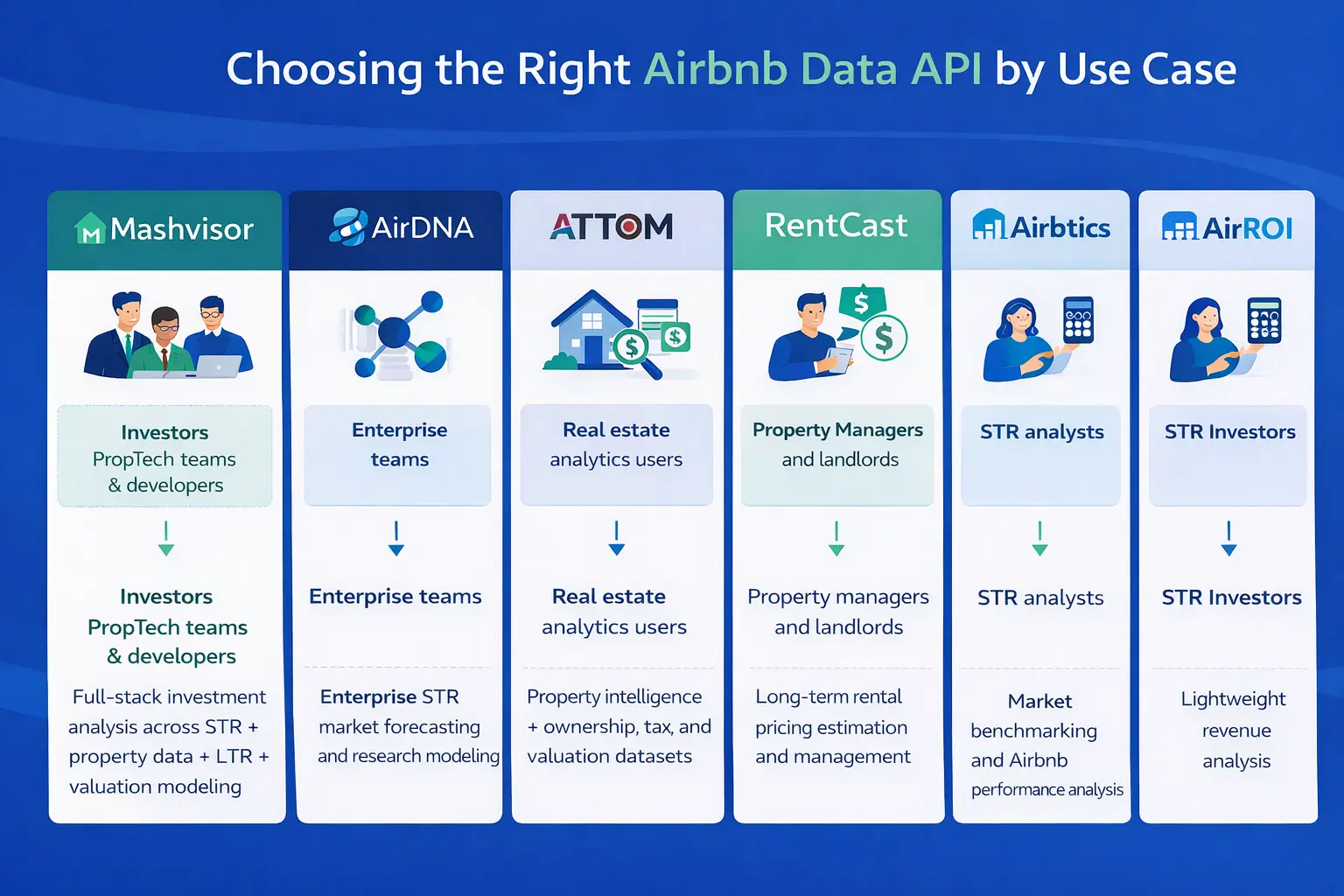
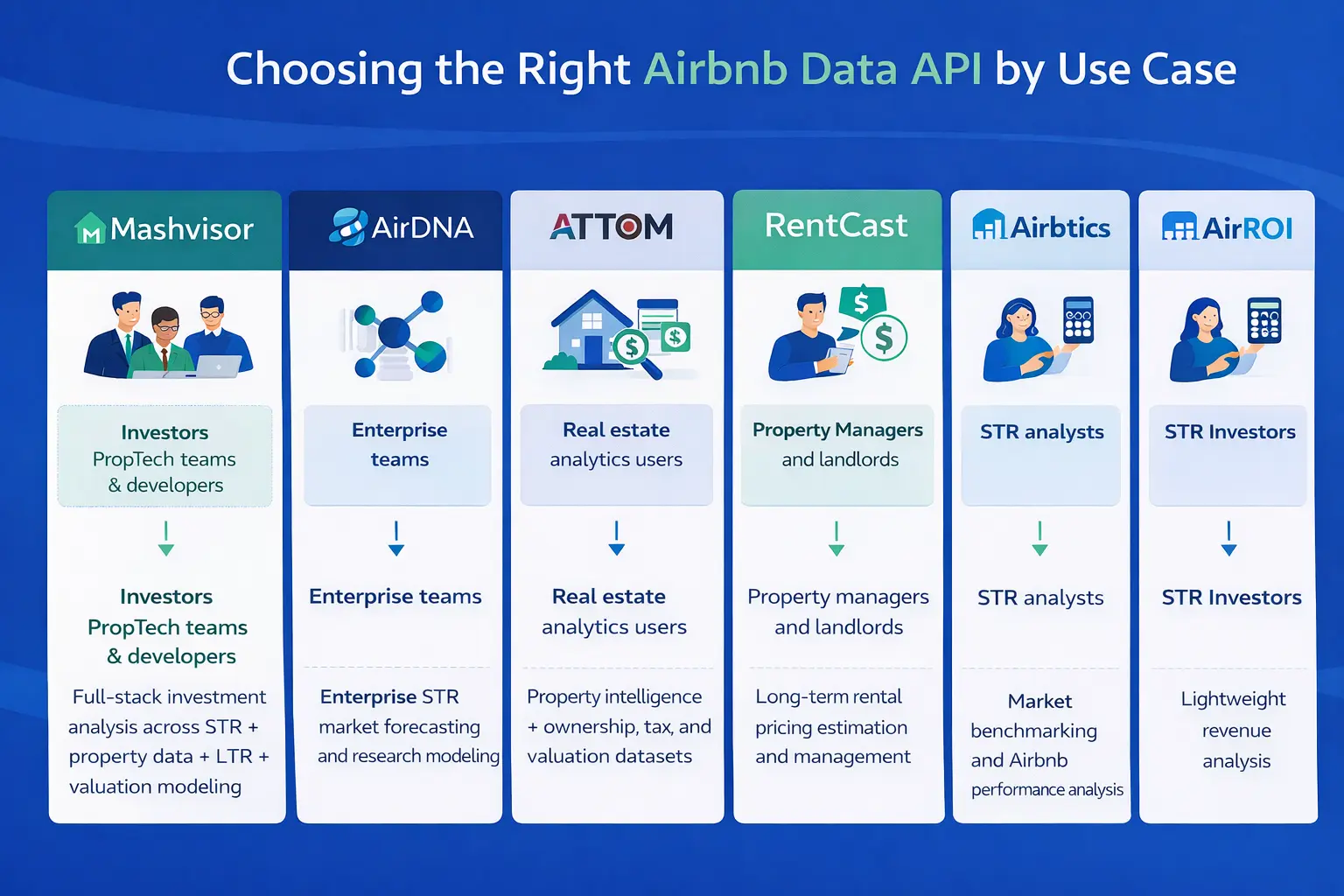
The ideal Airbnb data API in 2026 is characterized by its ability to deliver highly accurate short-term rental analytics, readily accessible investment metrics, flexible developer integration capabilities, and scalable pricing structures. Among the leading providers evaluated, Mashvisor distinguishes itself by consistently delivering actionable real estate market and property intelligence that covers the entire United States market. This makes it a particularly effective solution for investors, property managers, and developers aiming for comprehensive analysis.
While several platforms offer strong functionalities, each exhibits distinct strengths tailored to specific use cases:
- Mashvisor: Positioned as the top choice for investment-focused Airbnb data, it excels in integrating analytics, crucial investment metrics, and detailed property-level insights into a unified platform. This integration significantly reduces development time and accelerates data-driven real estate decision-making.
- AirDNA: A strong contender for enterprise-level short-term rental analytics, focusing on aggregated market data and forecasting models.
- ATTOM: Primarily a property data powerhouse, offering extensive public records and valuation data, ideal for comprehensive property intelligence platforms.
- RentCast: Specializes in long-term rental data, providing valuable insights for rental pricing engines and portfolio monitoring focused on the LTR market.
- Airbtics: Offers targeted Airbnb market intelligence, focusing on performance benchmarks and geographic insights for STR market research.
- AirROI: Provides simplified STR analytics and revenue estimation, suited for quick integrations and basic feasibility assessments.
A detailed evaluation of features, market coverage, and developer capabilities across these providers reveals nuanced differences. This comparison is crucial for selecting the platform that most precisely aligns with specific business objectives.
A Comparative Look at Leading Airbnb Data API Providers in 2026
The selection of a data provider often hinges on the platform’s ability to balance data depth, analytical sophistication, developer usability, and pricing flexibility. While all major providers furnish valuable real estate datasets, their core specializations diverge.
Quick Comparison Table
| Provider | Best For | Data Focus | Typical Use Cases | Developer Tools | Updates | Historical Data | Pricing |
|---|---|---|---|---|---|---|---|
| Mashvisor | Rental investors, managers, revenue managers; PropTech platforms; Real estate analytics apps | STR data, LTR data, Market data, Property data, Investment metrics | Full-stack RE investment analysis apps | Advanced, developer-friendly | Daily | 36 months | Usage-based, with scalable tiers |
| AirDNA | Enterprise STR investors, managers, analysts | STR only | STR forecasting models | Strong | Regular | Limited | Enterprise usage-based, custom contracts |
| ATTOM | Real estate market analysts | Property data only | Property intelligence platforms | Extensive | Unspecified | Limited | Tiered subscription, based on data products |
| RentCast | LTR investors, managers, analysts | LTR only | Rental pricing engines | Simple | Daily | Limited | Credit-based |
| Airbtics | Individual STR investors, managers | STR only | Airbnb market intelligence tools | Moderate | Weekly | 12 months | Pay-as-you-go |
| AirROI | Individual STR investors, managers | STR only | Airbnb revenue estimation tools | Basic | Unspecified | 15+ years | Lightweight usage-based |
Detailed Feature Breakdown
| Feature | Mashvisor | AirDNA | ATTOM | RentCast | Airbtics | AirROI |
|---|---|---|---|---|---|---|
| API Endpoints Diversity | Extensive | Strong | Extensive | Moderate | Moderate | Limited |
| Airbnb Data Accuracy | High (multi-source, validated) | High | Not relevant | Not relevant | High | Moderate |
| LTR Data | Yes | No | No | Yes | No | No |
| Market Data | Yes | Yes | Yes | Yes | Yes | Yes |
| Property Data | Yes | Limited | Yes | Yes | Yes | Yes |
| Investment Analytics | Yes (Cap rate, cash flow) | Limited | No | Limited | Limited | Limited |
| Valuations | Yes | No | Yes | Yes | No | No |
Competitive Snapshots in 2026
The market for Airbnb data APIs in 2026 is characterized by providers specializing in different facets of real estate data. Understanding these niches is key to selecting the most appropriate tool.
- Mashvisor Airbnb API: This API is meticulously designed for investment analysis. It integrates short-term rental analytics, long-term rental data, and comprehensive property intelligence. With access to 36 months of historical Airbnb performance data and nationwide market coverage, it is ideal for developing real estate investment analysis tools, STR forecasting models, and investor dashboards that require robust ROI metrics, accurate rental comparables, and actionable property-level insights.
- AirDNA Airbnb API: AirDNA focuses on providing large-scale short-term rental market data, encompassing occupancy trends, dynamic pricing metrics, and historical performance. It is best suited for enterprise analytics platforms, research teams, and large organizations developing market intelligence dashboards that rely on aggregated STR datasets, rather than granular property-level investment modeling.
- ATTOM Airbnb API: ATTOM’s strength lies in its extensive property data API, offering ownership records, property valuations, parcel information, and broad real estate market datasets. While not directly focused on STR performance, it is invaluable for applications requiring deep property intelligence, sophisticated valuation modeling, and data enrichment within broader real estate analytics workflows.
- RentCast Airbnb API: RentCast delivers rental market intelligence specifically focused on long-term rental estimates, pricing trends, and property-level rental data. It is an excellent choice for developers building rental analysis tools, pricing engines, and portfolio monitoring platforms that prioritize long-term rental analytics over dedicated Airbnb performance data.
- Airbtics Airbnb API: Airbtics provides Airbnb analytics with a specific focus on market trends, performance benchmarks, and geographic short-term rental insights. It is well-suited for platforms conducting STR market research, competitive benchmarking, and regional performance analysis where market-level Airbnb data is paramount, but comprehensive investment modeling is secondary.
- AirROI Airbnb API: AirROI offers simplified short-term rental analytics and Airbnb revenue estimates, designed for straightforward integration. It is ideal for startups and developers needing quick access to STR performance and feasibility indicators without the complexity of advanced analytics infrastructure or extensive investment modeling features.
Navigating STR Data API Pricing Structures
Pricing models for Airbnb data APIs vary significantly, reflecting the differing scopes and target audiences of the providers. Most platforms employ subscription-based or usage-based models, but the transparency, flexibility, and scalability of these structures differ.
Mashvisor API Pricing
Mashvisor utilizes a usage-based, credit-driven pricing model. Its tiered subscription plans are designed for scalability, allowing teams to start with modest needs and expand as their requirements evolve. Users pay only for the data and endpoints they actively use. Higher tiers unlock greater request volumes, and transitioning between tiers is designed to be seamless. Crucially, each plan offers access to all available endpoints with identical functionalities. Customers can opt for monthly or annual plans, with annual subscriptions providing a cost advantage equivalent to two months free. This model is particularly beneficial for startups, investor platforms, and growing PropTech products that require predictable and scalable costs.
AirDNA API Pricing
AirDNA employs a subscription and enterprise licensing model. Pricing is typically customized based on the scope of dataset access, geographic coverage, and specific usage requirements. Plans can differ based on whether users are accessing analytics tools or API data integrations. Enterprise contracts are common for large-scale deployments, and pricing can escalate considerably when access to multiple markets is required. This structure is best suited for enterprise analytics teams and large research platforms.
ATTOM API Pricing
ATTOM offers tiered and packaged pricing, calculated based on specific data products and request volumes. Costs are generally determined by the dataset scope and the scale of integration. Enterprise plans are customized to meet specific business requirements, and pricing is often negotiated based on usage and data access needs. This is ideal for enterprise property data integrations and valuation platforms.
RentCast API Pricing
RentCast utilizes tiered monthly pricing, which is directly tied to API request limits. They offer a free development plan with limited API calls, allowing for initial testing. Paid plans scale with usage volume, enabling developers to upgrade as their integrations grow. The pricing is structured around subscription tiers rather than per-endpoint billing, making it suitable for developers and startups building long-term rental analytics tools with predictable monthly usage.
Airbtics API Pricing
Airbtics adopts a pay-as-you-go pricing model. Costs are calculated per API endpoint request, eliminating the need for contracts or monthly commitments. This transparent pricing structure allows teams to scale their usage gradually and pay only for the data they consume, making it ideal for flexible integrations and usage-based analytics projects.
AirROI API Pricing
Similar to Airbtics, AirROI uses a pay-as-you-go model where costs are based on API requests rather than fixed subscriptions. Developers can begin with a small prepaid credit and scale their usage incrementally. Real-time tracking is available, and there are no contracts or monthly commitments required, making it suitable for lightweight integrations and flexible STR analytics experimentation.
Evaluating Airbnb Data API Endpoints Range
The diversity and structure of available API endpoints are critical determinants of what developers can realistically build. While many providers offer access to short-term rental or property datasets, the depth, organization, and usability of these endpoints can vary dramatically.
Mashvisor API Endpoints
Mashvisor provides an extensive suite of structured endpoints specifically designed for investment analysis and application development. These endpoints grant access to both Airbnb analytics and comprehensive property intelligence within a single, cohesive ecosystem. Key endpoints include:

- Property Lookup: Retrieve detailed information about a specific property, including its address, size, and features.
- Airbnb Performance Metrics: Access key STR performance indicators such as occupancy rate, average daily rate (ADR), monthly revenue, and annual revenue.
- Investment Metrics: Obtain crucial investment metrics like cash flow, cap rate, cash-on-cash return, and ROI.
- Rental Comps: Fetch comparable rental data for both short-term and long-term rentals to accurately assess market value.
- Market Analysis: Retrieve data on local market trends, occupancy rates, pricing dynamics, and demand for STRs.
- Neighborhood Analysis: Gain insights into specific neighborhood performance, including crime rates, school ratings, and walkability scores.
- Property Valuations: Access estimated property values and historical appreciation trends.
- Historical Performance: Retrieve up to 36 months of historical STR performance data.
These comprehensive endpoints empower developers to construct complete real estate investment workflows without the need to integrate multiple disparate APIs.
AirDNA API Endpoints
AirDNA’s endpoints are primarily focused on aggregated short-term rental analytics and market performance datasets. This includes:
- Market Demand & Supply: Data on active listings, booking trends, and market saturation.
- Occupancy Rates: Historical and projected occupancy percentages for STRs.
- Pricing Metrics: Average daily rates, seasonal pricing fluctuations, and revenue per available room (RevPAR).
- Performance Benchmarks: Data to compare a listing’s performance against market averages.
These endpoints are highly effective for large-scale market analysis and regional performance comparisons but are less suited for granular, property-level investment modeling or analyzing the long-term rental (LTR) market.
ATTOM API Endpoints
ATTOM offers a broad array of property data endpoints centered on real estate records and valuation intelligence:
- Property Records: Access to ownership details, deed information, and tax assessments.
- Valuations and Assessments: Data on property appraisals, market values, and tax assessments.
- Foreclosure Data: Information on pre-foreclosure, auction, and REO properties.
- Mortgage Data: Details on mortgage origination, servicing, and lien information.
- Neighborhood and Market Data: Broader real estate market statistics and trends.
While ATTOM’s API is powerful for property enrichment workflows, it does not natively include Airbnb performance analytics. It can serve as a valuable supplementary data source for STR analysis but not as an independent provider of STR-specific insights.
RentCast API Endpoints
RentCast provides streamlined endpoints focused on long-term rental analytics and pricing intelligence:
- Rental Estimates: Data on estimated monthly rental rates for properties.
- Rental Market Trends: Analysis of rental price fluctuations and demand within specific markets.
- Property-Level Rental Data: Information on historical rental performance for individual properties.
These endpoints are primarily designed for long-term rental analysis. However, they can also be beneficial for participants in the Airbnb rental arbitrage space, as they provide the necessary LTR data, which is also covered by Mashvisor.
Airbtics API Endpoints
Airbtics offers endpoints concentrating on Airbnb market analytics and benchmarking insights:
- Market Performance: Data on average daily rates, occupancy, and revenue in specific STR markets.
- Competitive Analysis: Tools to benchmark a listing against similar properties in the area.
- Geographic Insights: Analysis of STR performance trends across different cities and regions.
This API is most useful for conducting STR market research and geographic performance comparisons. However, it is not designed for comprehensive investment profitability analysis due to the lack of general real estate data, nor for LTR research.
AirROI API Endpoints
AirROI provides lightweight endpoints for simplified short-term rental performance analysis:
- Revenue Estimates: Basic projections of potential Airbnb revenue.
- Occupancy Rates: Simplified estimates of typical occupancy.
- Feasibility Indicators: Quick metrics to gauge the potential viability of an STR listing.
The platform prioritizes quick integrations over deep analytical granularity and lacks comprehensive real estate property and LTR data.
The Crucial Aspect of Airbnb Data Accuracy
Data accuracy is paramount, as investment decisions and forecasting models are only as reliable as the performance estimates they are built upon. Accuracy is influenced not only by dataset size but also by the methodologies providers use for data collection, validation, and modeling. Each provider employs a distinct approach to estimating trends, which directly impacts the trustworthiness of the data.
Mashvisor Data Accuracy
Mashvisor’s Airbnb API delivers highly accurate STR analytics through a multi-layered approach combining:
- Observed Performance Signals: Direct data on bookings, rates, and occupancy from actual STR listings.
- Historical Datasets: Comprehensive historical performance data, providing context and trend analysis.
- Comparable Property Validation: Cross-referencing data with similar properties in the market to ensure accuracy and identify outliers.
- Proprietary Algorithms: Advanced algorithms that refine data and generate investment-ready insights.
This robust methodology ensures property-level accuracy suitable for critical investment decision-making and sophisticated STR forecasting models.
AirDNA Data Accuracy
AirDNA achieves STR data accuracy through large-scale market aggregation methods, including:
- Extensive Listing Data: Collection of data from a vast number of active STR listings.
- Market Trend Aggregation: Statistical aggregation of pricing, occupancy, and revenue data across entire markets.
- Proprietary Modeling: Use of models to impute missing data and smooth out fluctuations for market-level insights.
AirDNA’s data methodology is particularly effective for macro-level market analytics and regional performance comparisons.
ATTOM Data Accuracy
ATTOM focuses on accuracy in property intelligence by leveraging:
- Public Records: Data sourced directly from county assessor and recorder offices.
- Government Databases: Access to a wide range of official property-related information.
- Verified Property Details: Emphasis on the accuracy of ownership, tax, and parcel information.
ATTOM ensures strong property data accuracy but does not directly model Airbnb performance metrics.
RentCast Data Accuracy
RentCast emphasizes long-term rental accuracy using structured housing market inputs such as:
- Rental Listing Data: Aggregation of data from active long-term rental listings.
- Market Price Analysis: Statistical analysis of rental prices across various submarkets.
- Property Characteristics: Consideration of property features that influence rental rates.
RentCast’s data accuracy is primarily applied to LTR analytics rather than STR forecasting.
Airbtics Data Accuracy
Airbtics generates Airbnb analytics accuracy through market-focused Airbnb revenue modeling approaches, including:
- Market-Specific Data Aggregation: Focus on collecting and analyzing data within targeted STR markets.
- Performance Benchmarking: Using comparable listings to refine revenue and occupancy estimates.
- Algorithmic Refinement: Employing algorithms to adjust estimates based on market dynamics.
Airbtics’ data accuracy is highest when analyzing STR market trends and competitive positioning.
AirROI Data Accuracy
AirROI provides simplified STR performance estimates using streamlined analytical inputs:
- Aggregated STR Data: Collection of readily available STR performance data.
- Simplified Revenue Models: Use of basic models for revenue estimation.
- General Market Indicators: Reliance on broader market indicators for context.
The AirROI data approach prioritizes accessibility and speed over deep investment modeling granularity.
Broad Market Coverage: A Key Differentiator
Market coverage is a critical factor, determining how effectively an Airbnb API can support analysis across diverse geographic scales—from national trends to hyper-local investment decisions. The depth of coverage also influences a platform’s ability to perform market analysis, localized forecasting, or property-specific evaluations.
Mashvisor Market Coverage
Mashvisor offers comprehensive coverage across the United States, encompassing all 50 states. Data is accessible at the state, city, neighborhood, ZIP code, and individual property levels. By integrating both market-level and property-level datasets, Mashvisor supports in-depth market analysis, neighborhood studies, and detailed rental property analysis within a single platform, facilitating scalable investment research and localized decision-making.
AirDNA Market Coverage
AirDNA provides extensive geographic coverage across global short-term rental markets, with a strong emphasis on market-level analytics and regional performance insights. Its coverage is particularly effective for city and regional trend analysis, but less so for detailed property-level investment evaluation.
ATTOM Market Coverage
The ATTOM API offers nationwide property data coverage sourced from public records and assessor datasets. Coverage is robust at the parcel and property levels but is primarily designed for property intelligence rather than short-term rental market analysis.
RentCast Market Coverage
RentCast covers long-term rental markets across the United States, providing rental estimates and pricing intelligence at city and property levels. Its geographic coverage supports rental analysis workflows but does not extend to dedicated Airbnb market analytics.
Airbtics Market Coverage
Airbtics covers numerous global Airbnb markets, focusing primarily on city-level and regional STR performance insights. The platform is well-suited for comparative market analysis but not for localized property investment modeling.
AirROI Market Coverage
The AirROI API offers selective market coverage, focusing on providing simplified short-term rental performance indicators. While its coverage supports high-level feasibility analysis, it is generally oriented towards broader market insights rather than granular geographic analysis.
When Alternatives Might Outshine Mashvisor
While Mashvisor presents a compelling all-in-one solution for investment analysis, certain niche use cases might be better served by more specialized Airbnb data API providers. The optimal platform choice invariably depends on specific goals, data requirements, and the desired level of analytical depth.
Scenarios where alternatives may be a more fitting choice include:
- Purely Macro-Level Market Research: If the primary objective is broad market trend analysis across multiple global regions without needing property-level investment metrics, AirDNA’s extensive global coverage might be preferable.
- Deep Property Record Integration: For applications requiring extensive public records, tax data, and deed information for large-scale property intelligence, ATTOM’s specialized datasets are unparalleled.
- Focus Solely on Long-Term Rentals: If the business model is exclusively centered on long-term rental analytics, pricing engines, and portfolio management, RentCast’s dedicated LTR data offers a more streamlined solution.
- Basic STR Feasibility Without Deep Investment Modeling: For quick feasibility checks or basic STR revenue estimations where complex investment calculations are not required, AirROI’s simplified approach might suffice.
However, for platforms demanding both short-term rental analytics and property-level investment insights within a single, integrated workflow, Mashvisor remains the most comprehensive and efficient option.
Practical Application: Sample Airbnb API Request and Response
To illustrate the practical implementation of an Airbnb data API, consider a sample request and response from Mashvisor, designed for developers. This provides a tangible example of how integration works and the data that can be obtained.
Example API Request (Mashvisor)
GET https://api.mashvisor.com/client/lookup
Authorization: Bearer YOUR_API_KEY
Content-Type: application/json

  "location": "Miami, FL",
  "property_type": "single_family",
  "strategy": "airbnb"
This Mashvisor API request is designed to retrieve key short-term rental performance and investment metrics for a specified property type in a given location. Specifically, it aims to:
- Identify and analyze properties matching the criteria in the specified "Miami, FL" location.
- Filter for "single_family" property types, ensuring the analysis is relevant to that category.
- Focus on the "airbnb" strategy, retrieving STR-specific performance data and investment potential.
Developers typically integrate this endpoint into their backend workflows to power features such as STR forecasting models, investment scoring systems, or dynamic property comparison tools.
Sample JSON Response for Developers (Mashvisor)
Upon receiving a request, the Mashvisor Airbnb API returns structured JSON data that applications can immediately process and display. This clean, well-organized output significantly reduces development time and allows teams to integrate Airbnb analytics directly into their tools.
  "property_id": "4839201",
  "location":
    "city": "Miami",
    "state": "FL",
    "zip_code": "33101"
  ,
  "strategy": "airbnb",
  "airbnb_metrics":
    "occupancy_rate": 0.71,
    "average_daily_rate": 214,
    "monthly_revenue": 3810,
    "annual_revenue": 45720
  ,
  "investment_metrics":
    "cap_rate": 0.084,
    "cash_on_cash_return": 0.112,
    "optimal_rental_strategy": "airbnb"
  ,
  "comparables":
    "airbnb_comps_count": 14,
    "average_comp_revenue": 46800
  ,
  "last_updated": "2026-01-15"
The structure of the Mashvisor Airbnb API offers several advantages for developers:
- Unified Data Model: All relevant STR performance and investment metrics are presented in a single, logical structure, eliminating the need for data aggregation from multiple sources.
- Analytics-Ready Output: The data is pre-processed and formatted, ready for immediate use in dashboards, reports, or predictive models, significantly reducing backend processing time.
- Reduced Integration Complexity: A well-defined and comprehensive set of endpoints simplifies the integration process, allowing developers to focus on building user-facing features rather than data plumbing.
- Actionable Insights: The API returns metrics directly applicable to investment decisions, such as revenue projections and return on investment calculations.
This approach allows developers to move swiftly from data retrieval to functional product features, accelerating time-to-market for new real estate applications.
Real-World Application: Building an Airbnb Investment Analysis Tool
Consider a PropTech startup aiming to build a platform that empowers investors to identify profitable short-term rental properties. Instead of manually collecting and processing data, the platform integrates the Mashvisor API to automate the entire investment analysis workflow.
The platform leverages the API to:
- Automate Property Discovery: Use the API to search for properties within target markets based on specific criteria (e.g., property type, location, price range).
- Generate STR Performance Reports: For each identified property, fetch real-time Airbnb performance metrics, including occupancy rates, average daily rates, and projected monthly and annual revenues.
- Calculate Investment Viability: Utilize the API to obtain crucial investment metrics such as cap rate, cash-on-cash return, and overall ROI projections, providing investors with a clear picture of potential profitability.
- Provide Comparative Analysis: Access comparable rental data for both STRs and LTRs to validate pricing and revenue estimates and understand the competitive landscape.
- Deliver Neighborhood Insights: Integrate neighborhood-level data to assess local demand, amenities, and potential risks or advantages.
By combining these capabilities, the startup can deliver a fully automated investment dashboard that guides users toward faster, data-driven decisions, all without the need to integrate multiple, disparate data providers.
Final Verdict: The Premier Airbnb Data API in 2026
Our extensive comparison of Mashvisor, AirDNA, ATTOM, RentCast, Airbtics, and AirROI, evaluated across accuracy, market coverage, endpoint diversity, pricing, and developer experience, leads to a clear conclusion: Mashvisor offers the best Airbnb data API in 2026 for real estate investors, PropTech startups, and developers building data-driven platforms.
Unlike providers with a single focus, Mashvisor consolidates multiple layers of real estate intelligence within a unified ecosystem. Through its single API, users gain access to property-level data, nationwide STR and LTR analytics, comprehensive investment metrics, rental comparables, valuation models, and historical performance insights. This integrated approach eliminates the need to stitch together data from multiple sources, enabling users to complete their entire real estate analysis workflow seamlessly.
Where Mashvisor Surpasses Other Airbnb API Providers:
Mashvisor uniquely combines:
- STR and LTR Data: Comprehensive insights into both short-term and long-term rental markets.
- Property-Level and Market-Level Analytics: Deep dives into individual properties alongside broader market trends.
- Investment Metrics and Performance Data: Actionable financial insights integrated with operational performance metrics.
- Nationwide US Coverage: Extensive data coverage across all 50 states.
- Developer-Friendly Infrastructure: Clean JSON responses and robust endpoints designed for scalable application development.
While other platforms excel in their specific niches—AirDNA for global STR market trends, ATTOM for deep property records, and RentCast for LTR analytics—Mashvisor stands out for its integrated approach. It provides a holistic view essential for sophisticated real estate investment analysis and application development.
Frequently Asked Questions
What is the best Airbnb API in 2026?
Mashvisor is considered the best Airbnb data API in 2026 due to its comprehensive integration of Airbnb analytics, property data, rental comps, and investment metrics within a single platform. This allows investors and developers to conduct complete real estate analysis without needing to integrate multiple data providers.
Does Airbnb offer a public analytics API?
No, Airbnb does not provide a public analytics API that delivers occupancy rates, revenue estimates, or detailed market performance data. Consequently, businesses rely on third-party short-term rental data API providers to access structured analytics.
Which API is best for Airbnb data for investors?
Mashvisor is the premier Airbnb analytics API for investors. It delivers market- and property-level revenue projections, ROI metrics, rental comps, and historical performance data in a unified system, empowering buyers to accurately evaluate profitability before purchasing or listing a property.
Which API provides the most accurate Airbnb data?
Accuracy varies by methodology, but Mashvisor emphasizes property-level modeling, supported by comparable analysis and historical STR datasets. This approach yields investment-ready analytics rather than purely aggregated market estimates, offering a high degree of reliability.
Which Airbnb API works best for developers building STR analytics platforms?
Developers building STR analytics platforms benefit most from APIs that provide clean JSON responses, structured endpoints, and investment-ready metrics, such as the Mashvisor API. Its unified data model simplifies backend processing and accelerates product development cycles.
Which Airbnb data API has the most affordable pricing?
Affordable pricing is contingent on usage. APIs with usage-based or scalable tier models, like Mashvisor, enable teams to commence with minimal investment and expand costs proportionally with their data needs. This makes them highly practical for startups and scaling real estate applications.

