

The economic landscape for mid-career professionals in the northeastern United States has become increasingly complex, characterized by a paradox of rising wages and escalating living costs. In central Connecticut, a case study involving two 34-year-old professionals, Brian and Michael, illustrates the broader financial challenges facing the millennial demographic—specifically the tension between high-income potential, significant consumer debt, and the aspirational goal of homeownership. As of late 2023, the couple reports a combined gross annual income of approximately $167,544, yet they remain encumbered by over $28,000 in high-interest consumer debt, highlighting a critical need for strategic fiscal intervention.

Professional Profiles and Income Dynamics
The household income is derived from a combination of public sector employment and secondary advocacy roles. Brian serves as a quality assurance manager for a state-run hospital, a position that provides not only a stable salary but also a robust benefits package, including a pension and lifetime healthcare—a rarity in the modern labor market. Michael operates as a project coordinator for a state behavioral health agency focused on youth services, supplemented by a secondary role as a disability leadership coordinator and advocate.
Their combined net annual income, after taxes and pre-tax deductions for healthcare and retirement, stands at $109,455. Despite this six-figure take-home pay, the couple’s cost of living in a refurbished industrial mill apartment in central Connecticut, combined with debt servicing and lifestyle expenses, has created a narrow margin for error. Their current monthly expenditures total $8,035, resulting in an annual spend of $96,414. This leaves a theoretical surplus of roughly $13,000 annually, though the couple reports feeling stagnant in their progress toward long-term wealth accumulation.

Chronology of Financial Volatility: 2022-2023
The current financial state of the household was precipitated by a series of disruptive events over the past 18 months. Previously, the couple resided in a 600-square-foot studio apartment with a monthly rent of $945, which allowed for significant capital preservation. However, the 2022-2023 period introduced several "shocks" to their financial system:
- Housing Uprooting: Due to a change in their previous living situation, the couple was forced to navigate a volatile rental market, eventually securing a two-bedroom, two-bathroom apartment in a converted mill. While the new space provides a dedicated home office and improved quality of life, the rent surged to $2,000 per month—a 111% increase from their previous housing expense.
- Veterinary Emergencies: The health crises of their late cat, Rex, and the subsequent medical needs of two new kittens, introduced unplanned veterinary expenses that drained liquid savings and contributed to credit card balances.
- Debt Conversion: While Brian successfully liquidated $58,000 in student loan debt in previous years, the transition to a higher-cost lifestyle and the aforementioned emergencies led to a resurgence of consumer debt.
By late 2023, the couple reached a "breaking point" where the psychological weight of debt began to overshadow their professional achievements, leading them to seek a comprehensive financial overhaul.

Structural Analysis of Debt and Assets
A granular look at the couple’s balance sheet reveals a significant disconnect between their long-term retirement security and their short-term liquidity.
The Debt Portfolio
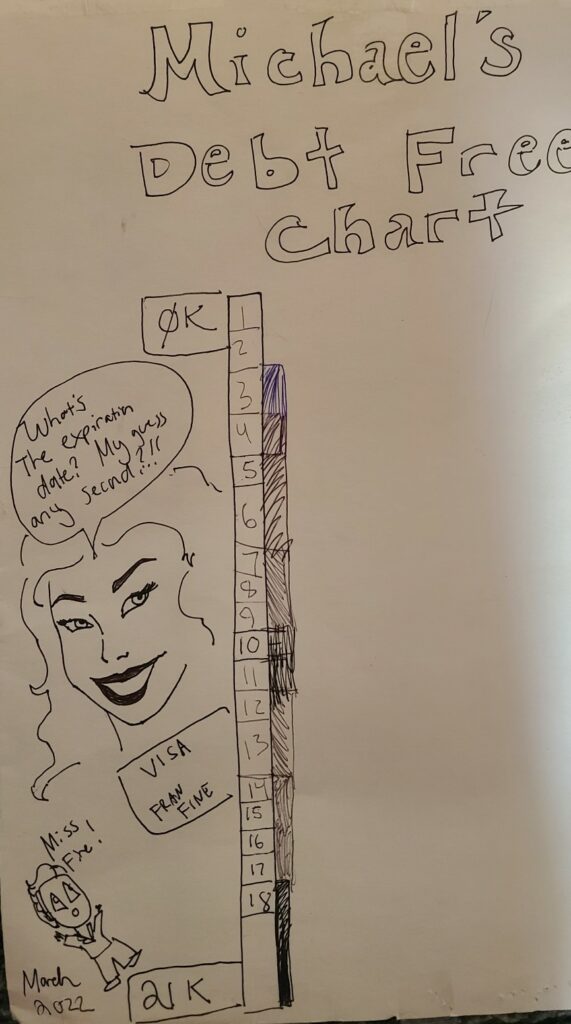
The household carries $28,259 in consumer debt across three primary accounts:

- SCU Visa (Brian): $16,057 at 0% APR until November 2023, after which a 17.99% rate applies.
- Navy Federal Visa (Michael): $9,700 at 10.99% APR.
- Navy Federal Visa (Brian): $2,503 at 0.99% APR until November 2023, after which a 17.74% rate applies.
The looming expiration of 0% and low-interest promotional periods represents a significant "fiscal cliff." Without aggressive repayment, the interest charges alone could exceed $4,000 annually, further eroding their ability to save for a down payment on a home.
The Asset Portfolio
The couple’s total assets are valued at $91,250, but the majority of this capital is "locked" in retirement accounts.
- Retirement Accounts: Michael holds $36,992 in a 401k, while Brian has a fragmented portfolio consisting of a 457b ($5,886), a 403b ($3,389), and an old 401k ($19,305).
- Pension Fund: Brian’s state pension is a cornerstone of their future security, with projected monthly payouts of $4,150 upon retirement in 2054.
- Liquid Cash: The couple maintains approximately $9,000 in combined savings, which covers only 1.1 months of their current monthly expenses—well below the recommended three-to-six-month emergency fund threshold.
The Connecticut Housing and Utility Context
The couple’s goal of homeownership is complicated by the specific economic conditions of Connecticut. The state consistently ranks among the top ten for the highest utility costs in the United States. Brian and Michael report an average monthly electricity bill of $235, despite living in an apartment, reflecting the high regional rates.
Furthermore, the Connecticut housing market has seen a sustained lack of inventory. In 2023, median home prices in the state rose as buyers from higher-cost urban centers like New York and Boston continued to seek value in the suburbs. For Brian and Michael, transitioning from a $2,000 rental to a mortgage in a rural area (their preferred location) would require a substantial down payment to remain competitive and avoid high monthly private mortgage insurance (PMI) costs.

Strategic Recommendations and Financial Re-engineering
Financial analysts suggest that for high-income households with consumer debt, the primary obstacle is often "lifestyle creep" and a lack of rigorous expense tracking. To reach their ten-year goals of homeownership and business ownership, a multi-phased strategy is required.
Phase I: The "Spending Detox"
The first recommendation involves a radical reduction in discretionary spending. By categorizing expenses into "Fixed," "Reduceable," and "Discretionary," the couple can identify immediate savings. Proposed cuts include the temporary elimination of dining out ($200/month), home goods ($200/month), and various personal care and subscription services. By reducing their monthly spend from $8,035 to $6,665, the couple could redirect $4,456 per month toward debt. At this rate, the $28,000 debt could be eliminated in approximately 6.5 months, effectively beating the high-interest rate triggers in November.

Phase II: Liquid Reserve Accumulation
Once the consumer debt is retired, the $4,456 monthly surplus should be diverted into a High-Yield Savings Account (HYSA). To reach a safe six-month emergency fund of $40,000, the couple would need to maintain this savings rate for an additional seven to eight months. This sequence ensures that future emergencies—such as car repairs for their high-mileage vehicles (2007 Mercedes and 2007 Subaru)—do not result in new credit card debt.
Phase III: Retirement Optimization
Given Brian’s access to both a 403b and a 457b, he has a unique opportunity for tax-advantaged growth. The 457b is particularly valuable as it allows for penalty-free withdrawals upon separation from service, regardless of age, providing a bridge for potential early retirement. Analysts recommend Brian roll over his old 401k into a consolidated IRA to reduce fees and improve investment oversight.

Broader Economic Implications and Millennial Trends
The situation faced by Brian and Michael is representative of a broader trend among older millennials. According to data from the Federal Reserve, while millennial wealth has seen a significant increase in the post-pandemic era, it is heavily concentrated in real estate and retirement accounts, with many households still struggling with high-interest consumer debt.
The psychological impact of this debt—noted as "shame" by both Brian and Michael—often prevents households from seeking professional advice early. However, the objective data suggests that for households with six-figure incomes, debt is often a structural issue rather than a terminal one. By treating debt as a "spreadsheet problem" rather than a moral failing, middle-income professionals can pivot toward wealth-building more effectively.

Conclusion and Outlook
For Brian and Michael, the path to "unlocking the next level of adulting" is contingent upon a short-term period of austerity to clear the path for long-term stability. Their 10-year outlook—which includes legal marriage, potential business ventures in coaching or organizing, and owning land for a garden—is mathematically achievable given their strong income base and Brian’s public sector benefits.
The primary risk remains the potential for "boomeranging" back into debt if the underlying spending habits are not permanently altered. As they approach their 10-year anniversary, the transition from debt-servicing to asset-building will likely be the defining factor in whether their goals remain "dreams deferred" or become a tangible reality. The Connecticut market remains challenging, but with a debt-free balance sheet and a fully funded emergency reserve, the couple will be positioned to capitalize on future market corrections, fulfilling their ambition of leaving a lasting financial legacy.

