

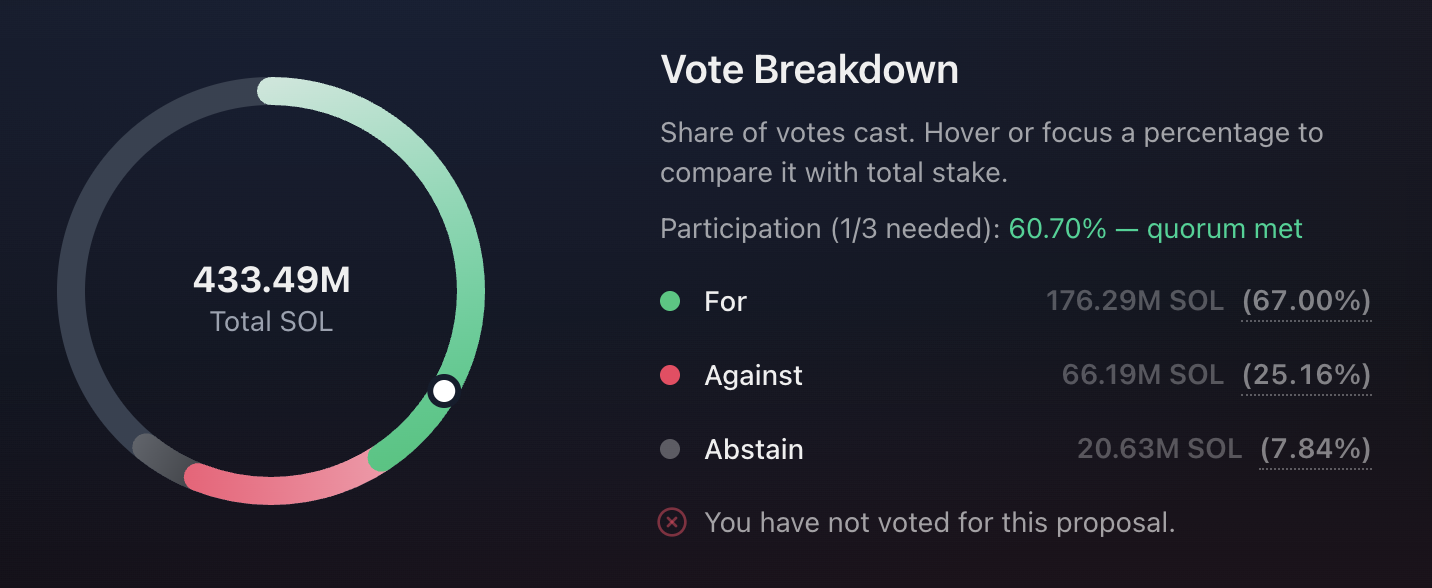
Solana validators have overwhelmingly approved a pivotal proposal to significantly increase the network’s annual disinflation rate, a move designed to reduce future SOL issuance and potentially enhance the scarcity of its native token. The decision, finalized through the network’s nascent binding governance process, marks a significant step in Solana’s monetary policy evolution. The proposal, known as SGP-0002 or "Double Disinflation," passed with a substantial 67% of the vote in favor, demonstrating a clear consensus among a significant portion of the network’s stakeholders. Voting results indicate that 25.16% of eligible stake opposed the measure, while 7.84% abstained. Overall participation reached an impressive 60.7% of the eligible staked SOL, highlighting the active engagement of the Solana community in shaping its future.
This strategic adjustment will see Solana’s annual disinflation rate double from its current 15% to 30%. Importantly, this change does not alter the network’s long-term inflation target of 1.5%, a rate at which new SOL issuance is expected to stabilize indefinitely. The accelerated disinflation schedule is projected to enable Solana to reach its 1.5% terminal inflation rate much sooner than previously anticipated. Under the previous policy, this milestone was estimated to be reached in approximately 5.7 years. However, with the newly approved disinflation rate, Solana is now expected to achieve its long-term inflation target in roughly 2.8 years, effectively halving the time it takes to reach this steady state of issuance.
The implications of this accelerated disinflation are multifaceted. Over the next six years, it is estimated that approximately 18.9 million fewer SOL tokens will be issued compared to the original schedule. This reduction in future supply is likely to be viewed positively by SOL holders, as it could contribute to reduced dilution and potentially support the token’s value by increasing its scarcity. However, this reduction in overall SOL issuance also directly impacts the rewards received by validators and delegators who stake their SOL to secure the network. Lower issuance means fewer new tokens are distributed as staking rewards, which could lead to a decrease in the annual percentage yield (APY) for stakers. This presents a trade-off between long-term token scarcity and short-term staking incentives, a dynamic that will be closely watched by market participants.
Background and Governance Process

The approval of SGP-0002 is particularly noteworthy as it represents one of the first major decisions made under Solana’s formal binding governance framework. This process, designed to empower SOL holders and validators to collectively steer the network’s development and economic parameters, is still in its early stages. The successful passage of SGP-0002, alongside the approval of a proposed Solana Constitution and the rejection of another proposal concerning resource and inclusion fees, underscores the growing maturity of Solana’s decentralized governance mechanisms.
The governance process began with the submission of proposals, followed by a period for discussion and debate within the community. Validators, who are responsible for validating transactions and maintaining the integrity of the Solana blockchain, then cast their votes using their staked SOL. The weighted voting system ensures that those with a larger stake in the network have a proportionally greater influence on the outcome, reflecting a commitment to decentralization while acknowledging the economic incentives aligned with network security.
Divergent Views Among Major Stakeholders
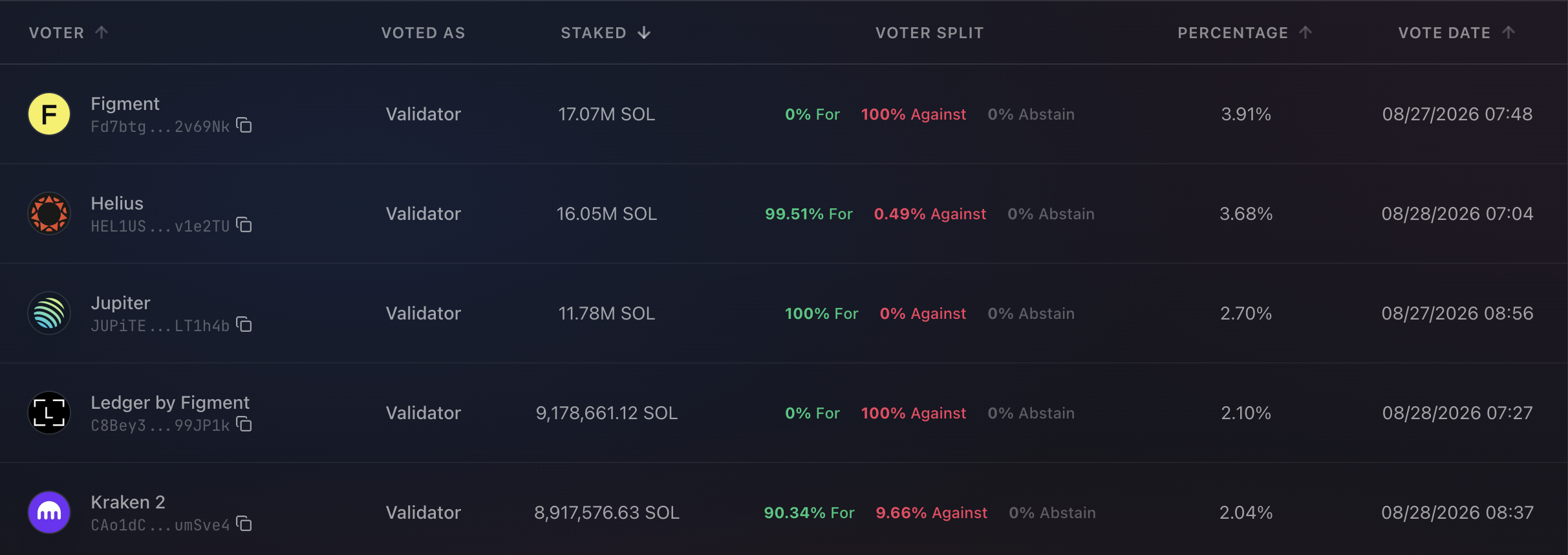
Despite the overall positive vote, the governance process revealed a notable division among some of the largest participants in the Solana ecosystem. Prominent staking service provider Figment, which held the largest voting stake among those whose positions were publicly visible in the finalized governance data with approximately 17.1 million SOL staked, voted entirely against SGP-0002. This stance suggests concerns from major infrastructure providers regarding the potential impact on validator economics or other unforeseen consequences.
In contrast, other significant entities, such as Helius and Jupiter, which are key players in Solana’s developer and decentralized exchange (DEX) ecosystems respectively, overwhelmingly backed the proposal. This divergence highlights the different priorities and perspectives that can exist within a complex blockchain network, with some focusing on the long-term value proposition of token scarcity and others perhaps more attuned to the immediate economic implications for network operators.
Kraken’s Shifting Stance
The voting dynamics also illustrated the fluidity of the governance process, with major entities like Kraken, a prominent US-based cryptocurrency exchange, exhibiting a shifting stance. Initially, Kraken’s voting power initially pushed support for SGP-0002 below the required threshold. At one point, shortly after 12:33 UTC, its vote was recorded as being against the measure. However, in a significant turnaround, more than 90% of Kraken’s approximately 8.9 million SOL voting stake ultimately supported the proposal by the end of the voting period. This late shift in position was crucial in securing the proposal’s passage, underscoring the impact that even a few large stakeholders can have on the final outcome and the importance of continuous community engagement throughout the governance window.
The initial opposition from Kraken, followed by a decisive swing in favor, could be interpreted in several ways. It might reflect an internal deliberation process, a response to community feedback received during the voting period, or a strategic reassessment of the proposal’s long-term benefits. Whatever the precise reasons, Kraken’s eventual endorsement played a vital role in solidifying the consensus for the doubled disinflation rate.
Broader Market Context: Solana ETFs and Investor Interest
The governance vote occurs against a backdrop of robust investor interest in Solana, particularly evident in the performance of US-listed Solana Exchange Traded Funds (ETFs). Despite periods of SOL’s weaker price performance earlier in the year, these investment products have continued to attract substantial capital inflows.
Recently, Bitwise’s Solana ETF achieved a significant milestone, surpassing $1 billion in assets under management. This achievement makes it the first Solana ETF to reach this benchmark, according to data shared by Bloomberg ETF analyst Eric Balchunas. The success of these ETFs indicates a growing institutional and retail appetite for exposure to Solana’s ecosystem, driven by its technological advancements, growing developer activity, and the potential for future growth.
Cumulatively, US-based Solana ETFs have seen approximately $1.7 billion in net inflows since their inception, with minimal sustained outflows reported. This sustained demand for regulated investment vehicles underscores a broader market confidence in Solana’s long-term prospects, even as the network navigates internal governance decisions that impact its monetary policy. The continued accumulation of SOL through ETFs, coupled with the network’s decision to accelerate its disinflationary path, could create a scenario of increasing scarcity relative to growing demand.
Implications for the Solana Ecosystem
The doubling of Solana’s annual disinflation rate is poised to have several key implications:
- Increased SOL Scarcity: The accelerated reduction in new SOL issuance will lead to a tighter supply of the token over the medium term. This could act as a positive catalyst for SOL’s price appreciation, assuming demand for the token and the Solana network remains strong.
- Impact on Staking Rewards: Validators and delegators will likely experience a decrease in their staking yields as the rate of new token distribution diminishes. This may prompt a strategic review of staking operations and could potentially lead to consolidation or increased focus on efficiency among validators. However, the long-term health of the network, supported by a potentially more valuable SOL, could offset these immediate yield reductions.
- Accelerated Path to Monetary Stability: Reaching the 1.5% terminal inflation rate in under three years provides a clearer and shorter roadmap to a predictable monetary policy. This predictability can be attractive to long-term investors and developers who value stable economic conditions for building and operating decentralized applications.
- Strengthened Governance: The successful execution of this binding governance proposal demonstrates the increasing effectiveness of Solana’s decentralized decision-making processes. This strengthens the network’s resilience and its ability to adapt to evolving market conditions and community needs.
- Potential for Network Efficiency Focus: With reduced inflation, the network’s economic incentives may shift further towards transaction fees and other revenue streams generated by network usage. This could encourage greater innovation in optimizing network performance and user experience to drive demand for blockspace.
The approval of SGP-0002 represents a significant turning point for Solana’s monetary policy. By electing to accelerate its path to lower inflation, the network signals a commitment to long-term tokenomics and scarcity, a strategy that has historically been viewed favorably by many in the cryptocurrency space. As the Solana ecosystem continues to mature, its governance mechanisms will remain a critical factor in its ability to adapt and thrive, balancing the interests of all its stakeholders. The coming months will likely see continued analysis of the impact of these changes on validator economics, SOL’s market dynamics, and the overall health of the Solana network.

