
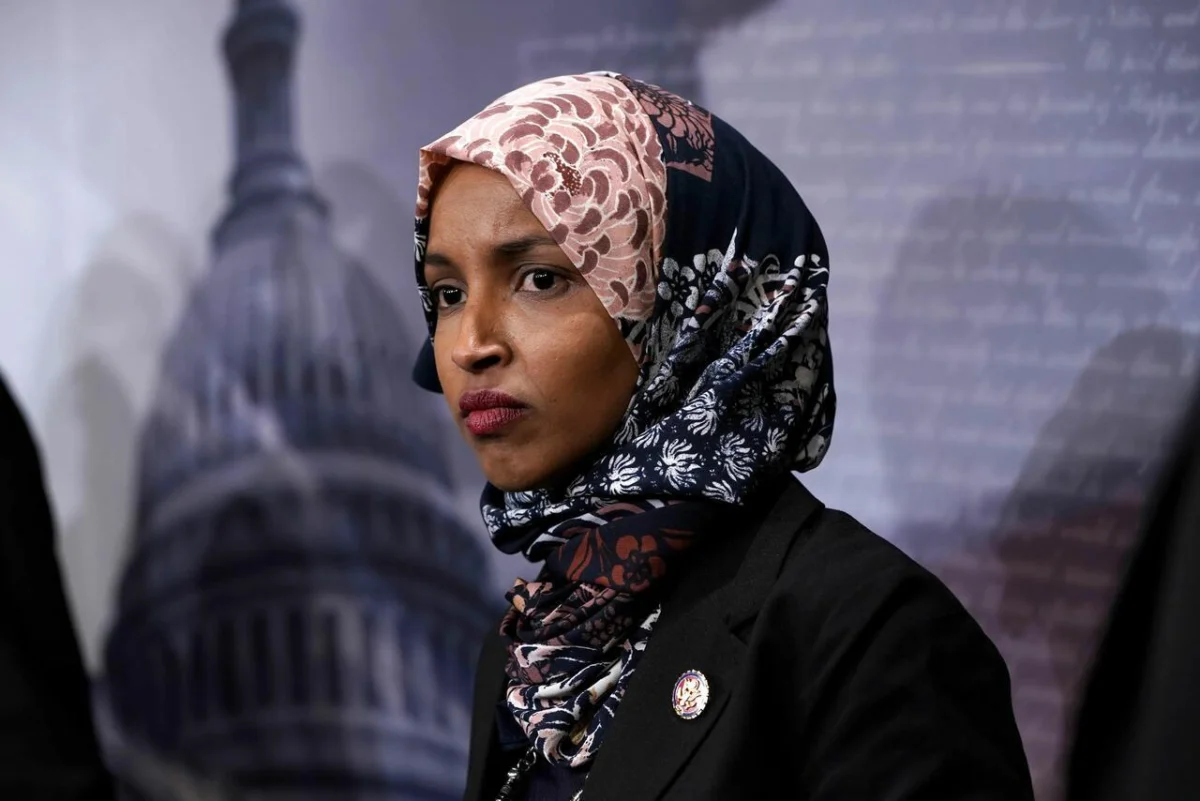
Former President Donald Trump reignited a persistent controversy on Sunday by sharing a Just the News article on Truth Social, which carried the headline "ICE refuses to disclose records on Ilhan Omar fraud probe, cites ongoing ‘enforcement proceedings.’" This decision to amplify the report, without adding personal commentary, immediately thrust years-old allegations against Representative Ilhan Omar (D-Minn.) back into the public discourse. While the Immigration and Customs Enforcement (ICE) response cites a specific legal exemption, it notably refrains from confirming that Rep. Omar herself is the direct target of any active enforcement proceeding, leaving the precise nature and scope of the alleged "enforcement proceedings" ambiguous.
The allegations concerning Rep. Omar’s marital history and potential immigration fraud have been a recurring theme in conservative media and political circles for several years. These claims primarily revolve around accusations that she married her brother, Ahmed Nur Said Elmi, for immigration purposes, and that she may have been simultaneously married to two individuals at different points in time. Such allegations, if proven true, could carry severe legal consequences, including immigration fraud charges or denaturalization proceedings. However, it is crucial to note that no court has ever established these claims as fact, and Rep. Omar has consistently and vehemently denied them.
Background of a Protracted Controversy
The controversy first gained significant public traction during Rep. Omar’s 2016 campaign for a seat in the Minnesota House of Representatives. At that time, blog posts and conservative news outlets began circulating claims about her marital history, including the assertion that she married her brother and that she remained legally married to her first husband, Ahmed Hirsi, when she wed Elmi. These allegations quickly became a flashpoint, fueling intense scrutiny and partisan debate.
Rep. Omar, born in Somalia, experienced a tumultuous early life, living in a refugee camp in Kenya before arriving in the United States in 1995 as a refugee. Her personal journey, from a refugee to a U.S. Congresswoman, has been a source of both inspiration and intense political targeting. The timeline of her marriages, as has been pieced together from public records and reports, forms the basis of the allegations. She applied for a marriage license with Ahmed Hirsi in 2002 but married him only through a Muslim ceremony, not a civil one. The couple separated in 2008. The following year, 2009, Omar married Ahmed Nur Said Elmi. Their separation, again through a Muslim divorce, occurred in 2011. She subsequently resumed her relationship with Hirsi in 2012. Despite these separations and reunions, Rep. Omar did not file for a formal, civil divorce from Elmi until 2017. She then legally married Hirsi in a civil ceremony in 2018, sixteen years after their initial marriage license application. This complex chronology, particularly the period between 2009 and 2017, is central to the allegations of bigamy and immigration fraud.
The Freedom of Information Act Request and ICE’s Response
The recent development stems from a Freedom of Information Act (FOIA) request filed by Just the News in January 2024. The request sought records pertaining to Rep. Omar’s marriage to Ahmed Nur Said Elmi. FOIA is a federal law that grants the public the right to request access to records from any federal agency. It is a cornerstone of government transparency, though it includes several exemptions that agencies can invoke to withhold information under specific circumstances.
ICE’s response to the FOIA request cited one such exemption: Title 5 U.S.C. § 552(b)(7)(A). This specific provision allows agencies to withhold "records or information compiled for law enforcement purposes, but only to the extent that the production of such law enforcement records or information could reasonably be expected to interfere with enforcement proceedings." The agency stated, "Disclosure of any responsive records at this time could reasonably be expected to interfere with enforcement proceedings."
This particular legal invocation by ICE is significant. Department of Justice guidance for agencies invoking exemption (b)(7)(A) requires a two-step justification. First, the agency must demonstrate a "reasonable likelihood" that a law enforcement proceeding is either pending or contemplated. Second, the agency must show that the release of the requested information could "reasonably be expected to cause some articulable harm" to that proceeding. By citing this exemption, ICE implicitly asserted that it had cleared both hurdles according to its own estimation. This means the agency believes there is indeed an active or planned law enforcement proceeding, and that releasing information related to it would genuinely jeopardize that process.
Understanding "Enforcement Proceedings"
The term "enforcement proceedings" is broad and can encompass a range of actions. In the context of ICE, it could refer to a criminal investigation, a civil immigration proceeding (such as a denaturalization case), or an administrative action related to immigration status. Without further clarification from ICE, the public cannot ascertain the specific nature of these proceedings, nor can it be confirmed whether Rep. Omar is directly the subject, a witness, or merely an individual whose name has appeared in a broader investigation. The agency’s careful phrasing, "stops short of confirming she is personally the target," underscores this ambiguity and highlights the constraints on information disclosure during active investigations. Legal experts often note that agencies are typically cautious about confirming the targets of investigations to protect the integrity of the process and the privacy of individuals who may ultimately not be charged.
The Somaliland Government’s Unsubstantiated Claims
Adding another layer to the complex narrative are the claims made by the government of Somaliland, a self-declared independent territory that split from Somalia in 1991. In March, Somaliland officials reportedly claimed on social media that Omar’s original last name was Elmi before it was changed, suggesting this as evidence supporting the brother-marriage allegations. They further alleged that this evidence "was available, but the Obama Justice Department refused to investigate." It is important to contextualize these claims: Somaliland’s government is not recognized by the international community as an independent state, and its assertions regarding U.S. citizens or U.S. investigations are not official government pronouncements in the same vein as those from recognized nations. Furthermore, these claims have not been substantiated by any U.S. government agency or court.
Rep. Omar’s Consistent Denials
Throughout the years, Rep. Omar and her campaign have consistently and unequivocally denied all allegations of marrying her brother or engaging in bigamy. In 2016, during her campaign for the Minnesota House, her then-campaign spokesman, Ben Goldfarb, stated, "Allegations that she married her brother and is legally married to two people are categorically ridiculous and false." These denials have been reiterated in various forms by her office and supporters whenever the allegations resurface. The absence of any official charges or convictions against her further supports her consistent stance, as U.S. legal processes require substantial evidence to proceed with such serious accusations.
Political Amplification and Broader Implications
Former President Trump’s decision to repost the Just the News article on Truth Social carries significant political weight. As a prominent political figure, his actions often shape narratives and direct public attention, particularly among his base. His amplification of the report, even without direct comment, signals a renewed focus on these allegations within conservative media and political discourse. This move can be interpreted as an attempt to keep the controversy alive, potentially to undermine a Democratic congresswoman, or to highlight what he perceives as a lack of accountability.
The broader implications of this ongoing saga extend beyond Rep. Omar’s individual case. It touches upon critical issues such as the integrity of the U.S. immigration system, the balance between government transparency and law enforcement confidentiality, and the political weaponization of allegations. For the public, ICE’s response, while legally justified, creates a vacuum of information that can be filled by speculation and partisan narratives. The invocation of an "ongoing enforcement proceeding" suggests that federal authorities are indeed engaged in some form of investigation, even if the target and scope remain undisclosed. This situation fuels the debate over how much information federal agencies should release about investigations involving public figures, especially when those investigations are not yet public or have not resulted in charges.
From a legal perspective, the Department of Justice’s guidance on FOIA exemptions emphasizes the need for a legitimate law enforcement purpose. Agencies must demonstrate that disclosure would genuinely impede their work, not merely that it would be inconvenient. The fact that ICE felt compelled to use this specific exemption suggests a degree of seriousness in the underlying "enforcement proceedings." However, without further details, it is impossible to determine whether the proceedings are related to Rep. Omar directly, her associates, or a broader investigation that incidentally involves her name.
The situation also highlights the challenges faced by public figures when allegations, even if unproven, become part of their political narrative. The constant re-emergence of these claims, often amplified by political opponents, can be a persistent distraction and a tool for discrediting. While Rep. Omar has firmly denied the accusations, the lack of definitive public closure from federal agencies allows the controversy to linger, impacting public perception and political discourse.
In conclusion, former President Trump’s recent repost has brought a long-standing and unconfirmed controversy surrounding Rep. Ilhan Omar back into the spotlight. ICE’s decision to withhold records based on an "ongoing enforcement proceeding" confirms that some form of investigation is active, yet it leaves critical questions unanswered regarding its scope and specific targets. As the situation unfolds, the public, the media, and political observers will continue to monitor for any official clarification, balancing the need for transparency with the requirements of law enforcement integrity.

