
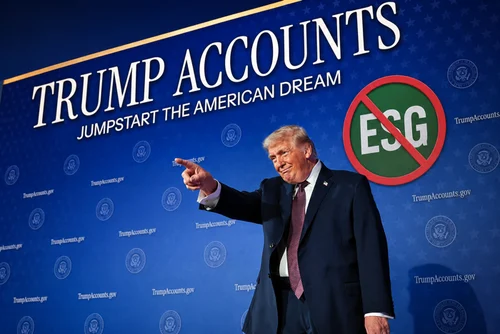
The United States Treasury Department is advancing new regulations designed to exclude investment funds structured around specific environmental, social, and governance (ESG) criteria from "Trump Accounts." This move signifies a broader effort to ensure that investment vehicles associated with the federal program adhere to what the department defines as objective financial metrics, rather than criteria perceived as driven by political or social activism.
Understanding the Treasury’s New Framework
Under the newly proposed framework, qualifying investment indexes for Trump Accounts would be required to track broad segments of either U.S. or global equity markets. The critical distinction lies in the criteria used for index construction: these indexes must rely exclusively on objective financial metrics. This stipulation is intended to prevent the inclusion of funds whose underlying methodologies incorporate non-financial considerations or those perceived as promoting a specific socio-political agenda, often associated with what critics term "social justice" movements.
Treasury Secretary Scott Bessent underscored the administration’s stance in a statement to Fox Business, asserting, "Corporate America has rejected ESG ideology, and we will not allow it to be a part of Trump Accounts." This declaration highlights a fundamental disagreement with the principles and application of certain ESG investing strategies, framing them as an ideological imposition rather than a purely financial consideration. The department’s initiative aims to align the investment options within Trump Accounts with a philosophy prioritizing financial returns and market-driven principles above all else.
The Genesis and Growth of Trump Accounts
The "Trump Accounts" initiative, a significant federal program, was officially launched on July 4, marking a new avenue for federal contributions to individual savings. According to a Treasury spokeswoman, the program has garnered substantial public interest since its inception, attracting more than 7 million registrations. A core feature of the program is its benefit for eligible children, with over 2 million enrolled children qualifying for a $1,000 federal contribution.
These accounts are designed to provide a savings vehicle, potentially for retirement or other long-term financial goals, with a federal incentive to encourage participation. The program’s rapid adoption suggests a significant demand for accessible, government-backed savings options. The Treasury Department’s current action regarding ESG funds is therefore not just a policy decision but one that directly impacts the investment landscape available to millions of American families and individuals participating in this new program. The federal government’s role in shaping the investment choices within these accounts grants its decisions considerable weight and potential influence over broader market trends.
The Contested Landscape of ESG Investing
ESG investing, at its core, refers to a set of standards for a company’s operations that investors use to screen potential investments. Environmental criteria consider how a company performs as a steward of nature. Social criteria examine how it manages relationships with employees, suppliers, customers, and the communities where it operates. Governance deals with a company’s leadership, executive pay, audits, internal controls, and shareholder rights. Initially, ESG factors were championed as a means to identify long-term risks and opportunities that traditional financial analysis might overlook, potentially leading to more sustainable and responsible corporate behavior and, ultimately, better financial performance.
However, over recent years, ESG investing has become a lightning rod for political and ideological debate, particularly from conservative lawmakers and commentators. Critics, including many Republicans, argue that certain ESG standards subordinate investor returns to political or social priorities. They contend that the integration of non-financial metrics can dilute the fiduciary duty of fund managers to maximize shareholder value, diverting capital based on subjective and often politically charged criteria rather than purely economic fundamentals.
Specific Criticisms and Examples
The Treasury Department’s stance echoes a growing chorus of criticism concerning the practical application and perceived inconsistencies within ESG scoring and fund management. One frequently cited example involves the comparative ESG ratings of companies like Tesla and traditional energy or tobacco firms. Critics point out instances where large tobacco companies have reportedly received higher ESG scores than innovative technology companies such as Elon Musk’s Tesla.
Musk himself has been a vocal critic of what he perceives as the arbitrary nature of ESG ratings. Several years ago, he highlighted on X (formerly Twitter) that "Exxon is rated top ten best in world for environment, social & governance (ESG) by S&P 500, while Tesla didn’t make the list!" This observation underscores a central point of contention for critics: the methodology used by rating agencies often produces outcomes that seem counterintuitive to the stated goals of environmental and social responsibility. Tesla, a pioneer in electric vehicles, is viewed by many as inherently aligned with environmental sustainability, making its exclusion from top ESG lists while fossil fuel companies are included, a significant point of contention.

Further illustrating these perceived inconsistencies, earlier this year, MSCI, a leading provider of ESG indexes and ratings, assigned SpaceX, another of Musk’s ventures, the "lowest possible ESG rating." This decision sparked further debate, especially as traditional "Big Oil" and defense companies often secure higher scores. For critics, these examples suggest that ESG frameworks are either fundamentally flawed, easily "hijacked," or intentionally "weaponized" to serve agendas beyond genuine environmental or social impact.
Prominent authors and commentators, such as James Lindsay, known for challenging what he terms "woke narratives," have amplified these criticisms. Lindsay has characterized ESG as a "weapon in the hands of ‘social justice warriors’" designed to "shake down corporations" and as a tool for those attempting to impose a "one-world government." While these are strong rhetorical positions, they reflect a significant segment of the conservative critique that views ESG not merely as an investment strategy but as a vehicle for broader ideological and political transformation.
Historical Context and Political Battlegrounds
The current Treasury Department action is not an isolated event but part of a broader, ongoing political struggle over ESG investing in the United States. The role of ESG in government-managed or regulated funds, particularly retirement accounts, has been a contentious issue across different administrations.
During the Trump administration, the Department of Labor (DOL) issued rules that sought to restrict fiduciaries of retirement plans from considering ESG factors unless they directly related to financial returns. These rules emphasized that investment decisions should be based solely on pecuniary factors. Conversely, the Biden administration subsequently reversed these restrictions, adopting rules that explicitly permitted plan fiduciaries to consider ESG factors when making investment decisions, arguing that these factors could be relevant to financial performance and long-term value. This back-and-forth illustrates the deeply politicized nature of ESG.
Beyond federal policy, the debate has also played out at the state level. Numerous Republican-led states have enacted or proposed legislation aimed at curbing ESG investments by public pension funds and other state entities. These initiatives often involve divesting from funds that incorporate ESG criteria or prohibiting state contracts with financial institutions that promote ESG policies. States like Florida, Texas, and West Virginia have been at the forefront of these efforts, citing concerns about financial returns, fiduciary duty, and the perceived politicization of finance.
The Treasury’s move concerning Trump Accounts can be seen as an extension of this broader conservative pushback, specifically targeting federal programs under its purview. It signals a clear intent to draw a line between what it considers legitimate financial investment and what it views as politically motivated allocation of capital.
Implications and Future Outlook
The Treasury Department’s proposed rules carry significant implications for various stakeholders. For the millions of Americans participating in Trump Accounts, it means a more restricted set of investment choices, deliberately steering them away from funds incorporating ESG criteria. This could be seen as a limitation of investor autonomy by some, while others might view it as a protection against ideologically driven investments.
For ESG fund managers and the broader sustainable investing industry, the exclusion from Trump Accounts represents a potential loss of a market segment, particularly one with federal backing and a growing participant base. It could also set a precedent or signal a continued federal stance that may influence other government-linked investment programs. Fund managers may need to consider how to adapt their offerings or marketing strategies in response to such policy shifts.
For corporations, the Treasury’s action reinforces pressure against adopting certain ESG policies, especially those that are perceived as "activist" or going beyond core business operations. Companies might face increased scrutiny from government entities and conservative investors regarding their ESG initiatives, potentially leading to a recalibration of their sustainability and social responsibility strategies.
More broadly, this decision contributes to the ongoing fragmentation of the financial market along political lines. As ESG becomes increasingly intertwined with partisan debates, investors, companies, and financial institutions may find themselves navigating a complex landscape where investment decisions are influenced not just by economic fundamentals but also by prevailing political winds. This could lead to a bifurcation of investment products and strategies, catering to different ideological preferences.
The immediate next steps involve the formalization and implementation of these proposed rules. While the Treasury Department has signaled its intent, the regulatory process typically involves public comment periods and potential revisions. There is also the possibility of legal challenges from proponents of ESG investing or advocacy groups, who might argue that such exclusions are arbitrary or detrimental to long-term investor interests. The future of ESG investing in federally associated accounts will likely remain a dynamic and contested area, reflecting the broader societal and political tensions surrounding the role of corporations and finance in addressing social and environmental issues.

