

In the dynamic landscape of real estate investment, the distinction between "landlord-friendly" and "tenant-friendly" states has become a crucial consideration for investors aiming to optimize cash flow and return on investment. These labels, while seemingly straightforward, encapsulate a complex web of local laws, regulations, and economic factors that can significantly influence the profitability and operational ease of managing rental properties. Understanding these nuances is paramount for making informed investment decisions.
Defining Landlord-Friendliness in Real Estate
A landlord-friendly state is characterized by a legal and regulatory environment that generally favors property owners and simplifies the management of rental properties. This typically translates to lower entry and operating costs, fewer bureaucratic hurdles, and a more predictable framework for addressing tenant-related issues. However, it is crucial to note that landlord-friendly does not equate to tenant mistreatment. Every state maintains robust tenant protection laws, and responsible landlords prioritize understanding and complying with these regulations. A positive landlord-tenant relationship remains a cornerstone of successful rental property management.
Several key characteristics contribute to a state’s landlord-friendly status:
Lower Property Taxes: A Direct Impact on Cash Flow
Property taxes represent a significant ongoing expense for real estate investors. In 2026, effective property tax rates across the U.S. typically range from 0.25% to 2% of a property’s assessed value. While property taxes are often deductible, leading to a reduction in taxable income, higher tax rates in certain states directly diminish a landlord’s net operating income and, consequently, their capitalization rate (cap rate). Furthermore, the annual increases in real estate taxes can exert consistent pressure on cash flow. Investing in states with lower property taxes can therefore help landlords retain more capital, boosting profitability and enabling greater reinvestment in their portfolios. For instance, states with lower property tax burdens allow for a more favorable cash-on-cash return, a key metric for many real estate investors.
Absence of Rent Control: Preserving Long-Term Growth
Rent control, a set of regulations limiting rent increases and dictating when and how often they can be implemented, is primarily designed to ensure housing affordability and stability for tenants. While these intentions are valid, such measures can impede a landlord’s ability to adapt to rising operational costs. When expenses such as insurance premiums, property taxes, management fees, and repair costs escalate, landlords operating under strict rent control may be unable to adjust rental income accordingly. This can lead to deferred maintenance, potentially diminishing the long-term value of the investment, and stifle revenue growth. Consequently, many new real estate investors opt for states without rent control to safeguard their potential for financial growth and avoid significant financial burdens.
Streamlined Entry and Licensing Requirements: Reducing Initial Costs
Establishing a rental property business often involves navigating a labyrinth of licenses and permits, the specifics of which can vary based on property type, rental strategy (e.g., short-term vs. long-term), and location. Some states impose stringent licensing requirements that can substantially increase upfront setup costs. Landlord-friendly states typically offer a more accessible pathway for investors to establish their rental businesses, minimizing bureaucratic obstacles and reducing initial capital outlay. This can include simplified permit processes or fewer mandatory certifications for property managers and owners.
Uncapped Security Deposits: Enhanced Protection for Landlords
Security deposits serve as a vital financial safeguard for landlords, covering potential losses from unpaid rent or utilities, property damage beyond normal wear and tear, lease violations, and necessary professional cleaning between tenancies. In states that cap security deposits, landlords may find themselves inadequately protected if damages exceed the maximum deposit amount. Moreover, lower security deposit limits can offer less insight into a tenant’s financial stability. Markets without security deposit caps provide greater financial recourse for landlords, although it’s important to note that these states typically expect landlords to set "reasonable" deposit amounts to avoid appearing predatory.
Minimal Notice-of-Entry Requirements: Facilitating Property Management
The ability to enter a rental property with minimal legally mandated notice is crucial for various property management tasks. This includes conducting routine inspections, performing necessary repairs and maintenance, showing the property to prospective tenants, and responding to emergencies. States with short or no notice-of-entry requirements empower landlords to address issues promptly, minimizing potential disruptions and costs. Typically, a 24 to 48-hour notice is standard, allowing for efficient scheduling of tasks without undue delay.
Expedited Eviction Processes: Mitigating Financial Losses
While landlords aim for stable, long-term tenancies, the reality of property management includes the possibility of eviction. Eviction processes can vary dramatically across the U.S., ranging from approximately three weeks to as long as six months from the initial notice to the final lockout. Lengthy and complex eviction procedures can result in significant financial strain on landlords, who may continue to incur holding costs (mortgage, taxes, insurance) without receiving rent. Disgruntled tenants may also cause damage to the property during extended eviction periods. States with streamlined and efficient eviction processes offer landlords a crucial tool to mitigate financial losses and regain possession of their property in a timely manner.

Additional Landlord Protections: Further Incentives for Investment
Beyond these core characteristics, some states offer additional incentives and rights for landlords. These can include the absence of limits on late rent fees, immediate rights to dispose of abandoned property left by tenants, and state preemption laws. State preemption prevents local governments from enacting regulations that are more stringent than state laws regarding rental properties, ensuring a more uniform and predictable regulatory environment.
It is important to recognize that no single state perfectly embodies all these landlord-friendly attributes. The "top" states often represent a balance of these factors, weighed against typical state laws. For example, in the Texas housing market, landlords benefit from no rent control and a relatively straightforward eviction process, but this may be counterbalanced by higher property taxes compared to other landlord-friendly states. Moreover, the influence of local municipalities cannot be overlooked; a state might be generally landlord-friendly, but specific cities within that state could have more tenant-centric regulations. Therefore, thorough research into local ordinances is always essential.
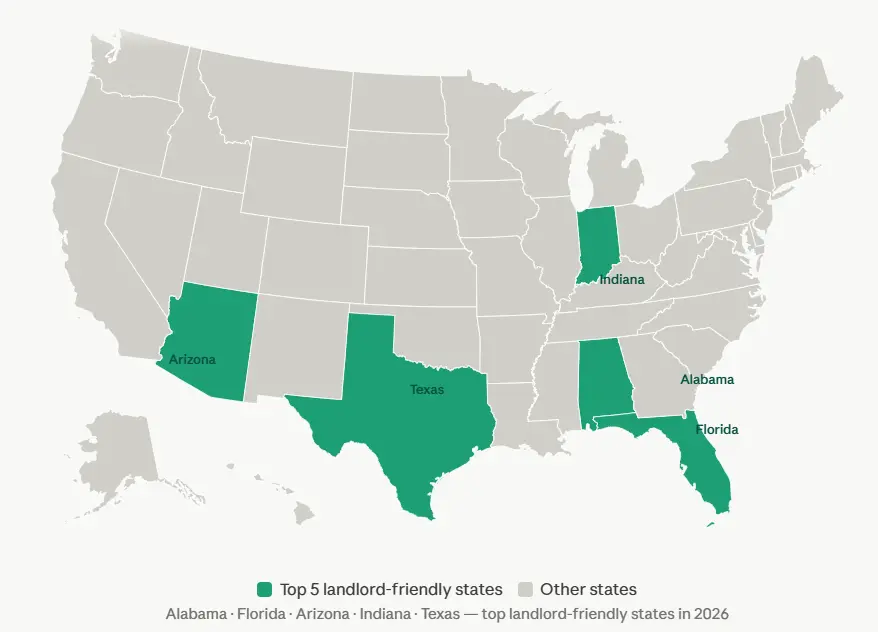
The Top 5 Most Landlord-Friendly States for 2026
Based on a comprehensive analysis of regulatory environments and economic factors, the following five states are identified as leading in landlord-friendliness for 2026:
1. Alabama
Alabama stands out in 2026 as a state with minimal regulations specifically targeting individual landlords, offering a notably permissive environment for rental property owners. The state’s legal framework generally favors property rights and allows for flexibility in lease agreements and property management practices.
- Low Property Taxes: Alabama boasts some of the lowest property tax rates in the nation, with effective rates often well below 1% of assessed property value. This significantly enhances a landlord’s net operating income and overall profitability.
- No Rent Control: The state does not have statewide rent control laws, allowing landlords to set rents competitively and adjust them based on market conditions and rising operational costs.
- Simplified Eviction Process: Alabama’s eviction procedures are generally considered more efficient than in many other states, with shorter notice periods and faster court proceedings, allowing landlords to resolve non-paying tenant situations more quickly.
- Few Licensing Requirements: The barriers to entry for landlords are relatively low, with minimal mandatory licensing or permit requirements for standard residential rental properties.
- Reasonable Security Deposit Laws: While security deposits are permitted, Alabama law generally allows landlords to set reasonable amounts and specifies the conditions for their use and return.
Top Landlord-Friendly City with High Average Cap Rate: Birmingham, Alabama, often presents attractive investment opportunities due to its relatively affordable property prices and steady rental demand, contributing to healthy cap rates for investors.
2. Florida
Florida continues to be a strong contender for landlord-friendly real estate investment, offering a business-friendly climate and robust legal protections for property owners. The state’s growth and tourism economy also contribute to consistent rental demand.
- Low Property Taxes: While not the absolute lowest, Florida’s property tax rates are generally moderate, particularly when compared to the overall cost of living and property values in many desirable areas. Homestead exemptions can further reduce the tax burden for primary residences, but investment properties also benefit from competitive rates.
- No Rent Control: Florida law explicitly prohibits rent control at the local level, ensuring landlords have the freedom to adjust rents to market rates.
- Expedited Eviction Process: Florida has a well-defined and relatively swift eviction process, with specific timelines for notice and court appearances, making it easier for landlords to address lease violations and non-payment of rent.
- Uncapped Security Deposits: Landlords in Florida are permitted to collect security deposits without a statutory cap, providing substantial protection against potential tenant damages or unpaid rent.
- State Preemption: Florida has enacted laws that preempt local governments from enacting certain rental housing regulations, providing a more consistent legal framework for landlords across the state.
Top Landlord-Friendly City with High Average Cap Rate: Jacksonville, Florida, is frequently cited for its strong rental market, diverse economy, and relatively affordable housing stock, leading to competitive cap rates for investors.
3. Arizona
Arizona offers a favorable environment for landlords, characterized by a growing economy and a legal system that supports property ownership rights. The state’s appeal is further enhanced by its attractive tax policies and straightforward regulatory framework.
- Moderate Property Taxes: Arizona’s property tax rates are generally moderate, often falling within the lower to middle range nationally. The state’s valuation methods and assessment appeals process can also provide predictability for investors.
- No Rent Control: Similar to Florida, Arizona prohibits rent control at the state and local levels, allowing for market-driven rent adjustments.
- Streamlined Eviction Process: Arizona has a relatively efficient eviction process, with statutory timelines designed to resolve landlord-tenant disputes without excessive delays.
- No Cap on Security Deposits: Arizona law does not impose a cap on security deposits, offering landlords significant financial protection against tenant-related liabilities.
- Limited Licensing Requirements: The state generally has fewer stringent licensing or permit requirements for landlords compared to some more regulated states, simplifying the startup process.
Top Landlord-Friendly City with High Average Cap Rate: Phoenix, Arizona, a rapidly expanding metropolitan area, offers robust rental demand and a diverse economy, which translates to attractive cap rates and investment opportunities for landlords.
4. Indiana
Indiana provides a balanced approach to landlord-tenant relations, with laws that offer clear protections for property owners while still acknowledging tenant rights. Its competitive real estate market and lower cost of living make it an appealing destination for investors.
- Low Property Taxes: Indiana is known for its relatively low property tax rates, which are a significant factor in boosting investor profitability and cash flow.
- No Rent Control: Indiana does not have rent control legislation, allowing landlords to adjust rents based on market dynamics and economic conditions.
- Efficient Eviction Process: The state’s eviction process is considered relatively efficient, with defined legal steps that allow landlords to address issues with non-paying or problematic tenants in a timely manner.
- Uncapped Security Deposits: Landlords in Indiana can collect security deposits without statutory limitations, providing a crucial financial buffer against damages and unpaid obligations.
- Minimal Bureaucracy: Indiana generally features a less burdensome regulatory environment for landlords, with fewer complex licensing or permit requirements compared to some other states.
Top Landlord-Friendly City with High Average Cap Rate: Indianapolis, Indiana, offers a large rental market with diverse housing options and a growing job sector, contributing to strong rental demand and favorable cap rates for investors.
5. Texas
Texas presents a compelling case for landlord-friendly investment, driven by its robust economy, rapid population growth, and a legal framework that generally favors property owners. While property taxes can be higher, this is often offset by other favorable aspects.
- Moderate to High Property Taxes: Texas is known for its relatively high property tax rates. However, this is often a trade-off for other landlord-friendly policies, and the state’s strong appreciation potential can mitigate this factor.
- No Rent Control: Texas has a statewide ban on rent control, allowing landlords to set and adjust rents freely in response to market demand and operational costs.
- Expedited Eviction Process: The eviction process in Texas is designed to be relatively quick and straightforward for landlords, with clear legal procedures for notice and court filings.
- Uncapped Security Deposits: Texas law does not impose a cap on security deposits, providing landlords with significant financial protection against tenant-related damages and outstanding debts.
- Strong Landlord Rights: Texas law provides landlords with considerable rights concerning late fees, abandoned property, and the ability to enter properties under specific circumstances, further enhancing their operational control.
Top Landlord-Friendly City with High Average Cap Rate: Houston, Texas, offers a vast and diverse rental market, fueled by a strong job economy and a lower cost of entry compared to some other major Texas cities, often resulting in attractive cap rates for investors.
The Strategic Appeal of Tenant-Friendly Markets
While landlord-friendly states offer clear advantages, it is important to understand why some investors deliberately choose to invest in tenant-friendly markets. These markets, despite their regulatory challenges, can present unique opportunities. For instance, a Q4 2025 Redfin report highlighted a significant increase in investor purchases in Milwaukee, Wisconsin, a market with increasingly renter-centric regulations that lengthen eviction timelines and impose stricter requirements on security deposits and inspections.
Daryl Fairweather, Chief Economist at Redfin, emphasizes that "Landlord-friendly and tenant-friendly labels can be helpful, but they can be too broad to guide an investment decision on their own. What matters more is the underlying economics (fundamentals) of a market, like home prices, rent levels, job growth, and long-term demand." She further notes that a landlord-friendly market with weak fundamentals might underperform a tenant-friendly market with strong population growth and tight supply. Therefore, investors should consider the regulatory environment as just one piece of a larger puzzle.
Fairweather also cautions against assuming that landlord-friendly markets are inherently low-risk. "Landlord-friendly doesn’t always mean low risk. Typically in some of these markets, rapid investor activity has already driven up prices, which can compress yields. There’s also the risk of overbuilding or economic volatility. Just because regulations are favorable doesn’t mean the investment will perform well. Always start by paying close attention to fundamentals like affordability, migration trends, and local employment."
Navigating Tenant-Friendly Markets: Expert Strategies
For investors considering or already operating in tenant-friendly markets, adapting strategies is crucial. Rent control, a significant concern, can be managed by focusing on the purchase price to ensure the initial basis makes sense given future rent constraints. Minimizing turnover and vacancy through property maintenance and strong tenant relationships becomes paramount. Investors might also explore properties where allowable increases, such as inflation-based adjustments or capital improvement pass-throughs, can help offset costs over time.
Fairweather advises a conservative underwriting approach and professional operations in tenant-friendly states. This includes rigorous tenant screening, setting rents appropriately from the outset, and budgeting for potentially longer timelines when issues arise. A deep understanding of local regulations—notice periods, eviction timelines, and rent increase rules—is essential to avoid unexpected challenges. Engaging local property managers or legal experts is particularly recommended for first-time investors in such markets.
The Nuance of Investment Decisions: Beyond Labels
Ultimately, the distinction between landlord-friendly and tenant-friendly states should not be the sole determinant of an investment decision. As Fairweather points out, "That’s increasingly true. What we’re seeing now is that investors are prioritizing fundamentals over labels. A market like Milwaukee, for example, may be considered tenant-friendly, but if it offers relatively affordable entry points and stable rental demand, it can still be attractive. Meanwhile, some traditionally landlord-friendly markets—like parts of Florida—have cooled due to rising prices and insurance costs. So today, the more important question is: ‘Does the deal make sense given the local market conditions?’ Regulation matters, but it’s not the whole story.”
The key to successful real estate investment lies in a thorough analysis of market fundamentals, including affordability, migration trends, employment growth, and local demand, alongside the regulatory environment. Investors must scrutinize the specific numbers of any potential deal and understand the prevailing market conditions. Platforms that provide comprehensive data and analytical tools can be invaluable in this process, enabling investors to underwrite deals effectively and identify profitable opportunities in any market.

