
Japanese Finance Minister Satsuki Katayama is poised to announce as early as Monday, August 5, 2026, that Tokyo and Washington have been actively coordinating on significant steps in the foreign exchange market. The joint effort aims to curb the persistent weakness of the Japanese yen, a development that signals a potential paradigm shift in global currency dynamics and economic policy. This unprecedented collaboration underscores the severity of the yen’s recent depreciation and the deep concern among leading economies regarding its broader implications for financial stability and global capital flows.
The precise details of the announcement are still being finalized, according to a person familiar with the situation who requested anonymity given the non-public nature of the information. However, multiple reports indicate that Minister Katayama will confirm the joint action, reinforcing a shared commitment between the two economic powerhouses to combat what they collectively deem as excessive and disruptive declines in the yen’s value. This public declaration marks a departure from Japan’s typical "no comment" stance on currency intervention and highlights the strategic importance of securing visible U.S. support for such an operation.
The Yen’s Precipitous Decline and the Catalyst for Intervention
The decision to intervene comes after a period of intense pressure on the yen. Just two days prior to the reported intervention, the Japanese currency was "flirting around the weakest levels since 1986," briefly touching rates that had not been observed in nearly four decades. This prolonged weakness had raised alarms within Japan, threatening to inflate import costs, squeeze corporate profits for non-exporters, and potentially undermine consumer confidence. For weeks, the Bank of Japan (BOJ) and the Ministry of Finance (MOF) had been under increasing domestic and international scrutiny to address the issue, with officials resorting to verbal warnings, or "jawboning," to deter speculative selling.
The primary driver behind the yen’s depreciation has been the stark divergence in monetary policy between the Bank of Japan and the U.S. Federal Reserve. While the BOJ has maintained an ultra-loose monetary stance, keeping interest rates near zero to stimulate its economy, the Federal Reserve has embarked on an aggressive tightening cycle to combat inflation. This significant interest rate differential has made the yen an attractive funding currency for carry trades, where investors borrow in yen at low rates to invest in higher-yielding assets abroad, particularly in the U.S. This persistent capital outflow exacerbated the yen’s downward trajectory against the dollar.
Friday’s Coordinated Action and Immediate Market Response
The concrete action began to unfold during New York trading hours on Friday, August 2, 2026. Japanese authorities reportedly intervened directly in the market, buying yen and selling dollars. This intervention was not merely a unilateral move; it was bolstered by a combination of explicit calls from officials to banks actively trading the currency and public "jawboning" from key figures in both administrations. The coordinated pressure proved effective, leading to a significant rebound for the yen. By the close of New York trading on Friday, the yen strengthened to 157.40 to the dollar, marking its strongest level since early May and reversing some of the steep losses incurred throughout the year. The market reaction underscored the power of coordinated action, particularly when backed by the implicit or explicit support of the world’s largest economy.

The Unveiling of U.S. Support: Secretary Bessent’s "To Do" List
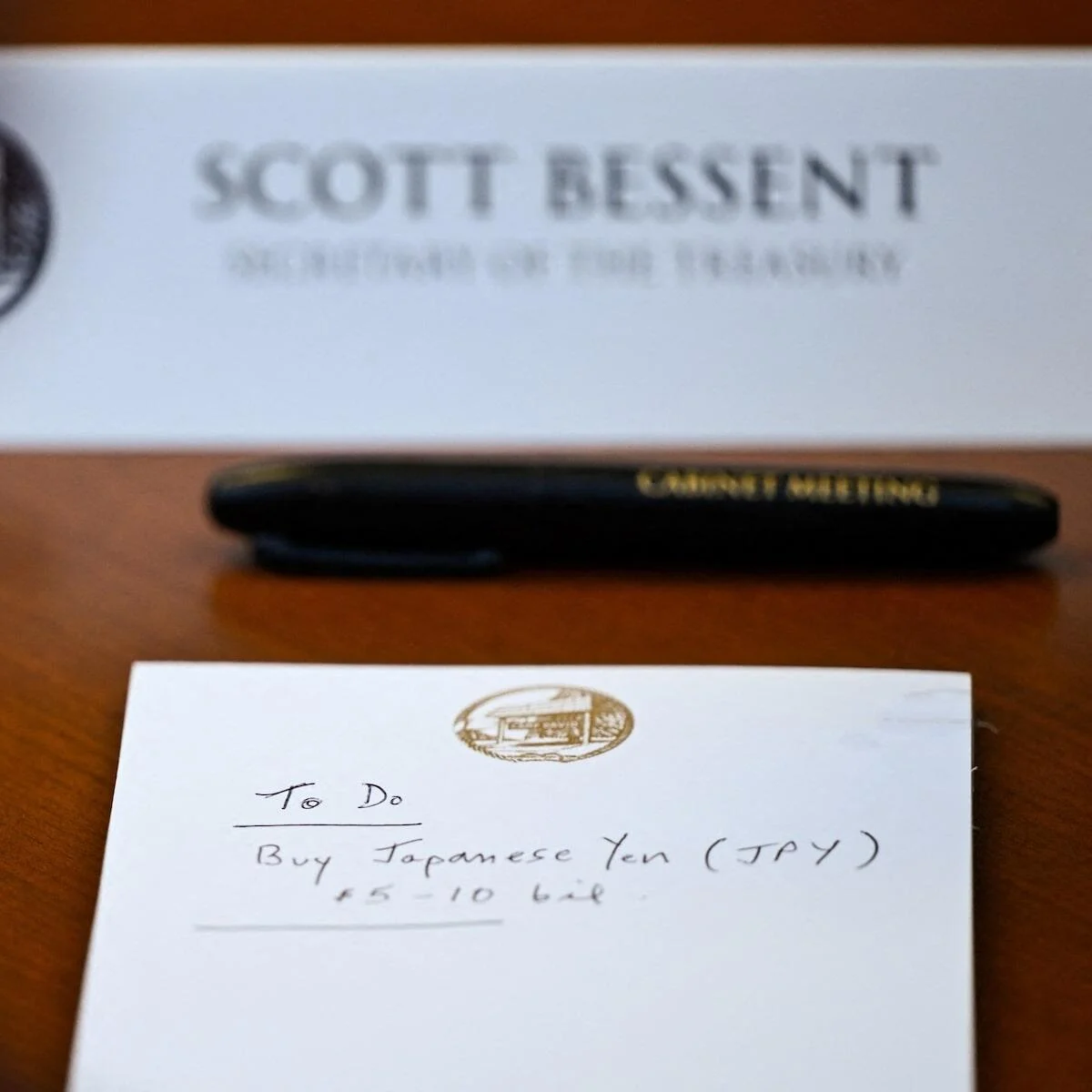
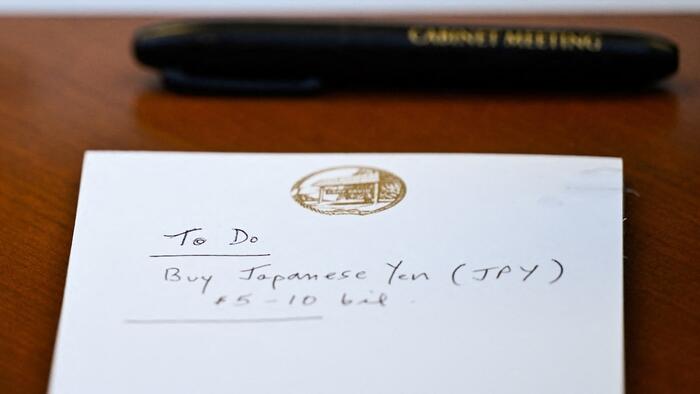
The extent of U.S. involvement became strikingly clear through an unexpected disclosure. Reuters published a photograph taken at a cabinet meeting in Camp David on Friday, August 2, 2026, revealing a notepad in front of U.S. Treasury Secretary Scott Bessent. Under a clear "To Do" heading, the note explicitly stated: "Buy Japanese Yen (JPY) $5-10 bil." This photographic evidence provided irrefutable proof of Washington’s direct engagement and its commitment to support Japan’s efforts. The revelation was particularly significant because it publicly confirmed the U.S.’s active participation, moving beyond subtle hints and into a realm of explicit, coordinated intervention.
Initially, Japan’s strategy appeared to lean towards maintaining a "no comment" stance while the intervention was underway, perhaps offering only veiled suggestions of U.S. backing. This approach was largely adhered to on Thursday and early Friday. However, the confluence of multiple media reports detailing the intervention and, crucially, Secretary Bessent’s inadvertently revealed "to-do list," likely prompted a strategic reassessment. Authorities in both countries may have concluded that a clear, public announcement of joint action would amplify the impact of their efforts and send an unambiguous message to currency speculators. Reuters further reported, citing an unidentified government official, that the operation on joint action is "still ongoing," suggesting sustained vigilance and potential for further coordinated steps.
Historical Context: Echoes of the Plaza Accord

The magnitude of this coordinated intervention has led some market observers to draw parallels with historical precedents, most notably the 1985 Plaza Accord. The Plaza Accord was an agreement signed by the Group of Five (G5) nations—France, West Germany, Japan, the United Kingdom, and the United States—to depreciate the U.S. dollar against the Japanese yen and German Deutsche Mark through coordinated intervention in currency markets. Its primary objective was to address the large U.S. current account deficit, which had become politically unsustainable. The current situation, while different in its specifics, shares a fundamental characteristic: major global economic powers are coordinating to address perceived currency imbalances that threaten global financial stability.
The reference to a "new Plaza Accord" or even the "opening phase of Bretton Woods 2.0" (a nod to the post-WWII international monetary system) by analysts like James Thorne, Chief Market Strategist at Wellington Altus, underscores the potentially transformative nature of this moment. It suggests that the current currency episode is not merely a tactical maneuver but possibly the precursor to a more fundamental restructuring of global financial relationships and frameworks.
Japan’s Role in Global Finance: The Unwinding Yen Carry Trade
For decades, Japan has occupied a central, albeit often understated, position in the global financial architecture, particularly through the mechanism of the "yen carry trade." Since the 1980s, Japan, with its persistently low interest rates and high savings rates, has been a major exporter of capital. Japanese investors and financial institutions have borrowed cheaply in yen and invested these funds in higher-yielding assets overseas, often U.S. Treasuries or other developed market bonds. This flow of capital, driven by the yen carry trade, effectively suppressed global yields, provided abundant liquidity, and helped sustain a financial order built on cheap leverage and central-bank engineering.

However, this long-standing order is now showing signs of significant strain, and perhaps even breaking down. The increasing pressure on the yen to strengthen, whether through unilateral or coordinated intervention, implies an unwinding of this carry trade. If Tokyo must defend the yen by buying its own currency, it often entails selling foreign assets, primarily U.S. Treasuries, from its vast foreign exchange reserves. As Japan is the largest foreign holder of U.S. debt, such a significant seller could trigger a substantial repricing of the long end of the U.S. Treasury market.
Broader Macroeconomic Implications: U.S. Treasuries and Global Rates
The potential for Japan to become a net seller of U.S. Treasuries is a critical implication of this currency intervention. James Thorne emphasizes that U.S. Treasury Secretary Bessent’s involvement signals a recognition within the U.S. Treasury that the long end of the yield curve is being driven by structural flows, rather than solely by the "inflation scare" narrative frequently recycled by Wall Street. If Japan, as a pivotal player in global capital flows, begins to liquidate its U.S. Treasury holdings to prop up the yen, it would inevitably push U.S. long-term yields higher. This would have profound effects on borrowing costs for the U.S. government, corporations, and consumers.
The argument is that the end of Quantitative Easing (QE) by major central banks and the impending end of the yen carry trade signify a fundamental shift. Instead of central banks dictating rates through massive asset purchases, capital markets, driven by supply and demand dynamics and the necessity of currency defense, will increasingly set interest rates. This transition away from an era dominated by central bank intervention towards one where market forces exert greater influence implies a more volatile and potentially higher-rate environment globally.

Beyond Inflation: A Structural Shift in the Global Economy
Thorne’s analysis posits that the current situation is "bigger than a routine currency episode" and fundamentally mislabeled by those who attribute every rise in long-term rates to "inflation risk." He argues that while inflation is a factor, the underlying forces are more structural. Breakeven inflation rates (market-implied inflation expectations) remain anchored, and credit markets are not pricing in a new, rampant inflation regime. The true narrative, he contends, revolves around Japan, the liquidation of global reserves, and a profound global adjustment process that has yet to be fully recognized by many.
Adding another layer to this structural shift is the evolving role of "Big Tech." Historically, major technology companies, with their immense cash reserves and robust profits, often acted as providers of savings, indirectly absorbing duration in capital markets. However, a pivot is underway. These same companies are now demanding significant credit to finance massive investments in AI infrastructure, data centers, advanced chips, and power generation. This shift from being net savers to net borrowers adds further upward pressure on the long end of the yield curve, exacerbating the impact of any reserve liquidation by Japan.
The Path Forward: Finesse, Adjustment, and a New Regime

The upshot of these converging forces is that secular trends are tightening global credit conditions. In this environment, central bankers may need to reconsider their policy stances. Thorne suggests that central bankers will eventually need to cut policy rates to help facilitate this adjustment, as a global economy that has been "hooked on the carry trade cannot go cold turkey." This unwind requires immense "finesse" from policymakers.
While Secretary Bessent appears to be initiating this complex process, there remains a challenge for central bankers and Wall Street to abandon what Thorne describes as "Keynesian dogma" that reflexively treats any rise in the long end of the yield curve as an "inflation scare." The deeper shift, he concludes, is structural. The U.S. economy, under a paradigm of supply-side economics, deregulation, and productive investment, may be moving towards escaping secular stagnation by running hotter. Meanwhile, Japan may finally be restructuring its economy and even its geopolitical role.
This ongoing currency coordination and its broader implications suggest that the global financial system is at an inflection point. It is not merely an inflation story but the nascent stage of a "new regime" where established financial orders are being challenged and potentially reshaped by the interplay of monetary policy, capital flows, technological shifts, and strategic international cooperation. The announcement from Minister Katayama on Monday will, therefore, be scrutinized not just for its immediate currency impact, but for its role as a harbinger of a more fundamental transformation in global finance.

