
The real estate industry, long reliant on meticulous manual processes, is undergoing a significant digital transformation, with the valuation and underwriting of properties at its forefront. For decades, the cornerstone of determining a property’s worth has been the analysis of comparable properties, or "comps." However, the traditional method of manually gathering and reconciling this data has emerged as a critical bottleneck, hindering efficiency, introducing inconsistencies, and limiting scalability. This challenge is now being addressed by the advent of Real Estate Comps APIs, a technological innovation that promises to automate data retrieval, streamline workflows, and empower more informed investment decisions.
At its core, the challenge in real estate valuation lies not in the complexity of the analytical logic, but in the accessibility and quality of the data. Even the most sophisticated underwriting frameworks are fundamentally dependent on timely, consistent, and comprehensive comparable property data. Analysts typically spend countless hours sifting through disparate sources – listing platforms, public records, proprietary databases – to compile datasets that are often fragmented and require extensive reconciliation. As real estate portfolios grow and investment strategies become more complex, these manual workflows become increasingly untenable, slowing down decision-making, increasing the risk of errors, and ultimately limiting an organization’s capacity to evaluate and capitalize on investment opportunities efficiently.
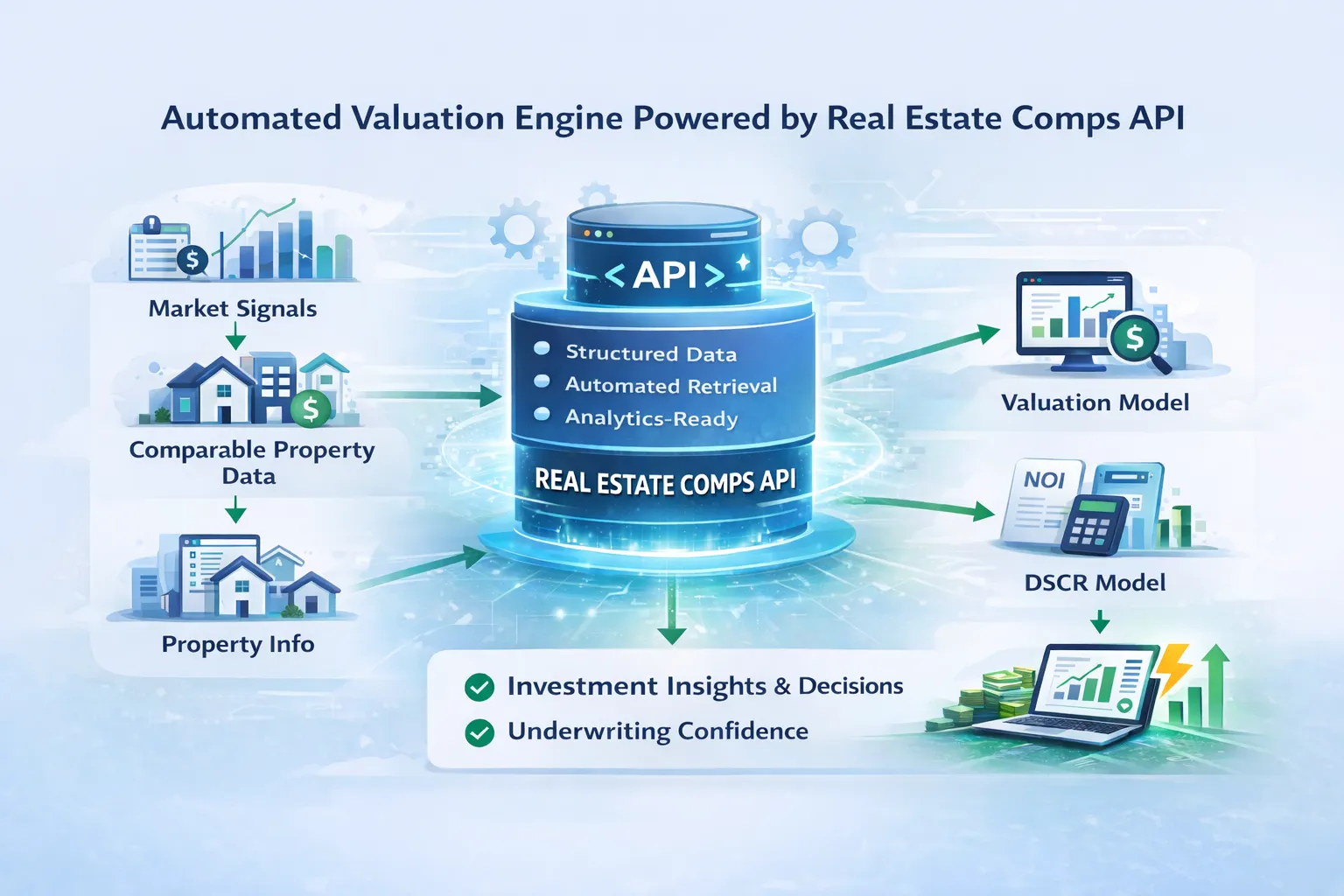
A Real Estate Comps API fundamentally alters this landscape by providing automated, structured access to comparable sales and rental data. This technology enables the creation of faster, more reliable valuation models and significantly enhances the accuracy of Debt Service Coverage Ratio (DSCR) analysis. Consequently, investors, developers, and financial institutions can now seamlessly integrate vital market intelligence directly into their existing technological tools and operational workflows. This guide will delve into the mechanics of comps APIs, explore how platforms like Mashvisor are leveraging this technology to foster smarter valuation and underwriting, outline the specific data endpoints available, and illustrate how businesses can harness automated comparable property data to construct robust and scalable real estate analytics solutions.
The Indispensable Role of Comparable Property Data in Modern Valuation
Comparable property data forms the bedrock of virtually all contemporary real estate valuation methodologies. By analyzing the recent sales and rental performance of similar nearby properties, investors and analysts can derive a credible estimate of a property’s Fair Market Value (FMV) and its potential income generation. These "comps" provide crucial market-based benchmarks against which potential deals can be rigorously compared, offering an objective perspective uncolored by subjective biases.
Defining Real Estate Comps
Real estate comps, short for comparable properties, are assets that share similar characteristics with the subject property under investigation. These characteristics typically include location, size, property type, age, and overall condition. The primary objective of identifying comps is to establish a reasonable price range for the property in question. Traditionally, the focus was predominantly on recent sales of similar homes. However, in the context of investment property analysis, rental comps have become equally, if not more, important.
Consequently, there are two principal categories of comps:
- Sales Comps: These are recently sold properties that share key attributes with the subject property. They are primarily used to establish a property’s market value, particularly for owner-occupied or properties intended for resale.
- Rental Comps: These are similar properties that are currently rented or have recently been rented. They are crucial for evaluating the income potential of investment properties, informing rental rate strategies, and assessing overall investment returns.
Together, these types of comps provide the essential foundation for sound pricing strategies, effective underwriting processes, and comprehensive investment analysis. The ability to access structured and reliable comparable sales and rental data is therefore paramount for investors seeking to build repeatable and scalable valuation frameworks, especially when operating across multiple diverse markets.
The Inherent Limitations of Manual Comp Analysis
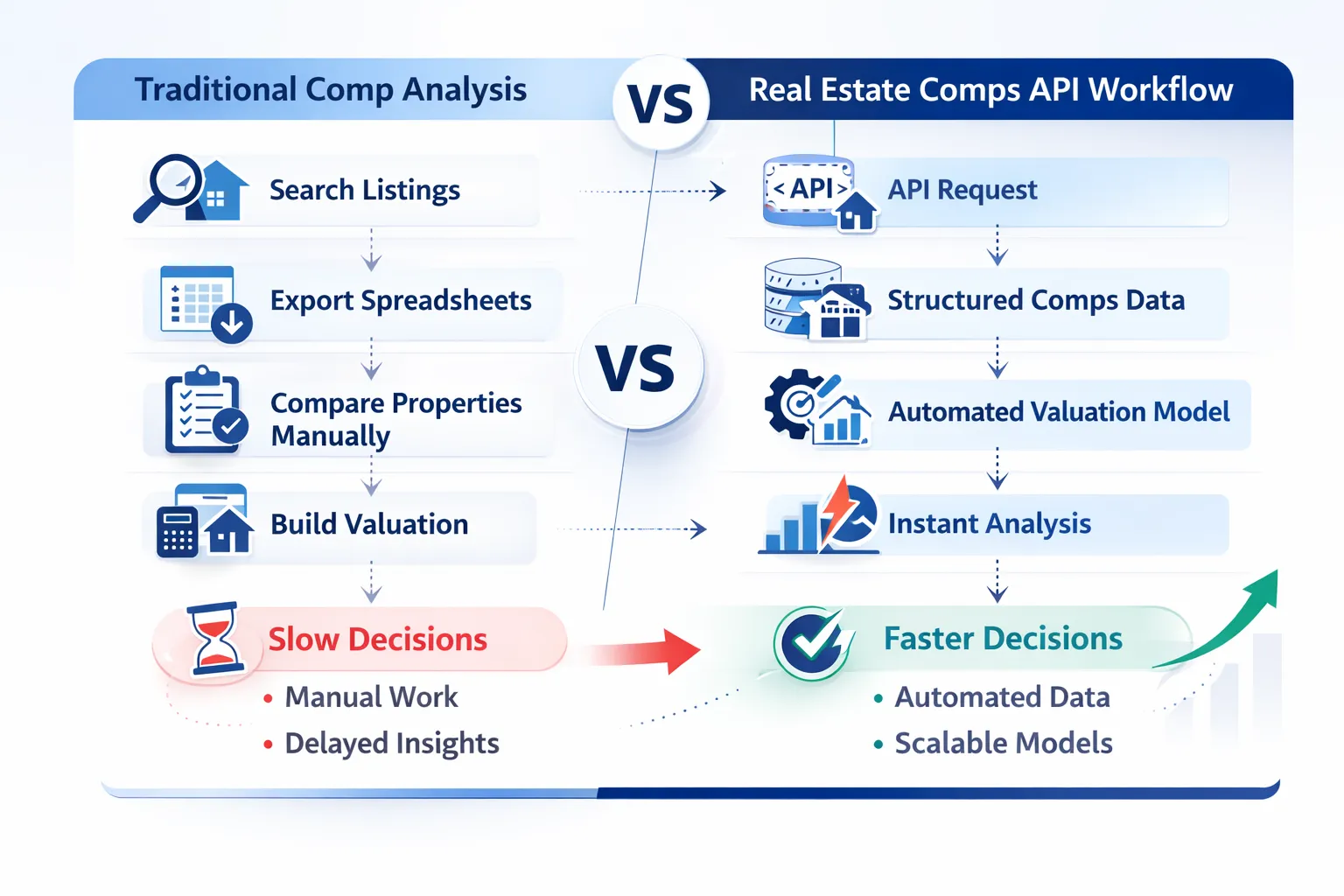
While the concept of using comps is fundamental to valuation, the traditional, manual approach presents significant challenges, particularly concerning scalability. The process often involves laborious manual searches across a multitude of listing platforms, local government databases, and fragmented spreadsheets. This reliance on manual intervention quickly gives rise to several critical limitations:
- Time-Intensive Data Gathering: Analysts spend an inordinate amount of time locating, downloading, and organizing data from various sources, diverting valuable resources from higher-value analytical tasks.
- Data Inconsistency and Inaccuracy: Information pulled from different sources may vary in format, completeness, and accuracy, leading to discrepancies that require extensive manual reconciliation. This can result in flawed valuations.
- Limited Scope and Timeliness: Manual searches are often restricted by the available time and resources, potentially leading to an incomplete set of comparables or outdated data, especially in rapidly shifting markets.
- Scalability Issues: The manual process simply cannot keep pace with the demands of analyzing a growing portfolio or a high volume of potential deals. As the number of properties to evaluate increases, the workflow becomes overwhelmingly slow and inefficient.
- Increased Risk of Human Error: Manual data entry and manipulation are inherently prone to mistakes, which can have significant financial implications in real estate transactions.
These limitations are amplified for professionals and organizations engaged in high-volume deal analysis. Consequently, there is a growing imperative for valuation workflows to transition towards automated data delivery mechanisms, such as APIs, which facilitate the instantaneous retrieval of comps data and its seamless integration into analytical models.
Unpacking the Real Estate Comps API: Functionality and Workflow
A Real Estate Comps API serves as an automated conduit for comparable property data, delivering essential information such as recent sales figures, pricing benchmarks, and detailed property characteristics through structured, programmatic requests rather than manual research. Users initiate a query, typically based on specific location parameters or property criteria, and the API responds with standardized comps data that can be directly assimilated into valuation and underwriting models.
From Static Reports to Dynamic Valuation
Traditional comp analysis typically relies on static reports that require manual generation for each property, or repetitive manual searches. A comps API revolutionizes this by replacing manual underwriting with an automated data retrieval process.
The automated workflow, at a high level, typically unfolds as follows:
- Data Request: An application or user system sends a request to the API, specifying parameters such as property address, geographic area (e.g., city, zip code), property type, and desired search radius.
- Data Retrieval and Processing: The API accesses its comprehensive database, identifies relevant comparable properties based on the provided criteria, and retrieves key data points for each.
- Data Standardization: The API processes the retrieved data, standardizing it into a consistent format (commonly JSON) for easy machine readability.
- Data Delivery: The standardized comparable property data is returned to the requesting application, ready for immediate integration into analytical workflows.
With the assistance of a property comps data API, investors and real estate platforms can access up-to-date datasets on demand. Because the data is delivered in a structured and standardized format, it can be utilized immediately to build repeatable valuation logic across diverse property types and geographical markets.
The Strategic Integration of Real Estate Valuation APIs into Modern Tech Stacks
Comparable property data is increasingly being embedded directly into software workflows, moving away from being a separate, siloed analysis. A real estate valuation API functions as a crucial data layer, powering a wide array of tools and platforms utilized by various stakeholders within the real estate ecosystem.
These stakeholders include:
- Investment firms: For portfolio analysis, deal sourcing, and asset management.
- Lending institutions: For collateral valuation, risk assessment, and loan underwriting.
- Real estate developers: For feasibility studies, market analysis, and project planning.
- PropTech companies: To enhance their existing platforms with robust valuation and analytics capabilities.
- Individual investors and agents: To conduct due diligence and make informed buying or selling decisions.
For those on the technical side, a real estate API designed for developers eliminates the burdensome task of aggregating raw listing datasets or maintaining complex, resource-intensive data pipelines. Instead, an automated property valuation API provides readily usable comps data that can be seamlessly integrated into underwriting systems, investment dashboards, or comprehensive real estate analytics platforms.
Mashvisor Real Estate Comps API: Comprehensive Data, Powerful Endpoints
The efficacy of a comparable sales data API is directly proportional to the quality, structure, and comprehensiveness of the data it delivers. The Mashvisor API distinguishes itself by offering comparable property datasets that are not only rich in detail but also enriched with crucial market benchmarks, investment analytics, and performance indicators, all unified within a single, cohesive real estate analytics API. This integration allows users to transition directly from raw comps to sophisticated valuation and underwriting processes without the need for extensive additional data processing or manipulation.
Key Data Points Accessible via the Mashvisor API
Mashvisor provides meticulously structured comparable property data, designed to support advanced real estate valuation models, precise pricing analysis, and well-informed investment decision-making.
Property-Level Comparable Data:
- Property Details: Comprehensive information on comparable properties, including address, property type (single-family, condo, multi-family), number of bedrooms and bathrooms, square footage, year built, and lot size.
- Transaction History: Details on recent sales, including sale price, sale date, and transaction type.
- Rental Performance: For income-generating properties, data on current rental rates, historical rental income, occupancy rates, and estimated rental yields.
- Property Condition and Features: Information on the condition of comparable properties, such as recent renovations, amenities, and any unique features that might influence value.
Market and Investment Context:
- Market Trends: Data on local market dynamics, including median home prices, average days on market, and year-over-year price appreciation.
- Investment Metrics: Key performance indicators relevant to investors, such as Cash-on-Cash Return, Cap Rate, and Return on Investment (ROI) for comparable rental properties.
- Neighborhood Data: Information on neighborhood demographics, school ratings, crime rates, and proximity to amenities, which can significantly impact property value and desirability.
These comprehensive data endpoints empower users to integrate a sophisticated real estate investment analysis API directly into their acquisition or real estate underwriting pipelines, streamlining the entire due diligence process.
Illustrative Mashvisor API Endpoints
Mashvisor offers a robust suite of API endpoints to facilitate access to comparable property data, catering to a wide range of analytical needs.
Common API Endpoints for Comparable Property Analysis:
GET /v1.1/client/property: Retrieves detailed information about a specific property.GET /v1.1/client/property/nearby: Fetches a list of comparable properties within a specified radius of a given property. This is a cornerstone for valuation analysis.GET /v1.1/client/property/transactions: Provides historical sales transaction data for a property or a set of properties.GET /v1.1/client/property/price-estimates: Delivers automated property valuation estimates based on market data and comparable sales.
These endpoints are meticulously designed to support a fully automated comps workflow, effectively replacing time-consuming manual research with structured, on-demand data retrieval.
Example Request: Retrieving Nearby Comparable Properties
Consider a real estate developer tasked with valuing a potential acquisition. To perform a preliminary valuation, they might use the Mashvisor API to fetch nearby comparable properties. The request would look something like this:
GET https://api.mashvisor.com/v1.1/client/property/nearby?state=AZ&city=Phoenix&address=123+Main+St
Headers:
x-api-key: YOUR_API_KEY
This request would query the API for properties in Phoenix, Arizona, located near "123 Main St," which are suitable for use as real estate comps in a valuation model.
Simplified Example Response
Upon receiving the request, the API would return structured comparable property data in a readily integrable format, such as JSON:
  "subject_property":
    "address": "123 Main St",
    "property_type": "Single Family",
    "price_estimate": 420000
  ,
  "nearby_properties": [

      "address": "118 Main St",
      "sale_price": 415000,
      "beds": 3,
      "baths": 2,
      "distance_miles": 0.3
    ,

      "address": "140 Oak Ave",
      "sale_price": 432000,
      "beds": 3,
      "baths": 2,
      "distance_miles": 0.6

  ]
This standardized JSON structure allows the data to be immediately fed into valuation dashboards and automated underwriting tools without requiring manual formatting or complex data transformation processes.
Building Smarter Valuation & DSCR Models with Mashvisor Data
The integration of comparable property data directly into analysis workflows dramatically enhances the accuracy and scalability of real estate valuation and DSCR models. By automating the retrieval of comps through an API, investors and developers can standardize their assumptions, significantly reduce manual research efforts, and evaluate properties using consistent, data-driven market benchmarks.
Constructing a Property Valuation Model with Comparable Data
Accurate property valuation models are intrinsically linked to the quality of comparable sales data used. These models estimate fair market value based on observable market behavior, rather than relying on subjective pricing assumptions. Leveraging API-delivered comps enables this crucial valuation process to be repeated automatically and consistently across multiple properties and diverse markets.
A simplified workflow for building a real estate valuation model using API-sourced comps might involve:
- Define Valuation Parameters: Establish the key criteria for selecting comparable properties (e.g., proximity, property type, age range, size).
- Automated Comps Retrieval: Utilize the API to fetch a relevant dataset of comparable properties based on the defined parameters for the subject property.
- Data Normalization and Adjustment: Apply standard adjustments to the comparable property data to account for differences in features, condition, or time of sale relative to the subject property.
- Value Calculation: Employ statistical methods (e.g., weighted averages, regression analysis) on the adjusted comps data to derive a fair market value estimate for the subject property.
- Model Output and Review: Generate the valuation report and allow for manual review or further algorithmic refinement.
As comps are delivered through a real estate valuation API, the valuation model can execute automatically whenever new properties are analyzed, ensuring consistent valuation practices at scale.
Harnessing Comps Data for DSCR Model Real Estate Analysis
The Debt Service Coverage Ratio (DSCR) model is critically dependent on realistic income and valuation assumptions. Comparable property data significantly enhances DSCR accuracy by grounding projections in verified market activity. The DSCR formula, DSCR = Net Operating Income / Total Debt Service, measures a property’s ability to generate enough income to cover its debt obligations.
To calculate DSCR for a rental property, analysts typically undertake the following steps:
- Estimate Gross Rental Income: Based on current market rental rates for comparable properties, estimate the potential annual rental income.
- Calculate Vacancy and Credit Loss: Deduct an allowance for potential vacancies and uncollectible rent, informed by local market trends and historical data for similar properties.
- Determine Operating Expenses: Estimate all recurring expenses associated with property ownership, including property taxes, insurance, property management fees, maintenance, utilities, and reserves for replacements.
- Calculate Net Operating Income (NOI): Subtract total operating expenses from the effective gross income (Gross Rental Income minus Vacancy and Credit Loss).
- Identify Total Debt Service: Sum up all annual principal and interest payments on outstanding loans for the property.
- Compute DSCR: Divide the calculated NOI by the Total Debt Service. A DSCR above 1.0 generally indicates that the property’s income is sufficient to cover its debt payments.
Accurate comps are instrumental in reducing risk by preventing the common underwriting errors of overestimated valuations or unrealistic income assumptions.
Automating Rental Property Underwriting Workflows
When comparable property data is delivered programmatically, the underwriting process can transition from a laborious manual review to an efficient, automated evaluation. A typical automation pipeline for rental property underwriting might look like this:
API → Valuation Model → DSCR Calculation → Investment Decision
This form of rental property underwriting automation empowers platforms to:
- Process deals faster: Significantly reduce the time required for due diligence and decision-making.
- Improve consistency: Ensure that all underwriting decisions are based on the same standardized data and methodologies.
- Reduce operational costs: Minimize the need for extensive manual data handling and analysis.
- Enhance risk management: Provide a more objective and data-driven basis for assessing investment risk.
Instead of investing in building extensive internal data infrastructure, teams can leverage a real estate data API partnership to access standardized comps data, ready for immediate integration into their modeling and underwriting systems.
Real-World Example: Automating DSCR-Based Loan Underwriting
Consider a scenario where a lending institution is evaluating a loan application for a rental property. Instead of relying on manual appraisals and extensive spreadsheet analysis, the system can automatically pull comparable property data through an API as soon as the property details are submitted.
The automated workflow would proceed as follows:
- Loan Application Submission: The borrower submits a loan application for a specific rental property.
- Automated Data Fetch: The lender’s system interfaces with the comps API to retrieve detailed information on comparable sales and rental properties in the immediate vicinity.
- Automated Valuation and Income Projection: The system uses the retrieved comps data to automatically generate a property valuation estimate and project potential rental income based on prevailing market rates.
- DSCR Calculation: Using the projected income and the loan terms, the system automatically calculates the DSCR.
- Risk Assessment and Decision: The calculated DSCR, alongside other risk factors, informs the lender’s decision on loan approval and terms.
In this setup, a process that previously might have taken hours or even days is transformed into a repeatable, near-instantaneous operation. Crucially, every loan application is evaluated using consistent, data-driven criteria, minimizing subjective biases and enhancing the overall integrity of the underwriting process. This example highlights just one of many practical applications of a real estate comps API in the financial sector.
Real-World Use Cases for Investors, Developers, and PropTech Teams
The true value of a real estate comps API is realized when it is seamlessly integrated into critical decision-making workflows. Different stakeholders within the real estate ecosystem leverage this technology to optimize their processes in distinct yet complementary ways.
Investors and Acquisition Teams
Real estate investors utilize comparable property data delivered via API to accelerate deal evaluation and ensure consistency across their investment activities in various markets. Common applications include:
- Rapid Deal Screening: Quickly assess the market value and income potential of numerous potential acquisitions to identify promising opportunities.
- Portfolio Valuation: Regularly update the valuation of existing portfolio assets based on current market conditions.
- Pricing Strategy Development: Determine optimal purchase prices and rental rates based on competitive market benchmarks.
- Market Entry Analysis: Evaluate the viability of entering new geographic markets by analyzing local comps and investment metrics.
Access to a centralized, API-driven real estate comps dataset allows investors to standardize their decision criteria and mitigate the impact of personal bias in deal evaluation.
Lenders and DSCR Underwriting
Financial institutions are increasingly relying on automated data workflows to meticulously evaluate borrower risk and collateral value. With API-delivered comps, lenders can:
- Automate Collateral Valuation: Streamline the appraisal process by automatically fetching relevant comparable sales data.
- Enhance Risk Assessment: Improve the accuracy of loan underwriting by using data-driven insights into a property’s market value and income-generating potential.
- Standardize Underwriting Criteria: Ensure consistent application of valuation and risk assessment standards across all loan applications.
- Accelerate Loan Processing: Significantly reduce the turnaround time for loan approvals, improving customer satisfaction and operational efficiency.
This approach aligns with broader industry trends towards automated underwriting, heavily reliant on historical real estate data APIs for informed decision-making.
PropTech Platforms and Developers
For startups and established analytics platforms, comparable property data serves as a fundamental data layer, powering their valuation and analytics tools. Typical developer use cases include:
- Building Valuation Tools: Integrating comps data into proprietary software to offer automated valuation services to their clients.
- Developing Investment Analysis Platforms: Enhancing platforms with robust market data for rental income projections, cap rate calculations, and ROI analysis.
- Creating Market Intelligence Dashboards: Providing clients with real-time insights into property values and market trends based on comprehensive comps data.
- Facilitating Deal Sourcing: Developing tools that identify investment opportunities based on predefined valuation and ROI criteria.
By partnering with a leading real estate data API provider, development teams can launch advanced valuation features without the substantial investment required to build and maintain complex property data pipelines internally.
Mashvisor API Pricing and Getting Started
Mashvisor’s API pricing model is designed to be flexible and scalable, based on usage. This approach ensures that companies can adjust their API access in line with their evolving data needs, making it suitable for a wide range of users, from early-stage startups to established enterprise platforms.
Mashvisor offers both monthly and annual subscription plans. Annual subscriptions provide a cost advantage, typically including two months of service free. The pricing structure is tiered, catering to different levels of data consumption and analytical requirements:
- Tiered Plans: These plans are structured to accommodate varying data volumes and feature access, allowing businesses to select the most appropriate option for their current operational scale and growth trajectory. Specific details on credits, usage limits, and feature access are available through Mashvisor’s official documentation and sales channels.
To initiate the process, prospective users are encouraged to schedule a consultation call with the Mashvisor Data Team. This allows for a personalized discussion of specific needs and helps in selecting the most effective API plan.
The Tangible Benefits of Using Mashvisor for Automated Property Valuation
Leveraging the Mashvisor API for comparable property analysis empowers investors and developers to transition from inefficient manual valuation workflows to scalable, data-driven decision-making processes. The advantages are multifaceted:
- Accelerated Valuation Cycles: Significantly reduce the time required to analyze individual properties and entire portfolios.
- Enhanced Data Accuracy and Consistency: Eliminate human error associated with manual data entry and ensure that valuations are based on reliable, standardized data.
- Scalable Analytics: Effortlessly analyze a growing number of properties and expand into new markets without proportional increases in manual effort.
- Deeper Market Insights: Access a rich dataset that includes not only comps but also market trends and investment metrics, providing a holistic view of investment opportunities.
- Streamlined Workflows: Integrate valuation data directly into existing CRM, underwriting, or portfolio management systems.
- Competitive Advantage: Make faster, more informed decisions than competitors who are still reliant on manual processes.
By consolidating comparable property data with crucial investment analytics on a single platform, Mashvisor enables faster, more reliable property valuation at scale, ultimately fostering more profitable investment strategies.
When a Real Estate Comps API May Not Be Necessary
While the benefits of a real estate comps API are substantial, it’s important to recognize that it may not be the optimal solution for every scenario. A comps API is most impactful when the need arises for large-scale property analysis or direct integration of valuation capabilities into software workflows.
You may not require a dedicated comps API if:
- Analysis is Infrequent and Low-Volume: For individuals or small teams analyzing only a handful of properties occasionally, manual research might still be sufficient and more cost-effective.
- Existing Data Sources are Adequate: If current internal data or readily available public data sources perfectly meet all analytical needs and are consistently updated.
- No Integration with Software is Required: If the output of the analysis is solely for personal use or simple reports, and there’s no need to feed data into automated systems.
- Budgetary Constraints are Severe: While usage-based models can be cost-effective, the initial investment or ongoing subscription costs might be prohibitive for very small operations with limited budgets.
In these specific circumstances, adopting an API might introduce unnecessary complexity and cost. However, the moment the need for faster analysis, consistent benchmarks, or simultaneous evaluation of multiple properties emerges, the value proposition of automated comps data becomes significantly more compelling.
Bottom Line
As the real estate analysis landscape continues its pivot towards data-driven methodologies, valuation and underwriting processes are progressively shifting from manual research paradigms to automated intelligence. In this evolving context, property comps data serves not merely as a one-time input for individual deal analysis but as a continuous, vital component that fuels pricing models, informs risk evaluation, and guides investment decisions across entire portfolios.
A real estate comps API is the critical enabler of this transition, facilitating the direct delivery of consistent market data into automated valuation and DSCR models. This technological advancement empowers teams to analyze opportunities with unprecedented speed while diligently maintaining standardized assumptions across their operations. With scalable access to comparable property data, essential investment metrics, and analytics-ready datasets, Mashvisor empowers investors, lenders, and PropTech platforms to redirect their focus from the labor-intensive task of data collection towards the more strategic imperative of building smarter, more profitable real estate strategies.
Frequently Asked Questions
What Is a Real Estate Comps API?
A Real Estate Comps API provides programmatic access to data concerning similar properties within a defined geographic area. This allows applications and software systems to automatically retrieve sales and market comparisons, integrating this vital data into various analytical functions.
How Is DSCR Calculated for Rental Properties?
The Debt Service Coverage Ratio (DSCR) is calculated by dividing a property’s Net Operating Income (NOI) by its total annual debt obligations. This metric effectively measures whether a property’s generated income is sufficient to cover its loan payments, serving as a key indicator for lenders to assess repayment risk.
Who Uses Real Estate Comps APIs?
Comparable property APIs are widely utilized by a diverse range of real estate professionals, including real estate investors, lending institutions, brokerages, and PropTech platforms. These entities require scalable valuation data for analysis, reporting, and the development of automated real estate analysis systems.
What Makes Mashvisor Different from Other Real Estate APIs?
Mashvisor distinguishes itself by focusing on investment-oriented analytics. It uniquely combines detailed property information with comprehensive market insights and performance indicators, enabling users to evaluate investment opportunities without the need to assemble data from multiple disparate sources.
How Do I Get Comparable Property Data Automatically?
Comparable property data can be accessed automatically by connecting analytical software tools to a data provider’s API. The API returns nearby property information and pricing benchmarks through automated requests, which are typically based on specific location parameters or property characteristics.

