
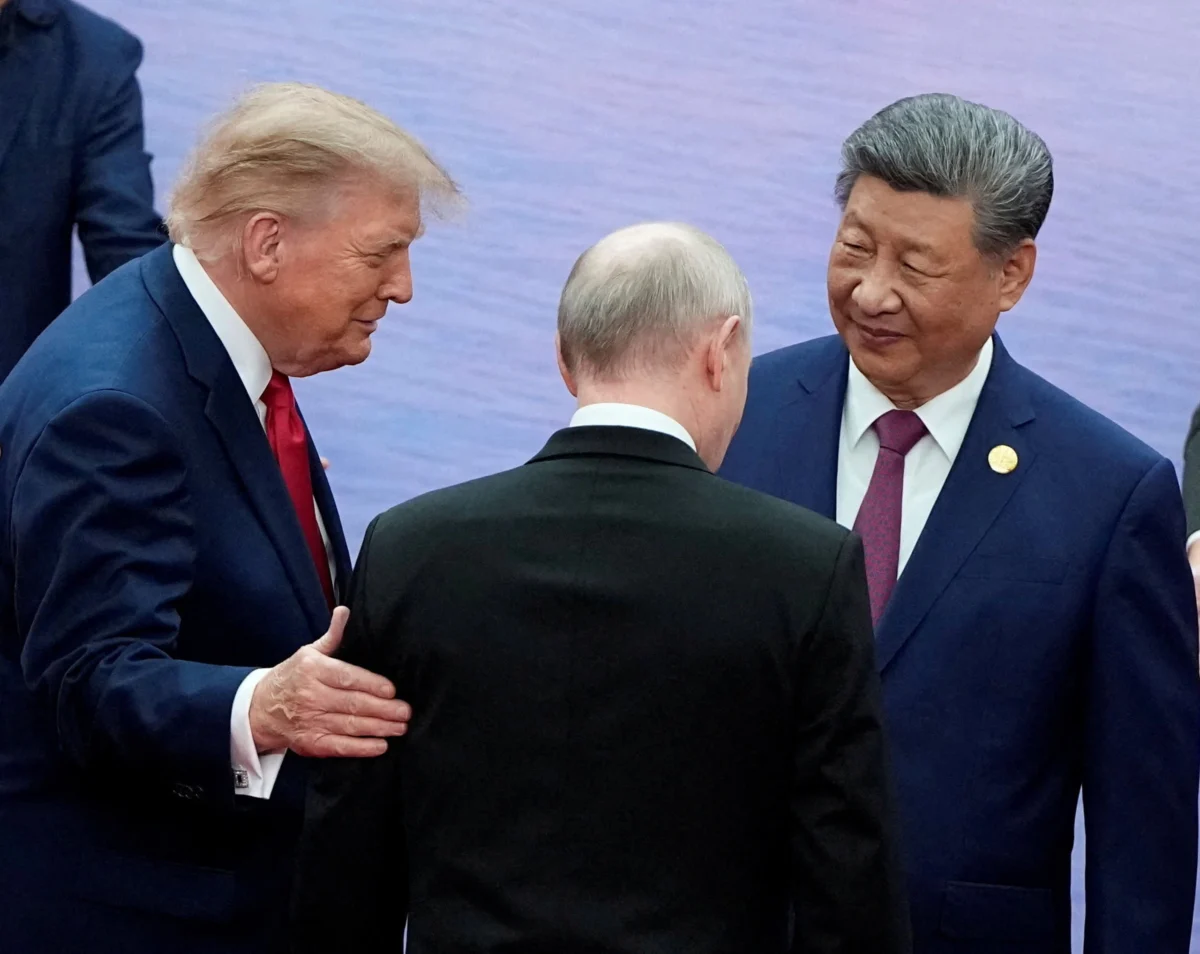
SHENZHEN, China – In a landmark moment for international diplomacy, U.S. President Donald Trump, Russian President Vladimir Putin, and Chinese President Xi Jinping convened for their first-ever trilateral meeting on Thursday, November 19, 2026, on mainland Chinese shores. The high-stakes engagement took place on the sidelines of the Asia-Pacific Economic Cooperation (APEC) Leaders’ Meeting in Shenzhen, following an initial encounter at a welcome banquet the preceding evening. This unprecedented gathering underscores China’s burgeoning influence as a global diplomatic broker and its ambition to shape a more multipolar world order.
The meeting, hosted by Beijing, provided a rare platform for direct dialogue between the leaders of the world’s three most powerful nations, whose relationships are frequently characterized by complex geopolitical competition and strategic divergence. While the optics of the three leaders standing together for a photo session before the welcome banquet on November 18, 2026, in Shenzhen’s gleaming financial district offered a potent visual, the subsequent trilateral discussion aimed at tackling some of the most pressing global challenges, including nuclear disarmament, the ongoing conflict in Ukraine, the volatile situation in the Middle East, and the denuclearization of the Korean Peninsula.
A Strategic Nexus: APEC as a Diplomatic Catalyst
The choice of the APEC summit as the backdrop for this historic meeting was no coincidence. APEC, a forum comprising 21 Pacific Rim member economies, including the United States, China, and Russia, accounts for approximately 60% of global GDP and about half of world trade. Its annual leaders’ meeting is a critical convergence point for economic cooperation and regional integration. By hosting the 2026 summit in Shenzhen, a symbol of China’s economic prowess and technological innovation, Beijing strategically positioned itself at the epicenter of regional and global dialogue.
The city of Shenzhen, a special economic zone that transformed from a fishing village into a megacity in just four decades, served as an apt metaphor for China’s rapid rise on the international stage. Its futuristic skyline and high-tech industries presented a compelling image of a nation ready to host, and indeed shape, the future of global discourse. China’s agenda for APEC 2026, articulated by President Xi Jinping, centered on fostering an "Asia-Pacific community with a shared future" – an iteration of his broader vision for humanity – and enhancing regional connectivity, trade, and sustainable development. As a tangible demonstration of this commitment, Xi announced a $20 million contribution from China to support development initiatives across the Asia-Pacific region.
China’s Ascendant Diplomatic Footprint
The Shenzhen trilateral meeting represents a significant milestone in China’s evolving diplomatic strategy, which increasingly emphasizes its role as a facilitator of dialogue and a provider of international platforms. This marks the second consecutive year President Xi has brought President Putin together with another major world leader on Chinese soil. In September 2025, Xi, Putin, and Indian Prime Minister Narendra Modi shared a cordial photo opportunity during an annual meeting of the Shanghai Cooperation Organization (SCO) in Tianjin, a gathering that notably followed an easing of tensions between Beijing and New Delhi.
These high-profile engagements underscore a deliberate effort by Beijing to project its influence not only across the Global South and Eurasia but also within the traditional "Western orbit," as observed by experts. Jodie Wen, a postdoctoral fellow at the Center for International Security and Strategy at Tsinghua University, noted that China’s "ability to engage directly with the world major powers" reflects its growing influence. "China hopes to play a more constructive role in this conflict-ridden, unstable world," Wen stated, adding that "China will hope to provide more platforms" within its borders for countries to discuss issues in the future.
Indeed, China has been increasingly active in mediating and hosting international negotiations. A prominent example was its successful brokering of the restoration of diplomatic ties between regional rivals Saudi Arabia and Iran in March 2023, a move that surprised many and solidified Beijing’s credentials as a neutral, effective arbiter. These diplomatic successes are part of a broader pattern: official Chinese readouts indicate that President Xi has hosted over 40 heads of state so far in 2026, with at least eight leaders converging around the APEC meetings in Shenzhen alone. This follows an impressive record of receiving over 60 state visits in 2025, according to CNBC analysis. Domestic Chinese media have consistently highlighted these interactions, framing them as evidence of China’s growing international stature and its commitment to multilateralism.
Geopolitical Undercurrents: The US-China-Russia Triangle
The unprecedented nature of the Trump-Xi-Putin trilateral meeting cannot be overstated. Relations between the United States and Russia have been severely strained for years, exacerbated by the conflict in Ukraine, while US-China relations are characterized by intense strategic competition across economic, technological, and geopolitical domains. Simultaneously, Russia and China have deepened their "no-limits" partnership, particularly since 2022, presenting a united front against perceived Western hegemony.
Against this complex backdrop, the willingness of all three leaders to sit together signifies a pragmatic recognition of shared global challenges that necessitate direct communication. For President Trump, the meeting offered an opportunity to directly address critical security concerns with his counterparts, particularly the issue of nuclear weapons reduction. He explicitly stated that the U.S., China, and Russia are "uniquely positioned" to discuss this existential threat, signaling a potential shift towards renewed arms control dialogue. For President Xi, hosting the meeting reinforced China’s image as a responsible major power and a crucial facilitator of global stability, while also demonstrating its ability to engage both friendly and rival powers simultaneously. For President Putin, the trilateral provided a high-profile platform to engage with the leaders of the world’s two largest economies, potentially mitigating some of Russia’s international isolation and asserting its continued relevance in global affairs.
The Substance of Dialogue: Critical Global Challenges
According to a Chinese readout following the trilateral meeting, the discussions covered a range of pressing international issues:
- Nuclear Weapons Reduction: President Trump’s emphasis on this topic reflects long-standing concerns about global nuclear proliferation and the erosion of arms control treaties. With the world’s three largest nuclear arsenals belonging to the U.S., Russia, and China, any progress towards dialogue on this front could have profound implications for international security. The inclusion of China in such a high-level discussion on nuclear arms control is particularly noteworthy, as Beijing has historically been reluctant to join bilateral U.S.-Russia disarmament talks.
- Ukraine Conflict: The ongoing war in Ukraine remains a significant source of international tension. While China has maintained a stated position of neutrality, it has not condemned Russia’s actions and has increased trade and diplomatic ties with Moscow. The discussion likely involved an exchange of perspectives, with the U.S. reiterating calls for a peaceful resolution respecting Ukraine’s sovereignty, and China potentially advocating for de-escalation and a negotiated settlement.
- Middle East Stability: The volatile situation in the Middle East, encompassing the Israeli-Palestinian conflict, regional proxy wars, and the broader challenges of extremism and energy security, was also on the agenda. All three nations have significant interests in the region, albeit often competing ones, making coordinated efforts or at least shared understanding crucial.
- Korean Peninsula Denuclearization: Efforts to denuclearize the Korean Peninsula have seen fluctuating progress over the years. With North Korea continuing its missile tests and nuclear program development, the roles of China, the U.S., and Russia as key regional stakeholders are paramount. Discussions likely focused on pathways to reduce tensions and restart meaningful dialogue with Pyongyang.
Expert Perspectives and Future Implications
The insights from experts underscore the multifaceted nature of China’s diplomatic endeavors. Yue Su, principal economist for China at EIU, highlighted that while Beijing uses "these multilateral platforms as opportunities to expand its international influence and demonstrate its commitment to multilateralism," bilateral diplomacy remains equally important. However, she cautioned that the increasing divergence in geopolitical and economic priorities among nations makes reaching consensus challenging, even within multilateral frameworks. Consequently, Su noted, China’s diplomatic priorities are increasingly "focused on delivering tangible economic benefits through trade, investment, financial connectivity and technology cooperation."
The Shenzhen summit’s capacity to create diplomatic space for future negotiations and potentially meaningful outcomes for crisis management is a key takeaway. As Tsinghua University’s Jodie Wen emphasized, the importance of leaders coming together in person cannot be overstated, as it helps to avoid misunderstandings and further tensions, particularly in an increasingly complex global environment. The physical presence of the leaders, even for a brief period, allows for nuanced communication that virtual meetings often lack.
Looking ahead, the historic trilateral meeting at APEC 2026 in Shenzhen could herald a new era of major power engagement. It signals China’s undeniable emergence as a central player in global governance, capable of hosting and facilitating dialogues among even the most estranged world leaders. While immediate breakthroughs might be elusive given the deep-seated differences, the mere fact of their meeting opens avenues for future discussions and potentially new mechanisms for managing geopolitical flashpoints. The summit reinforces the idea that in an interconnected world, even rivals must find ways to communicate, and China is positioning itself as the indispensable convener for such critical dialogues. The road ahead for global stability remains fraught with challenges, but the Shenzhen trilateral offered a glimpse of a future where multilateral platforms, hosted by emerging powers, play an increasingly vital role in navigating an unstable world.

