
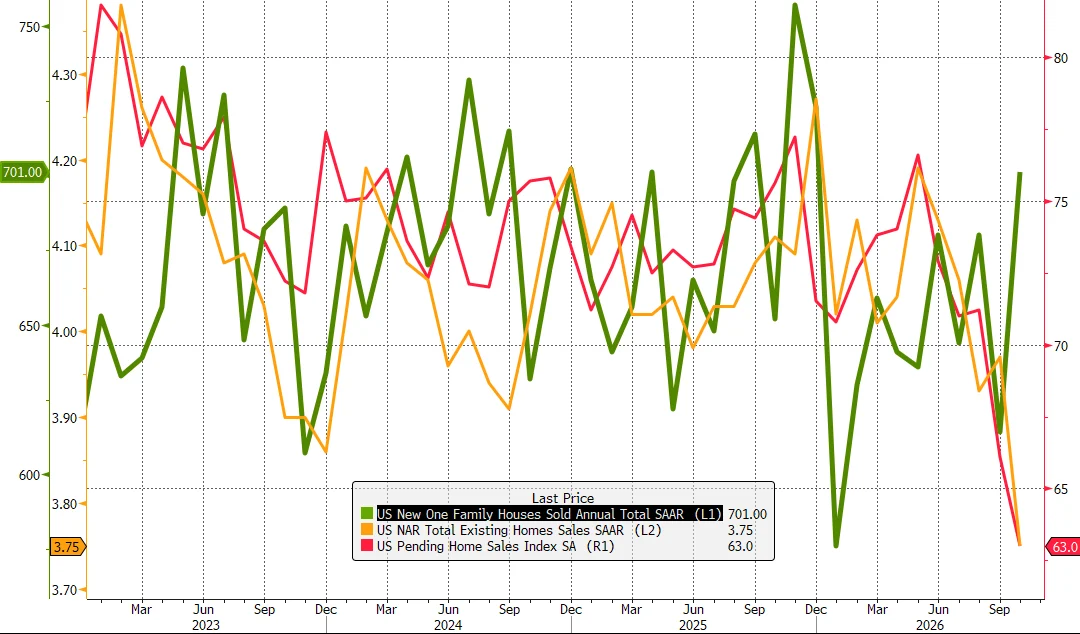
The U.S. housing market presented a paradox in October, as new home sales defied broader industry downturns by surging an unexpected 14.2% month-over-month, even as a dramatic downward revision to September’s figures cast a shadow of volatility over the sector. This unexpected rally in newly constructed homes occurred against a backdrop of persistently high mortgage rates and a struggling resale market, prompting analysts to scrutinize the underlying dynamics driving buyer behavior and builder strategies. The latest data from the U.S. Census Bureau and the Department of Housing and Urban Development revealed that the seasonally adjusted annual rate (SAAR) of new single-family home sales reached 701,000 units in October, significantly surpassing economists’ expectations for a 3.8% decline. However, this seemingly robust performance was heavily tempered by a substantial revision to September’s sales data, which was initially reported as a modest 0.6% dip but was subsequently revised to a precipitous 9.7% crash, highlighting the inherent instability and retrospective adjustments often seen in housing statistics.
The Nuance Behind the Numbers: A Closer Look at October’s Data
The headline figure of a 14.2% increase in new home sales for October certainly captured attention, suggesting a surprising resilience in a housing market otherwise characterized by contraction. This jump pushed the SAAR for new home sales above the critical 700,000 unit mark for the first time in several months, reaching 701,000. Such a performance would typically signal a robust demand environment. However, the context of the prior month’s revision is crucial for a comprehensive understanding. The initial report for September, which indicated a slight 0.6% decline, offered a relatively benign view of the market’s trajectory. The subsequent revision to a severe 9.7% drop, however, paints a much bleaker picture for September and raises questions about the true underlying momentum. This significant adjustment underscores the challenges in interpreting real-time housing data, as initial estimates are often subject to considerable changes that can fundamentally alter market perceptions. The volatility introduced by such revisions makes it difficult for economists and market participants to confidently assess the current health and future direction of the housing sector, suggesting that the October surge might be partially a statistical rebound from an even weaker September than previously understood, rather than a pure acceleration of demand.
A Broader Market Perspective: Existing Sales Lag
The performance of new home sales in October stands in stark contrast to the persistent struggles observed in the broader U.S. housing market, particularly within the existing home sales segment. While new home sales saw an unexpected rise, existing home sales have been plunging, reaching 16-year lows in recent months. Similarly, pending home sales, which are a leading indicator for existing home transactions, have also seen significant declines. This divergence can be attributed to several factors. The existing home market is largely constrained by homeowners who are reluctant to sell. Many current homeowners locked in historically low mortgage rates during the pandemic-era boom, and moving would mean sacrificing those advantageous rates for significantly higher current rates. This "lock-in effect" has severely limited the inventory of homes available for resale, creating a bottleneck that has stifled transaction volumes.
New home builders, conversely, operate on a different dynamic. They are not beholden to existing mortgage rates on properties they already own, and they have the flexibility to adjust pricing, offer incentives, and even alter the size and features of homes to meet buyer demand and affordability constraints. This strategic agility allows new home sales to potentially capture demand that cannot be met by the constrained existing home market, or to attract buyers who are particularly sensitive to price and financing incentives. Therefore, while both segments are influenced by macroeconomic factors like interest rates, their operational models lead to different responses and outcomes, explaining the seemingly contradictory trends observed in recent months.
The Affordability Equation: Prices and Mortgage Rates
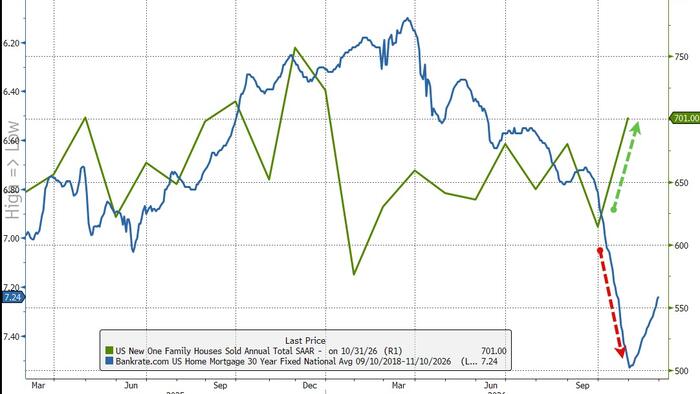
A critical component of October’s new home sales data, and indeed a defining characteristic of the current housing market, is the evolving affordability landscape. The median sales price for new homes decreased to $391,300 in October, marking a 3.2% decline from a year ago. This trend of softening prices is a significant development, especially in the context of the preceding years of rapid appreciation. For potential homebuyers, a reduction in median prices offers a glimmer of hope for improved affordability, although this relief is largely counteracted by the stubbornly high mortgage rates that have become the new normal.
October saw mortgage rates soar, with the average 30-year fixed-rate mortgage reaching levels not seen in over two decades, often hovering near or above 7.79%. This surge in borrowing costs has a profound impact on monthly housing payments, significantly diminishing purchasing power even when home prices moderate. For instance, a buyer financing a $391,300 home with a 20% down payment at a 3% interest rate would have a monthly principal and interest payment of approximately $1,320. At a 7.5% interest rate, that same payment jumps to around $2,195—an increase of over $875 per month. This substantial increase in carrying costs has priced out a significant segment of potential buyers, particularly first-time homebuyers and those with tighter budgets. The Federal Reserve’s aggressive campaign of interest rate hikes, aimed at taming inflation, has been the primary driver behind this rise in mortgage rates, creating a challenging environment where even declining home prices struggle to make homeownership more accessible. The interplay between declining prices and soaring rates creates a complex affordability challenge, where the benefit of one is often negated by the burden of the other.
Builders’ Strategic Adaptations: Driving Demand in a Challenging Market
The relative strength in new home sales, particularly when contrasted with the existing home market, is largely a testament to the proactive and adaptive strategies employed by homebuilders. Faced with a challenging environment of high interest rates and cautious buyers, builders have implemented a suite of incentives designed to stimulate demand and clear inventory. One of the most prevalent strategies has been the offering of mortgage rate buydowns. In these scenarios, builders use a portion of the home sale proceeds to pay down a buyer’s mortgage interest rate, either for the initial years of the loan or for its entire duration. This effectively lowers the buyer’s monthly payments, making homeownership more attainable despite the prevailing high market rates.
Beyond financing incentives, builders are also adjusting their product offerings. There’s an increasing trend towards constructing smaller, more affordable homes to appeal to a broader segment of the market, particularly first-time buyers who are more sensitive to price points. Furthermore, price cuts have become a widespread tactic. A November survey by the National Association of Home Builders (NAHB) and Wells Fargo revealed that 46% of builders reported cutting prices, marking the highest share since they began consistently tracking this metric six years ago. This aggressive pricing strategy, combined with flexible financing and diversified product lines, demonstrates builders’ commitment to moving inventory even if it means accepting lower margins. These tactical maneuvers have been crucial in generating sales in a market where organic demand has been significantly dampened by economic headwinds. Without these concerted efforts, the new home sales figures would likely mirror the declines seen in the existing home market.
Inventory Management and Supply Dynamics: Rebalancing the Market

The housing market’s delicate balance between supply and demand is undergoing significant adjustments, particularly within the new construction segment. Builders have been strategically slowing their pace of construction in response to market conditions, aiming to prevent an overwhelming oversupply of homes and to better align inventory levels with the current, more subdued sales pace. In October, the inventory of new single-family homes for sale decreased by 4.1% from a year ago, totaling 470,000 units. While this represents a reduction, the crucial metric for understanding market balance is the "months of supply."
Months of supply indicates how long it would take to sell all the homes currently on the market at the current sales pace. In October, this figure stood at 8 months. Historically, a balanced housing market is generally considered to have approximately 6 months of supply. A reading above 6 months typically suggests a buyer’s market, where supply outstrips demand, giving buyers more leverage. Conversely, a figure below 6 months indicates a seller’s market. The 8 months of supply in October, while still indicating a market favoring buyers, was actually the least since December 2005. This suggests that despite the slowdown in construction, builders are making progress in working through their existing inventory. The reduction in months of supply, even with a relatively high absolute inventory number, indicates that the sales pace, even with its volatility, is starting to catch up with the available homes. This cautious approach to construction and proactive inventory management are essential for builders to avoid a glut of unsold homes, which could lead to more drastic price reductions and financial strain.
Economic Context and Federal Reserve Influence
The performance of the U.S. housing market, including the nuanced picture presented by October’s new home sales data, is inextricably linked to the broader economic environment and, most significantly, the monetary policy decisions of the Federal Reserve. Over the past two years, the Fed has embarked on an aggressive campaign of interest rate hikes, responding to persistently high inflation that surged in the wake of pandemic-related fiscal stimuli and supply chain disruptions. By raising the federal funds rate, the Fed aims to cool the economy, thereby reducing demand and bringing inflation back down to its target of 2%.
However, a direct consequence of these rate hikes has been a significant increase in borrowing costs across the economy, most notably impacting mortgage rates. As the federal funds rate climbs, so too do the rates on various consumer loans, including home mortgages. This intentional tightening of financial conditions has had a chilling effect on the housing market, making homeownership less affordable for many Americans. The resulting slowdown in existing home sales, coupled with the need for builders to offer substantial incentives, reflects the direct impact of the Fed’s anti-inflationary measures. While the Fed’s actions are deemed necessary to achieve price stability, they inevitably create headwinds for interest-rate-sensitive sectors like housing. The current housing market’s complexity—with some segments showing surprising resilience due to builder ingenuity, while others remain constrained by affordability challenges—is a direct reflection of this ongoing economic recalibration. The future trajectory of mortgage rates will largely depend on the Fed’s assessment of inflation and its subsequent policy decisions, which remain a primary determinant of housing market health.
Expert Commentary and Market Sentiment
The October new home sales report has elicited a range of reactions from economists and industry analysts, reflecting the data’s inherent complexities and mixed signals. Many experts acknowledge the surprising strength of the 14.2% month-over-month increase but are quick to caution against overly optimistic interpretations due to the substantial downward revision of September’s figures. "While the headline number for October is undeniably strong, the context of the revised September data suggests significant volatility rather than a clear upward trend," noted a leading housing economist, who preferred to remain anonymous given the sensitivity of market reactions. "The market remains incredibly sensitive to interest rates, and the resilience shown by new home sales is largely attributable to builders’ aggressive use of incentives, not a sudden surge in underlying demand."

Builder sentiment, as evidenced by the NAHB/Wells Fargo Housing Market Index, has also reflected this cautious optimism. While some builders might feel a slight uplift from the sales figures, many continue to express concerns about ongoing affordability challenges, labor shortages, and rising material costs. "We’re working hard to meet buyers where they are, which means offering significant concessions," stated a representative from a national homebuilder association. "The market isn’t easy, but we’re adapting. The key will be whether these incentives can sustain sales momentum if mortgage rates remain elevated." Analysts generally agree that the market is in a state of rebalancing. While the existing home market is stalled by the "lock-in effect," new construction has the flexibility to adjust. However, this flexibility comes at a cost, potentially impacting builder margins. The consensus remains that the housing market will likely continue to face headwinds as long as mortgage rates stay high and broader economic uncertainties persist, making it a challenging environment for both buyers and sellers.
The Road Ahead: Implications and Outlook
The October new home sales data, with its dramatic surge tempered by a significant prior-month revision, underscores the persistent volatility and evolving dynamics within the U.S. housing market. The short-term implications suggest that while overall housing activity remains subdued due to high interest rates, new construction has found a way to carve out demand through aggressive builder incentives. This strategy, involving mortgage rate buydowns, price cuts, and smaller home offerings, has provided a lifeline for the new home sector, distinguishing its performance from the stagnant existing home market.
Looking ahead, the trajectory of the housing market will largely depend on several critical factors. Foremost among these is the path of mortgage rates. Should inflation continue to moderate, potentially leading the Federal Reserve to pause or even cut interest rates in the future, mortgage rates could ease, providing a much-needed boost to buyer affordability and overall market activity. Conversely, if inflation proves more stubborn, forcing the Fed to maintain a restrictive monetary policy, the housing market will likely continue to grapple with high borrowing costs, prolonging the current challenges. The effectiveness and sustainability of builder incentives will also be crucial. While these strategies have proven successful in the short term, their long-term viability depends on builder margins and their ability to continue absorbing costs. As inventory levels continue to adjust, the balance between supply and demand will remain a key determinant of future pricing and sales trends. The U.S. housing market is clearly in a period of transition, moving away from the pandemic-era frenzy towards a more balanced, albeit challenging, environment. Close monitoring of economic indicators, Federal Reserve policy, and builder strategies will be essential for understanding its future direction and broader economic implications.

