

The global stock market continues to demonstrate remarkable dynamism, consistently reaching new valuations that prompt both excitement and apprehension among investors. This recurring pattern of market ascent, often fueled by transformative technological advancements, inevitably leads to questions about sustainability and the specter of impending corrections. Currently, much of this heightened activity and associated anxiety centers around the burgeoning Artificial Intelligence (AI) sector, which many observers believe is driving a significant portion of recent market gains.

The Current AI-Driven Market Surge
The present AI boom is characterized by several key developments:

- Rapid Technological Advancement: Breakthroughs in machine learning, neural networks, and generative AI have led to the creation of powerful tools like large language models (LLMs) and sophisticated image generation capabilities.
- Widespread Adoption and Investment: Companies across various sectors are integrating AI into their operations, products, and services, driving massive investments in AI research, development, and infrastructure. Major tech firms are pouring billions into AI initiatives, while startups are attracting unprecedented venture capital funding.
- Market Enthusiasm: Investor sentiment has propelled the valuations of AI-centric companies to record highs, with many firms experiencing exponential stock price growth. This optimism stems from the perceived potential of AI to revolutionize industries, enhance productivity, and unlock new economic value.
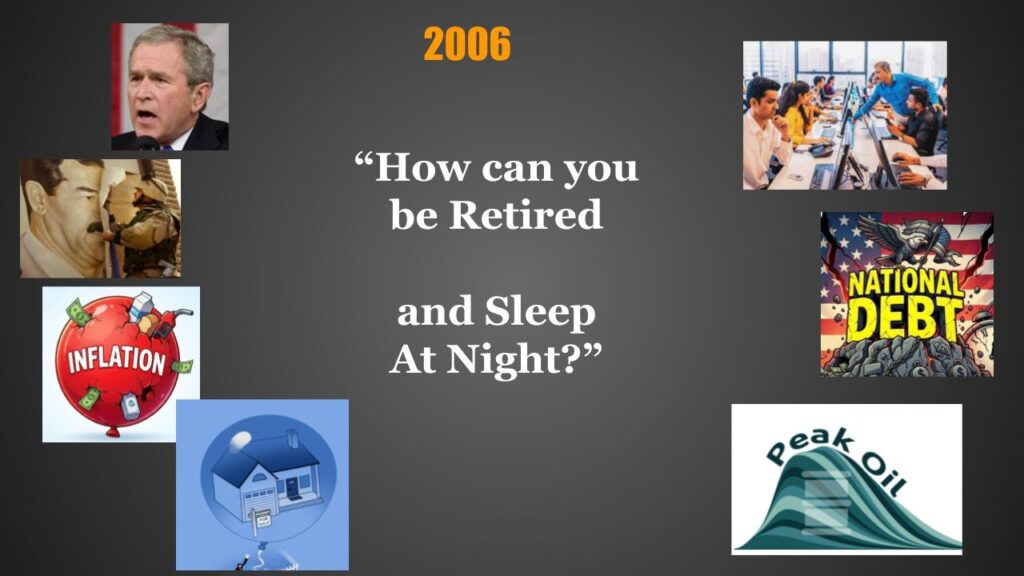
However, this rapid escalation has also ignited concerns among a segment of investors and economists. The prevailing worry is that the current market frenzy around AI may be exhibiting characteristics reminiscent of previous speculative bubbles, particularly the dot-com bubble of the late 1990s and early 2000s. Critics suggest that valuations may be detached from fundamental earnings, raising the probability of a substantial market correction.
A Look Back: Historical Market Cycles and Investor Psychology

Such anxieties are not new to financial markets. Over the past two decades, the global economy and stock markets have navigated a series of significant challenges, yet the overarching trend has been one of long-term growth and resilience. A retrospective view illustrates how market participants have consistently grappled with uncertainty.
For instance, in the mid-2000s, specific concerns dominated the financial discourse:
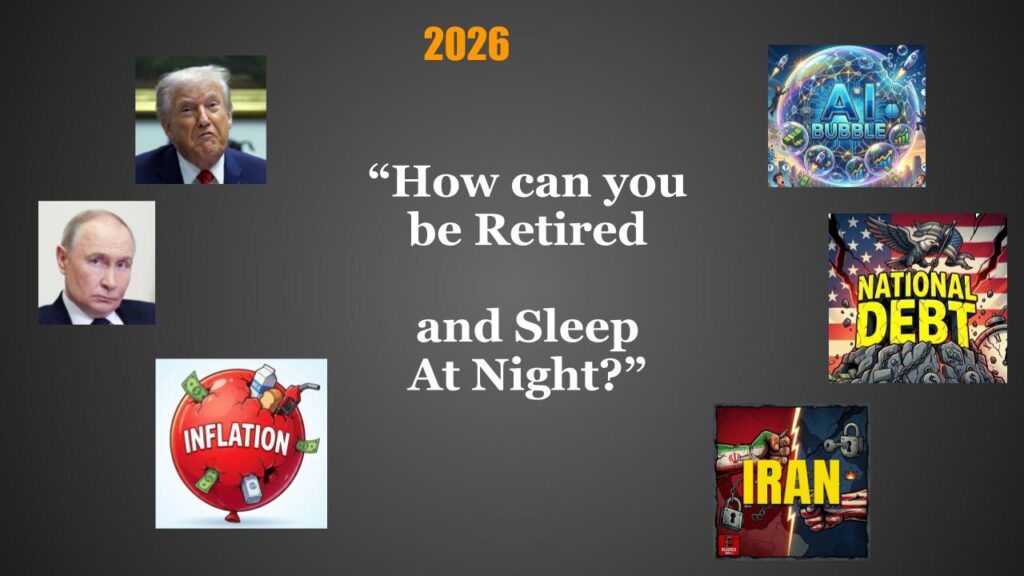
- Geopolitical Instability: The Iraq War and other regional conflicts fueled global instability.
- Housing Bubble Fears: The escalating U.S. housing market raised alarm bells about an unsustainable boom.
- National Debt and Inflation: Persistent concerns about government deficits and the erosion of purchasing power were prominent.
- Outsourcing and Job Displacement: The rise of globalization led to fears that jobs would be irrevocably lost to overseas markets, particularly India and China.
- Peak Oil Debate: A significant debate centered on the notion that global fossil fuel production was nearing its peak, potentially leading to energy scarcity and economic collapse.
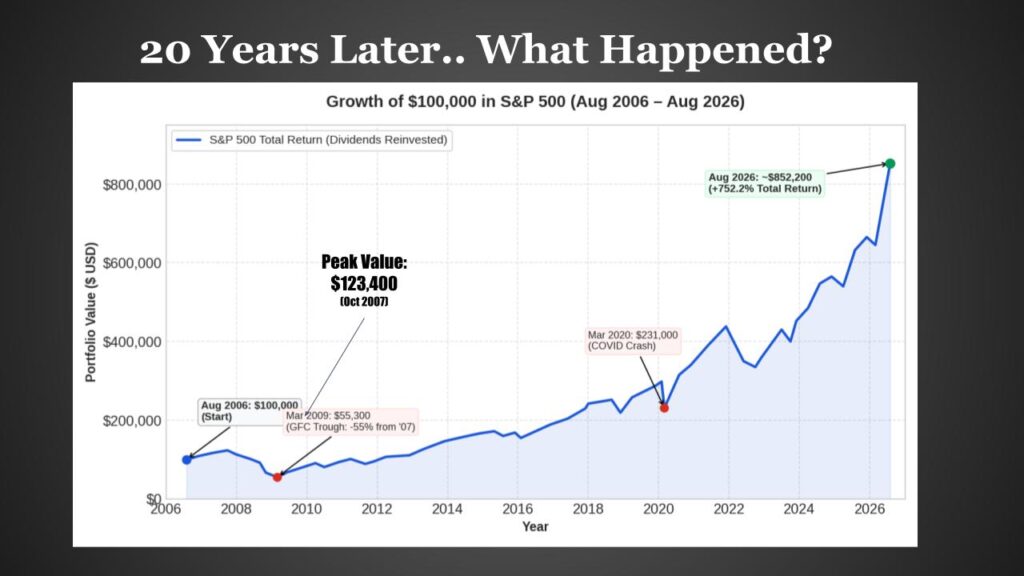
Despite these widespread concerns, the subsequent two decades witnessed substantial economic and social progress. While the Great Financial Crisis (GFC) of 2008, triggered by the collapse of the housing bubble and complex financial instruments, represented the most severe economic downturn since the Great Depression, its impact, when viewed on a long-term investment chart, appears as a significant but ultimately temporary dip. For example, a hypothetical $100,000 investment in a broad market index in 2006, despite the GFC and other subsequent corrections like the COVID-19 crash in 2020, would have appreciated significantly over the two decades, often multiplying several times over. This illustrates the market’s inherent capacity to recover and grow over extended periods.
Global Progress Beyond Market Fluctuations
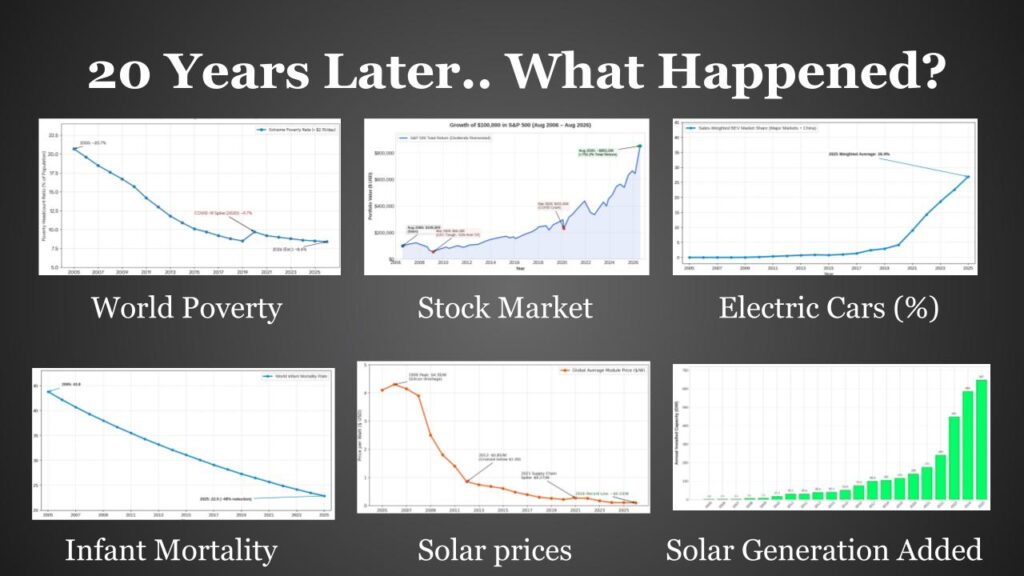
Beyond market performance, the period since the mid-2000s has been marked by profound improvements in various global indicators:
- Poverty Reduction: The proportion of people living in extreme poverty worldwide decreased dramatically, falling from approximately 20% in 2005 to around 8% in recent years. This represents hundreds of millions lifted out of the most dire conditions.
- Improved Health Outcomes: Infant mortality rates, a critical measure of global health and development, were halved over the same period, reflecting advancements in healthcare, sanitation, and nutrition.
- Clean Energy Revolution: The cost of solar panel technology plummeted by roughly 90% in two decades, making clean energy increasingly competitive. Solar power now accounts for a substantial majority of new electricity generation capacity added globally each year.
- Electric Vehicle Adoption: Sales of pure electric vehicles surged from negligible numbers to approximately a quarter of all new cars sold globally in recent years, with some countries like Norway already nearing 100% EV market share. This shift signals a significant move towards sustainable transportation.
These developments underscore a critical insight: sustained human ingenuity and productivity tend to drive progress, often overshadowing immediate fears and market volatility.
Prosperity Rooted in Productivity, Not Just Financial Metrics
At its core, genuine prosperity is derived from productivity – the efficiency with which goods and services are produced. The financial system and stock market, while crucial for capital allocation and wealth generation, are ultimately reflections of this underlying economic activity. When the "numbers on computers" falter, human societies possess the capacity to adapt, restructure, and continue innovating. The response to the 2008 crisis, involving coordinated global efforts to stabilize financial systems, exemplified this ability to redefine economic frameworks and resume productive activity.
Every tool and invention that enhances productivity contributes to a higher standard of living and economic growth. From the agricultural revolution to the industrial age and the information era, each wave of innovation has reshaped economies and created new opportunities, even as it displaced older forms of labor. AI, in this context, can be seen as a "cognitive nail gun"—a powerful tool that dramatically boosts efficiency and intellectual output, making complex tasks faster and more accessible.
AI’s Dual Impact: Opportunities and Challenges

The advent of AI presents a similar duality of opportunity and challenge:
- Enhanced Efficiency and New Industries: AI is expected to accelerate productivity across almost all sectors, from healthcare and manufacturing to finance and creative arts. This will lead to the creation of entirely new industries and job categories that are currently unforeseen, much like the internet and smartphone revolutions.
- Job Displacement: Like all disruptive technologies, AI will inevitably automate certain tasks and roles, leading to job displacement in sectors such as entry-level office administration, data processing, and eventually, transportation. This necessitates proactive strategies for workforce retraining and adaptation.
- Wealth Concentration: The benefits of AI, particularly in its initial phases, tend to accrue disproportionately to the owners of the technology and the capital invested in its development. This can exacerbate existing wealth disparities, a pattern observed in previous technological shifts. Public companies developing or heavily utilizing AI also see their shareholder value increase, benefiting diversified investors.
Managing Fear and Fostering Resilience in Investment
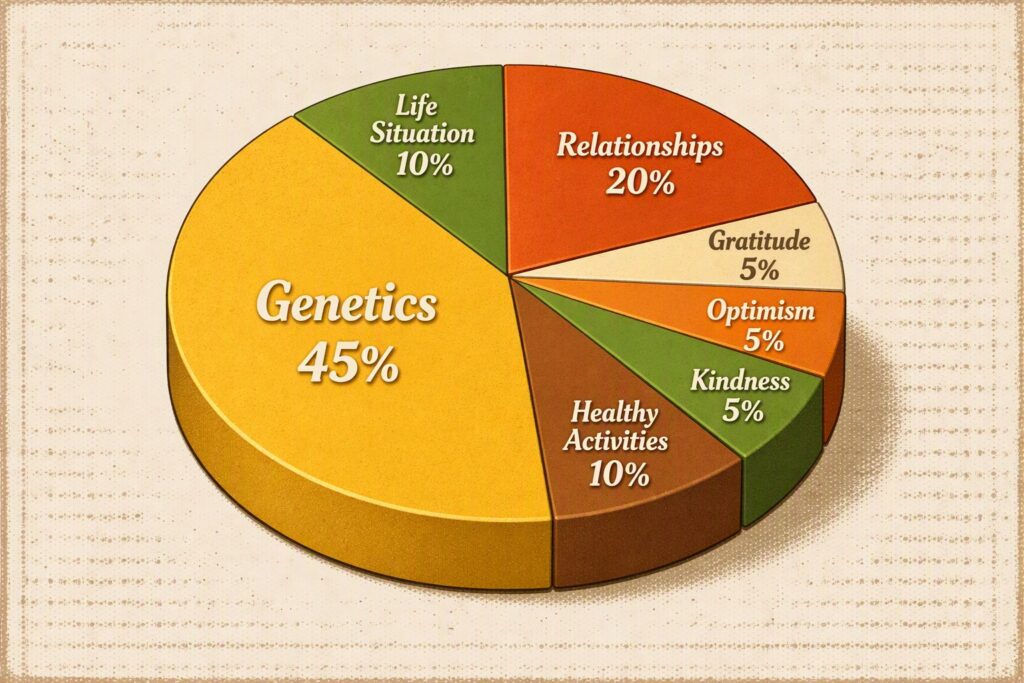
The persistent undercurrent of fear in investment decisions often stems from deeply ingrained human psychological traits. Humans are inherently "danger detection machines," an evolutionary adaptation that once ensured survival. However, in modern society, this mechanism can manifest as chronic anxiety, constantly seeking new threats even in relatively secure environments. Behavioral economics highlights phenomena like "anchoring bias" and the "contrast effect," where individuals judge their current situation against arbitrary benchmarks or past experiences, leading to perpetual dissatisfaction or fear even as objective conditions improve. The "worry about RMDs" (Required Minimum Distributions from retirement accounts for the ultra-wealthy) is a stark example of fear shifting its goalposts from scarcity to the burdens of abundance.
To counter this irrational fear, a multi-faceted approach is necessary for investors:

- Self-Awareness: Understanding personal historical contexts, such as childhood experiences with scarcity or past traumas, can illuminate the roots of financial anxieties. Recognizing that these feelings may stem from personal history rather than objective current reality is the first step.
- Rational Fear Identification: Clearly articulating the worst-case scenario can often reveal its irrationality or manageability. For instance, scenarios of "running out of money" for a well-prepared investor are often far less catastrophic than imagined, involving lifestyle adjustments rather than destitution.
- Action and Resilience: Taking proactive steps, whether in financial planning, skill development, or personal growth, builds confidence and resilience. The ability to adapt to new situations ("Badassity," as some call it) renders uncertainty less daunting.
- Critical Information Consumption: Disengaging from the constant stream of sensationalized news, which often prioritizes fear-mongering for engagement, is crucial. Instead, seeking in-depth, balanced information from reputable sources allows for a more objective assessment of reality.
- Positive Social Connections: Surrounding oneself with optimistic, productive individuals can significantly influence one’s outlook. In communities focused on financial independence (FI), the emphasis is often on proactive living and mutual support rather than market anxieties.
- Embracing an "Experiment" Mindset: Approaching new situations, including major technological shifts like AI, as grand experiments rather than existential threats can transform fear into fascination. This mindset encourages learning, adaptation, and proactive engagement.
Conclusion
The AI era, while presenting significant changes and challenges, is fundamentally another chapter in humanity’s ongoing story of innovation and adaptation. While market corrections are an inevitable part of economic cycles, and AI will bring both immense benefits and disruptive forces, the long-term trajectory of human progress, driven by productivity and ingenuity, has historically proven resilient. Investors who anchor their strategies in a deep understanding of market history, embrace a mindset of learning and adaptability, and consciously manage their psychological biases are better positioned to navigate periods of uncertainty and capitalize on the opportunities that transformative technologies like AI present. As many wise individuals have noted, the greatest barriers to achieving our goals often reside not in external circumstances, but in the fears we allow to dictate our actions.

