
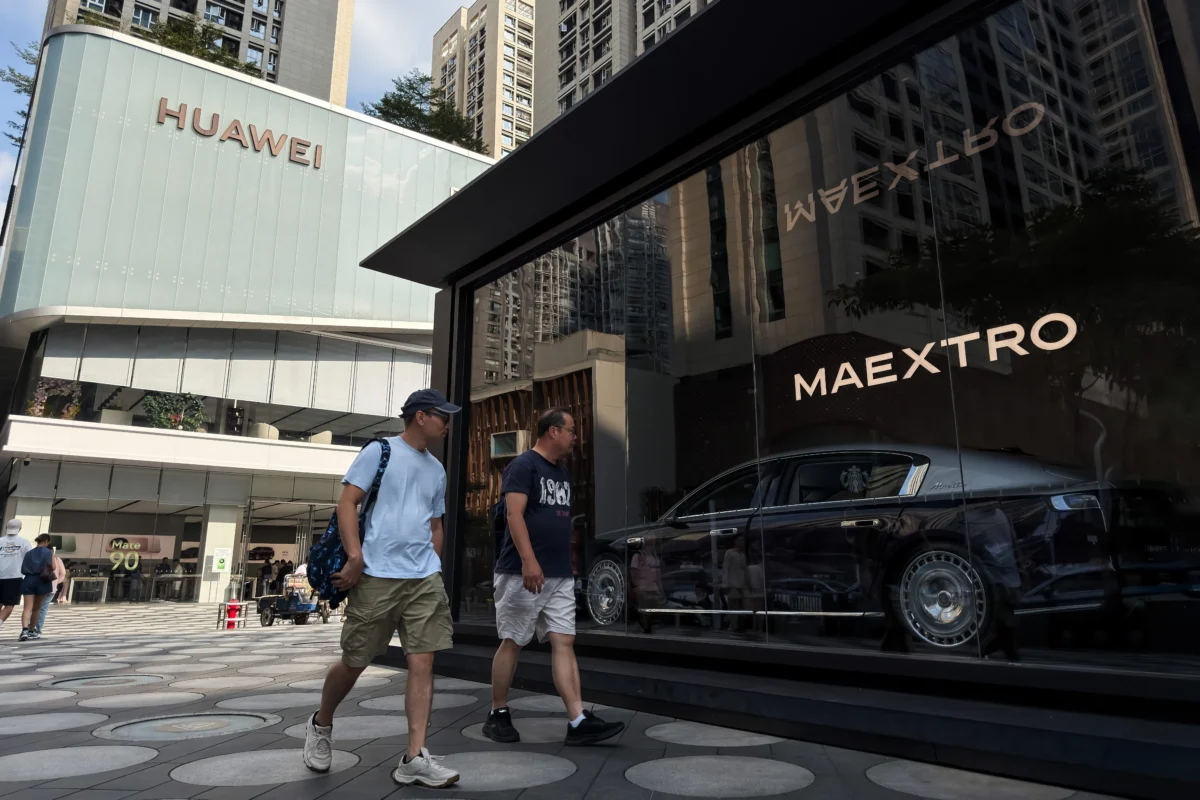
Shenzhen, China – New data released for October reveals a deepening economic malaise in China, with key indicators like retail sales, fixed-asset investment, and industrial output all falling short of economists’ projections. This deceleration underscores a growing reliance on external demand, particularly from the booming global market for AI-related technologies, a dependency that analysts warn leaves the world’s second-largest economy increasingly vulnerable to geopolitical shocks and shifts in international trade dynamics. The grim economic figures were released as two men walked past a Maextro showroom displaying an S800 sedan with a Huawei store visible nearby in Shenzhen on October 9, 2026, a scene that ironically juxtaposes domestic consumer aspirations with the broader economic headwinds.
Deepening Economic Malaise and Missed Projections
The latest economic data paints a concerning picture of China’s internal economic health. Retail sales, a crucial barometer of consumer spending, advanced by a mere 0.4% year-on-year in October. This figure not only missed analysts’ consensus forecast of a 0.8% rise but also marked a significant slowdown from the six-month high of 1.1% recorded in September. The persistent sluggishness in consumer spending is largely attributed to a protracted downturn in the property market, now entering its fifth year, which has systematically eroded household wealth and confidence.
Industrial output, an indicator of factory production, also disappointed, expanding by 4.8% from a year earlier. This fell short of analysts’ estimates for 5.3% growth and represented a sharp deceleration from September’s 5.5%, which had been the highest level in five months. The cooling momentum in manufacturing signals broader challenges for the industrial sector, despite pockets of strength in export-oriented industries.
Perhaps most alarming was the performance of fixed-asset investments, which encompass property, infrastructure, and manufacturing. For the first ten months of this year, these investments contracted by 8.1%, deepening a collapse that has plagued the economy throughout the year and is unprecedented outside the highly disruptive Covid-19 period. This contraction significantly worsened compared to analysts’ expectations for a 7% decline, highlighting a profound reluctance among both state-owned enterprises and private businesses to commit to new projects. The slump reflects a crisis of confidence, aggravated by policy uncertainties and the ongoing property sector turmoil.
The Property Sector’s Persistent Drag
The property market’s woes continue to be a central theme in China’s economic narrative. The sector, which historically contributed as much as a quarter of China’s GDP, has been in a severe downturn since 2021 when developers like Evergrande Group began defaulting on their debts. Strict "three red lines" policies implemented by Beijing to deleverage the sector, while intended to reduce systemic risk, inadvertently triggered a liquidity crunch that has ensnared numerous major developers, including Country Garden. This has resulted in widespread project delays, unfinished homes, and a dramatic fall in property values, directly impacting the wealth of millions of Chinese households who often hold a significant portion of their assets in real estate.
The psychological impact of this prolonged crisis cannot be overstated. With property perceived as a safe haven and a primary vehicle for wealth accumulation, its decline has fostered a climate of caution among consumers. This wealth effect translates directly into reduced spending on non-essential goods and services, exacerbating the retail sales slump. Government efforts to stabilize the market, including interest rate cuts and easing of purchase restrictions in some cities, have so far yielded limited success, failing to restore robust confidence or stimulate a meaningful rebound. The continued erosion of household wealth poses a significant challenge to Beijing’s long-term goal of fostering a consumption-driven economy.
Labor Market Under Strain

The economic slowdown has inevitably spilled over into the labor market. While the overall unemployment rate saw a slight dip to 5.1% in October, this masks persistent structural challenges, particularly among younger demographics. The jobless rate for individuals aged between 16 and 24, excluding students, hovered near its highest level in a year, standing at 18% in September. This high youth unemployment rate is a persistent concern, reflecting a mismatch between the skills of new graduates and the available job opportunities, as well as the impact of regulatory crackdowns on sectors like technology and education that previously absorbed many young workers. A substantial portion of recent graduates face intense competition for a limited number of positions, leading to disillusionment and potential social instability.
The implications of high youth unemployment extend beyond individual hardship. It represents a significant underutilization of human capital, hindering long-term productivity growth and potentially fostering a generation grappling with economic insecurity. Addressing this issue requires not only broad economic stimulus but also targeted policies to bridge the skills gap and create new job opportunities in emerging industries.
A Paradox of Growth: External Strength vs. Domestic Weakness
Despite the domestic struggles, China’s external trade sector continues to demonstrate remarkable resilience and strength. Subdued consumer inflation at home, which ticked down to 0.7% in October after two months of increases, stands in stark contrast to surging exports. October saw exports surge by a more-than-expected 35.2%, a testament to China’s continued dominance in global manufacturing and supply chains.
This strong export performance has propelled China towards another record-breaking trade surplus. By October, the trade surplus had already reached the $1 trillion threshold, marking the fastest it has ever achieved that mark and putting it on track to surpass last year’s record $1.2 trillion surplus. This dual economic reality – robust exports fueling external demand while internal consumption languishes – highlights a significant imbalance in China’s growth model. While exports contribute to GDP growth and provide foreign currency reserves, they do not directly stimulate domestic consumption or address the underlying issues of household wealth erosion and confidence.
AI Demand and Mounting Geopolitical Headwinds
A significant driver of China’s export momentum, particularly in recent times, has been the robust global demand for AI-related technology and equipment. Components, hardware, and specialized machinery crucial for AI development have seen a surge in orders, with China serving as a key global supplier. However, analysts warn that this reliance on a specific, high-growth sector also introduces substantial risks.
Zhiwei Zhang, president and chief economist at Pinpoint Asset Management, noted that "the market was already worried" about a potential slowdown in the AI capital-spending cycle even before recent events. The "Nvidia scandal," referring to renewed scrutiny and restrictions on the flow of advanced chips to China, has intensified these concerns. The U.S. government’s ongoing efforts to limit China’s access to cutting-edge semiconductor technology, citing national security implications, directly impacts China’s ability to produce and acquire advanced AI hardware. "Now the risk has become even more serious," Zhang stated, forecasting further downside risk for global economic growth next year if these tensions escalate.
The increasingly lopsided growth, heavily skewed towards exports, has prompted major trading partners, particularly in the West, to renew calls for China to rebalance its economy towards greater domestic consumption. This push for rebalancing is not merely an economic suggestion but also a political imperative, as countries like the United States and European Union express concerns about unfair trade practices, industrial overcapacity, and the strategic implications of China’s technological advancements.
The headwinds on China’s export engine are expected to intensify next year. Citi Research analysts anticipate further trade restrictions from the European Union, posing a critical downside risk. "More EU trade measures targeting China look plausible to us, potentially adding to tensions ahead," the bank warned. These measures could range from tariffs on specific industries, such as electric vehicles, to broader investigations into state subsidies and market access barriers. While Beijing is likely to be open to negotiating "reasonable, practical concessions," such as import pledges, sector-specific deals, and value-added tax rebate cuts, the underlying geopolitical tensions are unlikely to dissipate quickly.

Growth Projections and Policy Outlook
Despite the moderation in growth, Goldman Sachs projects China’s economy to expand by 4.6% this year, a slight dip from the 5% expansion in 2025, before easing further to 4.5% in 2027. This projected growth rate, while slower than historical averages, still positions the economy to achieve Beijing’s ambitious target of doubling 2020 per capita income by 2035.
The Wall Street bank also expects low inflation to persist, with consumer inflation ticking lower to 0.8% this year and 0.5% in 2027. They attribute this to soft domestic demand, abundant aggregate supply, easing commodity-price momentum, and the potential for artificial intelligence to disrupt pricing dynamics.
Beijing faces a complex balancing act. The government has repeatedly emphasized "high-quality development" over sheer speed, but maintaining stable growth remains a priority for employment and social stability. Policymakers are likely to continue targeted fiscal spending, particularly in infrastructure and strategic industries, and to provide some monetary easing, though large-scale stimulus packages akin to those seen in the past are less likely, given concerns about debt levels and structural imbalances. The challenge lies in stimulating domestic demand and restoring consumer confidence without re-inflating the property bubble or exacerbating existing debt risks.
Furthermore, the "dual circulation" strategy, championed by President Xi Jinping, aims to reduce China’s reliance on external markets by boosting domestic demand while simultaneously maintaining its international competitiveness. The current economic data, however, suggests that the "internal circulation" component is struggling to gain traction, while "external circulation" remains robust but vulnerable.
Broader Implications
The current economic trajectory has profound implications both domestically and globally. Internally, the prolonged property downturn and weak consumer spending could entrench a cautious mindset, hindering the desired pivot towards a consumption-led growth model. High youth unemployment poses social challenges and could impact future productivity. For Beijing, the situation demands a delicate policy response that addresses structural issues while navigating intensifying geopolitical pressures.
Globally, China’s economic performance reverberates through international trade, investment, and supply chains. A slowdown in China, particularly if it impacts its import demand, could have ripple effects on commodity exporters and manufacturers worldwide. Conversely, its export strength, especially in advanced technologies, continues to reshape global markets, even as it fuels trade tensions with major economic blocs. The interplay between China’s domestic economic challenges, its formidable export engine, and the escalating global trade and technological rivalry will undoubtedly be a defining feature of the global economic landscape in the coming years.
— CNBC’s Evelyn Cheng contributed to this report.

