
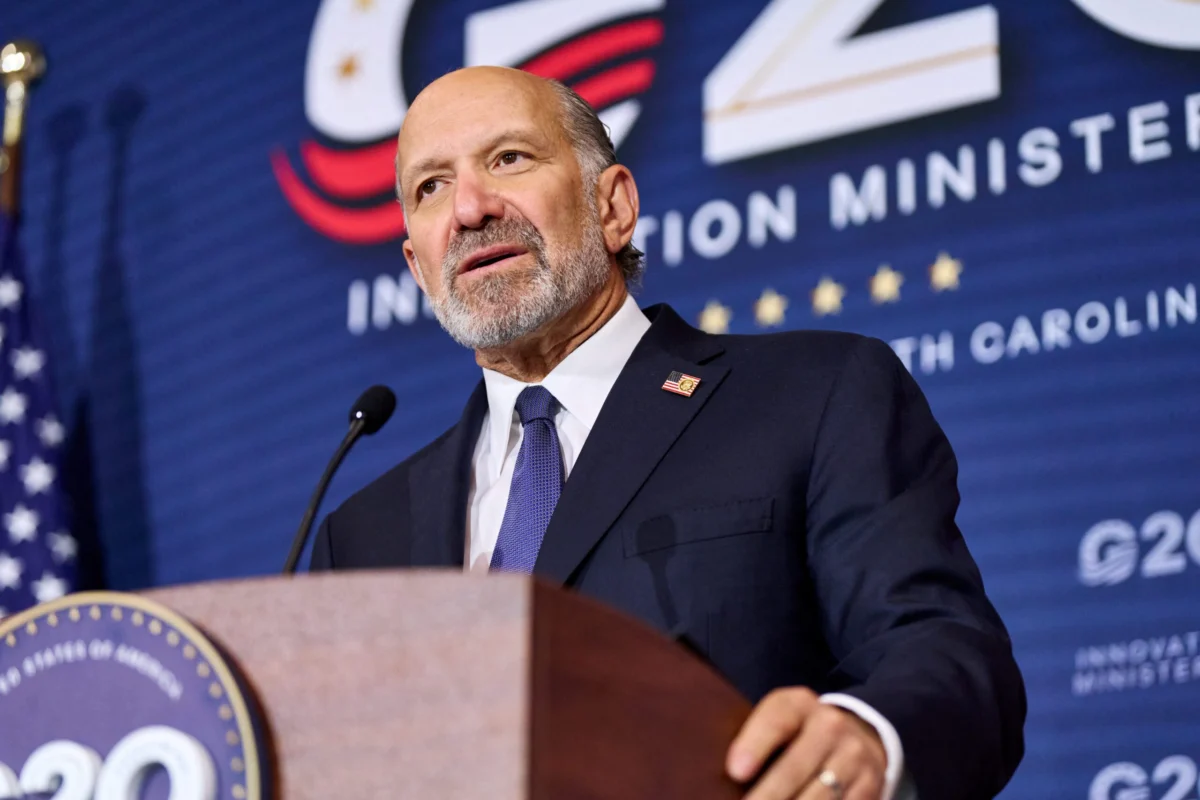
Washington D.C. finds itself embroiled in a complex web of national security concerns, high finance, and potential conflicts of interest, as Commerce Secretary Howard Lutnick faces increasing scrutiny over his former firm, Cantor Fitzgerald’s, financial dealings with Nvidia, even as White House and intelligence officials pressed him to restrict the flow of advanced AI chips to China. The controversy intensified following reports that Lutnick repeatedly resisted efforts to crack down on companies suspected of funneling Nvidia’s critical technology to Beijing, coinciding with significant shifts in Cantor Fitzgerald’s Nvidia holdings and ongoing business relationships within the chipmaker’s expansive ecosystem. This intricate situation brings into sharp focus the ethical boundaries for public officials with deep ties to industries under their regulatory purview, particularly in an era of intense geopolitical competition over technological supremacy.
Mounting Scrutiny on Commerce Secretary Lutnick
The focal point of the burgeoning controversy is Howard Lutnick, a prominent figure on Wall Street before his appointment as Commerce Secretary in February 2025. Lutnick, who formerly led Cantor Fitzgerald, transferred his ownership stake in the firm to his children via trusts in May 2025. His sons, Brandon and Kyle Lutnick, now helm the storied investment bank. However, the firm’s continued engagement with Nvidia and its partners has drawn sharp criticism and raised questions about potential influence, especially given the Commerce Department’s pivotal role in U.S. export controls and technology policy aimed at China.
Reports from Axios on November 10 and 11, 2026, revealed that Lutnick had received a classified intelligence warning concerning Nvidia CEO Jensen Huang’s alleged ties to a suspected Chinese spy. Furthermore, White House and U.S. intelligence officials had, for months, pressed Lutnick to take action against Megaspeed, a Singapore-based entity suspected of diverting Nvidia’s cutting-edge artificial intelligence chips to China. Despite President Donald Trump authorizing new export restrictions on such companies for a third time on November 5, Lutnick reportedly resisted these efforts, fueling concerns about the integrity of the administration’s national security posture. This resistance, coupled with Lutnick’s public appearances alongside Huang, including at a G20 technology summit in North Carolina, has painted a picture of a Commerce Secretary seemingly at odds with elements of his own administration on a critical national security issue.
A Deepening Dive into Cantor Fitzgerald’s Nvidia Holdings
Central to the scrutiny are the shifts in Cantor Fitzgerald’s reported holdings of Nvidia shares. Historically, Nvidia had been one of Cantor’s largest reported stock positions. At the close of 2024, before Lutnick’s move to public service, the firm disclosed owning over 3.5 million Nvidia shares, valued at an estimated $479 million. This position was second only to bitcoin investor MicroStrategy (now Strategy) in Cantor’s reported portfolio. The share count remained stable through September 2025, with its value appreciating significantly to $652 million, largely driven by Nvidia’s stellar market performance and a Trump administration decision over the summer to ease restrictions on Nvidia’s H20 chip sales to China.
However, a dramatic shift occurred between September 2025 and March 2026. CNBC’s analysis of securities filings (excluding options) revealed that Cantor Fitzgerald’s reported Nvidia share count plummeted by nearly 50%, falling to 3 million shares in December 2025 and further to 1.78 million by the end of March 2026. Concurrently, the value of these holdings decreased from $652 million to $310 million. This substantial reduction in reported holdings occurred during a period of escalating internal pressure on Lutnick regarding Nvidia’s chip exports to China and growing public concerns on Capitol Hill. While Nvidia’s stock had more than doubled from its April 2025 lows by late October, it experienced a 6.5% decline between the end of September and the end of March, potentially influencing the valuation of Cantor’s remaining stake.
Cantor Fitzgerald has not publicly offered a detailed explanation for this significant decline in its reported Nvidia share count. A spokesperson for the firm stated that "Cantor has to date from time to time had only immaterial stand-alone proprietary positions in Nvidia, unlike the positions reflected in 13F filings which were entered into in the ordinary course of business in connection with client swap transactions, that are common in institutional markets." This statement suggests that a substantial portion of their reported holdings might be related to client-driven hedging activities rather than proprietary investment positions. Furthermore, filings indicated that most of these shares were attributed to CF Secured, a Cantor brokerage subsidiary, and the firm also held substantial Nvidia options positions, overwhelmingly skewed toward put options, which typically serve as a hedge against stock price declines. These details suggest a complex financial strategy, but they do not fully dissipate the questions arising from the timing of the reduction alongside the mounting geopolitical tensions.
The Geopolitical Chessboard: AI Chips and U.S.-China Tensions
The context for this controversy is the fierce geopolitical competition between the United States and China, particularly in the realm of advanced technology. Artificial intelligence chips, like those produced by Nvidia, are considered critical infrastructure for national security, economic competitiveness, and military superiority. Their advanced processing capabilities are essential for everything from sophisticated AI models to high-performance computing, making control over their supply chain a paramount strategic objective for both superpowers.
The U.S. has implemented a series of stringent export controls, utilizing the Commerce Department’s "entity list" to restrict access for Chinese companies to American technology deemed vital. The objective is to hobble China’s technological advancements, especially in areas with potential military applications, and to prevent U.S. innovation from being leveraged by strategic adversaries. Nvidia, as the undisputed global leader in AI chips, finds itself at the epicenter of this struggle. Its H20 and H200 chips, designed for the Chinese market with reduced specifications to comply with export rules, still represent highly advanced technology that Washington seeks to control. The suspected funneling of even these restricted chips, or more advanced ones, to unauthorized Chinese entities directly undermines U.S. national security policy.
The "Megaspeed" case, involving a Singapore-based company allegedly funneling Nvidia chips to China, highlights the persistent challenges of enforcing these controls. The repeated authorization of new export restrictions by President Trump underscores the White House’s perceived urgency, contrasting sharply with Lutnick’s reported reluctance to act. This policy friction within the administration signals potential divisions on how aggressively to pursue technological decoupling from China.
Converging Timelines: Warnings, Deals, and Policy Decisions
A detailed chronology of events reveals a striking convergence of internal warnings, major financial transactions involving Cantor Fitzgerald, and critical policy decisions:
- February 2025: Howard Lutnick is appointed U.S. Commerce Secretary.
- May 2025: Lutnick transfers his ownership stake in Cantor Fitzgerald to his children. Around this time, Semafor reported that Cantor bankers informally advised TSMC, Nvidia’s primary chip manufacturer, on navigating Washington, a claim Cantor denied as "baseless and false."
- October 2025: Cantor advises Lancium, an AI infrastructure developer and future Nvidia partner, on a $600 million financing deal. Newmark, a firm controlled by Cantor, also facilitated a $7.1 billion construction loan for Lancium’s Abilene campus in May 2025.
- Late 2025 – Early 2026: White House and intelligence officials begin pressing Lutnick to crack down on Megaspeed.
- March 2026: Senators Jim Banks (R-Ind.) and Elizabeth Warren (D-Mass.) urge Lutnick to suspend or reconsider Nvidia’s export licenses after indictments linked to a Super Micro Computer customer smuggling chips to China.
- May 7, 2026: Nvidia and Australia-based cloud provider IREN announce a five-year, $3.4 billion cloud computing contract and a strategic partnership, including Nvidia’s right to invest up to $2.1 billion in IREN.
- May 10, 2026: Axios reports Lutnick had received a highly classified intelligence memo detailing concerns about Jensen Huang’s ties to a suspected Chinese spy.
- May 12, 2026: Trump departs for China. Secretary of State Marco Rubio reportedly warns him about Huang’s relationship with a suspected Chinese spy during the trip. On the same day, IREN announces the pricing of a convertible bond offering.
- May 14, 2026: The IREN convertible bond offering closes, raising $3 billion. Cantor Fitzgerald is one of seven bookrunners, alongside giants like JPMorgan Chase and Goldman Sachs. On this same day, Lutnick’s Commerce Department quietly clears roughly 10 Chinese companies, including Alibaba and ByteDance, to buy Nvidia’s advanced H200 chips.
- Late September 2026: Cantor Fitzgerald hosts Jensen Huang and other Nvidia executives for investor meetings in New York. Cantor analysts subsequently maintain an "overweight" rating and a $350 price target on Nvidia stock, despite the firm’s reduced holdings.
- November 5, 2026: President Trump authorizes new export restrictions on companies suspected of smuggling Nvidia chips to China for a third time.
- November 10, 2026: Axios reports Lutnick received a classified intelligence warning about Huang’s ties to a suspected Chinese spy.
- November 11, 2026: Axios reports Lutnick repeatedly resisted cracking down on companies suspected of smuggling Nvidia chips to China.
- November 12, 2026: Jensen Huang resigns as CEO of Nvidia (reported Thursday). Treasury Secretary Scott Bessent reveals on CNBC’s "Squawk Box" that Treasury, Defense, State, and USTR all favored putting Megaspeed on the entity list "for months."
- November 13, 2026: Senators Warren and Coons demand that Lutnick, Rubio, and White House Chief of Staff Stephen Miller preserve records on Nvidia’s chip exports to China and intelligence warnings about Huang, questioning if "prudent defensive counter-intelligence action was taken or national security recommendations were overruled."
This tight timeline illustrates how significant financial opportunities for Cantor Fitzgerald, including its role in the $3 billion IREN bond offering, unfolded concurrently with escalating national security warnings and policy debates within the Trump administration concerning Nvidia and China.
The Ethics of Influence: A Former Firm’s Financial Footprint
The intertwining of Lutnick’s official duties and his former firm’s financial interests has ignited a debate among ethics experts. Richard Painter, former chief White House ethics lawyer for President George W. Bush and now a corporate law professor at the University of Minnesota, commented on the situation, stating that while there is "no proof of" Lutnick sharing nonpublic information with Cantor Fitzgerald, "the appearance doesn’t look great." Painter emphasized, "His conversations with his sons better be about publicly available information." This highlights the challenge for public officials in avoiding even the perception of conflict of interest, especially when their family members directly benefit from related business activities.
Beyond the reduced Nvidia stock holdings, Cantor Fitzgerald’s deep engagement with Nvidia’s broader "AI empire" continued. The firm helped arrange billions in financing for Nvidia’s business partners. For instance, its participation as a bookrunner in IREN’s $3 billion convertible bond offering in May 2026, just days after Nvidia announced its strategic partnership and investment rights in IREN, is particularly notable. By the end of June 2026, Cantor reported substantial holdings in IREN stock, totaling $115 million, alongside $362 million in Nvidia shares. Combined, these two positions represented over 9% of Cantor’s reported $5.2 billion in securities holdings (excluding options), underscoring the firm’s significant financial exposure to Nvidia’s ecosystem.
Similarly, Cantor’s advisory role for Lancium, an AI infrastructure developer backed by OpenAI, SoftBank, and Oracle, further illustrates these ties. Lancium subsequently received a $2 billion investment from Nvidia for a 20% stake, with potential for another $1 billion, to advance its gigawatt-scale AI factory development. While it’s unclear if Cantor continued its advisory role through the Nvidia investment, the sequence of events shows a pattern of Cantor Fitzgerald facilitating growth for companies that subsequently become key Nvidia partners or recipients of its investment.
These dealings, occurring while Howard Lutnick was reportedly resisting administration efforts to control Nvidia chip exports to China, inevitably raise questions. While there is no direct evidence that Lutnick’s sons had advance knowledge of intelligence concerns, or that Cantor’s business interests directly influenced their father’s decisions, the close proximity of these events creates an optical challenge for the Commerce Secretary and the administration.
Inter-Agency Discord and Congressional Demands
The controversy has exposed cracks within the Trump administration’s unity on China policy. Treasury Secretary Scott Bessent publicly stated on CNBC’s "Squawk Box" that the departments of Treasury, Defense, and State, along with the Office of the U.S. Trade Representative, all "were in favor of putting Megaspeed on the entity list for months." Bessent directly pointed to the Commerce Department as responsible for imposing the entity list, adding, "You will have to ask them about their internal processes." This public disclosure of inter-agency discord underscores the seriousness of the disagreement and places Lutnick and the Commerce Department squarely in the spotlight for perceived inaction.
Congressional leaders have also taken swift action. In December, Democratic senators called for an ethics investigation into whether the Lutnick family stood to benefit from Howard Lutnick’s push to expand AI data centers. More recently, on November 13, Senators Elizabeth Warren (D-Mass.) and Chris Coons (D-Del.) formally demanded that Howard Lutnick, Secretary of State Marco Rubio, and White House Chief of Staff Stephen Miller preserve all records related to Nvidia’s chip exports to China and any intelligence warnings concerning Jensen Huang. Their letter explicitly questioned "whether prudent defensive counter-intelligence action was taken or national security recommendations were overruled," reflecting deep congressional concern over potential national security compromises. Senator Coons further criticized the administration on CNBC, accusing it of "turning a blind eye to the black market for more advanced chips" and failing to prevent the export of critical technology.
Despite the growing pressure and inter-agency friction, President Trump has publicly stood by his Commerce Secretary. A White House official told Reuters that the president maintains "complete confidence" in Howard Lutnick, suggesting the administration is prepared to weather the storm, at least for now. However, the resignation of Jensen Huang as Nvidia CEO, though the reasons for his departure were not immediately clear, adds another layer of intrigue to an already complex narrative.
Broader Implications for Tech Governance and National Security
The unfolding situation surrounding Howard Lutnick, Cantor Fitzgerald, and Nvidia carries significant broader implications for U.S. tech governance, national security policy, and the ethical conduct of public officials.
Firstly, it intensifies the debate around the "revolving door" phenomenon, where individuals transition between influential private sector roles and high-level government positions. While such transitions are common, they necessitate robust ethical safeguards to prevent actual or perceived conflicts of interest. The Lutnick case underscores the need for greater transparency and potentially stricter rules, especially when the official’s former firm continues to operate within the very industry they are now tasked with regulating and overseeing, particularly in areas of critical national security.
Secondly, the reported inter-agency disagreements highlight the challenges of a coordinated, coherent U.S. policy towards China on technology. A fractured approach risks undermining the effectiveness of export controls and sending mixed signals to both allies and adversaries. This incident could prompt a reevaluation of decision-making processes within the National Security Council and other relevant inter-agency bodies to ensure a unified front on critical economic and security issues.
Finally, for the technology industry, particularly companies like Nvidia operating at the cutting edge of AI, this controversy serves as a stark reminder of the heightened geopolitical stakes. The scrutiny on CEO Jensen Huang’s alleged ties and the company’s export practices demonstrates that even market leaders are subject to intense government oversight, especially when their products become strategic assets in international competition. The long-term implications for U.S.-China tech relations could include even more stringent export controls, increased pressure on American companies to divest from certain Chinese markets, and a further push towards supply chain diversification away from geopolitical flashpoints.
As the Commerce Department remains silent on detailed questions and the White House reiterates its confidence in Lutnick, Congress and a watchful public will continue to demand answers. The ultimate resolution of this controversy will not only shape the future of Howard Lutnick’s tenure but also influence the framework for ethical conduct in government and the strategic direction of U.S. technology policy in an increasingly interconnected and competitive world.

