

The narrative surrounding Alice Huang, a figure U.S. officials reportedly link to Chinese intelligence, has escalated into a multifaceted saga, tracing her journey from Chinese state television to a pivotal role within an Nvidia cloud partner in Singapore. This intricate web of personal relationships, high-stakes business dealings, and national security concerns now places NVIDIA, a multi-trillion-dollar semiconductor titan, at the heart of an international controversy, intensified by revelations of her husband’s detention in Shanghai and her subsequent grand tour of Europe. The unfolding events raise profound questions about corporate governance, the integrity of global supply chains, and the ongoing technological rivalry between the United States and China.
From State Broadcaster to Silicon Valley’s Orbit
Born Huang Le, and now approximately 42 years old, Alice Huang’s career trajectory is as varied as it is intriguing. Her academic foundation was laid at Hong Kong Baptist University, where she pursued media management. Early professional years saw her navigating the landscape of Chinese state media, with stints at prominent outlets such as Hunan Television and the national broadcaster CCTV. This initial phase of her career, as former CCTV journalist Bai Jie publicly noted before her post disappeared, suggested she was "no ordinary figure."
However, Huang’s path took a significant turn into the high-stakes world of finance. She transitioned to wealth management, working for HSBC’s private bank in Hong Kong and then for CITIC Securities, one of China’s largest full-service investment banks. This period likely honed her understanding of capital flows, market mechanisms, and high-net-worth individuals, skills that would prove crucial in her subsequent ventures.
Her decisive financial breakthrough occurred in November 2015, marking her entry into Shanghai Hexi Investment as a senior executive. Here, she acquired a 25% stake from the firm’s founder, Kang Wei, who retained a 48.75% share. Multiple sources, including Caixin, have identified Kang Wei as Huang’s husband, adding a layer of personal and professional entanglement to their shared ventures. Kang Wei himself was a notable figure in Chinese asset management, having risen to lead Zhonghai Fund at the young age of 32. Their collaboration extended to significant deals, including a 2019 agreement where 7Road, a company with which Huang was associated, committed 1 billion yuan to acquire 12 gaming companies through an offshore structure. In this arrangement, Huang was listed as the registered shareholder, with Hexi serving as the ultimate controlling party, underscoring her direct involvement in complex cross-border financial maneuvers.
The NVIDIA Connection: Megaspeed, Data Centers, and Personal Access
Huang’s professional narrative took another critical turn toward the semiconductor industry and, specifically, NVIDIA, a company synonymous with advanced AI graphics processing units (GPUs). Her attributed WeChat posts from 2024, a curious blend of high-society travel snapshots and hardware business updates, included images of NVIDIA’s flagship GB200 servers and congratulations for a funding round for Shanghai Advanced Silicon Technology. These seemingly disparate elements painted a picture of a woman deeply embedded in both the opulent global elite and the cutting-edge tech sector.

A pivotal moment in her connection to NVIDIA arrived in March 2023 when Huang became the controlling shareholder of Megaspeed, a Singapore-based entity originally incorporated in 2015 as 7Road International. Megaspeed subsequently evolved into an official NVIDIA cloud partner, a designation that granted it crucial access to NVIDIA’s coveted GPU technologies and cloud services. The strategic importance of being an NVIDIA cloud partner cannot be overstated in the current AI landscape, where access to high-performance computing is paramount. Later that year, ownership of Megaspeed shifted to an entity named SwiftData. However, researchers at the defense nonprofit C4ADS expressed concern to Reuters, noting their inability to identify the ultimate controllers of SwiftData and suggesting that Huang might have retained influence over Megaspeed even after the transfer, raising transparency issues.
Further cementing her business activities in the chip supply chain, shipping records reviewed by Reuters revealed that Megaspeed’s Indonesian subsidiary, where Huang served as managing director for most of 2023, imported NVIDIA hardware, including the highly sought-after H100 processors. These imports were scheduled from 2024 through 2026, highlighting her involvement in the critical distribution of advanced AI components. Among Megaspeed’s suppliers was Giga Computing, a subsidiary of the Taiwanese hardware manufacturer Gigabyte.
Beyond supply chain logistics, Huang and her husband, Kang Wei, were reportedly pitching Chinese investors on a massive Southeast Asian data-center project in early 2025, valued at hundreds of millions of dollars. Crucially, they leveraged their asserted access to NVIDIA GPUs and even named Alibaba, the Chinese e-commerce and cloud computing giant, as a client. Such a project, if realized, would represent a significant conduit for advanced AI infrastructure, potentially raising concerns about the circumvention of U.S. export controls designed to restrict China’s access to cutting-edge chip technology. The Financial Times first reported on these pitches, adding another layer to the complex narrative of her business activities.
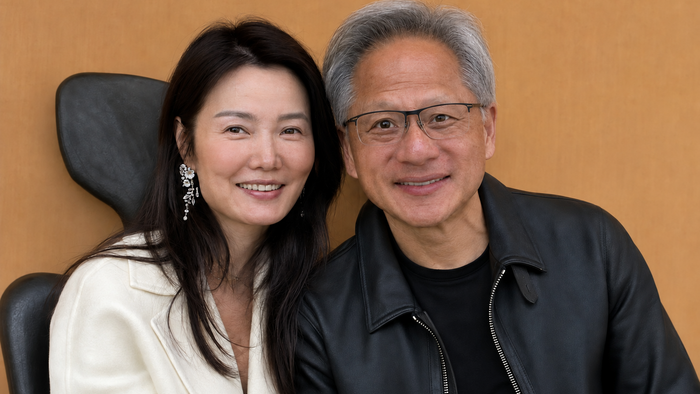
Alongside these substantial business dealings, a clear pattern of personal access to NVIDIA CEO Jensen Huang emerged. U.S. border records, reviewed by CNN, document Alice Huang undertaking ten trips to the United States between 2017 and 2025. Her final recorded visit in March 2025 saw her photographed inside NVIDIA’s Santa Clara headquarters during its annual conference, a clear indicator of her privileged access. Further evidence of their proximity includes Reuters’ report of the pair seated side-by-side at a Gigabyte party during Computex 2024, captured in a LinkedIn photograph. CNN also reported WeChat photos placing them together at a California golf resort in September 2024. In May 2025, their association continued with a dinner in Taipei, after which they reportedly departed in the same car. This consistent, high-level personal access to Jensen Huang has become a central point of scrutiny, fueling questions about the nature of their relationship and its implications.

The Allegations: Espionage, Infidelity, and International Scrutiny
The story intensified dramatically on November 8, 2026, when Jensen Huang publicly admitted to having been unfaithful to his wife. While he did not name the woman involved, this admission came after The New York Times had reported that U.S. officials had concluded Alice Huang was a Chinese intelligence asset. This explosive allegation, which Beijing vehemently denies and Reuters has stated it could not independently verify, transformed the narrative from one of corporate dealings and personal indiscretion into a matter of national security.
The timing of these revelations and the broader context of U.S.-China tech rivalry are critical. Washington has implemented stringent export controls on advanced semiconductors, particularly those vital for AI development, explicitly to curb China’s technological advancement for military purposes. An alleged Chinese intelligence asset with deep access to a leading U.S. chipmaker like NVIDIA would represent a significant intelligence coup and a severe breach of national security. The Commerce Department had reportedly initiated a probe into whether NVIDIA chips were being funneled to China, a probe that was allegedly halted in late 2025 after NVIDIA reached out to the agents involved. This case has since been transferred to a Justice Department criminal inquiry, signaling the serious nature of the ongoing investigation.
A Tale of Two Fortunes: European Grand Tour vs. Shanghai Detention

The personal dimension of Alice Huang’s story took a stark turn with the detention of her husband, Kang Wei. Around the Lunar New Year in February 2026, Shanghai police apprehended Kang in connection with a suspected stock-manipulation case, as reported by Caixin. This development placed him in the crosshairs of Chinese authorities, a common occurrence in Beijing’s ongoing anti-corruption and market regulation campaigns.
In stark contrast to her husband’s predicament, Alice Huang’s social media activity painted a picture of unbridled luxury and extensive travel. Screenshots attributed to her WeChat Moments, compiled by X user @alphahunter000 and republished by Sing Tao, documented a lavish, multi-month tour of at least 13 European countries, commencing shortly after Kang Wei’s detention.
The chronology of her European sojourn reads like a high-end travelogue:
- February 2026: Tenerife, Amsterdam, Budapest, Belgium.
- Late February/Early March 2026: Northern journey to witness the aurora in Norway and hike glaciers in Iceland. A stop in Paris included visits to the Louvre and, according to the chronology, Michelin-starred dining experiences.
- Spring/Early Summer 2026: London, Edinburgh, a Scottish filming location from "Skyfall," the famed "Mr. Darcy" estate, and Northern Ireland’s Giant’s Causeway. Coastal retreats in Naples and Capri were also featured, with one caption toasting a sunset "with my girlfriends."
- September 2026: Rome, Florence, and a picturesque northern Italian road trip towards the Swiss border.
- October 2026: Milan, Lake Como, Paris, Switzerland’s Lake Oeschinen, Barcelona, Munich, Prague, and Vienna, interspersed with cultural notes on Van Gogh, a narrowly missed train, and a night at the opera.
Intriguingly, online sleuths quickly noted an overlap between parts of her October itinerary and Jensen Huang’s professional engagements in Europe. Jensen Huang was reportedly in Paris on October 13 and delivered a keynote speech in Berlin on October 21. While Sing Tao observed that NVIDIA’s chief executive did not appear in any of Alice Huang’s 2026 posts, the geographical and temporal proximity added another layer of speculation to their relationship amidst the unfolding scandal. This stark contrast between her husband’s detention and her opulent travels has fueled public interest and questions about her financial resources and priorities.

The Fallout: Damage Control and Broader Implications
The swirling allegations have triggered a cascade of official responses and investigations, underscoring the gravity of the situation. Singapore’s Ministry of Home Affairs confirmed an active police investigation into Megaspeed, though it denied a Wall Street Journal report suggesting Singapore was investigating Huang over alleged intelligence ties. This clarification highlights the careful diplomatic tightrope being walked by regional governments caught between major powers.
NVIDIA, a company whose market capitalization has soared on the back of the AI boom, is facing significant pressure. Its board of directors has established a committee of independent directors, aided by external counsel, to conduct its own inquiry into the matter. In a public statement, the board asserted it had "no reason to believe that either national security or NVIDIA secrets were compromised," an attempt to reassure investors and stakeholders.
However, the political and legal pressure continues to mount. Shareholders have already initiated lawsuits against NVIDIA and its CEO, citing the alleged relationship with a Chinese spy as grounds for damages, highlighting the financial and reputational risks involved. Jensen Huang is scheduled to report NVIDIA’s earnings on November 17, and the call with investors will undoubtedly be dominated by questions regarding this controversy. Furthermore, lawmakers are demanding answers. On November 4, the chairmen of the House Foreign Affairs Committee, the House Select Committee on the CCP, and the House Intelligence Committee jointly requested a closed-door briefing from Jensen Huang on his dealings with Alice Huang and NVIDIA’s internal safeguards.

Adding a political dimension, former U.S. President Donald Trump weighed in, revealing that Jensen Huang told him, "I had no idea that she was a spy," and further noting that "the FBI is looking into it in terms of something else." This public statement from a former president underscores the national security implications perceived by high-level U.S. officials.
The Chinese embassy, for its part, dismissed The New York Times’ reporting as "unsubstantiated" and "nothing but smears against China," adhering to Beijing’s consistent stance of denying allegations of espionage.
The scandal’s implications extend far beyond NVIDIA’s corporate walls. For the U.S. government, it exemplifies the persistent challenges in safeguarding critical technologies from foreign adversaries and highlights the potential vulnerabilities within the private sector. The "honeypot" allegation, while unverified, speaks to a recognized tactic in intelligence operations aimed at gaining access and influence. For NVIDIA, the crisis threatens its carefully cultivated image, its stock valuation, and its ability to navigate the complex geopolitical landscape of chip manufacturing and distribution. It could lead to increased regulatory oversight, stricter internal compliance measures, and potentially impact its market access in both the U.S. and China.
Ultimately, the central question remains: was Alice Huang’s extraordinary network, spanning Chinese state media, offshore financial vehicles, and intimate access to one of the world’s most influential tech CEOs, purely a vehicle for commercial GPU arbitrage, or was it a sophisticated intelligence operation aimed at America’s most strategic chipmaker? The answer, currently hanging over Santa Clara and echoing in the halls of power in Washington and Beijing, will have profound consequences for NVIDIA, global technology policy, and the ongoing contest for technological supremacy.

