
The real estate industry, long reliant on meticulous manual analysis, is undergoing a significant transformation driven by technological advancements. At the heart of this evolution lies the pervasive challenge of data: not a lack of logic in valuation models, but a bottleneck in accessing timely, consistent, and structured comparable property data. This data scarcity forces analysts to dedicate considerable hours to the laborious tasks of gathering and reconciling fragmented datasets. As real estate portfolios expand and market dynamics accelerate, these manual workflows become increasingly untenable, leading to delayed decisions, introduced inconsistencies, and a diminished capacity for efficient deal evaluation.
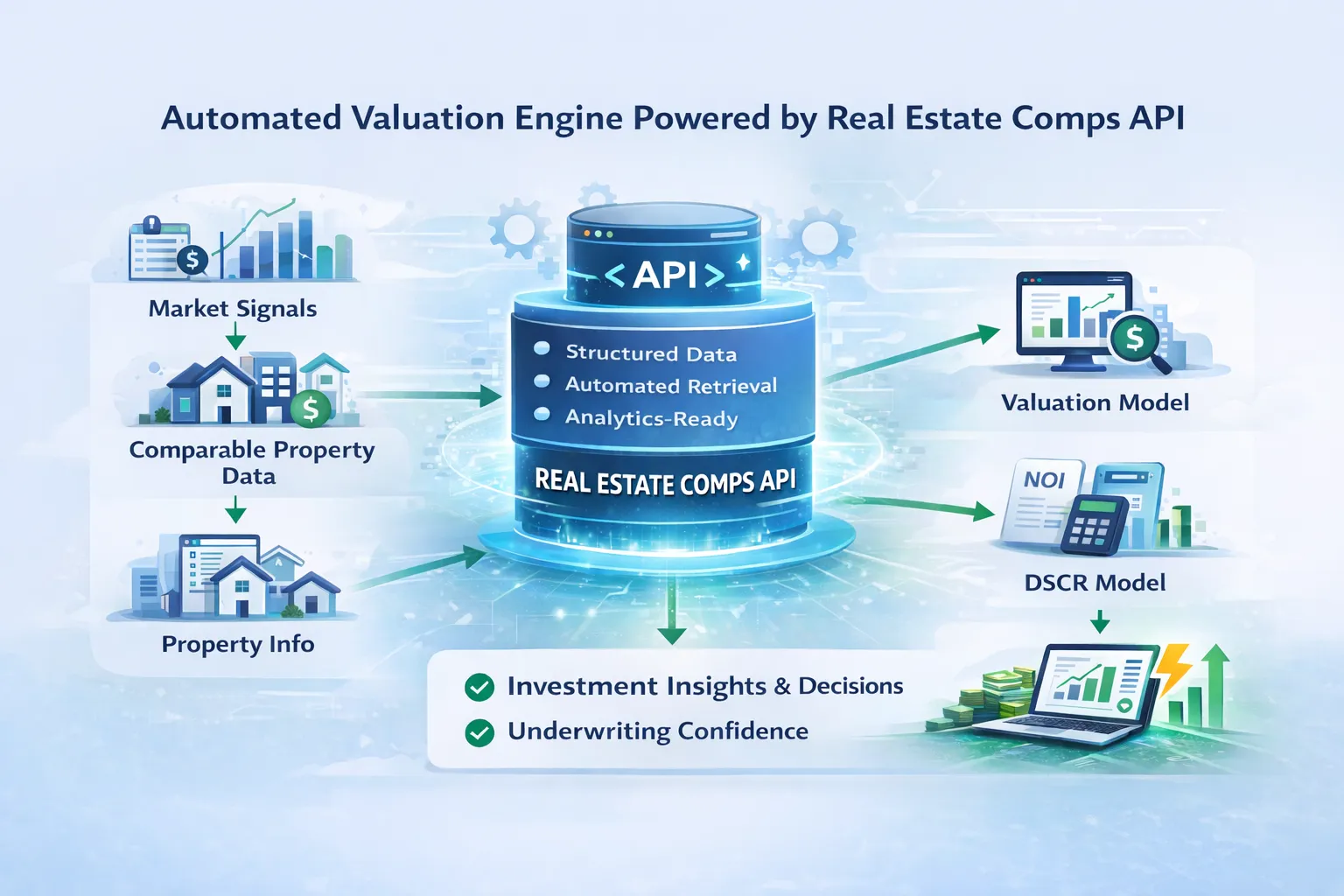
A pivotal solution emerging to address these critical pain points is the real estate comps API. This technology fundamentally reshapes the valuation process by delivering structured comparable sales and rental data automatically. This automation empowers faster, more reliable valuation models and enhances the accuracy of crucial financial analyses like the Debt Service Coverage Ratio (DSCR). Consequently, real estate investors and developers can now seamlessly integrate vital market intelligence directly into their existing tools and operational workflows, ushering in an era of data-driven efficiency. This comprehensive guide will delve into the intricacies of how comps APIs function, highlight the capabilities of Mashvisor’s offering in supporting smarter valuation and underwriting models, detail the specific endpoints available, and illustrate how businesses can leverage automated comparable property data to construct scalable real estate analytics solutions.
The Foundational Role of Comparable Property Data in Modern Valuation
Comparable property data serves as the bedrock of contemporary real estate valuation methodologies. By analyzing recent sales and rental performance of similar properties in proximity, investors and analysts can effectively estimate a property’s fair market value (FMV) and its income-generating potential. These "comps," as they are commonly known, provide essential market-based benchmarks against which potential deals can be rigorously compared.
Defining Real Estate Comps
In essence, real estate comps, or comparables, are properties that share similar characteristics with the subject property under investigation. These characteristics typically include geographical location, physical size, property type (e.g., single-family home, condominium, commercial space), and overall condition. Historically, the focus of comps analysis has been primarily on recent sales transactions. However, for investment property analysis, particularly in the rental market, rental comps are equally, if not more, crucial for evaluating income-generating potential.
Therefore, the two principal categories of comps are:
- Sales Comps: These are properties that have recently sold in the same or a very similar market. They are used to establish a baseline for what buyers are willing to pay for similar assets, directly informing sales price estimates.
- Rental Comps: These are properties that are currently being rented or have recently been rented out. They provide crucial data points for estimating potential rental income, a key factor in assessing the profitability of investment properties.
Collectively, these comps form the indispensable foundation for robust pricing strategies, thorough underwriting processes, and insightful investment analyses. The availability of structured comparable sales data becomes particularly vital for investors seeking to establish repeatable valuation frameworks that can be applied consistently across diverse markets.
The Inherent Limitations of Manual Comp Analysis
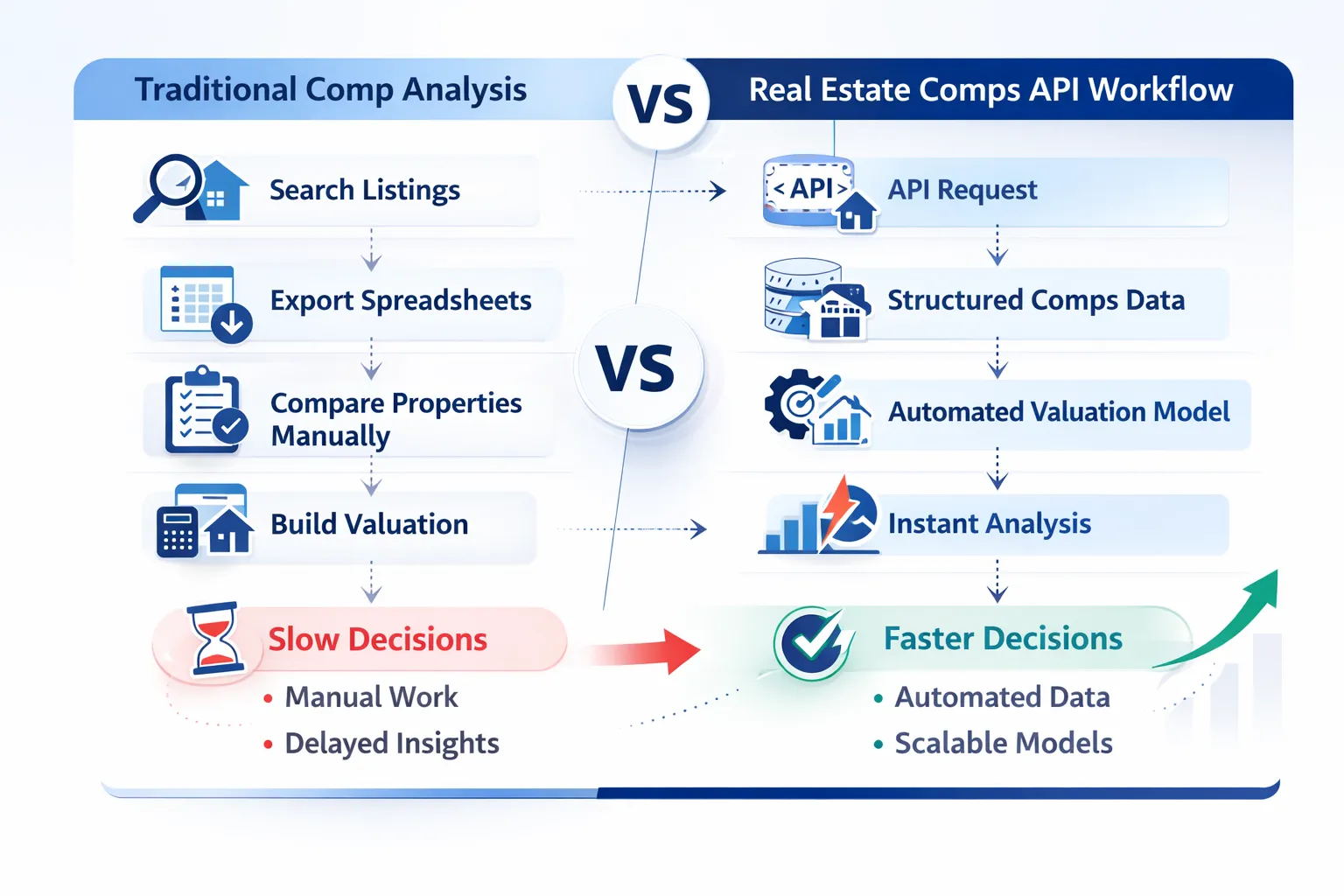
Despite their central importance in valuation, the traditional approach to compiling and analyzing comps is fraught with challenges, making it exceptionally difficult to scale. This difficulty stems from the necessity of relying on manual searches across a multitude of listing platforms, local government databases, and often, unwieldy spreadsheets.
The following significant challenges emerge rapidly from this manual process:
- Time-Intensive Data Collection: Sourcing relevant comparable properties from disparate sources consumes an inordinate amount of an analyst’s time, diverting their focus from higher-value analytical tasks.
- Data Inconsistency and Fragmentation: Information across different platforms is rarely standardized, leading to discrepancies in data fields, formatting, and levels of detail. This necessitates extensive data cleaning and reconciliation.
- Risk of Omissions and Errors: Manual data entry and comparison are inherently prone to human error, such as miskeyed figures, missed comparables, or incorrect property characteristic assignments, which can significantly skew valuation outcomes.
- Lack of Real-Time Data: Publicly available data sources may not always reflect the most current market conditions, leading to valuations based on outdated information.
- Scalability Issues: As the volume of properties to analyze increases, the manual process becomes exponentially more time-consuming and resource-intensive, rendering it impractical for large portfolios or high-frequency trading environments.
These limitations become acutely pronounced for professionals and organizations engaged in analyzing deals at scale. Consequently, valuation workflows are increasingly pivoting towards automated data delivery mechanisms, specifically through Application Programming Interfaces (APIs), which enable the instantaneous retrieval of comps data and its direct integration into sophisticated analytical models.
Understanding the Real Estate Comps API: Bridging the Data Gap
A real estate comps API fundamentally transforms the comparable property data acquisition process. Instead of engaging in time-consuming manual research, users can leverage the API to automatically retrieve crucial data points such as recent sales prices, prevailing market benchmarks, and detailed property characteristics. The operational mechanism is straightforward: users submit a query, typically based on specific location parameters or property criteria, and the API responds by returning standardized comps data that is immediately usable within valuation and underwriting models.
From Static Reports to Automated Valuation Intelligence
Traditional comp analysis often relies on static reports generated periodically or requires repetitive manual searches for each property being evaluated. A comps API effectively supplants this manual underwriting process with automated data retrieval, enabling a dynamic and efficient workflow.
The automated workflow, at a high level, typically unfolds as follows:
- Data Request: A user or an integrated system sends a structured request to the API, specifying criteria such as a property’s address, geographical coordinates, or desired search radius.
- Data Retrieval: The API accesses its comprehensive database, which aggregates and normalizes data from various sources, to identify and retrieve relevant comparable properties.
- Data Standardization: The retrieved data is then processed and standardized into a consistent format, ensuring uniformity in fields like sale price, square footage, number of bedrooms and bathrooms, and date of sale.
- Data Delivery: The standardized comparable property data is returned to the requesting application or user in a machine-readable format, such as JSON.
With the assistance of a property comps data API, investors and real estate platforms gain the ability to pull updated datasets on demand. Because the data is delivered in a standardized format, it can be directly applied to build repeatable valuation logic that is consistent across different property types and diverse market conditions. This automation not only accelerates the valuation process but also significantly enhances its reliability.
The Strategic Integration of a Real Estate Valuation API in Modern Tech Stacks
In contemporary real estate operations, comparable property data is increasingly being embedded directly into software workflows rather than being analyzed in isolation. A real estate valuation API functions as a crucial data layer, empowering a wide array of tools and platforms utilized by various industry stakeholders.
A real estate valuation API acts as a data layer powering tools used by:
- Investment Platforms: Providing the data necessary for portfolio analysis, deal screening, and automated valuation of potential acquisitions.
- Lending Institutions: Enabling faster and more accurate collateral valuation for loan underwriting and risk assessment.
- Property Management Software: Facilitating accurate rental pricing and market rent analysis.
- Real Estate Brokerages: Equipping agents with up-to-date market data for listing and buyer consultations.
- PropTech Startups: Serving as a foundational data component for new analytical tools and services.
For technology teams, a real estate API designed for developers eliminates the substantial burden of aggregating raw listing datasets or maintaining complex, in-house data pipelines. Instead, an automated property valuation API delivers readily usable comps data that can be seamlessly integrated into underwriting systems, interactive dashboards, or sophisticated investment analysis platforms. This integration allows for a more fluid and efficient flow of information, directly impacting decision-making speed and accuracy.
Mashvisor’s Real Estate Comps API: A Comprehensive Data Solution
The efficacy of a comparable sales data API is intrinsically linked to the quality, structure, and comprehensiveness of the data it provides. The Mashvisor API distinguishes itself by offering comparable property datasets that are not only rich in detail but also enriched with vital market benchmarks, sophisticated investment analytics, and key performance indicators, all unified within a singular real estate analytics API. This integrated approach allows users to transition directly from raw comps data to robust valuation and underwriting assessments without the need for cumbersome additional data processing steps.
Key Data Points Available Through the Mashvisor API
Mashvisor delivers structured comparable property data designed to robustly support real estate valuation models, pricing analysis, and informed investment decision-making. The data is meticulously organized to be readily consumable by analytical tools and platforms.
Property-Level Comparable Data:
- Address: The full street address of the comparable property.
- Property Type: Classification of the property (e.g., Single Family, Condo, Townhouse).
- Sale Price: The final sale price of the property.
- Date of Sale: The date on which the transaction was completed.
- Square Footage: The total livable area of the property.
- Number of Bedrooms and Bathrooms: Key metrics for property size and utility.
- Lot Size: The dimensions of the land parcel.
- Year Built: The construction year of the property.
- Property Condition: An indicator of the property’s state of repair (if available).
- Listing Status: Whether the property is currently listed, pending, or sold.
Market and Investment Context:
- Rental Comps Data: Information on comparable rental properties, including rent price, occupancy rates, and rental yield.
- Neighborhood Data: Key demographic and economic indicators for the surrounding area.
- Market Trends: Information on recent price appreciation or depreciation in the local market.
- Investment Metrics: Data points such as cash-on-cash return, cap rate, and ROI for comparable investment properties.
- Property Tax Information: Relevant tax data for the property and comparable assets.
These comprehensive data points and integrated metrics enable users to embed a powerful real estate investment analysis API directly into their acquisition or real estate underwriting pipelines, streamlining the entire investment evaluation process.
Illustrative Mashvisor API Endpoints
Mashvisor provides access to detailed comparable property data through a variety of specialized endpoints, each designed to cater to specific analytical needs within the real estate valuation ecosystem.
Common API Endpoints for Comparable Property Analysis:
GET /v1.1/client/property: Retrieves detailed information about a specific property.GET /v1.1/client/property/nearby: Fetches a list of comparable properties located near a specified property address or coordinates. This is crucial for finding direct comparables.GET /v1.1/client/property/transactions: Provides historical sales transaction data for a given property or within a defined area.GET /v1.1/client/property/price-estimates: Returns estimated property values, which can be used as a benchmark against market comps.
By leveraging these endpoints, users can access a dynamic and granular view of the market. The GET /v1.1/client/property/nearby endpoint, for instance, is instrumental in quickly identifying properties that share similar attributes and are in close proximity to a subject property, forming the core of a comps analysis. The GET /v1.1/client/property/transactions endpoint allows for a deeper dive into recent sales activity, providing sale prices, dates, and other transaction specifics. The GET /v1.1/client/property/price-estimates endpoint offers an independent valuation perspective that can be cross-referenced with market comps.
Combined, these endpoints facilitate a fully automated comps workflow, effectively replacing laborious manual research with efficient, structured data retrieval. This transition is critical for organizations aiming to enhance their analytical capabilities and operational speed.
An Example Request: Retrieving Comparable Properties
To illustrate the practical application of the Mashvisor API, consider a scenario where a real estate developer needs to quickly assess the market value of a potential acquisition. Using the API, they can automate the retrieval of nearby comparable properties for valuation modeling.
Example API Request:
GET https://api.mashvisor.com/v1.1/client/property/nearby?state=AZ&city=Phoenix&address=123+Main+StHeaders:
x-api-key: YOUR_API_KEYThis request is designed to query the API for properties located near "123 Main St" in Phoenix, Arizona. The API will then return a list of properties that are considered comparable based on their proximity and other inherent characteristics.
Simplified Example API Response
Upon receiving the request, the API returns structured comparable property data in a standardized JSON format. This data can be directly integrated into valuation or underwriting models without the need for manual parsing or formatting.
  "subject_property":
    "address": "123 Main St",
    "property_type": "Single Family",
    "price_estimate": 420000
  ,
  "nearby_properties": [

      "address": "118 Main St",
      "sale_price": 415000,
      "beds": 3,
      "baths": 2,
      "distance_miles": 0.3
    ,

      "address": "140 Oak Ave",
      "sale_price": 432000,
      "beds": 3,
      "baths": 2,
      "distance_miles": 0.6

  ]
The response clearly delineates the subject property and provides an array of nearby comparable properties, each with essential details like sale price, number of bedrooms and bathrooms, and distance from the subject property. This structured output ensures that the data is immediately actionable, powering valuation dashboards and automated underwriting tools with minimal friction.
Enhancing Valuation and DSCR Models with Mashvisor Data
The integration of comparable property data directly into analysis workflows significantly elevates the accuracy and scalability of real estate valuation and DSCR models. By automating the retrieval of comps through an API, investors and developers can standardize their assumptions, drastically reduce manual research efforts, and consistently evaluate properties against reliable market benchmarks.
Building a Property Valuation Model with Comparable Data
Accurate property valuation models are fundamentally reliant on comparable sales data. This data allows for the estimation of fair market value based on observable market behavior, rather than subjective pricing assumptions. The ability to obtain comps through API-delivered data enables this valuation process to be repeated automatically across a multitude of properties and markets, fostering consistency and efficiency.
A simplified workflow for constructing a real estate valuation model using API-delivered comps involves:
- API Integration: Connect the valuation model to the real estate comps API.
- Property Identification: Input the address or key identifiers of the property to be valued.
- Automated Comps Retrieval: The API fetches relevant comparable properties based on predefined criteria (e.g., proximity, property type, recent sale dates).
- Data Aggregation and Analysis: The model aggregates the retrieved comps data, calculates averages, medians, and applies relevant weighting based on property characteristics.
- Valuation Output: The model generates an estimated fair market value for the subject property.
As comps data is delivered via the API, the valuation model can run automatically whenever new properties are introduced for analysis. This automation ensures consistent valuation practices at scale, a critical factor in managing large portfolios or operating in high-volume markets.
Leveraging Comps Data for DSCR Model Real Estate Analysis
The Debt-Service Coverage Ratio (DSCR) model, a cornerstone of real estate lending and investment analysis, critically depends on realistic income and valuation assumptions. Comparable property data significantly enhances DSCR accuracy by grounding these projections in verified market activity, thereby reducing the reliance on speculative figures.
The DSCR calculation is fundamentally:
DSCR = Net Operating Income / Total Debt Service
To accurately calculate the DSCR for a rental property, analysts typically perform the following steps, which are directly improved by API-sourced comps data:
- Estimate Rental Income: Utilize rental comps data from the API to determine a realistic market rent for the subject property, considering its size, amenities, and location. This is far more reliable than relying on guesswork.
- Project Vacancy and Credit Loss: Analyze historical vacancy rates for comparable properties in the API data to establish a more accurate vacancy loss factor.
- Estimate Operating Expenses: While not directly provided by comps, understanding the market context from comps can inform more realistic estimates of property management fees, maintenance costs, and insurance premiums.
- Determine Net Operating Income (NOI): Subtract projected operating expenses from gross potential income.
- Calculate Total Debt Service: Obtain loan terms (interest rate, amortization period) to calculate annual principal and interest payments.
- Compute DSCR: Divide the projected NOI by the total annual debt service.
Accurate comps data plays a pivotal role in mitigating risk by preventing the common underwriting errors of overestimated valuations or unrealistic income projections. By providing a data-backed foundation for these critical assumptions, comps APIs enable more sound financial decision-making.
Automating Rental Property Underwriting Workflows
When comparable property data is delivered programmatically through an API, the underwriting process can transition from a manual, labor-intensive review to an automated, data-driven evaluation. This shift is crucial for enhancing efficiency and consistency in real estate operations.
A typical automated underwriting pipeline powered by a comps API looks like this:
API → Valuation Model → DSCR Calculation → Investment Decision
This form of rental property underwriting automation allows platforms and organizations to:
- Process Deals at Scale: Evaluate a high volume of properties rapidly without a proportional increase in human resources.
- Standardize Underwriting Criteria: Ensure that every deal is assessed using the same objective data points and methodologies, reducing bias and subjective interpretations.
- Accelerate Turnaround Times: Significantly reduce the time required to underwrite a loan or evaluate an investment opportunity, from days or weeks to minutes or hours.
- Enhance Data Accuracy: Minimize the risk of manual errors by relying on structured, programmatically delivered data.
Instead of investing substantial resources in building and maintaining complex data infrastructure from scratch, teams can leverage a real estate data API partnership to supply standardized comps data that is immediately ready for modeling and analysis.
Real-World Applications: Investors, Developers, and PropTech Teams
A real estate comps API demonstrates its greatest value when seamlessly integrated into critical decision-making workflows across various industry segments. Its ability to automate data retrieval and analysis offers tangible benefits to diverse stakeholders.
Investors and Acquisition Teams
Real estate investors and their acquisition teams utilize comparable property data to accelerate deal evaluation and ensure consistency across diverse markets. This data is instrumental in several common applications:
- Deal Screening: Quickly identify potentially undervalued properties by comparing asking prices against recent sales of similar assets.
- Valuation Analysis: Generate rapid and reliable property valuations to inform offer strategies and negotiation positions.
- Portfolio Management: Continuously monitor market trends and re-evaluate existing assets against current comparable data.
- Risk Assessment: Identify potential overvaluation or undersupply in a market by analyzing the volume and pricing of comparable sales.
Access to a centralized, real-time real estate comps dataset empowers investors to standardize their decision criteria, reduce inherent biases in deal evaluation, and make more informed and timely investment decisions.
Lenders and DSCR Underwriting
Lending institutions are increasingly embracing automated data workflows to enhance the efficiency and accuracy of evaluating borrower risk and collateral value. With API-delivered comps, lenders can:
- Automate Collateral Valuation: Quickly obtain market-based valuations for properties serving as loan collateral, reducing reliance on lengthy appraisal processes for initial assessments.
- Improve DSCR Accuracy: Ground loan underwriting assumptions in verifiable market income potential derived from rental comps.
- Streamline Loan Origination: Accelerate the loan origination process by automating key data-gathering steps.
- Enhance Risk Management: Utilize consistent, data-driven criteria for loan approvals, leading to a more robust risk profile.
This approach aligns with broader industry trends towards automated underwriting, which is increasingly powered by historical real estate data APIs that provide rich contextual information.
PropTech Platforms and Developers
For startups and established analytics platforms, comparable property data serves as a foundational data layer upon which sophisticated valuation and analytics tools are built. Typical developer use cases include:
- Building Valuation Engines: Integrating comps data into proprietary algorithms to offer automated valuation services to their clients.
- Developing Investment Analysis Tools: Providing users with market-driven insights for identifying and analyzing investment opportunities.
- Creating Market Reports: Generating dynamic and data-rich reports on local market conditions and property values.
- Enhancing User Experience: Offering seamless access to relevant property data within user-friendly interfaces.
By partnering with a leading real estate data API provider, development teams can launch advanced valuation features without the immense undertaking of building and maintaining complex property data pipelines internally. This allows them to focus on innovation and delivering core product value.
Mashvisor API: Pricing and Getting Started
Mashvisor offers a flexible, usage-based pricing model for its API, designed to accommodate businesses at various stages of growth. This model allows companies to scale their API access in tandem with their increasing data requirements, making it suitable for both nascent projects and large-scale enterprise platforms.
Mashvisor provides both monthly and annual subscription plans. Opting for annual subscriptions offers a cost advantage, typically equivalent to two months of service at no additional charge. The pricing structure is tiered, catering to different levels of data consumption and analytical needs:
- Tiered Plans: These plans are structured to align with varying usage volumes, from smaller projects requiring occasional data access to large platforms demanding high-frequency data retrieval. Specific tiers might include different data credit allocations, request limits, and feature access.
- Custom Enterprise Solutions: For organizations with exceptionally high data demands or unique integration requirements, Mashvisor offers custom enterprise solutions tailored to their specific needs.
To initiate the process of integrating Mashvisor’s data into your operations, scheduling a consultation call with the Mashvisor Data Team is the recommended first step. This allows for a detailed discussion of your specific data requirements and helps in selecting the most appropriate plan or solution.
Advantages of Utilizing Mashvisor for Automated Property Valuation
Employing the Mashvisor API for comparable property analysis empowers investors and developers to transition from cumbersome manual valuation workflows to scalable, data-driven decision-making processes. The advantages are multifaceted and directly impact operational efficiency and profitability.
Key advantages include:
- Accelerated Valuation: Significantly reduces the time required to assess property values by automating data collection and processing.
- Enhanced Accuracy and Consistency: Provides standardized, reliable data, minimizing human error and ensuring consistent valuation benchmarks across all analyses.
- Scalability: Effortlessly handles increasing volumes of property analysis, crucial for growing portfolios or high-frequency trading.
- Deeper Market Insights: Integrates property-level data with market trends and investment analytics for a more holistic understanding.
- Reduced Operational Costs: Frees up analyst time from manual data tasks, allowing them to focus on strategic analysis and deal-making.
- Improved Decision-Making: Enables faster, more informed decisions based on comprehensive and up-to-date market intelligence.
By consolidating comparable property data with robust investment analytics within a single platform, Mashvisor enables faster, more reliable property valuation at scale, a critical capability in today’s competitive real estate landscape.
When a Real Estate Comps API May Not Be Necessary
While the benefits of a real estate comps API are substantial, it’s important to recognize that it may not be the optimal solution for every scenario. The primary value proposition of a comps API lies in its ability to automate data retrieval for large-scale analysis and seamless integration into software workflows.
You may not require a comps API if:
- Low Volume of Analysis: You only analyze a handful of properties infrequently and manual research is manageable within your time constraints.
- Limited Need for Automation: Your existing processes do not require integration into software or automated workflows, and standalone reports suffice.
- Budgetary Constraints: The cost of an API subscription exceeds the perceived value for your specific, low-volume needs.
- Access to Comprehensive Internal Data: You possess a well-maintained, internal database of comparable properties that meets all your analytical requirements.
In these specific circumstances, implementing an API might introduce unnecessary complexity and cost. However, the moment the need arises for faster analysis, consistent market benchmarks, or the simultaneous evaluation of multiple properties, automated comps data becomes an indispensable tool.
Conclusion: The Future of Real Estate Valuation is Automated
As the real estate analysis landscape continues its trajectory towards greater data-driven methodologies, valuation and underwriting processes are inevitably shifting from traditional manual research to sophisticated automated intelligence. Within this evolving paradigm, property comps data transcends its role as a one-time analysis input for individual deals, becoming a continuous stream of information that powers pricing models, risk evaluations, and strategic investment decisions across entire portfolios.
A real estate comps API is the critical enabler of this transition, providing consistent, high-quality market data directly into automated valuation and DSCR models. This capability empowers teams to analyze opportunities with unprecedented speed while upholding standardized, reliable assumptions.
With scalable access to comparable property data, essential investment metrics, and analytics-ready datasets, Mashvisor empowers investors, lenders, and PropTech platforms to redirect their focus from the arduous task of data collection to the more strategic endeavor of building smarter, more profitable real estate strategies. The era of manual comps is rapidly giving way to an era of automated, intelligent valuation, driven by the power of APIs.
Frequently Asked Questions
What Is a Real Estate Comps API?
A real estate comps API provides programmatic access to data pertaining to similar properties within a specific geographic area. This allows applications and software to automatically retrieve sales and market comparison data, facilitating rapid analysis.
How Is DSCR Calculated for Rental Properties?
The Debt-Service Coverage Ratio (DSCR) is calculated by dividing a property’s Net Operating Income (NOI) by its total annual debt obligations. This metric serves to measure whether a property’s generated income is sufficient to cover its loan payments and is a key indicator for lenders assessing repayment risk.
Who Uses Real Estate Comps APIs?
Comparable property APIs are widely utilized by real estate investors, lending institutions, brokerage firms, and PropTech platforms that require scalable valuation data for analysis, reporting, or the development of automated real estate analysis systems.
What Makes Mashvisor Different from Other Real Estate APIs?
Mashvisor distinguishes itself by focusing on investment-oriented analytics. It uniquely combines detailed property information with crucial market insights and performance indicators, enabling users to evaluate investment opportunities without the need to assemble data from multiple disparate sources.
How Do I Get Comparable Property Data Automatically?
Comparable property data can be accessed automatically by integrating analytical software tools with a data provider’s API. This API returns nearby property information and pricing benchmarks through automated requests, typically based on specified location or property characteristics.

