

The dynamics of the United States housing market are constantly evolving, and for real estate investors, understanding the regulatory environment of different states is paramount. The designation of a state as "landlord-friendly" or "tenant-friendly" is not merely a semantic distinction; it carries significant implications for cash flow, return on investment, and the overall ease of managing rental properties. This analysis delves into the characteristics that define a landlord-friendly state and identifies the top five states poised to offer the most advantageous conditions for rental property owners in 2026, while also exploring the nuances that investors must consider beyond these labels.
Defining Landlord-Friendliness in Real Estate Investment
A landlord-friendly state is characterized by laws and regulations that simplify the process of owning and operating rental properties. These frameworks often aim to reduce entry costs for investors and streamline operational management. It is crucial to understand that this designation does not imply a disregard for tenant rights. Every state mandates tenant protections, and responsible landlords are expected to be fully compliant with these laws. In fact, fostering a positive landlord-tenant relationship is widely recognized as a cornerstone of success in the rental property business.
Landlord-friendly markets typically exhibit a combination of the following characteristics, designed to support rental property businesses and their owners:
The Impact of Property Taxes on Landlord Profitability
Property taxes represent a significant ongoing expense for real estate investors. In 2026, effective property tax rates across the U.S. generally range from 0.25% to 2% of a property’s assessed value. While these taxes are often deductible, thereby reducing taxable income, higher tax rates in certain states directly translate to lower net operating income and reduced capitalization rates (cap rates). Furthermore, real estate taxes are subject to annual increases, which can steadily erode profit margins. Therefore, states with lower property tax burdens are inherently more attractive to landlords seeking to maximize their cash flow and investment returns. Investing in a state with a low property tax rate can be a strategic move to retain more of the rental income generated.
The Economic Implications of Rent Control Policies
Rent control, a regulatory measure designed to stabilize rental markets and protect tenants by limiting rent increases, can present significant challenges for landlords. While intended to ensure affordability, these policies can stifle long-term cash flow and investment growth. When the costs associated with property ownership—such as insurance premiums, property taxes, management fees, and repair expenses—rise, landlords operating under rent control may be unable to adjust rental rates accordingly. This can lead to a situation where landlords are forced to defer essential maintenance or major repairs, potentially diminishing the value of their investment properties due to a lack of revenue growth. Without a robust strategy to mitigate these effects, rent control can become a substantial financial burden, prompting many new real estate investors to seek out states that do not impose such restrictions.
Streamlining Entry: The Advantage of Low-Barrier Entry
The process of becoming a landlord often involves obtaining various licenses and permits, the requirements for which can vary significantly based on property type, rental strategy (e.g., long-term versus short-term rentals), and geographic location. Some states impose stringent licensing requirements that can substantially increase initial setup costs for investors. Landlord-friendly states, conversely, tend to simplify this process, allowing investors to establish their rental property businesses with fewer bureaucratic hurdles and lower upfront expenditures. This ease of entry can be a critical factor for investors looking to scale their portfolios efficiently.
Security Deposits: A Landlord’s Financial Safeguard
Security deposits serve as a vital financial protection for landlords against potential tenant-related issues, including unpaid rent or utilities, property damage beyond normal wear and tear, lease violations, and the costs associated with professional cleaning between tenants. When renter-friendly states implement caps on security deposit amounts, it can create a precarious situation for landlords. In instances of significant damage or extensive lease violations, the capped deposit may not be sufficient to cover the incurred expenses. Moreover, lower security deposit limits can provide less insight into a tenant’s financial stability. States that do not impose caps on security deposits offer landlords greater recourse and protection. However, it is important to note that even in these states, landlords are generally expected to set "reasonable" deposit amounts that are not punitive.
Notice-of-Entry Requirements: Balancing Privacy and Property Management
Landlords often require the ability to enter their rental properties for various legitimate reasons, such as conducting routine maintenance, performing inspections, showing the property to prospective tenants or buyers, or responding to emergencies. States with minimal or short notice-of-entry requirements offer landlords greater flexibility and efficiency in managing their properties. While tenant privacy is a fundamental right, overly long mandated notice periods (often 24 to 48 hours is standard) can hinder timely property upkeep and tenant screening processes. Flexibility in this area allows landlords to address issues promptly and maintain the condition and marketability of their investments.
The Eviction Process: A Critical Factor for Landlord Stability
While most landlord-tenant relationships are amicable and do not result in eviction, the process can become necessary in certain situations. The eviction process in the United States can be complex, costly, and time-consuming, varying significantly from one jurisdiction to another. The duration from initial notice to a final lockout can range from as little as three weeks to as long as six months. In cases where a tenant is not paying rent, lengthy eviction timelines mean landlords continue to incur expenses—mortgage payments, property taxes, insurance—out of their own pockets. During this period, there is also an increased risk of property damage by disgruntled tenants. States that offer a quicker and more streamlined eviction process provide landlords with a crucial layer of financial protection and operational efficiency, minimizing potential losses and allowing for the swift re-renting of the property.

Additional Landlord Rights and Protections
Beyond the core characteristics, some states offer additional legal provisions that further benefit landlords. These may include the absence of limits on late rent fees, allowing landlords to recoup costs associated with late payments. Immediate rights to dispose of abandoned property left behind by a tenant can also simplify the turnover process. Furthermore, some states implement "state preemption," which prevents local governments from enacting their own rental property ordinances that might contradict or add to state-level regulations. It is important to note that not all landlord-friendly states possess every one of these attributes. The designation often arises from a balance of favorable regulations, and sometimes landlords may trade one advantage, such as no rent control, for a different characteristic, like higher property taxes, as seen in Texas. Moreover, local ordinances within a state can significantly alter the landlord-tenant landscape, even if the state itself is considered landlord-friendly. Thorough due diligence into specific city and municipal laws is always essential.
The Top 5 Most Landlord-Friendly States in 2026
Based on an analysis of regulatory environments, tax structures, and landlord-tenant laws, the following five states are identified as the most landlord-friendly for 2026:
Alabama: Minimal Regulatory Burden
Alabama stands out in 2026 as a state with exceptionally few regulations specifically targeting individual landlords. This minimal regulatory environment contributes to a more straightforward and less costly ownership experience.
- Property Taxes: Alabama generally features moderate property tax rates, contributing positively to landlord cash flow.
- Rent Control: The state does not have statewide rent control laws, allowing landlords to adjust rents based on market conditions.
- Entry Barriers: The licensing and permitting requirements for landlords are typically minimal, reducing upfront investment costs.
- Security Deposits: There are generally no state-imposed caps on security deposit amounts, offering landlords greater financial protection.
- Notice to Enter: Alabama law typically requires reasonable notice for entry, which is often interpreted as 24-48 hours, allowing for efficient property management.
- Eviction Process: The eviction process in Alabama is generally considered more streamlined compared to many other states, reducing the time and expense landlords might incur.
Top Landlord-Friendly City with High Average Cap Rate: Birmingham, Alabama, often presents attractive cap rates for rental properties, driven by its affordable housing market and steady rental demand.
Florida: Business-Centric Real Estate Climate
Florida has long been recognized for its business-friendly environment, and this extends to its real estate market, offering significant advantages to landlords.
- Property Taxes: While property taxes can vary, Florida’s overall tax burden is often competitive, especially when considering property values and local economic factors.
- Rent Control: Florida law prohibits rent control at the local level, ensuring landlords have the freedom to set and adjust rental rates.
- Entry Barriers: The state has a relatively low barrier to entry for new landlords, with straightforward licensing and registration processes.
- Security Deposits: Florida law permits landlords to collect security deposits and advance rent, with specific guidelines on handling these funds. There are no strict caps that would unduly limit landlord protection.
- Notice to Enter: Landlords are typically required to provide reasonable notice, usually 12 hours for non-emergency entry, facilitating property access.
- Eviction Process: Florida’s eviction process is known for its relative speed and efficiency, providing landlords with a reliable legal pathway to regain possession of their property if necessary.
Top Landlord-Friendly City with High Average Cap Rate: Jacksonville, Florida, offers a robust rental market with diverse property types and a favorable balance of rental income potential and property acquisition costs, often resulting in strong cap rates.
Arizona: Balanced Regulatory Approach
Arizona strikes a balance between protecting tenant rights and providing a favorable environment for property owners, making it a strong contender for landlord-friendliness.
- Property Taxes: Arizona’s property tax rates are generally considered moderate, contributing to positive cash flow for landlords.
- Rent Control: Similar to Florida, Arizona law preempts local rent control ordinances, allowing for market-driven rent adjustments.
- Entry Barriers: The state has a relatively uncomplicated process for obtaining necessary licenses and permits, reducing initial setup costs.
- Security Deposits: Arizona law allows landlords to collect security deposits and outlines specific rules for their use and return, offering landlords a reasonable degree of protection without excessive limitations.
- Notice to Enter: Landlords are generally required to provide at least one day’s notice for non-emergency entry, a common and manageable timeframe.
- Eviction Process: Arizona’s eviction process is structured to be efficient, providing a clear legal framework for landlords to address non-compliance by tenants.
Top Landlord-Friendly City with High Average Cap Rate: Phoenix, Arizona, remains a high-growth market with consistent demand for rental properties, offering investors opportunities for solid returns and favorable cap rates, despite increasing property values.
Indiana: Predictable and Stable Environment
Indiana offers a stable and predictable real estate market, characterized by straightforward regulations that benefit landlords.
- Property Taxes: Indiana generally has competitive property tax rates, which aids in maintaining healthy profit margins for rental property owners.
- Rent Control: The state does not have rent control laws, allowing landlords flexibility in setting rental rates.
- Entry Barriers: The requirements for becoming a landlord in Indiana are typically less complex than in many other states, simplifying the initial setup.
- Security Deposits: Indiana law permits landlords to collect security deposits, with clear guidelines on their handling, providing a protective measure against tenant-related damages or defaults.
- Notice to Enter: Landlords are generally required to provide reasonable notice, often 24 hours, for entry into a rental unit, which balances tenant privacy with landlord needs.
- Eviction Process: Indiana’s eviction process is known for its relative speed and clarity, helping landlords efficiently resolve lease disputes and regain possession of their properties.
Top Landlord-Friendly City with High Average Cap Rate: Indianapolis, Indiana, presents a dynamic rental market with a diverse tenant base and a growing economy, often resulting in attractive cap rates for investors looking for steady income.
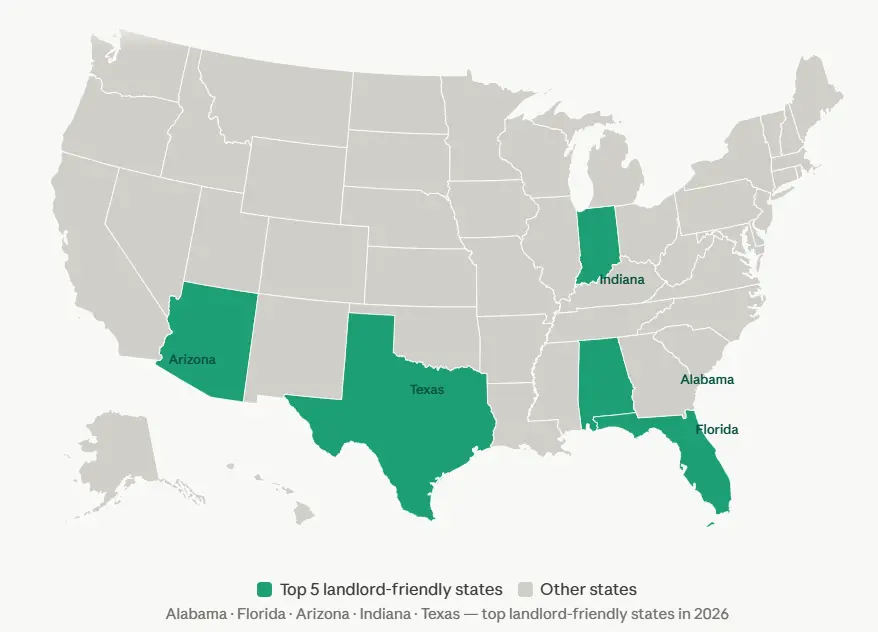
Texas: Robust Investor Protections
Texas is renowned for its strong pro-business stance, which extends to its real estate sector, offering significant advantages to landlords, although it’s important to acknowledge the trade-off with potentially higher property taxes.
- Property Taxes: Texas is known for having higher property taxes compared to some other states on this list. However, this is often offset by other landlord-favorable regulations.
- Rent Control: Texas law explicitly prohibits rent control, granting landlords complete freedom to adjust rents as per market conditions.
- Entry Barriers: The state generally has a low barrier to entry for landlords, with straightforward licensing and registration processes.
- Security Deposits: Texas law allows landlords to collect security deposits and outlines specific rules for their use and return, providing substantial protection against damages and unpaid rent.
- Notice to Enter: Landlords are typically required to provide reasonable notice, often 24 hours, for non-emergency entry, facilitating property maintenance and showings.
- Eviction Process: Texas offers one of the most efficient eviction processes in the nation, allowing landlords to quickly address tenant non-compliance and regain possession of their properties.
Top Landlord-Friendly City with High Average Cap Rate: Houston, Texas, offers a vast and diverse rental market, driven by its large population and strong job growth. This often translates into strong rental demand and competitive cap rates for investors.
Beyond the Labels: The Nuance of Investment Decisions
While the "landlord-friendly" label can be a useful starting point for investors, it is crucial to recognize that it is not the sole determinant of a profitable investment. Daryl Fairweather, Chief Economist at Redfin, emphasizes that the underlying economic fundamentals of a market—such as home prices, rent levels, job growth, and long-term demand—are often more critical than regulatory labels alone. A landlord-friendly market with weak economic fundamentals may underperform a tenant-friendly market with robust population growth and limited housing supply. Therefore, investors should treat the regulatory environment as one of many factors to consider.
Furthermore, "landlord-friendly" does not always equate to low risk. In some rapidly developing markets, intense investor activity can drive up property prices, compressing yields. Risks such as overbuilding, economic volatility, and the potential for future regulatory shifts also exist. Investors must diligently assess market fundamentals like affordability, migration trends, and local employment to make informed decisions.
Strategies for Investing in Tenant-Friendly Markets
Despite the advantages of landlord-friendly states, compelling investment opportunities frequently arise in tenant-friendly markets. For instance, a Redfin report highlighted a significant increase in investor purchases in Milwaukee, Wisconsin, a market with recently enacted renter-friendly regulations that slow down evictions and impose stricter requirements for security deposits and inspections.
For investors considering tenant-friendly markets, particularly those with rent control, Fairweather offers strategic advice:
- Acquisition Price is Key: In rent-controlled markets, cash flow generation begins with the purchase price. Investors must acquire properties at a basis that makes financial sense, accounting for future rent constraints.
- Minimize Turnover and Vacancy: Since rent increases may be limited, focusing on tenant retention is paramount. Maintaining properties well and cultivating positive tenant relationships can significantly reduce vacancy rates and associated costs.
- Leverage Allowable Increases: Investors can explore opportunities for allowable rent increases, such as inflation-based adjustments or capital improvement pass-throughs, to help offset rising operational costs over time.
When investing in tenant-friendly states, a conservative underwriting approach and professional operations are essential. This includes rigorous tenant screening, setting rents appropriately from the outset, and budgeting for potentially longer timelines when resolving issues. A deep understanding of local regulations—including notice periods, eviction timelines, and rent increase rules—is critical to avoid unexpected challenges. Collaborating with a local property manager or legal expert can provide invaluable guidance, especially for first-time investors in such markets.
The Final Verdict: Fundamentals Over Labels
In conclusion, the era of solely relying on "landlord-friendliness" as a primary investment criterion is evolving. As Fairweather notes, investors are increasingly prioritizing market fundamentals over regulatory labels. A market like Milwaukee, while considered tenant-friendly, might still be attractive if it offers affordable entry points and stable rental demand. Conversely, some traditionally landlord-friendly markets, such as parts of Florida, have seen their appeal diminish due to rising prices and insurance costs.
The most pertinent question for today’s real estate investor is: "Does the deal make sense given the local market conditions?" While regulations play a role, they are not the sole determinant of an investment’s success. Ultimately, scrutinizing the financial viability of a deal, supported by comprehensive market data and analysis, is the cornerstone of achieving profitability in any real estate market. Platforms offering data and tools for deal underwriting are indispensable for investors aiming to identify profitable opportunities, regardless of their location.

