
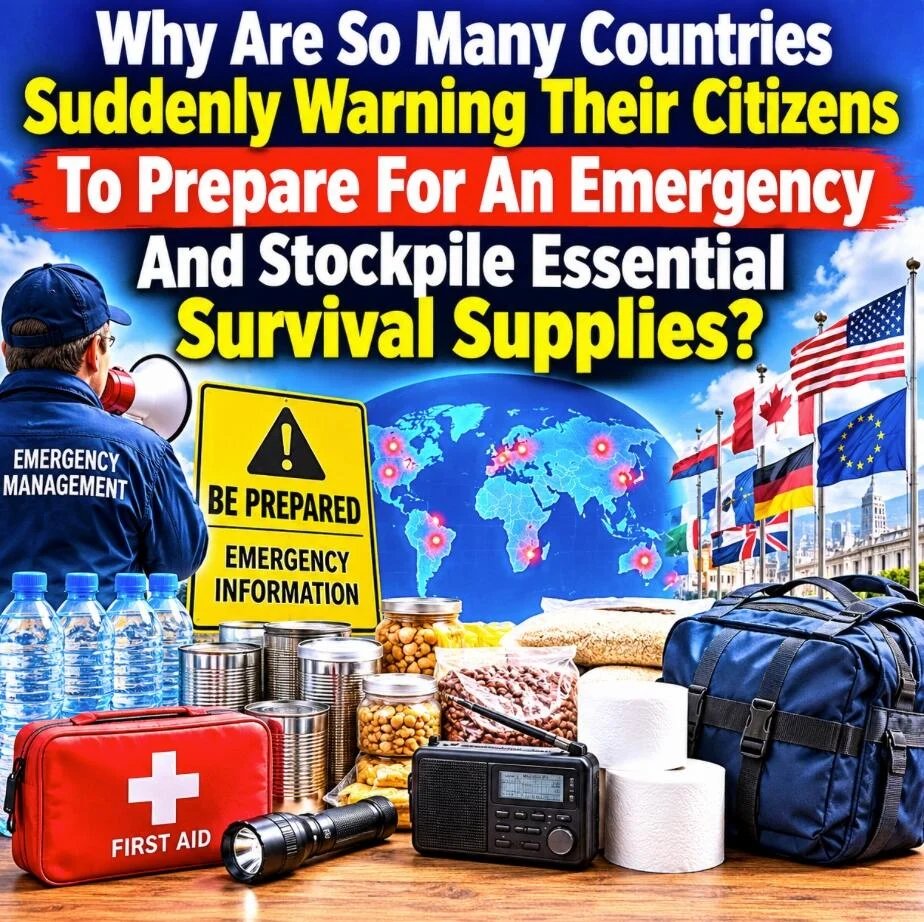
A striking and seemingly coordinated trend has emerged across the globe: governments are increasingly urging their citizens to prepare for a range of potential emergencies by stockpiling essential supplies. This widespread call for individual resilience, unprecedented in its global scope and simultaneous nature, raises critical questions about the current state of global affairs and the specific threats intelligence agencies and defense ministries may be anticipating. From European nations bracing for potential conflict to Asian countries bolstering disaster readiness and the United States military fortifying its operational independence, a discernible shift towards national and individual preparedness is underway, signaling a profound sense of urgency among international leaders.
A Global Imperative: The Rise of National Preparedness Campaigns
The phenomenon of national governments advising citizens to become "preppers" is not isolated to a single region or type of threat. Instead, it represents a global consensus that the risk landscape has fundamentally altered. While individual nations have historically issued preparedness guidelines for specific, localized threats like natural disasters, the current wave of advisories is characterized by its broad-spectrum approach, encompassing everything from extreme weather and cyberattacks to infrastructure failures and military conflict. This simultaneous push for civilian readiness suggests a shared perception of escalating and interconnected global risks.
In Europe, the call for preparedness has been particularly emphatic. Governments in the United Kingdom, Sweden, Germany, Ireland, the Netherlands, and France have all recently encouraged households to maintain reserves of food, water, medicines, and other critical essentials. This concerted effort marks a significant departure from previous policy, reflecting a heightened sense of vulnerability across the continent.
The United Kingdom has launched its "Be Ready campaign," a comprehensive initiative urging every citizen to stockpile at least enough food and bottled water to last for 72 hours. This guidance specifies a minimum of nine liters of bottled water and three days’ worth of non-perishable food. The campaign is explicitly framed as a response to the growing impact of the climate crisis, increasing technological dependency, and the evolving threat landscape posed by hostile state actors. Dan Jarvis, the UK’s security minister, underscored the importance of these "simple steps to be ready for everyday emergencies," positioning them as crucial components of a broader national effort to enhance resilience. The UK’s defense secretary, Wes Streeting, articulated the underlying rationale, stating bluntly that "there’s no sugarcoating the fact that we do live in a more dangerous and turbulent world." Streeting clarified that potential crises could range from floods and wildfires to terrorism, cyberattacks, and even war, urging families to prepare for disruptions from such events. This official rhetoric signals a departure from more generalized preparedness advice, explicitly linking individual readiness to geopolitical realities.
Sweden, a nation with a long history of robust civil defense, has similarly updated its guidance, instructing households to be capable of self-sufficiency for at least one week "in case of crisis or war." A bulletin from Sweden’s civil defense agency starkly outlined the deteriorating global situation: "The state of the world has worsened drastically in recent years. War is being waged in our vicinity. Extreme weather events are becoming increasingly common. Terror threats, cyberattacks, and disinformation campaigns are being used to undermine and influence us." The explicit mention of "war" by Swedish authorities is particularly noteworthy, resonating with public discourse and social media speculation suggesting that European governments are increasingly bracing for potential military confrontation, with some theories pointing towards a direct conflict with Russia.
Beyond Europe: Japan’s Proactive Disaster Management
The trend extends beyond the European continent. In Asia, the government of Japan has also initiated significant preparedness measures. Japan’s Disaster Management Minister has indicated plans to issue a nationwide "emergency request" urging all households to stockpile essential survival supplies. This announcement is slated to coincide with the official launch of Japan’s National Disaster Management Agency, a new entity designed to coordinate national efforts in disaster planning, immediate emergency response, and long-term recovery and reconstruction.
Japanese citizens are being advised to secure at least a three-day supply of essentials, with a recommendation to aim for a one-week supply where feasible. This move, while seemingly aligned with Japan’s historical vulnerability to natural disasters such as earthquakes and tsunamis, is nonetheless unprecedented in its scale and urgency, suggesting a broader reassessment of national resilience beyond purely environmental threats. The establishment of a dedicated national agency underscores a strategic, long-term commitment to enhancing the nation’s capacity to withstand major shocks.
United States Military Fortifies Against Civilian Infrastructure Collapse
Across the Pacific, the United States is also engaged in significant preparedness efforts, though with a different focus. The Pentagon has launched Project FORTRESS, an initiative aimed at ensuring the U.S. military’s operational continuity for at least 90 days, even in a scenario where all civilian infrastructure collapses. This ambitious goal is a direct response to the vulnerability of military operations to disruptions in power grids, supply chains, and other critical civilian services on American soil.
Pentagon chief spokesperson Sean Parnell articulated the strategic necessity: "We don’t want to rely on standard civilian municipal infrastructure to run our national defense. We just simply can’t. It’s an intolerable risk." This statement reveals a deep concern within the highest levels of U.S. defense about scenarios that could cripple national infrastructure, implying threats far beyond conventional warfare, potentially encompassing large-scale cyberattacks, electromagnetic pulse (EMP) events, or even complex coordinated attacks. The scope of Project FORTRESS highlights the U.S. military’s recognition that future conflicts may not be confined to traditional battlefields but could involve significant disruption to the home front.
Expert Warnings and the Unspoken Concerns
Adding another layer of urgency to these governmental initiatives are warnings from prominent figures with strong ties to national security. Shortly after details of Project FORTRESS emerged, former Deputy Director of the FBI, Dan Bongino, issued a stark public warning to Americans. Echoing the advice from European governments, Bongino urged citizens to develop a preparedness plan, including at least three days of food and power, an emergency radio, batteries, and water filtration systems, specifically mentioning "rain collection" as a necessary component. His fervent appeal, "Get your stuff today. Please. Do it for your family," suggests an underlying intelligence or assessment that has deeply alarmed him.
Bongino’s emphasis on "rain collection" is particularly telling. Such a measure would typically only be necessary in a long-term catastrophic emergency where conventional water sources are contaminated or unavailable. His urgency, despite no longer holding a government position, implies access to information or a perspective that has driven him to make such an extraordinary public plea. The combined weight of official government campaigns and such emphatic expert warnings points to a shared, though largely unarticulated, apprehension about impending challenges.
Underlying Rationale: A Confluence of Global Threats
The simultaneous and urgent nature of these preparedness calls suggests a convergence of multiple, severe global threats that governments are increasingly recognizing and attempting to mitigate.
-
Geopolitical Instability and Military Conflict: The most explicit reason cited by several European nations is the heightened risk of "war" or "hostile state threats." The ongoing conflict in Ukraine has dramatically reshaped the security landscape in Europe, elevating concerns about regional escalation, proxy conflicts, and direct confrontation with Russia. The rhetoric from Sweden and the UK directly acknowledges this threat, hinting at a potential expansion of military conflict beyond current borders. The increasing assertiveness of various state actors and the fracturing of international consensus contribute to a volatile geopolitical environment where large-scale conflict, even if initially conventional, could rapidly escalate to disrupt civilian life.
-
Climate Change and Extreme Weather Events: Governments globally are grappling with the escalating frequency and intensity of natural disasters. Heatwaves, droughts, unprecedented floods, and severe storms are becoming more common, capable of overwhelming infrastructure, disrupting supply chains, and displacing populations. These events pose significant challenges to emergency services and can leave communities isolated for extended periods. Preparedness campaigns recognize that climate-induced disruptions are no longer abstract future threats but present-day realities that demand immediate attention.

-
Cyber Warfare and Infrastructure Vulnerability: The digital age has introduced new vulnerabilities. Critical national infrastructure, including power grids, water treatment plants, communication networks, and financial systems, are increasingly reliant on complex digital systems. These systems are prime targets for state-sponsored cyberattacks, which could cause widespread disruption, economic paralysis, and social chaos. Project FORTRESS in the U.S. directly addresses this risk, acknowledging that a sophisticated cyberattack could cripple civilian infrastructure, demanding military self-sufficiency. The Swedish bulletin also explicitly mentions cyberattacks as a key concern.
-
Economic Disruption and Supply Chain Fragility: The COVID-19 pandemic starkly exposed the fragility of global supply chains. Wars, trade disputes, and natural disasters can quickly disrupt the flow of essential goods, leading to shortages of food, medicine, and critical components. Governments are likely preparing for scenarios where these disruptions are more severe or prolonged, necessitating local stockpiles to buffer against global shocks.
-
Terrorism and Hybrid Threats: While not explicitly detailed in all advisories, the threat of terrorism, coupled with "hybrid threats" that blend conventional and unconventional tactics (including disinformation campaigns and sabotage), remains a persistent concern. These threats aim to undermine societal stability and can necessitate rapid, localized emergency responses.
Implications for Society and the Future Outlook
These widespread preparedness campaigns carry significant implications for citizens, national economies, and the broader social fabric. For individuals, the advice prompts a re-evaluation of personal and household resilience, potentially leading to increased sales of emergency supplies and a greater focus on self-sufficiency skills. While intended to empower, such directives can also generate anxiety and speculation, as evidenced by social media discussions about the undisclosed "something big" that governments might be anticipating.
Economically, a sustained push for stockpiling could stimulate certain sectors, such as emergency supply manufacturers and food storage companies. However, it also places an additional burden on households, particularly those with limited financial resources, to acquire and maintain these reserves.
Societally, the emphasis on individual preparedness, while crucial, must be balanced with robust community and national resilience efforts. The effectiveness of these campaigns hinges on clear, transparent communication from governments, avoiding panic while conveying the genuine necessity of preparation. The lack of specific, publicly articulated triggers for this global surge in preparedness fuels speculation and underscores the challenge governments face in communicating complex, evolving threats without causing undue alarm.
The coordinated nature of these warnings, extending from European capitals to Tokyo and the Pentagon, suggests a shared assessment among global leaders that the world has entered a new era of heightened, multi-faceted risk. Whether these preparations are a response to an imminent, specific threat or a broader recognition of a permanently more volatile global environment remains a subject of intense scrutiny and concern. The coming months, particularly following significant political events such as the midterm elections in the United States, may shed more light on the precise nature of the "dangerous and turbulent world" that governments are now urging their citizens to be ready for. Until then, the message from official channels is clear: prepare for the unexpected.

