

PropTech companies are fundamentally built on data. The bedrock of their offerings—listings, comparable sales, rental rates, occupancy trends, and investment returns—is entirely dependent on structured, reliable information. This intrinsic reliance leads many founders to a seemingly strategic instinct: build the data pipeline internally, own the entire technology stack, and meticulously control all input sources. This approach, at first glance, promises defensibility and long-term competitive advantage through absolute control.
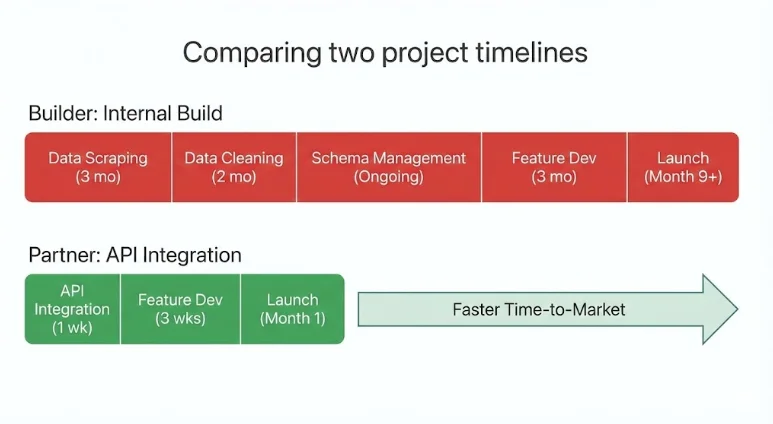
However, the reality for many PropTech teams paints a different picture. The pursuit of internal data infrastructure often consumes months of valuable engineering time before yielding any visible product value. Scrapers are notoriously brittle, frequently breaking due to website changes or evolving data formats. Schema shifts are commonplace, requiring constant adjustments. Integrating and normalizing data from multiple disparate sources demands ongoing, labor-intensive cleaning processes. Consequently, product roadmaps falter as engineering resources are diverted to build and maintain what is essentially commodity infrastructure, rather than focusing on core product innovation.
Meanwhile, competitors who have strategically integrated mature, external data systems are able to ship features and iterate on their products at a significantly faster pace. The PropTech companies demonstrating the most efficient scaling today are not necessarily those that have attempted to build every dataset from scratch. Instead, they are making deliberate, strategic decisions about which elements truly define their unique value proposition and are actively partnering with specialized providers for the rest. In the modern PropTech landscape, the ultimate advantage is not derived from absolute control, but from effective leverage.
The Rise of Strategic Data Partnerships in PropTech
A strategic data partnership in the PropTech sector can be defined as a long-term integration with a specialized data provider that delivers production-ready real estate data through robust APIs. This approach sidesteps the costly and time-consuming process of building and maintaining in-house data pipelines. Instead of dedicating months to scraping, cleaning, and updating fragmented data sources, PropTech teams can integrate pre-structured, continuously refreshed datasets that are immediately ready for product integration. This allows companies to treat data as a utility, much like electricity or cloud hosting, rather than as a core differentiator.
In practice, these strategic partnerships empower PropTech teams to achieve several critical objectives:
- Accelerated Product Development: By offloading the complexity of data acquisition and normalization, engineering teams can focus on building user-facing features and core functionalities.
- Reduced Operational Overhead: Eliminating the need for constant pipeline maintenance, error correction, and data validation significantly lowers ongoing operational costs and technical debt.
- Enhanced Data Quality and Reliability: Specialized data providers often possess the resources and expertise to ensure higher data accuracy, consistency, and timeliness than an in-house team might achieve, especially in the early stages.
- Scalability and Market Coverage: Partners with extensive data aggregation capabilities can provide broad market coverage from day one, enabling rapid expansion without the need for sequential build-outs.
It is crucial to understand that a strategic data partnership is not about outsourcing the entire product. Rather, it is about strategically outsourcing the acquisition and maintenance of commodity infrastructure, thereby allowing internal teams to double down on the aspects of the business that truly differentiate them and create unique customer value.
The Strategic Decision: Build vs. Partner
Every PropTech founder eventually confronts a pivotal question: should a particular capability be built internally, or is it more advantageous to partner for it? The answer to this question has profound implications, shaping not only the product’s architecture but also its development speed, burn rate, and long-term scalability.
When Building Internally Makes Sense
Building a data capability internally is generally justified when that capability is intrinsically linked to the company’s core differentiation and forms a central part of its value proposition. Owning the logic and infrastructure for such features strengthens defensibility against competitors. This often applies to proprietary underwriting algorithms, unique scoring models, advanced predictive analytics, or workflow automation processes that are difficult for others to replicate.
Internal builds are typically warranted when:
- The Capability is a Core Differentiator: If a feature is the very reason customers choose your product over others, owning its development and underlying data infrastructure is essential.
- Proprietary Data is the Moat: If your company’s unique advantage stems from exclusive data collection or a novel method of data generation that cannot be easily replicated, building internally is a strategic imperative.
- Deep Customization is Required: When off-the-shelf solutions cannot meet highly specific, nuanced functional requirements, an internal build might be necessary.
In these scenarios, the feature in question is not merely a component of the business; it is the business.

When Partnering Becomes the Strategic Choice
Partnerships, on the other hand, are generally more advantageous when the data layer, while foundational, is not a primary source of differentiation. Real estate datasets, by their nature, require continuous aggregation, meticulous cleaning, rigorous validation, and daily updates. Attempting to reconstruct and maintain this complex infrastructure in-house often leads to significant delays in core product development.
Partnering becomes a strategic imperative when:
- Data is Foundational but Not Differentiating: If the data is essential for your product to function but does not constitute your unique selling proposition, leveraging an external provider is more efficient.
- Speed to Market is Critical: In fast-moving markets, the ability to launch quickly is paramount. Partnerships allow for rapid integration of essential data, enabling faster product rollout.
- Resource Constraints Exist: Early-stage startups and even growth-stage companies often face limitations in engineering talent and capital. Partnering allows them to access sophisticated data capabilities without the extensive investment required for in-house development.
- Focus on Core Competencies is Paramount: By entrusting data infrastructure to specialists, internal teams can dedicate their expertise to areas like user experience, business development, and strategic innovation.
In these situations, integrating with a data partner is not a shortcut; it is a deliberate and strategic allocation of resources that optimizes for growth and efficiency. The most effective PropTech teams excel at building what makes them distinct while integrating what enables them to scale effectively.
Partnerships as a Capital Allocation Strategy
Strategic data partnerships should not be viewed as mere technical workarounds. Instead, they represent sophisticated capital allocation decisions. For PropTech companies, particularly those in their early and growth stages, engineering time is arguably their most valuable and expensive resource. Every month an engineering team dedicates to building and maintaining internal data pipelines is a month they are not spending on improving the product experience, developing innovative automation, or enhancing core differentiators.
The process of reconstructing nationwide real estate data infrastructure internally is a monumental undertaking. It involves aggregating millions of MLS records, harmonizing diverse property attributes, modeling rental income streams, cleaning and validating short-term rental signals, meticulously calculating occupancy trends, and computing key investment return metrics. Crucially, all of this data must be refreshed daily to remain relevant. This work is inherently complex, continuous, and largely invisible to the end-users of the product.
When companies opt to integrate mature real estate APIs from specialized providers, they gain immediate access to a suite of critical data points:
- Comprehensive Property Listings: Access to up-to-date details on residential and commercial properties.
- Historical Sales and Rental Data: Time-series information on past transactions and rental performance.
- Market Comparables and Benchmarks: Data points that allow for accurate property valuation and performance assessment.
- Occupancy Rates and Trends: Insights into how properties are being utilized.
- Rental Income Projections and Performance Metrics: Data vital for investment analysis, including Average Daily Rate (ADR) and Revenue Per Available Room (RevPAR) for short-term rentals.
- Built-in Investment Analytics: Pre-calculated metrics such as Return on Investment (ROI), cash-on-cash return, and cap rates.
All of this is delivered through structured, machine-readable endpoints, designed to be easily integrated into any PropTech application. The result is immediate acceleration. Teams reduce their infrastructure overhead, preserve precious engineering focus, and move more rapidly toward developing revenue-generating features. For venture-backed PropTech companies, in particular, partnerships are not about relinquishing capability; they are about strategically directing capital toward innovation and allowing specialized data providers to handle the labor-intensive foundational work.
Applied Examples Across PropTech Verticals
The strategic value of data partnerships becomes even clearer when examined through the lens of various PropTech categories. While business models differ significantly, the fundamental challenge of scaling often remains the same: transforming fragmented real estate data into reliable, production-ready intelligence.
Marketplaces
- Challenge: Property marketplaces require highly accurate and comprehensive listings, real-time pricing history, granular neighborhood benchmarks, reliable rental comparables, and robust investment indicators across numerous cities and regions.
- Risk of Building: In-house ingestion of MLS data, property attribute normalization, and performance modeling demand constant updates and multi-source validation. Expanding market coverage incrementally is a slow process that often introduces data inconsistencies.
- Strategic Partnership: By integrating structured property data endpoints, sophisticated search APIs, and detailed neighborhood analytics with nationwide coverage, marketplaces can bypass the need to build infrastructure that does not directly contribute to their core differentiation.
- Scaling Outcome: Engineering resources can be redirected towards enhancing liquidity, optimizing user experience, and streamlining transaction workflows—the true drivers of marketplace value.
Example: Rapid Deployment of an STR Underwriting Tool
A PropTech startup focused on developing a short-term rental (STR) underwriting tool leveraged an existing real estate API to deploy production-grade analytics in under two weeks. Instead of spending months on the complex tasks of normalizing listings, analyzing rental performance, and calculating ROI metrics, the team was able to concentrate on refining the user interface, optimizing workflows, and enhancing deal evaluation logic. This agility allowed them to quickly test product-market fit, onboard early users, and iterate on their offering without the significant delay and expense of building a dedicated data engineering team.
CRMs & Deal Management Platforms
- Challenge: Users of CRM platforms often need to exit the system to validate financial assumptions or conduct property research, leading to fragmented workflows and reduced user stickiness.
- Risk of Building: Developing in-house underwriting layers requires integrating property data, short-term rental metrics, long-term rental estimates, historical performance arrays, and complex ROI calculations. Each of these datasets demands rigorous cleaning and daily updates.
- Strategic Partnership: Embedding unified real estate APIs directly within the CRM platform allows for deal validation and property intelligence to be accessed seamlessly, directly within the user’s workflow.
- Scaling Outcome: The time required for users to make critical decisions is significantly reduced. User retention improves as the platform evolves from a simple workflow tool into a comprehensive decision engine.
AI Underwriting & Analytics Tools
- Challenge: Machine learning systems are inherently dependent on structured, time-series datasets with consistent schemas and highly reliable inputs.
- Risk of Building: Data obtained through scraping methods often lacks crucial normalization, sample size validation, or robust fallback logic, leading to inconsistent inputs and unstable model outputs.
- Strategic Partnership: Integrating APIs that deliver comprehensive historical performance data (e.g., 36 months of monthly performance), built-in investment metrics, and statistical confidence indicators facilitates cleaner model training and accelerates deployment cycles.
- Scaling Outcome: AI-powered tools can transition from prototype to production environments more rapidly, with a reduced risk of modeling inaccuracies stemming from poor data quality.
Investment & Portfolio Platforms
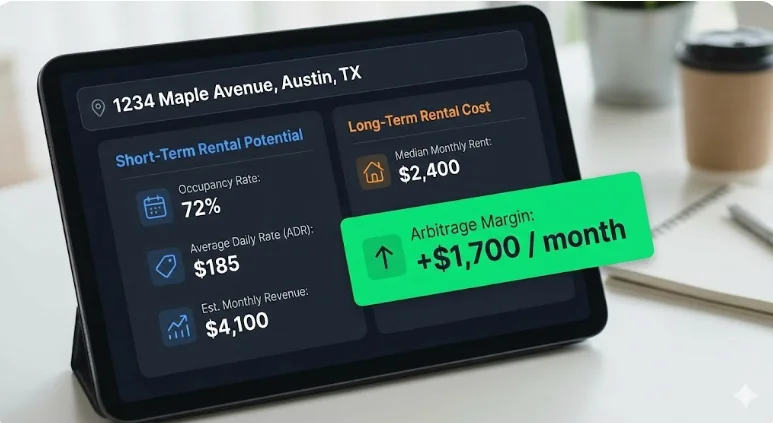
- Challenge: Institutional-grade underwriting necessitates access to detailed data on occupancy rates, Average Daily Rate (ADR), Revenue Per Available Room (RevPAR), rental comparables, expense modeling, and projected ROI across multiple markets. Furthermore, identifying highly profitable rental arbitrage opportunities requires the simultaneous evaluation of both short-term and long-term rental potential.
- Risk of Building: Replicating nationwide data coverage with daily refresh cycles is exceptionally capital-intensive and time-consuming. Developing separate data pipelines for short-term and long-term rental data effectively doubles the infrastructure burden.
- Strategic Partnership: Leveraging harmonized datasets with unified schemas and pre-modeled financial indicators eliminates significant infrastructure drag. Partnering for an API that provides both STR and LTR data unlocks immediate arbitrage analysis capabilities without the need for multiple, competing data subscriptions and complex integration efforts.
- Scaling Outcome: Investment platforms can deliver sophisticated institutional analytics and deep arbitrage modeling capabilities without incurring the prohibitive overhead associated with building such infrastructure internally, thereby accelerating market expansion.
The Competitive Advantage of Speed
In the dynamic world of real estate, markets do not pause for product development roadmaps. Short-term rental revenue can experience fluctuations of 20% to 50% between peak and off-peak seasons. Supply levels in a given market can shift rapidly as new listings enter the fray. Regulatory environments are constantly evolving, and changes in interest rates can alter underwriting assumptions almost overnight. In this environment, speed is not merely a cosmetic advantage; it is a strategic imperative.
Companies that opt to build every data layer internally often spend months stabilizing their data pipelines before they can even launch initial features. By the time this foundational infrastructure is robust and reliable, the market may have already shifted significantly.
In contrast, companies that integrate mature, externally provided data infrastructure are better positioned to:
- Launch Features Faster: Rapidly deploy new functionalities that leverage up-to-date market intelligence.
- Iterate Based on Real-Time Data: Quickly adapt product offerings in response to evolving market conditions and user feedback.
- Gain First-Mover Advantage: Establish a dominant market position by being the first to offer innovative solutions powered by comprehensive data.
- Reduce Time-to-Revenue: Accelerate the process of generating income by bringing revenue-generating features to market sooner.
Speed compounds over time. Shipping earlier leads to accelerated feedback loops, faster revenue generation, and a stronger brand positioning. In highly competitive PropTech categories, the difference between leading and lagging is often measured not by the brilliance of an idea, but by the velocity of its execution.
The Modern Scaling Model: Builders vs. Orchestrators
As the PropTech industry matures, a distinct pattern of scaling models is emerging. Companies tend to align with one of two primary approaches: "Builders" or "Orchestrators."
Builders endeavor to own and control every layer of their technology stack. This typically involves ingesting raw listings, normalizing property data, modeling rental performance, calculating ROI, and managing all update cycles internally. While this approach offers the perceived benefit of absolute control, it inherently creates significant infrastructure drag. This drag manifests as ongoing maintenance burdens, the accumulation of technical debt, and a slower pace of feature velocity.
Orchestrators, conversely, adopt a more strategic approach. They integrate best-in-class data providers for foundational datasets, thereby leveraging external expertise and infrastructure. Their internal resources are then concentrated on developing and enhancing what truly differentiates them: superior user experience, advanced automation, sophisticated AI logic, and innovative workflow solutions.
Builders often compete on the basis of data completeness, aiming to have the most comprehensive internal data assets. Orchestrators, however, compete on speed and focus, using integrated data as a platform for rapid innovation and superior execution. In an increasingly data-dense market, true differentiation rarely stems from reinventing commodity infrastructure. Instead, it arises from the intelligence and efficacy with which that foundational infrastructure is applied. The PropTech companies achieving the most efficient scaling today largely resemble orchestrators. They strategically leverage partnerships to accelerate their development cycles and build smarter, more focused products.
What an Infrastructure-Level Data Partnership Looks Like in Practice
In practical terms, a strategic data partnership entails integrating a unified, production-ready real estate API rather than attempting to build fragmented, in-house data pipelines. Infrastructure-grade solutions, such as the Mashvisor API, consolidate property data, MLS-style listings, short-term rental performance metrics, long-term rental estimates, and detailed investment analytics into structured REST endpoints meticulously designed for PropTech applications.
Instead of laboriously stitching together scraped calendar data, disparate rental platforms, and public records, PropTech teams can seamlessly retrieve clean, machine-readable JSON data. This data includes crucial metrics such as occupancy rates, ADR, revenue, RevPAR, rental comparables, built-in ROI metrics, and even 36 months of historical performance arrays, all refreshed daily and available across all 50 US states.
This approach effectively removes the substantial burden of multi-source data aggregation, normalization, and ongoing maintenance. It liberates engineering teams to concentrate on critical areas like workflow design, automation implementation, AI model development, and user experience enhancement, all while relying on a validated, continuously updated data infrastructure beneath them. This is the tangible reality of a strategic data partnership in execution.
Conclusion: The New PropTech Playbook
In an industry as data-intensive as real estate, the instinct for control can feel like a source of strength. However, in practice, leverage—the ability to utilize external resources effectively—often proves to be a more potent driver of growth and success. Strategic data partnerships enable PropTech companies to scale their operations and offerings without overextending their engineering teams or inadvertently delaying crucial product innovation.
By integrating mature, structured datasets that span property intelligence, rental performance, and investment analytics, companies can sharpen their focus on what truly sets them apart: the sophistication of their workflows, the effectiveness of their automation, the power of their AI capabilities, and the intuitiveness of their user experience.
The decision to build or partner is no longer solely a technical one; it is fundamentally strategic. Founders must critically assess not only whether they can build a capability internally but, more importantly, whether doing so moves them closer to their core competitive advantage. The PropTech companies experiencing the most rapid growth in today’s landscape are not necessarily those that hoard the most raw data. They are the organizations that master the art of connecting the right data, through the right infrastructure, at the right speed. This constitutes the modern playbook for sustainable growth in the PropTech sector.
Who Strategic Data Partnerships Are Best For
This approach to data infrastructure is most beneficial for PropTech teams that:
- Prioritize speed to market and rapid iteration.
- Wish to focus engineering resources on core product differentiation rather than commodity infrastructure.
- Seek to reduce operational overhead and technical debt associated with data pipelines.
- Require access to comprehensive, reliable, and continuously updated real estate data across broad geographic areas.
- Are looking to enhance their product offerings with advanced analytics and insights without significant upfront investment in data engineering.
This model may not be ideal for companies whose primary business is data licensing itself or for those whose core differentiator is the creation of proprietary datasets from scratch.
Exploring Build vs. Buy for Your Data Stack?
For PropTech leaders currently evaluating whether to develop their own real estate data infrastructure or integrate with an API partner, engaging in a thorough architectural and roadmap review is essential. A short introductory call with a data API provider can offer valuable pressure-testing of your current strategy, enabling a clearer understanding of the trade-offs involved and the potential benefits of a partnership. This consultation can help clarify use cases, technical requirements, and long-term scaling goals, facilitating a more informed strategic decision.

