
Accurate and up-to-date short-term rental (STR) data is no longer a competitive advantage; it’s a fundamental necessity for profitability in the dynamic real estate industry. Investors, property managers, PropTech startups, marketplaces, and analytics platforms all grapple with the same core challenge: how to access reliable Airbnb performance insights at scale. Recognizing the limitations of Airbnb’s own public analytics access, businesses are increasingly turning to third-party providers for actionable intelligence, often delivered through a specialized Airbnb data API.
This evolving landscape necessitates a rigorous evaluation of available solutions. Developers building sophisticated STR analytics platforms, real estate startups launching innovative investment tools, and data teams powering complex rental property analyses must meticulously assess multiple providers. This article undertakes a comprehensive comparison of leading Airbnb data API solutions in 2026, examining their offerings based on critical factors such as API endpoint diversity, data accuracy, market coverage, and pricing models. The goal is to provide a clear understanding of which platform best aligns with diverse business use cases.
Understanding the Power of an Airbnb Data API
At its core, an API for Airbnb data functions as a software interface. This interface empowers platforms, applications, and analytics tools to programmatically access structured short-term rental data. Instead of the laborious and time-consuming process of manually collecting Airbnb listing information, businesses can leverage these APIs to automatically retrieve vital performance metrics, identify emerging market trends, gain pricing insights, and conduct in-depth property analytics. This integration is made possible through a specialized real estate data API designed for scalable and seamless integration into existing workflows.
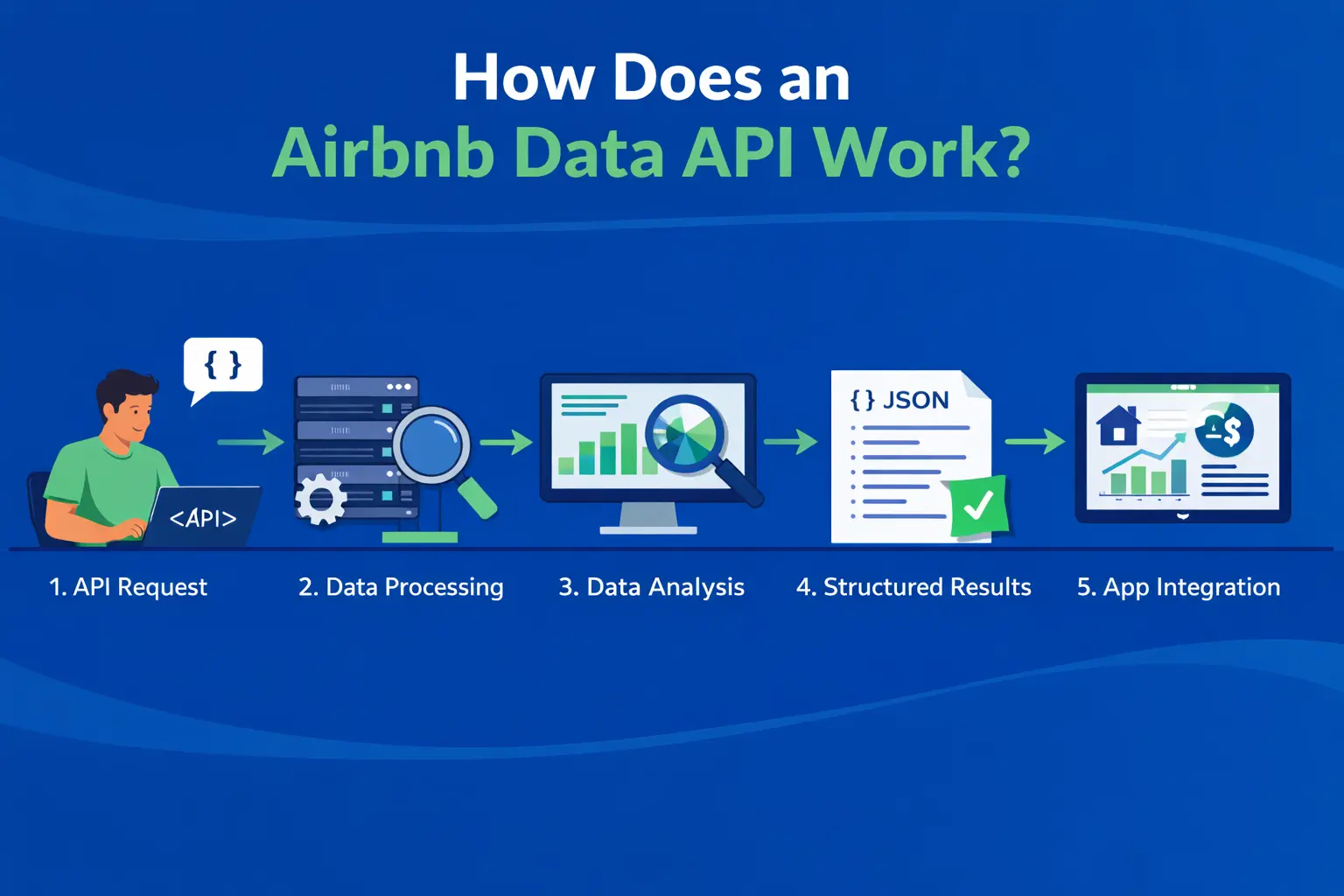
The operational mechanism of an Airbnb data API involves a direct connection between applications and data providers. This connection is facilitated through automated requests and responses, creating a fluid data exchange. Typically, the process unfolds as follows:
- Developer Request: An application sends a specific query to the API, requesting particular data points (e.g., occupancy rates for a given city, average daily rates for a specific property type).
- API Processing: The API receives the request, interprets it, and queries its underlying database or data sources.
- Data Retrieval: Relevant data is identified and compiled based on the request parameters.
- Data Formatting: The retrieved data is structured into a standardized format, most commonly JSON (JavaScript Object Notation), which is easily readable by software.
- API Response: The API sends the formatted data back to the requesting application.
This automated process, often underpinned by a robust real estate data API partnership, allows businesses to integrate vacation rental data directly into their operational frameworks without the significant overhead of building and maintaining their own data collection infrastructure.
Who Benefits Most from Airbnb Data APIs?
The demand for reliable Airbnb data APIs spans a wide spectrum of real estate market participants. Key stakeholders include:
- Real Estate Investors: Seeking to identify profitable STR investment opportunities, analyze market potential, and project ROI.
- Property Managers: Needing to optimize pricing, track performance, and benchmark against competitors to maximize occupancy and revenue.
- PropTech Startups: Developing innovative solutions for the real estate market, such as automated valuation models, investment analysis tools, or dynamic pricing engines.
- Marketplaces and Listing Platforms: Requiring granular market data to inform their users, enhance search functionalities, and provide competitive insights.
- Data Analytics Firms: Specializing in real estate intelligence, they utilize these APIs to aggregate, analyze, and package data for various industry clients.
- Financial Institutions and Lenders: Assessing the viability and risk associated with STR-backed loans or investments.
In essence, Airbnb data APIs transform fragmented STR market information into cohesive, usable intelligence. This intelligence is invaluable for both seasoned investment professionals and technical teams striving to build data-driven applications. A clear understanding of how these APIs function is crucial for effectively evaluating which provider offers the most compelling combination of analytics, market coverage, and ease of use.
Identifying the Leading Airbnb Data API Providers in 2026
The "best" Airbnb data API in 2026 is characterized by its ability to deliver accurate short-term rental analytics, readily available investment metrics, flexible developer integration capabilities, and scalable pricing. While numerous platforms offer robust solutions, each tends to excel in specific niches.
Among the top contenders, Mashvisor distinguishes itself by consistently delivering actionable real estate market and property intelligence that spans the entire United States market. This comprehensive approach makes it particularly effective for investors, property managers, and developers who require a holistic view of the market.
However, a nuanced evaluation reveals that other platforms also hold significant strengths:
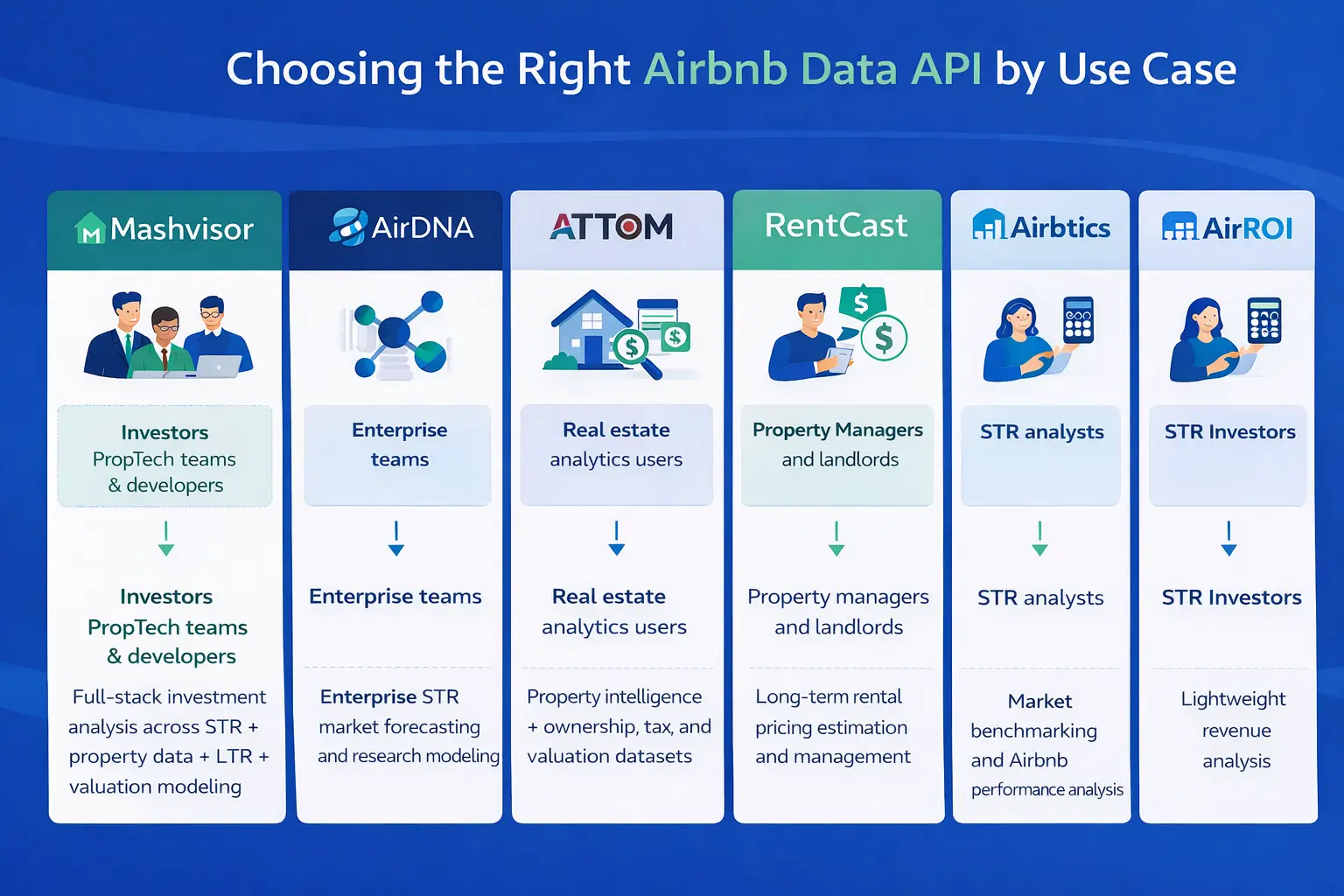
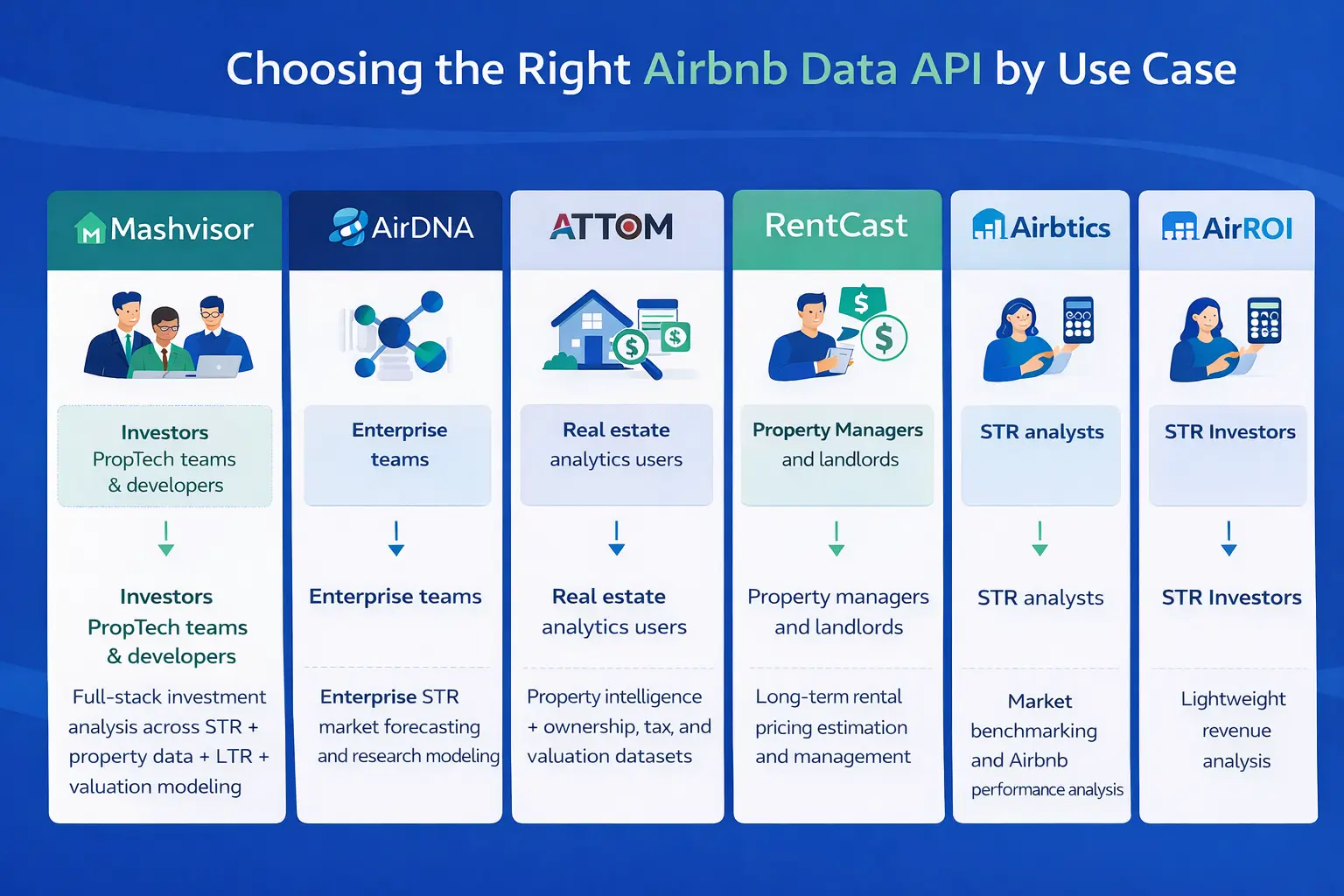
- Mashvisor: Positioned as the top choice for investment-focused Airbnb data API needs, it integrates analytics, investment metrics, and property-level insights into a unified platform, significantly reducing development time and accelerating data-driven real estate decisions.
- AirDNA: A strong contender for enterprise-level STR investors and managers, offering broad market data and forecasting models.
- ATTOM: Primarily focused on comprehensive property data, making it suitable for market analysts and platforms requiring deep property intelligence.
- RentCast: Specializes in long-term rental (LTR) data, catering to investors and platforms focused on the traditional rental market.
- Airbtics: Offers targeted STR analytics for individual investors and managers seeking market intelligence.
- AirROI: Provides simplified STR analytics for revenue estimation, suitable for basic feasibility studies.
A detailed comparison of these leading platforms, considering their diverse strengths and weaknesses, is essential for making an informed selection.
Comparative Analysis: Airbnb Data API Providers in 2026
Choosing the right data provider often hinges on a delicate balance between data depth, analytical capabilities, developer usability, and pricing flexibility. While all major providers offer valuable real estate datasets, their primary focus areas and the depth of their offerings vary significantly.
Airbnb Data API Providers: Quick Comparison
| Provider | Best For | Data Focus | Typical Use Cases | Developer Tools | Updates | Historical Data | Pricing |
|---|---|---|---|---|---|---|---|
| Mashvisor | Rental investors, managers & revenue managers; PropTech platforms; Real estate analytics apps | STR data, LTR data, Market data, Property data, Investment metrics | Full-stack RE investment analysis apps | Advanced, developer-friendly | Daily | 36 months | Usage-based, with scalable tiers |
| AirDNA | Enterprise STR investors, managers & analysts | STR only | STR forecasting models | Strong | Regular | Limited | Enterprise usage-based, custom contracts |
| ATTOM | Real estate market analysts | Property data only | Property intelligence platforms | Extensive | Unspecified | Limited | Tiered subscription, based on data products |
| RentCast | LTR investors, managers & analysts | LTR only | Rental pricing engines | Simple | Daily | Limited | Credit-based |
| Airbtics | Individual STR investors & managers | STR only | Airbnb market intelligence tools | Moderate | Weekly | 12 months | Pay-as-you-go |
| AirROI | Individual STR investors & managers | STR only | Airbnb revenue estimation tools | Basic | Unspecified | 15+ years | Lightweight usage-based |
Airbnb Data API Providers: Detailed Comparison
| Provider | API Endpoints Diversity | Airbnb Data Accuracy | LTR Data | Market Data | Property Data | Investment Analytics | Valuations |
|---|---|---|---|---|---|---|---|
| Mashvisor | Extensive | High (multi-source, validated) | ✅ | ✅ | ✅ | ✅ (Cash flow, Cap rate, Cash on cash return) | ✅ |
| AirDNA | Strong | High | ❌ | ✅ | Limited | Limited | ✅ |
| ATTOM | Extensive | Not relevant | ❌ | ✅ | ✅ | ❌ | ✅ |
| RentCast | Moderate | Not relevant | ✅ | ✅ | ✅ | Limited | ✅ |
| Airbtics | Moderate | High | ❌ | ✅ | ✅ | Limited | ✅ |
| AirROI | Limited | Moderate | ❌ | ✅ | ✅ | Limited | ✅ |
Competitive Snapshots in 2026
- Mashvisor: Stands out for its comprehensive data integration, offering a unified platform for STR and LTR analysis, property data, and crucial investment metrics. This makes it exceptionally well-suited for building full-stack real estate investment analysis tools.
- AirDNA: Dominates in providing large-scale, aggregated STR market data. It is ideal for enterprise analytics platforms and research teams focused on broad market trends and forecasting models, though it lacks LTR data.
- ATTOM: Offers extensive property data, including ownership, valuations, and parcel information. It is a powerful tool for property intelligence platforms and data enrichment but does not natively provide STR performance analytics.
- RentCast: Focuses exclusively on long-term rental markets, providing rental estimates and property-level data. It is a go-to for applications centered on LTR analysis and pricing engines.
- Airbtics: Delivers specialized Airbnb analytics with a focus on market trends and geographic insights, suitable for STR market research and benchmarking.
- AirROI: Offers streamlined STR analytics and revenue estimates, designed for straightforward integrations and basic feasibility studies.
Provider Deep Dives: Strengths and Specializations
Mashvisor Airbnb API: This API is engineered with investors and PropTech platforms in mind. It seamlessly integrates short-term rental analytics, long-term rental data, and comprehensive property intelligence. With access to 36 months of historical Airbnb performance data and nationwide market coverage, Mashvisor is ideal for creating robust real estate investment analysis tools, STR forecasting models, and investor dashboards that demand precise ROI metrics, rental comparables, and actionable property-level insights. Its API documentation provides a detailed breakdown of all available endpoints, enabling developers to build sophisticated functionalities.
AirDNA Airbnb API: AirDNA provides extensive large-scale short-term rental market data, encompassing occupancy trends, pricing metrics, and historical Airbnb performance. It is best suited for enterprise analytics platforms, research teams, and large organizations developing market intelligence dashboards that rely on aggregated STR datasets. However, its focus remains strictly on STRs, lacking LTR data or the deep property-level investment modeling capabilities found in other solutions.
ATTOM Airbnb API: ATTOM’s strength lies in its property data API, offering detailed ownership records, valuations, parcel information, and broad real estate market datasets. While not specifically an STR analytics provider, it excels in applications requiring property intelligence, valuation modeling, and data enrichment as part of broader real estate analytics workflows. Its extensive property data can supplement STR analysis but doesn’t independently provide STR performance metrics.
RentCast Airbnb API: RentCast delivers rental market intelligence primarily focused on long-term rental estimates, pricing trends, and property-level rental data. It is an excellent choice for developers building rental analysis tools, pricing engines, and portfolio monitoring platforms that prioritize LTR analytics over dedicated Airbnb performance data. While it covers LTR data, which Mashvisor also offers, it doesn’t delve into the STR specificities.
Airbtics Airbnb API: Airbtics offers Airbnb analytics focused on market trends, performance benchmarks, and localized short-term rental insights. It is best for platforms conducting STR market research, competitive benchmarking, and regional performance analysis where market-level Airbnb data is paramount, but it falls short for comprehensive investment profitability analysis or LTR research.
AirROI Airbnb API: AirROI provides simplified short-term rental analytics and Airbnb revenue estimates through lightweight integrations. It is designed for startups and developers needing quick access to STR performance and feasibility indicators without the complexity of extensive analytics infrastructure or deep investment modeling features. Its focus is on speed and accessibility for basic STR analysis.
Pricing Structures: A Critical Factor for Scalability
The pricing models for Airbnb data APIs vary significantly, impacting the financial feasibility for different businesses. Most platforms employ subscription or usage-based models, but the transparency, flexibility, and scalability of these structures differ widely.
STR Data APIs: Pricing Comparison
Mashvisor API Pricing: Mashvisor utilizes a usage-based, credit-driven pricing model. Subscription plans are tiered, allowing teams to start with smaller commitments and scale their data access as their needs evolve. Users pay only for the data and endpoints they actively use. Higher tiers offer increased request volumes, and switching between tiers is designed to be straightforward. Importantly, each plan provides access to all available endpoints and functionalities. Options for both monthly and annual plans are available, with annual subscriptions offering a cost saving equivalent to two months free. This model is particularly attractive to startups, investor platforms, and growing PropTech products requiring scalable and predictable costs.
AirDNA API Pricing: AirDNA employs a subscription and enterprise licensing model. Pricing is typically customized based on dataset access, geographic coverage, and usage requirements. Plans differ depending on whether users access their analytics tools or API data integrations. Enterprise contracts are common for large-scale deployments, and accessing multiple markets can lead to significant costs, making it best suited for enterprise analytics teams and large research platforms.

ATTOM API Pricing: ATTOM offers tiered and packaged pricing based on specific data products and request volumes. Costs are generally determined by the dataset scope and the scale of integration, with customized enterprise plans available. Pricing is often negotiated based on individual usage and data access needs, making it suitable for enterprise property data integrations and valuation platforms.
RentCast API Pricing: RentCast utilizes tiered monthly pricing based on API request limits. A free development plan with limited API calls is available, and paid plans scale with usage volume, allowing developers to upgrade as their integrations grow. The pricing structure is based on subscription tiers rather than per-endpoint billing, ideal for developers and startups building LTR analytics tools with predictable monthly usage.
Airbtics API Pricing: Airbtics operates on a pay-as-you-go model, where costs are calculated per API endpoint request. This model eliminates contracts and monthly commitments, offering transparent pricing that allows teams to scale usage gradually and pay only for the data they consume. It is well-suited for flexible integrations and usage-based analytics projects.
AirROI API Pricing: Similar to Airbtics, AirROI uses a pay-as-you-go pricing model based on API requests rather than fixed subscriptions. Developers can start with a small prepaid credit and scale usage incrementally, with real-time tracking and no contractual obligations. This makes it a good option for lightweight integrations and flexible STR analytics experimentation.
Mashvisor stands out for its pricing flexibility, offering a usage-based structure with tiered levels that scale effectively with platform growth. This allows businesses to manage costs precisely, starting small and expanding access predictably as their data needs increase. This balance makes it particularly appealing for startups and production-ready real estate applications. For those looking to test its capabilities, Mashvisor offers a 7-day free trial with 30 credits.
API Endpoint Diversity: Enabling Comprehensive Development
The range and structure of available API endpoints are critical determinants of what developers can actually build. While many providers offer access to STR or property datasets, the depth, organization, and usability of these endpoints can vary dramatically.
Mashvisor API Endpoints
Mashvisor provides an extensive suite of structured endpoints designed for comprehensive investment analysis and application development. These endpoints allow access to both Airbnb analytics and property intelligence within a single, unified ecosystem. Key endpoints include:
- Property Lookup: Retrieve detailed information and analytics for specific properties.
- Market Analysis: Access city, neighborhood, and ZIP code level data for market trends and opportunities.
- Investment Metrics: Obtain cash flow, cap rate, cash-on-cash return, and ROI projections.
- Occupancy Rates & Daily Rates: Get historical and projected occupancy and average daily rates.
- Rental Comps: Access comparable rental data for both STR and LTR.
- Property Valuations: Retrieve estimated property values and trends.
- Historical Performance: Access past performance data for properties and markets.
- Neighborhood Data: Detailed insights into specific neighborhoods, including amenities and demographics.
These endpoints enable the creation of complete real estate investment workflows, eliminating the need to integrate multiple disparate APIs. Developers can consult the Mashvisor API documentation for a comprehensive breakdown of all available endpoints.
AirDNA API Endpoints
AirDNA’s endpoints are primarily focused on aggregated short-term rental analytics and market performance datasets, including:
- Market Overview: Aggregated data on occupancy, ADR, and revenue for specific markets.
- Property Performance: Performance metrics for individual listings, often aggregated.
- Pricing Trends: Historical and forecasted pricing data.
- Demand & Supply Metrics: Insights into market supply and demand dynamics.
These endpoints are well-suited for large-scale market analysis and regional performance comparisons but are not designed for property-level investment modeling or LTR market analysis.
ATTOM API Endpoints
ATTOM offers extensive property data endpoints centered on real estate records and valuation intelligence, such as:
- Property Details: Comprehensive information on property characteristics.
- Ownership Records: Publicly available ownership information.
- Tax and Assessment Data: Details on property taxes and assessments.
- Mortgage and Deed Information: Records related to property financing.
- Valuation Data: Estimated property values and historical trends.
This API supports property enrichment workflows but lacks native Airbnb performance analytics. It can be used to supplement STR analysis but not as a standalone source for STR insights.
RentCast API Endpoints
RentCast delivers streamlined endpoints focused on long-term rental analytics and pricing intelligence, including:
- Rental Estimates: Property-specific rental value estimates.
- Rental Market Trends: City and regional LTR market performance.
- Property Rental Data: Historical rental data for specific addresses.
These endpoints are designed for long-term rental analysis. They can also be beneficial for those in the Airbnb rental arbitrage space, as they provide necessary LTR data that Mashvisor also offers.
Airbtics API Endpoints
Airbtics provides endpoints concentrated on Airbnb market analytics and benchmarking insights, such as:
- Market Performance: STR performance metrics at city and regional levels.
- Revenue Benchmarking: Comparative revenue data for STRs.
- Occupancy & Pricing Analysis: STR occupancy and pricing trends.
- Geographic STR Insights: Data specific to certain geographical STR markets.
This API is most useful for STR market research and comparative geographic performance analysis, but it cannot be used for comprehensive investment profitability analysis or LTR research.
AirROI API Endpoints
AirROI offers lightweight endpoints for simplified short-term rental performance analysis, including:
- Revenue Estimates: Basic STR revenue projections.
- Occupancy Estimates: Simplified occupancy rate forecasts.
- Feasibility Indicators: High-level indicators for STR viability.
The platform prioritizes quick integrations over extensive analytics depth and lacks comprehensive real estate property and LTR data.
Mashvisor emerges as the provider with the strongest option for diverse API endpoints, consolidating property data, STR analytics, LTR intelligence, and investment metrics into a single, cohesive ecosystem. This breadth allows developers to construct complete analysis workflows without the complexity of integrating multiple APIs.
Data Accuracy: The Foundation of Trustworthy Insights
Data accuracy is paramount, as investment decisions and forecasting models are heavily reliant on the reliability of performance estimates. Accuracy is influenced not only by dataset size but also by the methods providers employ for data collection, validation, and modeling. Each provider utilizes distinct methodologies to estimate trends, directly impacting the trustworthiness of their data.
Mashvisor Data Accuracy
The Mashvisor Airbnb API provides highly accurate STR analytics by combining:
- Observed STR Performance Signals: Direct data from active Airbnb listings.
- Comparable Property Analysis: Validating performance against similar local listings.
- Historical STR Datasets: Leveraging past performance trends for forecasting.
- Long-Term Rental Data: Incorporating LTR market dynamics for a comprehensive view.
This multi-layered modeling approach ensures property-level accuracy suitable for critical investment decision-making and robust STR forecasting models.
AirDNA Data Accuracy
AirDNA achieves STR data accuracy through large-scale market aggregation methods, including:
- Extensive Listing Data Aggregation: Collecting data from a vast number of STR listings.
- Market-Level Trend Analysis: Focusing on aggregate market performance.
- Proprietary Algorithmic Modeling: Employing algorithms to derive insights from aggregated data.
AirDNA’s data methodology is particularly effective for macro-level market analytics and regional performance comparisons.
ATTOM Data Accuracy
ATTOM prioritizes accuracy in property intelligence rather than STR analytics by leveraging:
- Public Records and Assessor Data: Sourcing information from official government records.
- Title and Deed Information: Utilizing comprehensive property transaction data.
- Automated Valuation Models (AVMs): Employing algorithms for property valuation.
ATTOM ensures strong property data accuracy but does not directly model Airbnb performance metrics.
RentCast Data Accuracy
The RentCast API emphasizes long-term rental accuracy using structured housing market inputs such as:
- MLS Data Integration: Leveraging multiple listing service data.
- Public Record Data: Incorporating property ownership and tax information.
- Rental Market Surveys: Utilizing data from rental market surveys.
RentCast’s data accuracy is primarily applicable to LTR analytics rather than STR forecasting.
Airbtics Data Accuracy
Airbtics generates Airbnb analytics accuracy through market-focused Airbnb revenue modeling approaches, including:
- STR Listing Data Analysis: Analyzing performance of specific STR listings.
- Market Trend Identification: Identifying patterns in STR market performance.
- Revenue Forecasting Models: Developing models to predict STR revenue.
Airbtics’ data accuracy is highest when analyzing STR market trends and competitive positioning.
AirROI Data Accuracy
The AirROI API provides simplified STR performance estimates using streamlined analytical inputs such as:
- Aggregated Listing Data: Utilizing broader STR listing performance data.
- Simplified Revenue Models: Employing less complex revenue calculation methods.
- Market Snapshot Analysis: Providing high-level market performance overviews.
The AirROI data approach prioritizes accessibility and speed over deep investment modeling granularity.
Mashvisor emerges as a leading provider for Airbnb data accuracy and reliability. By integrating observed STR performance signals, historical datasets, and comparable property validation, its methodology yields highly accurate, investment-ready analytics. This approach enables more comprehensive and precise forecasting and ROI analysis compared to providers focused solely on aggregated market estimates.
Market Coverage: Breadth and Depth of Geographic Reach
Market coverage is a critical factor, determining how effectively an Airbnb API can support analysis across diverse geographic scales—from national trends to neighborhood-level investment decisions. The depth of coverage also dictates the platform’s ability to perform granular market analysis, localized forecasting, and property-specific evaluations.
Mashvisor Market Coverage
Mashvisor provides comprehensive coverage across the United States, encompassing all 50 states. Data is accessible at the state, city, neighborhood, ZIP code, and individual property levels. This dual approach, combining market-level and property-level datasets, supports in-depth market analysis, neighborhood analysis, and detailed rental property analysis within a single platform, facilitating scalable investment research and localized decision-making.
AirDNA Market Coverage
AirDNA offers broad geographic coverage across global short-term rental markets, excelling in market-level analytics and regional performance insights. Its strength lies in city and regional trend analysis, though it provides less granular detail for property-level investment evaluation.
ATTOM Market Coverage
The ATTOM API provides nationwide property data coverage, sourced from public records and assessor datasets. Its coverage is robust at the parcel and property levels, designed for property intelligence rather than direct short-term rental market analysis.
RentCast Market Coverage
RentCast covers long-term rental markets across the US, offering rental estimates and pricing intelligence at city and property levels. Its geographic reach supports rental analysis workflows but does not extend to dedicated Airbnb market analytics.
Airbtics Market Coverage
Airbtics covers multiple global Airbnb markets, with a primary focus on city-level and regional STR performance insights. It is well-suited for comparative market analysis but not for localized property investment modeling.
AirROI Market Coverage
The AirROI API offers selective market coverage, focusing on providing simplified short-term rental performance indicators. Its coverage supports high-level feasibility analysis but is generally oriented towards broader market insights rather than granular geographic analysis.
Mashvisor is best fitted for US-focused deep market research, offering both nationwide market intelligence and granular property-level analytics. This allows users to seamlessly transition from national market research to neighborhood and individual property analysis within a single API.
When Mashvisor Might Not Be the Optimal Choice
While Mashvisor presents a powerful all-in-one solution for investment analysis, certain niche use cases might be better served by more specialized Airbnb data API providers. The optimal platform choice hinges on specific goals, data requirements, and the required depth of analysis.
Scenarios where alternatives might be preferable include:
- Purely Global STR Market Aggregation: If the sole requirement is aggregated STR market data across numerous international markets without the need for property-level investment metrics or LTR data, AirDNA might offer a more specialized, albeit less integrated, solution.
- Deep Property Data and Public Records: For applications exclusively focused on deep property data, ownership records, and public tax information, ATTOM’s specialized offerings would be more appropriate.
- Long-Term Rental Focus Only: If an application strictly requires LTR data and pricing engines without any STR component, RentCast provides a dedicated solution.
- Basic STR Feasibility for Non-Investment Purposes: For developers needing very basic STR performance indicators for non-investment related feasibility studies, AirROI might suffice due to its simplicity.
However, for platforms requiring both short-term rental analytics and property-level investment insights within a unified workflow, Mashvisor remains the most comprehensive and integrated option.
Real-World Application: Sample API Request and Response
To illustrate the practical application of an Airbnb data API, consider a sample Mashvisor API request and its corresponding JSON response. This example demonstrates how developers can integrate these tools into their applications.
Sample Airbnb API Request (Mashvisor Example for Developers)
A developer building an investment analysis tool might use the following request to retrieve STR performance and investment metrics for a specific property in Miami, Florida:
GET https://api.mashvisor.com/client/lookup
Authorization: Bearer YOUR_API_KEY
Content-Type: application/json

  "location": "Miami, FL",
  "property_type": "single_family",
  "strategy": "airbnb"
This request effectively asks the Mashvisor API to:
- Query for properties in "Miami, FL".
- Filter for "single_family" property types.
- Specify the "airbnb" strategy to retrieve STR-specific analytics.
This endpoint is typically integrated into backend workflows to power features like STR forecasting models, investment scoring systems, or dynamic property comparison tools.
Sample JSON Response for Developers
Upon receiving the request, the Mashvisor API returns structured JSON data, ready for immediate processing and display within an application:
  "property_id": "4839201",
  "location":
    "city": "Miami",
    "state": "FL",
    "zip_code": "33101"
  ,
  "strategy": "airbnb",
  "airbnb_metrics":
    "occupancy_rate": 0.71,
    "average_daily_rate": 214,
    "monthly_revenue": 3810,
    "annual_revenue": 45720
  ,
  "investment_metrics":
    "cap_rate": 0.084,
    "cash_on_cash_return": 0.112,
    "optimal_rental_strategy": "airbnb"
  ,
  "comparables":
    "airbnb_comps_count": 14,
    "average_comp_revenue": 46800
  ,
  "last_updated": "2026-01-15"
The structure of this response offers significant benefits for developers:
- Clean, Structured Data: The JSON format is universally recognized and easy for software to parse.
- Analytics-Ready Output: The data is already processed into meaningful metrics (occupancy, revenue, ROI), reducing the need for complex post-processing.
- Unified Data Model: Access to both Airbnb metrics and investment metrics within a single response simplifies development and integration.
- Reduced Backend Processing: Developers can focus on front-end features and user experience, as the heavy lifting of data retrieval and analysis is handled by the API.
This approach allows developers to accelerate product development, moving swiftly from data retrieval to functional application features.
Building an Airbnb Investment Analysis Tool: A Real-World Scenario
Consider a PropTech startup aiming to build a platform that empowers investors to identify profitable short-term rental properties. Instead of manual data collection, the startup integrates the Mashvisor API to automate the entire investment analysis workflow.
The platform leverages Mashvisor’s API to:
- Automate Property Identification: Automatically pull listings based on user-defined criteria (location, price range, property type) and enrich them with STR potential data.
- Generate STR Performance Projections: Fetch estimated monthly and annual revenue, occupancy rates, and average daily rates for identified properties.
- Calculate Investment ROI: Access key investment metrics like cap rate, cash-on-cash return, and overall ROI projections.
- Provide Rental Comparables: Retrieve data on similar STR and LTR properties to inform pricing and revenue estimates.
- Display Property-Level Insights: Present detailed market and property-specific data, including neighborhood performance and valuation estimates.
By combining these capabilities, the platform delivers a fully automated investment dashboard, enabling users to make faster, data-driven decisions without relying on multiple data providers or manual data processing.
Final Verdict: The Premier Airbnb Data API in 2026
An in-depth comparison of Mashvisor, AirDNA, ATTOM, RentCast, Airbtics, and AirROI, analyzed across accuracy, market coverage, endpoint diversity, pricing structure, and developer experience, leads to a clear conclusion: Mashvisor offers the best Airbnb data API in 2026 for real estate investors, PropTech startups, and developers building data-driven platforms.
Unlike providers with a single focus, Mashvisor integrates multiple layers of real estate intelligence under one unified ecosystem. Through a single API, users gain access to property-level data, nationwide STR and LTR analytics, crucial investment metrics, rental comparables, valuation models, and historical performance insights. This comprehensive approach enables complete real estate analysis without the need to stitch together data from disparate sources.
Where Mashvisor Surpasses Other Airbnb API Providers
Mashvisor stands alone in its ability to seamlessly combine:
- Short-Term Rental (STR) Analytics: Detailed performance metrics and projections.
- Long-Term Rental (LTR) Data: Comprehensive insights into the traditional rental market.
- Property-Level Data: Granular information on individual real estate assets.
- Investment Metrics: Key financial indicators for profitability assessment.
- Nationwide Market Coverage: Extensive data across all US states.
- Developer-Friendly Ecosystem: Robust endpoints and clear documentation.
While other platforms offer specialized strengths—AirDNA for global STR aggregation, ATTOM for deep property data, or RentCast for LTR focus—only Mashvisor integrates these diverse capabilities into a cohesive Airbnb analytics infrastructure designed for actionable investment decision-making and scalable application development.
Frequently Asked Questions
What Is the Best Airbnb API in 2026?
Mashvisor is considered the best Airbnb data API in 2026 due to its comprehensive integration of Airbnb analytics, property data, rental comparables, and investment metrics within a single platform, enabling full real estate analysis without multiple integrations.
Does Airbnb Offer a Public Analytics API?
No, Airbnb does not provide a public analytics API that delivers occupancy rates, revenue estimates, or market performance data. This is why businesses rely on third-party short-term rental data API providers for structured analytics.
Which API Is Best for Airbnb Data for Investors?
Mashvisor is the premier Airbnb analytics API for investors, offering market and property-level revenue projections, ROI metrics, rental comps, and historical performance data in one system, crucial for evaluating profitability before investing or listing a property.
Which API Provides the Most Accurate Airbnb Data?
Accuracy varies by methodology, but Mashvisor focuses on property-level modeling, supported by comparable analysis and historical STR datasets. This approach yields investment-ready analytics rather than purely aggregated market estimates.
Which Airbnb API Works Best for Developers Building STR Analytics Platforms?
Developers building STR analytics platforms benefit most from APIs like Mashvisor that offer clean JSON responses, structured endpoints, and investment-ready metrics, significantly reducing backend processing and speeding up product development.
Which Airbnb Data API Has the Most Affordable Pricing?
Affordability is usage-dependent, but APIs with usage-based or scalable tier models, such as Mashvisor, allow teams to start small and scale costs predictably as their data needs grow, making them practical for startups and scaling real estate applications.

