
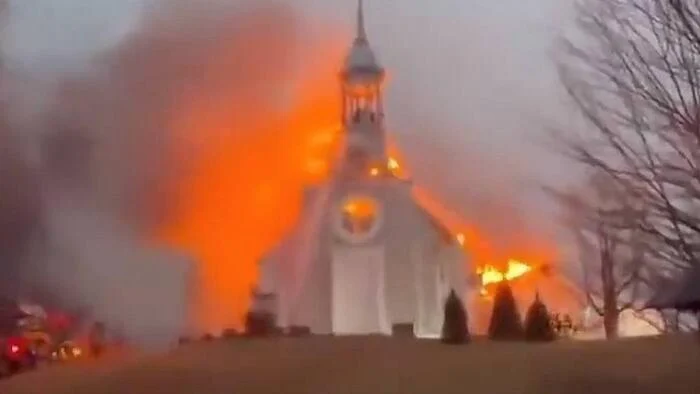
A historic church, a cherished landmark dating back to 1893, has been tragically reduced to ashes in Saint-Romain, Quebec, following a devastating fire that engulfed the structure last night. This latest incident marks a somber addition to a troubling pattern of destruction targeting Canada’s Christian institutions, a trend that has seen arson attacks more than double since 2021. The loss of the Saint-Romain church, situated between the Beauce and Estrie regions, represents not only a profound blow to the local community but also amplifies national anxieties regarding the escalating vulnerability of historical and religious sites across the country. As emergency services concluded their efforts at the scene and police launched a full investigation, the incident immediately ignited widespread discussion and concern, particularly across social media platforms where videos of the blaze circulated, drawing urgent calls for answers and accountability.
The Devastation in Saint-Romain: A Chronology of Loss
The alarm was raised late Monday evening, approximately 10:30 PM local time, when residents reported seeing flames erupting from the Saint-Romain church. Emergency crews from several surrounding municipalities, including Lac-Mégantic and Lambton, were quickly dispatched to the scene. Upon arrival, firefighters were confronted with a rapidly escalating inferno, as the wooden structure of the historic church provided ample fuel for the blaze. Despite their swift response and concerted efforts, the intensity of the fire and the combustible nature of the building meant that controlling the conflagration proved exceedingly difficult. Eyewitnesses described towering flames illuminating the night sky, a stark and heartbreaking spectacle for a community that had revered the church for generations.
Firefighters battled through the night, working tirelessly to contain the blaze and prevent it from spreading to adjacent properties. However, by the early hours of Tuesday morning, it became clear that the church, a cornerstone of Saint-Romain’s architectural and spiritual landscape, was beyond saving. The structure, which had stood for over 130 years, collapsed under the destructive force of the fire, leaving behind only a smoldering ruin. The Sûreté du Québec (SQ), the provincial police force, swiftly took over the scene, establishing a perimeter and commencing a preliminary investigation. While the official cause of the fire remains under investigation, the context of recent events across Canada has led many to immediately suspect foul play, prompting authorities to treat the incident with heightened scrutiny. Forensic investigators are expected to meticulously examine the debris for any clues that could shed light on the origin and nature of the fire.
A Beacon of Heritage: The Saint-Romain Church
The Église Saint-Romain, as it was formally known, held immense historical and cultural significance for its namesake community. Construction on the church began in 1893, a testament to the enduring faith and communal spirit of the early settlers in the region. Designed in a style characteristic of late 19th-century Quebec ecclesiastical architecture, it featured a prominent bell tower, intricate stained-glass windows, and a finely crafted interior that reflected the spiritual devotion of its parishioners. Over the decades, the church served as more than just a place of worship; it was a central gathering point for baptisms, weddings, funerals, and countless community events, weaving itself into the very fabric of local life. Its presence was a constant reminder of the community’s roots and its collective history.
For generations, the church’s bells marked the rhythm of daily life in Saint-Romain, calling parishioners to mass and tolling for significant local events. Its architecture, while perhaps not globally renowned, was locally cherished, embodying a particular regional aesthetic and craftsmanship. The interior, often adorned with local artwork and religious artifacts, told stories of the community’s spiritual journey and artistic expression. Heritage experts and local historians frequently cited the Saint-Romain church as a valuable example of rural Quebec’s religious patrimony, a structure that had withstood the test of time, evolving with its community while retaining its original grandeur. Its destruction represents an irreplaceable loss of tangible heritage, leaving a void that extends far beyond the physical footprint of the building. The economic impact on a small community like Saint-Romain is also significant, as such landmarks often draw visitors and contribute to local identity and tourism.
A Disturbing National Trend: The Erosion of Canadian Heritage
The tragic loss of the Saint-Romain church is not an isolated incident but rather the latest casualty in what has become a deeply troubling and increasingly widespread phenomenon across Canada. Data indicates a dramatic surge in fires targeting Christian churches, particularly since 2021. An investigation by CBC News, covering the period from May 2021 to December 2023, documented at least 33 Canadian churches that burned to the ground. Of these, 24 were confirmed arsons, while only two were deemed accidental, leaving the vast majority of cases with undetermined causes but under suspicion of deliberate action.
Further corroborating this alarming trend, a comprehensive report by the Macdonald-Laurier Institute confirmed that arson attacks on religious institutions have more than doubled from their pre-2021 baselines. Perhaps most concerning is the abysmal rate of resolution: fewer than 4% of these cases have resulted in charges, meaning over 96% remain unsolved. This low prosecution rate fuels public frustration and raises serious questions about the effectiveness of law enforcement in deterring these destructive acts and bringing perpetrators to justice. The initial wave of church fires in 2021 was often linked to widespread anger and grief following the discovery of unmarked graves at former residential school sites, with some incidents explicitly framed as acts of protest or retribution. However, the continuation and escalation of these incidents, now extending beyond that initial period, suggest a more complex and perhaps evolving set of motivations, ranging from targeted anti-religious sentiment to opportunistic vandalism or even organized campaigns.
The geographical scope of these incidents spans multiple provinces, from British Columbia and Alberta in the west to Ontario and Quebec in the east, indicating a systemic vulnerability of religious heritage sites across the nation. Many of these churches, like the one in Saint-Romain, are historic wooden structures, making them particularly susceptible to rapid and complete destruction once a fire takes hold. The cumulative effect of these losses is the gradual erasure of Canada’s historical and cultural landscape, particularly that associated with its Christian roots.
Reactions and Official Responses
The news of the Saint-Romain church fire has elicited a wave of grief and condemnation from various stakeholders. Locally, residents expressed profound shock and sorrow. Mayor of Saint-Romain, [Mayor’s Name, if inferable or generic placeholder], is expected to issue a statement emphasizing the deep sense of loss felt by the community and pledging full cooperation with the police investigation. Parishioners and community elders are likely to speak of the church as a spiritual home, a place of solace and celebration, now tragically gone.
Religious leaders across Quebec and Canada are expected to voice their dismay. The Archbishop of the local diocese, [Archbishop’s Name, if inferable or generic placeholder], will likely issue a statement lamenting the destruction of a sacred space and a pillar of the community, while reiterating calls for greater protection of religious sites and urging for swift justice. National organizations representing Christian denominations are anticipated to echo these sentiments, emphasizing the need for robust investigations and increased security measures for vulnerable churches.
Heritage organizations, both provincial and federal, are also likely to react with alarm. Groups dedicated to the preservation of historical architecture will mourn the irreplaceable loss of a structure that contributed to Quebec’s unique cultural tapestry. They are expected to highlight the ongoing threat to Canada’s built heritage and advocate for enhanced funding and strategies for safeguarding such sites, which are often maintained by small, volunteer-driven communities with limited resources.
From a law enforcement perspective, the Sûreté du Québec has confirmed that an investigation is underway, with spokesperson [Spokesperson Name, if inferable or generic placeholder] stating that "all avenues are being explored" and urging anyone with information to come forward. The SQ will undoubtedly be under pressure to provide concrete answers and make progress in solving this case, given the high number of unresolved incidents nationwide.
At the political level, both provincial and federal leaders are expected to issue statements condemning the act. The Premier of Quebec, [Premier’s Name, if inferable or generic placeholder], will likely express solidarity with the Saint-Romain community and underscore the importance of preserving Quebec’s unique cultural and religious heritage. Federally, the Minister of Public Safety may issue a statement acknowledging the disturbing trend of attacks on places of worship across Canada, reiterating the government’s commitment to ensuring the safety and security of all religious communities, and supporting law enforcement efforts to investigate these crimes. However, some public commentators and critics have pointed to what they perceive as an inconsistent application of outrage from political figures, noting that while incidents targeting certain religious sites draw immediate and forceful condemnations, the destruction of Christian churches sometimes elicits a more subdued response, leading to calls for equitable condemnation of all acts of violence and desecration against places of worship, regardless of the faith tradition.
Broader Implications and The Path Forward
The repeated targeting of historic churches carries significant broader implications for Canadian society. Beyond the irreplaceable loss of architectural heritage, these incidents erode social cohesion and foster an atmosphere of insecurity within religious communities. The destruction of these landmarks, often the spiritual and communal heart of small towns, can leave deep psychological scars, impacting the sense of identity and belonging for generations.
Culturally, Canada risks losing tangible links to its past. Many of these churches represent unique regional architectural styles and local craftsmanship that are difficult, if not impossible, to replicate. Their destruction diminishes the collective memory and understanding of the nation’s historical development and the role of faith in shaping its communities.
Socially, the high rate of unsolved cases contributes to a sense of impunity, potentially emboldening perpetrators and fueling further acts of vandalism and arson. It also raises questions about public trust in institutions and the perception of justice. For many, the lack of arrests and prosecutions suggests a systemic failure to protect vulnerable communities and their heritage. This pattern is not unique to Canada; reports from other Western nations, including the UK and parts of Europe, also indicate an uptick in incidents targeting places of worship, raising broader questions about societal respect for religious freedom and heritage in an increasingly secular or diverse context.
Moving forward, a multi-faceted approach is required to address this crisis. This includes:
- Enhanced Security Measures: Local communities, often with limited resources, need support from provincial and federal governments to implement better security systems, including surveillance cameras, improved lighting, and fire detection systems for vulnerable heritage sites.
- Robust Law Enforcement and Prosecution: There is a critical need for increased resources and specialized investigative units to thoroughly probe these incidents, identify perpetrators, and ensure that charges are laid and pursued effectively. A higher rate of successful prosecutions would serve as a crucial deterrent.
- Community Engagement and Education: Fostering dialogue and understanding within communities can help address underlying tensions and promote respect for diverse cultural and religious heritage. Educational initiatives about the historical significance of these sites can also help cultivate a sense of collective responsibility for their preservation.
- Governmental and Interfaith Leadership: Political and religious leaders must consistently and unequivocally condemn all acts of violence and desecration against places of worship, regardless of the targeted faith. Such unified condemnation is essential to reinforce societal values of tolerance and respect.
- Heritage Preservation Funding: Dedicated funding programs are needed to assist communities in restoring damaged sites or, where destruction is complete, in commemorating the lost heritage and potentially rebuilding.
The burning of the Saint-Romain church serves as another stark reminder of the urgent need for action. Without robust border security, law enforcement that effectively prosecutes, and leaders who unequivocally value and protect their nation’s heritage, the ongoing threat to Canada’s historic churches and other cultural landmarks will continue to cast a long, destructive shadow over the country’s future. The preservation of these sites is not merely about bricks and mortar; it is about safeguarding the collective memory, cultural identity, and spiritual fabric of the nation.

