

The landscape of real estate investment is increasingly influenced by state-level legislation and regulatory environments, with the terms "landlord-friendly" and "tenant-friendly" becoming significant considerations for investors. These classifications, while seemingly straightforward, can have profound implications for cash flow, return on investment, and the overall ease of managing rental properties. This analysis delves into what defines a landlord-friendly state and explores the top five states identified for 2026, offering a nuanced perspective for investors navigating the complexities of the U.S. housing market.
Understanding the "Landlord-Friendly" Classification
A landlord-friendly state is characterized by laws and regulations that generally favor property owners and simplify the management of rental properties. This often translates to lower barriers to entry, reduced operating costs, and more streamlined processes for addressing tenant-related issues. It is crucial to understand that this designation does not imply that tenant rights are disregarded. Every state maintains a framework of tenant protection laws that landlords are legally obligated to uphold. The essence of a landlord-friendly market lies in a balance that supports rental property businesses and their owners, often through a combination of specific legal and economic factors.
Key characteristics contributing to a landlord-friendly environment include:
Low Property Taxes
Property taxes represent a significant ongoing expense for real estate investors. In 2026, effective property tax rates across the U.S. typically range from 0.25% to 2% of a property’s assessed value. While property taxes are generally deductible, reducing taxable income, higher rates in certain states directly impact a landlord’s net operating income and capitalization rate (cap rate). The constant potential for annual increases in property taxes further underscores the importance of this factor. States with lower property tax burdens allow landlords to retain more of their rental income, thereby enhancing cash flow and potentially increasing the profitability of their investments. For instance, a property in a state with a 0.5% effective property tax rate will generate considerably more net income than an identical property in a state with a 1.5% rate, assuming all other factors remain constant.
Absence of Rent Control
Rent control policies, designed to ensure housing affordability and stability for tenants, limit the amount landlords can charge for rent and dictate the frequency and magnitude of rent increases. While intended to protect renters, these regulations can significantly hinder a landlord’s ability to manage rising operational costs. Expenses such as insurance premiums, property taxes, maintenance, and repairs are subject to market fluctuations and inflation. In a rent-controlled environment, landlords may be unable to adjust rents to offset these increases, potentially leading to reduced cash flow or even negative returns. This financial strain can force landlords to defer essential maintenance or major repairs, ultimately diminishing the long-term value of their investment properties. Consequently, many new real estate investors opt for states without rent control to ensure greater flexibility in revenue management and long-term investment growth.
Streamlined Entry and Licensing
The process of becoming a landlord and operating a rental property business can involve various licenses and permits, the requirements for which vary significantly by state, property type, and rental strategy (e.g., short-term vs. long-term rentals). These can include business licenses, rental permits, occupancy certificates, and specific certifications. Some states impose stringent licensing requirements that can substantially increase upfront setup costs and administrative burdens. Landlord-friendly states typically offer a more accessible and less costly pathway for investors to establish their rental property businesses, minimizing bureaucratic hurdles and initial financial outlays. This ease of entry can be a significant draw for both new and experienced investors looking to expand their portfolios efficiently.
Uncapped Security Deposits
Security deposits serve as a vital financial safeguard for landlords, protecting against potential losses due to unpaid rent or utilities, property damage beyond normal wear and tear, lease violations, and the costs associated with professional cleaning between tenants. In states that cap security deposits, landlords may find that the maximum allowed amount is insufficient to cover significant damages or accumulated arrears. Furthermore, lower security deposit limits might not provide a reliable indicator of a tenant’s financial stability. Markets that do not impose caps on security deposits offer landlords greater protection and flexibility. However, it’s important to note that even in these states, landlords are generally expected to set "reasonable" deposit amounts, which are typically tied to a percentage of the monthly rent or a fixed sum.
Minimal Notice-of-Entry Requirements
The ability for landlords to access their rental properties without lengthy, legally mandated notice periods is crucial for various reasons. This includes conducting routine inspections to ensure property maintenance and identify potential issues, performing necessary repairs or upgrades, showing the property to prospective tenants or buyers, and responding to emergencies. While tenant privacy rights are paramount, states with shorter notice-of-entry requirements (often 24-48 hours) provide landlords with greater operational agility. This facilitates efficient property management, reduces vacancy periods, and allows for prompt attention to maintenance needs, all of which contribute to a smoother landlord-tenant experience and better property upkeep.

Expedited Eviction Processes
While evictions are an unfortunate reality for some landlords, the legal process for removing a tenant can vary dramatically in its complexity, cost, and duration across different states. Some eviction processes can be protracted, taking anywhere from a few weeks to six months or even longer from the initial notice to the final lockout. During lengthy eviction proceedings, landlords may continue to incur expenses such as mortgage payments, property taxes, and insurance, all while receiving no rental income. Furthermore, disgruntled tenants may cause damage to the property during this period. States that offer a quicker and more straightforward eviction process provide landlords with essential recourse, minimizing financial losses and the potential for property damage, thus safeguarding their investments.
Additional Landlord Protections
Beyond the aforementioned factors, some states offer additional rights and incentives for landlords. These can include the absence of limits on late rent fees, allowing landlords to recoup additional costs incurred due to tenant tardiness. Some jurisdictions also grant landlords immediate rights to dispose of abandoned property left behind by tenants, streamlining the process of preparing a unit for new occupancy. State preemption laws, which prevent local governments from enacting their own rental regulations that may be more restrictive than state laws, also contribute to a more uniform and predictable operating environment for landlords.
It is important to note that no single state perfectly embodies all these landlord-friendly characteristics. The designation often arises from a combination of these factors, and the overall balance determines a state’s position on the landlord-friendliness spectrum. For example, Texas is often cited for its lack of rent control and a relatively efficient eviction process, but it may present higher property taxes compared to other landlord-friendly states.
Furthermore, the regulatory environment can vary significantly at the city and local municipal levels within a state. A state might be generally considered landlord-friendly, but a major city within that state could have specific ordinances that impose additional regulations or restrictions on landlords. Therefore, investors must conduct thorough due diligence on local laws and regulations, even within a state that appears favorable.
The Top 5 Most Landlord-Friendly States in 2026
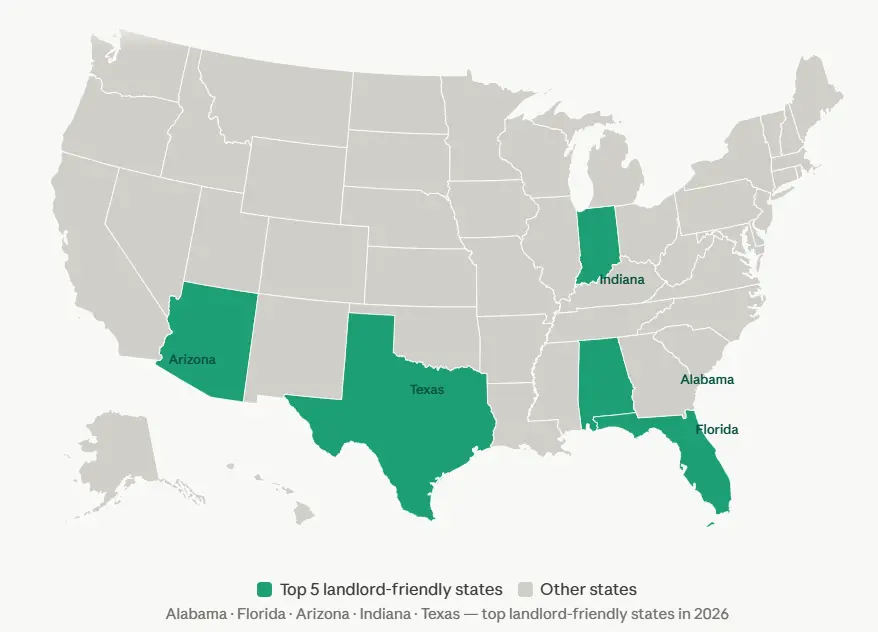
Based on an analysis of regulatory frameworks, tax structures, and tenant-landlord laws, the following states are identified as the most landlord-friendly for 2026:
1. Alabama
Alabama stands out as a state with notably minimal regulations impacting individual landlords. This regulatory environment contributes to a straightforward and cost-effective ownership experience. The state generally has low property taxes, a critical factor for maximizing rental income. Eviction processes in Alabama are typically efficient, providing landlords with a relatively swift resolution should the need arise. There are also no state-level rent control mandates, allowing landlords to adjust rents based on market conditions. The legal framework often favors landlords in disputes, provided they adhere to all established tenant rights.
- Key Landlord-Friendly Aspects: Minimal state-level regulations, efficient eviction process, low property taxes, absence of rent control.
- Considerations for Investors: While state laws are favorable, investors should still familiarize themselves with local ordinances in specific cities.
- Top Landlord-Friendly City with High Average Cap Rate: Birmingham. Known for its growing economy and relatively affordable housing market, Birmingham often presents opportunities for strong cap rates, especially in established neighborhoods with consistent rental demand.
2. Florida
Florida’s appeal to landlords is multifaceted, stemming from its robust economy, growing population, and favorable legal climate. The state generally imposes no rent control, allowing for market-driven rent adjustments. Property taxes, while present, are often competitive, especially when compared to other high-growth states. Florida’s eviction process, while requiring adherence to specific legal procedures, is generally considered more streamlined than in many other parts of the country. Furthermore, the state does not cap security deposits, offering landlords a more substantial financial buffer. Florida also benefits from strong property rights protections for owners.
- Key Landlord-Friendly Aspects: No rent control, competitive property taxes, generally efficient eviction process, uncapped security deposits, strong property rights.
- Considerations for Investors: Rising insurance costs, particularly related to hurricanes and flooding, are a significant factor that investors must carefully underwrite.
- Top Landlord-Friendly City with High Average Cap Rate: Jacksonville. As one of Florida’s largest cities by land area, Jacksonville offers diverse rental markets. Its affordability and ongoing development contribute to attractive cap rates for investors, particularly for single-family and multi-family properties.
3. Arizona
Arizona has established itself as a business-friendly state, and this extends to its rental property regulations. The state does not have statewide rent control, providing landlords with the flexibility to set and adjust rents according to market dynamics. Property taxes in Arizona are generally moderate, contributing to positive cash flow. The legal framework surrounding evictions is designed to be relatively efficient, with clear procedures for landlords to follow. Arizona also does not cap security deposits, offering landlords enhanced protection against tenant defaults or damages. The state’s growing population and economic development further bolster rental demand.
- Key Landlord-Friendly Aspects: No rent control, moderate property taxes, efficient eviction procedures, uncapped security deposits, strong tenant screening laws.
- Considerations for Investors: Investors should be aware of specific regulations concerning notice periods for entry and other landlord-tenant interactions, which, while reasonable, require compliance.
- Top Landlord-Friendly City with High Average Cap Rate: Phoenix. The capital and largest city in Arizona, Phoenix, is a major economic hub with a rapidly growing population. This sustained demand, coupled with a relatively stable regulatory environment, makes it a prime location for real estate investment with favorable cap rates.
4. Indiana
Indiana offers a compelling environment for landlords, characterized by low property taxes and a generally business-supportive regulatory climate. The state does not enforce rent control, allowing landlords to respond to market shifts in rental pricing. The eviction process in Indiana is designed to be efficient, helping landlords resolve issues with non-paying tenants in a timely manner. While there might be caps on security deposits in certain circumstances, the overall framework is less restrictive than in many other states. Indiana’s stable economy and affordable cost of living contribute to consistent rental demand, making it an attractive location for long-term investment.
- Key Landlord-Friendly Aspects: Low property taxes, no rent control, efficient eviction process, business-friendly regulations.
- Considerations for Investors: Understanding specific state statutes regarding landlord obligations, such as repair responsibilities and lease agreements, is still essential for compliance.
- Top Landlord-Friendly City with High Average Cap Rate: Indianapolis. As the state capital and a significant Midwest economic center, Indianapolis benefits from a diverse job market and a steady influx of residents. Its affordability and rental demand contribute to attractive cap rates for investors.
5. Texas
Texas is frequently cited as a prime example of a landlord-friendly state, largely due to its absence of state-level rent control and a generally straightforward eviction process. Property taxes in Texas can be higher than in some other states on this list, but this is often offset by the robust rental market and lack of other significant regulatory burdens. The state does not cap security deposits, providing landlords with a crucial financial safety net. Texas also benefits from strong population growth and a dynamic economy, which fuels consistent demand for rental housing across its major metropolitan areas. State preemption laws also prevent local governments from enacting more restrictive rental regulations.
- Key Landlord-Friendly Aspects: No rent control, efficient eviction process, uncapped security deposits, strong population growth, state preemption laws.
- Considerations for Investors: Texas has notably higher property taxes compared to some other states, which requires careful financial planning and underwriting to ensure profitability.
- Top Landlord-Friendly City with High Average Cap Rate: Houston. As the most populous city in Texas and a major global energy hub, Houston offers a vast and diverse rental market. Its economic resilience and continuous growth attract a large tenant pool, contributing to competitive cap rates for investors.
The Nuance: Why Investors Consider "Tenant-Friendly" Markets
While the appeal of landlord-friendly states is clear, it’s important to acknowledge that investors also actively seek opportunities in markets designated as "tenant-friendly." This strategy often hinges on identifying underlying economic fundamentals that may outweigh regulatory concerns. For example, a report by Redfin highlighted a significant increase in investor purchases in the Milwaukee housing market (Wisconsin), a state that has recently enacted renter-friendly regulations, including slower eviction processes and stricter requirements for security deposits and inspections.
Daryl Fairweather, Chief Economist at Redfin, offers a critical perspective: "Landlord-friendly and tenant-friendly labels can be helpful, but they can be too broad to guide an investment decision on their own. What matters more is the underlying economics (fundamentals) of a market, like home prices, rent levels, job growth, and long-term demand. A landlord-friendly market with weak fundamentals can underperform a tenant-friendly market with strong population growth and tight supply, for example. I would suggest that investors should treat the regulatory environment as just one of many factors."
This perspective underscores that regulatory favorability is just one piece of the investment puzzle. A landlord-friendly market with stagnant economic growth or declining property values might offer less favorable returns than a tenant-friendly market experiencing rapid population growth and a robust job market, even with stricter regulations.
Navigating Challenges in Tenant-Friendly Markets
For investors who find compelling opportunities in tenant-friendly markets, understanding and mitigating potential challenges is paramount. Rent control, a common feature in such markets, requires strategic financial planning. Fairweather advises: "In rent-controlled markets, cash flow starts with the purchase price. You need to buy at a basis that makes sense given future rent constraints. After that, focus on minimizing turnover and vacancy, since you might not be able to raise rents between tenants. Keeping units well-maintained and building good tenant relationships can reduce churn. I’ve seen some investors also look for properties where allowable increases like inflation-based adjustments or capital improvement passthroughs can help offset costs over time."
Beyond rent control, investors in tenant-friendly states are encouraged to:
- Underwrite Conservatively: Assume longer timelines for potential issues, such as evictions or repairs, and budget accordingly.
- Operate Professionally: Implement rigorous tenant screening processes, set rents at appropriate market levels from the outset, and maintain excellent property upkeep.
- Master Local Regulations: Thoroughly understand specific local laws concerning notice periods, eviction timelines, and rent increase rules to avoid surprises.
- Leverage Local Expertise: Engage with local property managers or legal experts who are intimately familiar with the nuances of the tenant-friendly regulatory environment.
The Bottom Line: Beyond the Labels
Ultimately, the decision to invest in a particular market should not be solely based on whether it is labeled "landlord-friendly" or "tenant-friendly." As Fairweather emphasizes, "That’s increasingly true. What we’re seeing now is that investors are prioritizing fundamentals over labels. A market like Milwaukee, for example, may be considered tenant-friendly, but if it offers relatively affordable entry points and stable rental demand, it can still be attractive. Meanwhile, some traditionally landlord-friendly markets—like parts of Florida—have cooled due to rising prices and insurance costs. So today, the more important question is: ‘Does the deal make sense given the local market conditions?’ Regulation matters, but it’s not the whole story.”
The critical factor for long-term success in real estate investment lies in meticulous financial analysis and a deep understanding of local market dynamics. Investors must look beyond broad classifications and focus on the specific numbers of a deal, including property prices, rental demand, economic growth, vacancy rates, and projected operating expenses. Tools and data that facilitate comprehensive deal underwriting are essential for identifying profitable opportunities in any market, regardless of its regulatory label.

