
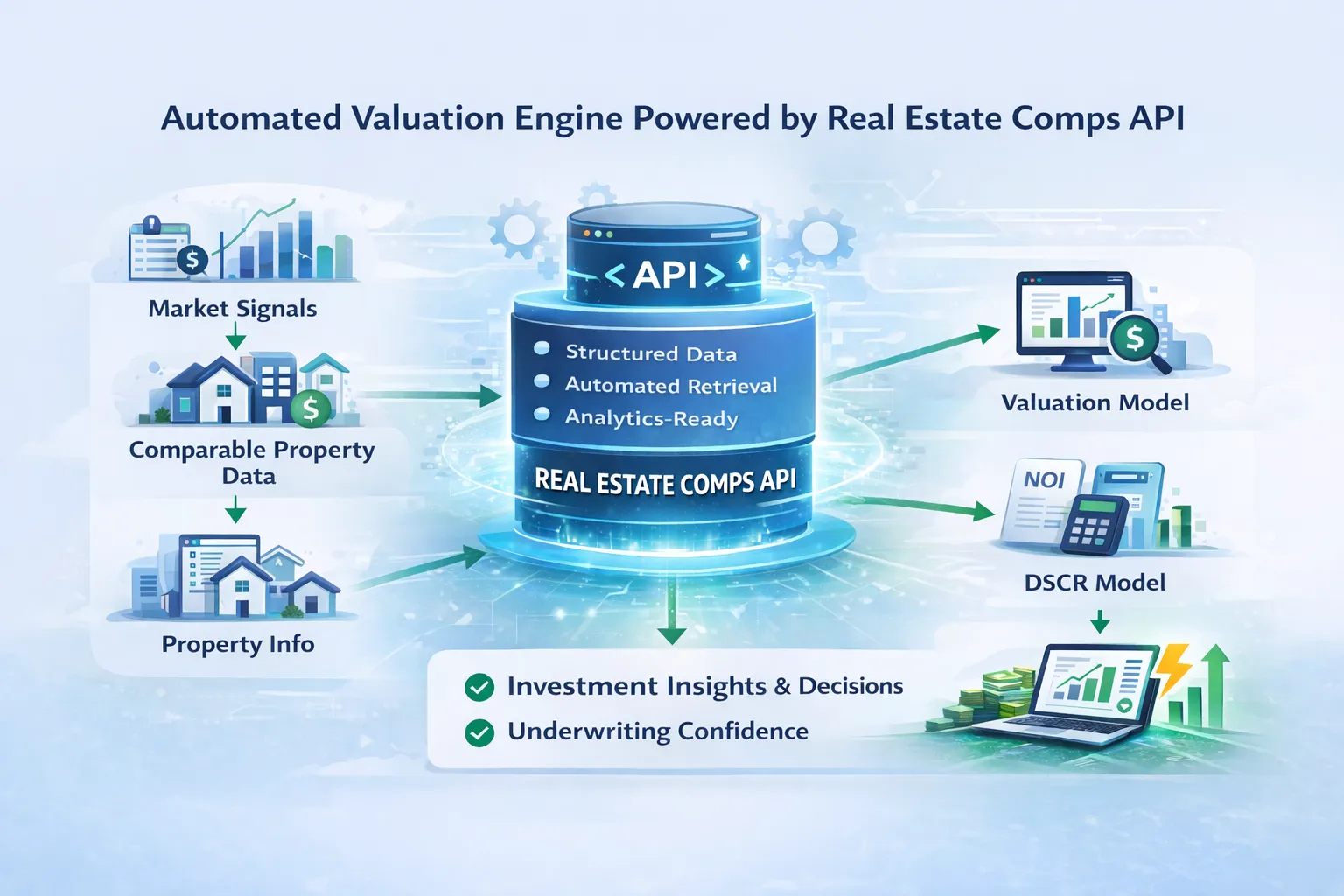
The real estate industry, long reliant on meticulous manual processes, is undergoing a significant transformation driven by technological advancements. At the core of this evolution lies the increasing adoption of Real Estate Comps APIs, a powerful tool that is fundamentally reshaping how properties are valued and underwritten. For decades, the biggest hurdle in real estate valuation models has not been the complexity of the logic, but the scarcity and inconsistency of data. Even the most sophisticated underwriting frameworks are hobbled by the laborious task of gathering and reconciling fragmented datasets of comparable properties. As real estate portfolios expand and market dynamics accelerate, these manual workflows become a critical bottleneck, leading to delayed decisions, introduction of errors, and a diminished capacity to efficiently assess potential deals.
A Real Estate Comps API addresses this challenge head-on by automating the delivery of structured comparable sales and rental data. This immediate access to accurate, up-to-date market intelligence empowers analysts and investors to build faster, more reliable valuation models and perform more robust Debt Service Coverage Ratio (DSCR) analyses. Consequently, real estate professionals can now seamlessly integrate vital market insights directly into their existing tools and operational workflows. This guide delves into the mechanics of comps APIs, explores how platforms like Mashvisor are leveraging this technology to enhance valuation and underwriting, outlines the available data endpoints, and illustrates how businesses can harness automated comparable property data to construct scalable real estate analytics solutions.
The Crucial Role of Comparable Property Data in Modern Valuation
Comparable property data forms the bedrock of contemporary real estate valuation methodologies. It enables investors and analysts to derive the Fair Market Value (FMV) and estimate income potential by examining the performance of similar properties within a specific geographic area. By analyzing recent sales transactions and prevailing rental rates, these "comps" provide essential market-based benchmarks against which new investment opportunities can be rigorously evaluated.
Defining Real Estate Comps
In essence, "real estate comps," short for real estate comparables, are properties that share key characteristics with the property under investigation. These similarities typically include location, size, property type, and overall condition. Traditionally, the primary focus of comps has been on recent sales data. However, for investment property analysis, the evaluation of rental income potential is equally critical, making rental comps indispensable.
Therefore, the two primary categories of comps are:
- Sales Comps: These are recently sold properties that are similar in nature to the subject property. They are used to establish a market-driven price range for a property based on what buyers have recently been willing to pay.
- Rental Comps: These are comparable rental properties that have recently been leased. They provide crucial data points for estimating the potential rental income a property can generate, a vital component for income-focused investments.
Collectively, these types of comparable data serve as the foundational elements for accurate pricing, sound underwriting, and informed investment decision-making. The accessibility of structured comparable sales data is thus paramount for investors aiming to establish repeatable and scalable valuation frameworks across diverse markets.
The Inherent Limitations of Manual Comp Analysis
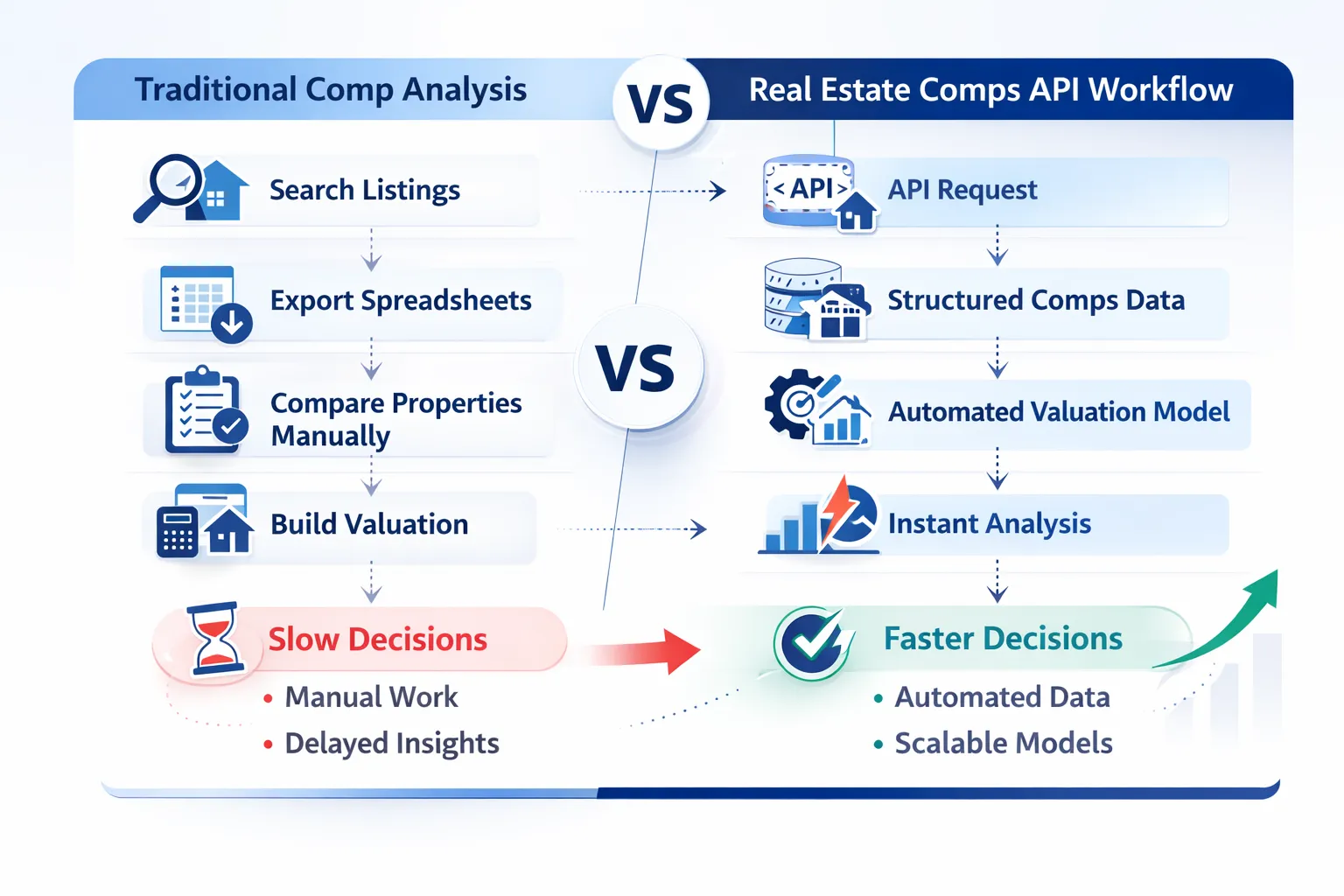
Despite their critical importance, the traditional methods of analyzing comps are notoriously difficult to scale. This inefficiency stems from the necessity of manually searching through a multitude of listing platforms, local property databases, and extensive spreadsheets. This laborious process is prone to several significant challenges:
- Time-Intensive Data Gathering: Manually sourcing and compiling comparable property data from disparate sources consumes a substantial amount of an analyst’s valuable time. This can delay critical investment decisions.
- Data Inconsistency and Fragmentation: Information across different platforms and databases often lacks standardization. This can lead to discrepancies in property details, sale prices, and dates, making direct comparisons unreliable.
- Potential for Human Error: Manual data entry and reconciliation are inherently susceptible to typos, misinterpretations, and oversights, which can introduce inaccuracies into valuation models.
- Limited Scalability: As the volume of deals to be analyzed increases, manual workflows become exponentially more time-consuming and resource-intensive, severely limiting an organization’s ability to grow its investment activities.
- Delayed Market Insights: The time lag associated with manual data collection means that valuations are often based on slightly outdated market information, potentially leading to suboptimal investment outcomes.
These limitations become particularly pronounced for entities that analyze a high volume of deals or operate across multiple geographic markets. Consequently, modern valuation workflows are increasingly migrating towards automated data delivery mechanisms, such as APIs, which enable the instantaneous retrieval of comps data and its seamless integration into analytical models.
Unpacking the Real Estate Comps API: Functionality and Workflow
A Real Estate Comps API fundamentally transforms the process of data acquisition by automating the delivery of comparable property data. This includes essential information such as recent sales figures, current pricing benchmarks, and detailed property characteristics, all accessed through structured programmatic requests rather than manual research. Users initiate a query, typically based on specific location parameters or property criteria, and the API responds by returning standardized comps data that is immediately ready for integration into valuation and underwriting models.
From Static Reports to Dynamic Valuation
The traditional approach to comp analysis relies on static reports or repetitive manual searches, each requiring a fresh effort for every property under consideration. In contrast, a comps API replaces this manual underwriting drudgery with automated data retrieval.
The automated workflow, at a high level, operates as follows:
- Automated Data Ingestion: The API continuously collects and updates comparable property data from various reliable sources.
- Programmatic Data Request: An application or system sends a request to the API, specifying the property for which comps are needed, along with relevant search parameters (e.g., address, zip code, property type, radius).
- Structured Data Retrieval: The API processes the request and returns a structured dataset containing relevant comparable properties, their key attributes, and sales/rental information.
- Direct Integration into Models: The returned data is automatically fed into valuation models, underwriting software, or analytics platforms, enabling immediate analysis and decision-making.
This API-driven approach allows investors and platforms to access updated datasets on demand. Because the data is delivered in a standardized format, it can be directly utilized to build consistent and repeatable valuation logic across a wide spectrum of property types and markets.
Integrating a Real Estate Valuation API into Modern Tech Stacks
In today’s technology-driven landscape, comparable property data is no longer treated as a separate analytical component but is increasingly embedded directly into software workflows. A real estate valuation API serves as a crucial data layer, powering a diverse array of tools and platforms utilized by:
- Real Estate Investors: To quickly assess the potential value and investment viability of properties.
- Appraisal Management Companies (AMCs): To streamline the appraisal process and ensure data consistency.
- Lending Institutions: To perform accurate collateral valuations and risk assessments for loan origination.
- Property Management Software: To provide market-driven rental rate recommendations.
- Real Estate Brokerages: To enhance listing presentations and inform pricing strategies.
- PropTech Platforms: To power automated valuation models, market analytics tools, and investment recommendation engines.
From a technical perspective, a real estate API designed for developers eliminates the considerable burden of aggregating raw listing datasets or maintaining complex, in-house data pipelines. Instead, an automated property valuation API provides readily usable comps data that can be seamlessly integrated into underwriting systems, client-facing dashboards, or sophisticated investment analysis platforms.
The Mashvisor Real Estate Comps API: Comprehensive Data and Functionality
The efficacy of a comparable sales data API hinges directly on the quality, structure, and breadth of the data it provides. The Mashvisor API distinguishes itself by offering comparable property datasets that are not only comprehensive but also enriched with vital market benchmarks, sophisticated investment analytics, and key performance indicators. This unified approach consolidates critical real estate intelligence into a single, powerful API, allowing users to transition directly from raw comps to accurate valuation and underwriting without the need for extensive additional data processing.
Key Data Points Available Through the Mashvisor API
Mashvisor delivers structured comparable property data designed to bolster real estate valuation models, refine pricing analysis, and inform robust investment decision-making. The data is categorized to provide both granular property details and broader market context:
Property-Level Comparable Data:
- Address and Location: Precise geographical identification of comparable properties.
- Property Type: Categorization such as single-family home, condominium, multi-family unit, etc.
- Size and Dimensions: Square footage, lot size, number of bedrooms, and bathrooms.
- Sale Price and Date: The final transaction price and the date of sale, crucial for understanding market timing.
- Rental Income and Yield: For investment properties, estimated monthly rent, cap rate, and cash-on-cash return.
- Property Condition and Features: Details regarding renovations, amenities, and overall condition, which influence value.
- Transaction History: A record of past sales and ownership changes.
Market and Investment Context:
- Neighborhood Demographics: Insights into local population, income levels, and employment trends.
- Market Trends and Appreciation Rates: Historical data on property value appreciation within the area.
- Rental Demand and Vacancy Rates: Indicators of the health of the local rental market.
- Crime Rates and School District Quality: Factors that influence property desirability and value.
- Walk Score and Transit Accessibility: Measures of neighborhood convenience.
These comprehensive data endpoints enable users to integrate a powerful real estate investment analysis API directly into their acquisition or real estate underwriting pipelines, providing a holistic view of a property’s market position and potential.
Illustrative Mashvisor API Endpoints
Mashvisor provides access to comparable property data through a suite of dedicated API endpoints, each designed to facilitate specific analytical tasks:
- GET /v1.1/client/property: Retrieves detailed information about a specific property, including its attributes and history.
- GET /v1.1/client/property/nearby: This is a cornerstone endpoint, designed to fetch a list of comparable properties within a specified radius of a given address. It’s instrumental for direct comp analysis.
- GET /v1.1/client/property/transactions: Provides a history of sales transactions for a property or within a defined area, offering insights into market liquidity and price movements.
- GET /v1.1/client/property/price-estimates: Returns automated valuation estimates, often derived from a combination of comps data and proprietary algorithms, offering a quick initial valuation.
By utilizing these endpoints, users can construct a fully automated comps workflow. This not only replaces the time-consuming nature of manual research but also ensures that data retrieval is structured, consistent, and immediately usable for analytical purposes.
Example Request: Retrieving Comparable Properties
Consider a scenario where a real estate developer needs to quickly assess the market value of a potential acquisition. Using the Mashvisor API, they could programmatically request nearby comparable properties for valuation analysis with a simple API call:
GET https://api.mashvisor.com/v1.1/client/property/nearby?state=AZ&city=Phoenix&address=123+Main+St

Headers:
x-api-key: YOUR_API_KEY
This request, targeting properties near "123 Main St" in Phoenix, Arizona, would yield a dataset of relevant sales and rental comparables.
Simplified Example Response
The API would return structured comparable property data in a standardized JSON format, ready for direct integration into valuation or underwriting models:
  "subject_property":
    "address": "123 Main St",
    "property_type": "Single Family",
    "price_estimate": 420000
  ,
  "nearby_properties": [

      "address": "118 Main St",
      "sale_price": 415000,
      "beds": 3,
      "baths": 2,
      "distance_miles": 0.3
    ,

      "address": "140 Oak Ave",
      "sale_price": 432000,
      "beds": 3,
      "baths": 2,
      "distance_miles": 0.6

  ]
This immediate availability of standardized data eliminates manual formatting, allowing for the rapid deployment of valuation dashboards and automated underwriting tools.
Building Smarter Valuation & DSCR Models with Mashvisor Data
The integration of comparable property data directly into analysis workflows dramatically enhances the accuracy and scalability of real estate valuation and DSCR models. By automating the retrieval of comps via an API, investors and developers can standardize critical assumptions, drastically reduce manual research efforts, and evaluate properties against consistent, up-to-date market benchmarks.
Constructing a Property Valuation Model with Comparable Data
Accurate property valuation models are fundamentally reliant on comparable sales data. This data allows for the estimation of fair market value based on observable market behavior, rather than subjective pricing assumptions. Utilizing API-delivered comps makes this process repeatable and automatable across numerous properties and markets.
A simplified workflow for building a real estate valuation model incorporating API-driven comps:
- Automated Comps Retrieval: The system automatically queries the comps API for relevant comparable properties based on the subject property’s location and characteristics.
- Data Standardization and Cleaning: The API-provided data is inherently structured, reducing the need for manual data cleaning.
- Feature Engineering: Key attributes from comps (e.g., price per square foot, sales price per bedroom) are extracted and potentially weighted.
- Model Application: These engineered features are fed into a valuation model (e.g., regression analysis, machine learning model) to generate an estimated value for the subject property.
- Output and Reporting: The valuation result is presented, often integrated into a larger report or dashboard.
As comps data is delivered through the API for real estate valuation, the model can run automatically whenever new properties are analyzed, ensuring consistent valuation practices at scale.
Leveraging Comps Data for DSCR Model Analysis
The Debt-Service Coverage Ratio (DSCR) model is critically dependent on realistic income and valuation assumptions. Comparable property data significantly improves DSCR accuracy by grounding projections in verified market activity rather than speculative forecasts.
The fundamental DSCR Calculation Formula is:
DSCR = Net Operating Income / Total Debt Service
To calculate the DSCR for a rental property, analysts typically undertake the following steps:
- Estimate Potential Gross Rental Income: This is derived from analyzing recent rental comps in the area for similar properties.
- Factor in Vacancy and Credit Loss: A conservative percentage is deducted to account for periods when the property might be vacant or a tenant defaults.
- Calculate Effective Gross Income: Potential Gross Income minus vacancy and credit loss.
- Estimate Operating Expenses: This includes property taxes, insurance, property management fees, maintenance, utilities (if not paid by tenant), and other operational costs, often informed by market data for similar properties.
- Determine Net Operating Income (NOI): Effective Gross Income minus Operating Expenses.
- Identify Total Debt Service: The sum of all annual principal and interest payments on outstanding loans.
- Calculate DSCR: Divide the NOI by the Total Debt Service.
Accurate comps data plays a vital role in mitigating risk by preventing the common underwriting errors of overestimating property valuations or projecting unrealistic income levels.
Automating Rental Property Underwriting Workflows
When comparable property data is delivered programmatically, the underwriting process can transition from a manual, review-intensive task to an automated, data-driven evaluation.
A typical automation pipeline for rental property underwriting might look like this:
API → Valuation Model → DSCR Calculation → Investment Decision
This automated approach to rental property underwriting empowers platforms to:
- Process Deals at Scale: Significantly increase the volume of properties that can be evaluated within a given timeframe.
- Enhance Consistency: Ensure that every deal is assessed using the same data-driven criteria, reducing subjective bias.
- Improve Accuracy: Leverage real-time market data for more precise valuation and income projections.
- Reduce Operational Costs: Minimize the need for extensive manual data handling and analysis.
- Accelerate Decision-Making: Expedite the loan approval or investment decision process.
Instead of investing resources in building complex data infrastructure from the ground up, teams can leverage a real estate data API partnership to supply standardized comps data that is immediately ready for modeling and analysis.
Real-World Example: Automating DSCR-Based Loan Underwriting
Consider a scenario involving a lending institution evaluating a loan application for a rental property. Instead of relying on time-consuming manual appraisals and spreadsheet analysis, the system can automatically pull comparable property data through an API the moment a property is submitted for consideration.
The automated workflow unfolds as follows:
- Loan Application Submission: A borrower submits an application for a rental property loan.
- API Data Fetch: The lender’s system automatically queries a comps API (like Mashvisor’s) for comparable sales and rental data relevant to the subject property’s location and characteristics.
- Automated Valuation and Income Projection: The retrieved comps data is used to generate an estimated market value and projected rental income for the property.
- DSCR Calculation: Based on the projected income and the loan terms, the system automatically calculates the DSCR.
- Risk Assessment and Decision: The calculated DSCR, along with other data points, informs the lender’s risk assessment and the final decision on the loan application.
In this streamlined setup, a process that previously might have taken hours or even days is transformed into a repeatable, near-instantaneous procedure. Crucially, every loan application is evaluated using consistent, data-driven criteria, minimizing the impact of subjective assumptions that can lead to increased lending risk. While this example highlights a typical underwriting workflow, the applications of a real estate comps API extend to numerous other practical scenarios.
Real-World Use Cases for Investors, Developers, and PropTech Teams
The true value of a real estate comps API is realized when it is deeply integrated into critical decision-making workflows. Different user types leverage this technology to optimize their specific processes:
Investors and Acquisition Teams
Real estate investors and their acquisition teams utilize comparable property data to accelerate deal evaluation and ensure consistency across diverse markets. Common applications include:
- Quick Deal Screening: Rapidly assessing the market viability of a large number of potential investment properties.
- Accurate Price Setting: Determining optimal offer prices based on current market comparables.
- Rental Income Projections: Estimating achievable rental rates for income-generating properties.
- Market Entry Strategy: Identifying promising investment areas by analyzing local market trends and comp performance.
- Portfolio Diversification Analysis: Evaluating how new acquisitions align with existing portfolio strategies based on market data.
Access to a centralized real estate comps dataset empowers investors to standardize their decision criteria and significantly reduce inherent biases in deal evaluation.
Lenders and DSCR Underwriting
Lending institutions are increasingly adopting automated data workflows to enhance their evaluation of borrower risk and collateral value. With API-delivered comps, lenders can:
- Perform Rapid Collateral Valuations: Quickly determine the market value of properties serving as collateral.
- Enhance Loan Underwriting Accuracy: Improve the precision of DSCR calculations by using reliable income and valuation data.
- Standardize Risk Assessment: Apply consistent data-driven criteria to all loan applications, regardless of the property’s location.
- Streamline Loan Processing: Reduce the turnaround time for loan approvals by automating data retrieval and analysis.
- Monitor Portfolio Risk: Continuously assess the market value and performance of existing loan collateral.
This approach aligns with broader industry trends favoring automated underwriting powered by historical real estate data APIs.
PropTech Platforms and Developers
For startups and established analytics platforms, comparable property data serves as a fundamental data layer, enabling the development and enhancement of valuation and analytics tools. Typical developer use cases include:
- Building Automated Valuation Models (AVMs): Integrating comps data to power proprietary AVMs for internal use or client offerings.
- Developing Investment Analysis Tools: Creating platforms that provide users with data-driven insights into property potential.
- Enhancing Listing Portals: Enriching property listings with market context and comparable sales data.
- Powering Algorithmic Trading Platforms: Providing real-time market data for automated investment strategies.
- Creating Custom Analytics Dashboards: Developing tailored reporting solutions for clients that incorporate dynamic market intelligence.
With access to the best real estate data API, development teams can launch sophisticated valuation features and analytics tools without the substantial investment in building and maintaining complex property data pipelines internally.
Mashvisor API Pricing and Getting Started
Mashvisor’s API pricing follows a usage-based model, providing flexibility for companies to scale their API access in line with their evolving data requirements. This structure makes it suitable for a wide range of users, from early-stage startups to established enterprise platforms.
Mashvisor offers both monthly and annual subscription plans, with annual subscriptions providing a cost-saving benefit of two free months. The pricing structure is tiered to accommodate different stages of growth and data consumption levels:
- Tiered Plans: Offering various levels of API credits and features to match diverse business needs.
- Scalable Access: The ability to increase API usage as data demands grow.
- Consultative Approach: Encouraging direct engagement with the Mashvisor Data Team to determine the most suitable plan.
To initiate the process, interested parties are encouraged to schedule a consultation call with the Mashvisor Data Team to discuss their specific data needs and explore how the API can be integrated into their workflows.
Benefits of Utilizing Mashvisor for Automated Property Valuation
Leveraging the Mashvisor API for comparable property analysis empowers investors and developers to transition from manual, time-consuming valuation workflows to scalable, data-driven decision-making. The specific advantages that users can expect include:
- Accelerated Valuation Cycles: Significantly reducing the time required to assess property values, enabling faster deal closure.
- Enhanced Data Accuracy and Consistency: Providing access to structured, reliable data that minimizes errors and ensures uniformity in analysis.
- Improved Investment Decisions: Facilitating more informed choices through comprehensive market insights and performance metrics.
- Scalable Operations: Enabling the analysis of a larger volume of properties without a proportional increase in manual effort.
- Reduced Operational Costs: Automating data collection and processing tasks, leading to significant savings in labor and resources.
- Integrated Analytics: Combining property comps with investment analytics within a single platform, streamlining the entire valuation process.
By consolidating comparable property data with essential investment analytics into a unified platform, Mashvisor facilitates faster, more reliable property valuation at scale.
When a Real Estate Comps API May Not Be Necessary
While the benefits of a real estate comps API are substantial, it’s important to acknowledge that this technology may not be universally required for every use case. A comps API is most valuable when the need for analyzing properties at scale or integrating valuation directly into software workflows is paramount. However, for certain scenarios, the complexity and cost associated with an API might be prohibitive or unnecessary.
You may not require a comps API if:
- Analysis Volume is Minimal: You only evaluate a handful of properties per year and can comfortably manage manual data collection without significant time constraints.
- Budgetary Constraints are Severe: The cost of API access exceeds the immediate financial capacity or perceived return on investment for a very small operation.
- Integration Requirements are Non-Existent: Your workflow does not involve software applications or automated systems that would benefit from programmatic data access.
- Focus is Solely on Local, Hyper-Niche Markets: In very specific, limited markets where data is readily available and highly standardized through other means, the added layer of an API might be overkill.
In these specific circumstances, employing an API might introduce unnecessary complexity. However, as soon as the need arises for faster analysis, consistent market benchmarks, or the simultaneous evaluation of multiple properties, automated comps data rapidly demonstrates its significant value proposition.
Conclusion: The Future of Property Valuation is Automated
As the real estate analysis landscape increasingly embraces data-driven methodologies, valuation and underwriting processes are steadily shifting from manual research to automated intelligence. Within this paradigm, property comps data serves as a continuous, vital input, powering pricing models, risk evaluations, and investment decisions across entire portfolios, rather than being confined to one-off analyses for individual deals.
A real estate comps API is the critical enabler of this transition, ensuring the consistent delivery of market data directly into automated valuation and DSCR models. This empowers teams to analyze opportunities with unprecedented speed while maintaining standardized, reliable assumptions. With scalable access to comparable properties, essential investment metrics, and analytics-ready datasets, Mashvisor equips investors, lenders, and PropTech platforms to dedicate more resources to strategic development and less to the arduous task of data collection, ultimately fostering smarter real estate strategies.
For those ready to build more intelligent valuation and DSCR models, exploring solutions like the Mashvisor API is a strategic step towards achieving greater efficiency and accuracy in the competitive real estate market.
Frequently Asked Questions
What Is a Real Estate Comps API?
A Real Estate Comps API provides programmatic access to data on properties that are similar to a subject property within a specific geographic area. This enables applications to automatically retrieve sales and market comparison data, facilitating faster and more efficient analysis.
How Is DSCR Calculated for Rental Properties?
The Debt-Service Coverage Ratio (DSCR) is calculated by dividing a property’s Net Operating Income (NOI) by its total annual debt obligations. This ratio serves as a key indicator for lenders, measuring a property’s ability to generate sufficient income to cover its loan payments and thereby assessing repayment risk.
Who Uses Real Estate Comps APIs?
Comparable property APIs are extensively used by real estate investors, lending institutions, brokerages, and PropTech platforms that require scalable valuation data for analysis, reporting, or the development of automated real estate analysis systems.
What Makes Mashvisor Different from Other Real Estate APIs?
Mashvisor distinguishes itself by focusing on investment-oriented analytics. It uniquely combines detailed property information with critical market insights and performance indicators, allowing users to evaluate investment opportunities without the need to aggregate data from multiple disparate sources.
How Do I Get Comparable Property Data Automatically?
Comparable property data can be accessed automatically by connecting analytical software tools to a data provider’s API. This API then returns nearby property information and pricing benchmarks through automated requests, typically based on specified location or property characteristics.

