
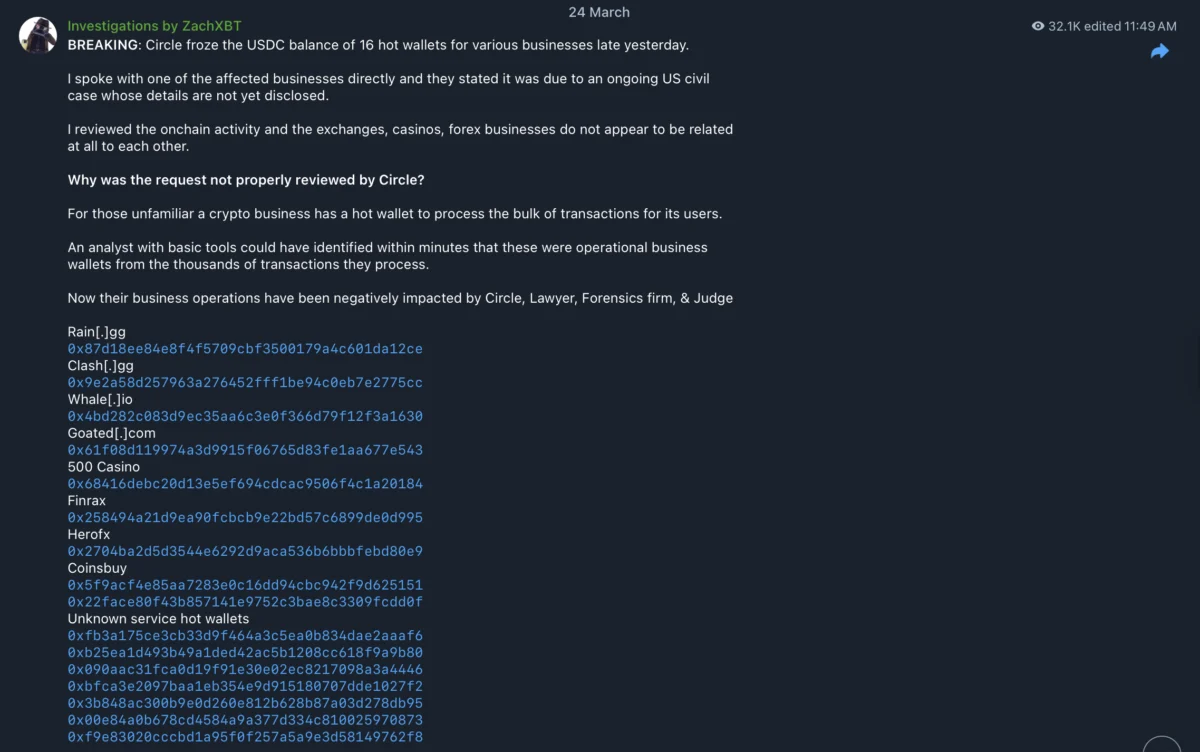
The stablecoin issuer Circle, the company responsible for the USD Coin (USDC) token, is facing significant criticism following accusations that it erroneously froze sixteen wallets in connection with a civil legal case in the United States. The allegations, brought forth by prominent on-chain investigator and security researcher ZachXBT, suggest a potentially egregious oversight in Circle’s asset-freezing protocols, raising concerns about the operational integrity and decentralized ethos of centralized stablecoin providers.
According to ZachXBT’s findings, the frozen wallets belonged to a diverse range of entities, including cryptocurrency exchanges, online casinos, and foreign currency exchange businesses. The investigator asserted that these entities "do not appear related at all" to each other or to any discernible illicit activity that would warrant such broad action. This lack of apparent connection, ZachXBT argued, points to a fundamental flaw in the identification and vetting process employed by Circle.
"An analyst with basic tools could have identified, within minutes, that these were operational business wallets from the thousands of transactions they process," ZachXBT stated in his findings, highlighting the apparent ease with which these wallets could have been differentiated from those genuinely involved in malfeasance. The implication is that Circle may have relied on superficial or automated criteria, leading to the inadvertent entanglement of legitimate businesses in a legal proceeding.
Further details emerged from a separate social media post by ZachXBT, where he described the legal case as "sealed." This secrecy, he contended, provided Circle with "zero basis" to freeze the fiat-pegged tokens. His critique was particularly sharp, suggesting a profound failure in Circle’s decision-making process for asset freezes.
"In my 5-plus years of investigations, it could potentially be the single most incompetent freeze I have seen," ZachXBT declared. "This is what happens when you outsource your freezing decisions to literally any random federal judge instead of having a process." This statement directly challenges the procedural safeguards and internal due diligence that one would expect from a major financial institution operating within the digital asset space.
Cointelegraph reached out to Circle for comment on these allegations but had not received a response by the time of publication. The lack of immediate official statement leaves the claims from ZachXBT as the primary public account of the incident.
The Mechanics of Centralized Stablecoin Freezing
The ability of centralized stablecoin issuers like Circle to freeze assets is a double-edged sword. On one hand, it provides a mechanism for law enforcement and legal entities to trace and recover funds suspected of being involved in illegal activities, such as fraud, money laundering, or terrorist financing. This capability is often presented as a necessary component for regulatory compliance and mainstream adoption, aligning digital assets with traditional financial oversight.

However, as the current situation illustrates, this power also carries significant risks. Critics argue that the very act of freezing assets by a central authority undermines the core principles of decentralization and censorship resistance that underpin much of the cryptocurrency movement. The potential for error, as alleged by ZachXBT, raises questions about the accountability and transparency of these freezing mechanisms.
The implication of ZachXBT’s assessment is that the legal process for obtaining freeze orders may have been insufficient, or that Circle’s execution of those orders was overly broad and lacked the necessary granular analysis. The involvement of a "random federal judge" without a more robust internal vetting process by Circle could lead to what appears to be a collateral impact on innocent third parties.
A Pattern of Concern: Centralized Control vs. Decentralized Ideals
This incident is not an isolated one and taps into a broader debate within the cryptocurrency community regarding the role of centralized entities in managing digital assets. Centralized stablecoins, by their very nature, are susceptible to external control and intervention. Unlike truly decentralized cryptocurrencies, where control is distributed across a network of participants and transactions are generally immutable, centralized stablecoins are issued and managed by a single entity.
This centralization means that the issuer has the ultimate authority to control the supply, mint new tokens, and, crucially, freeze or reverse transactions. While this can be a tool for combating illicit finance, it also means that these assets are not entirely "permissionless" in the traditional cryptocurrency sense. Users of these stablecoins are, to a degree, subject to the issuer’s policies, regulatory pressures, and the decisions of legal authorities.
Broader Implications for the Stablecoin Ecosystem
The accusations against Circle have significant implications for the broader stablecoin ecosystem and the ongoing discussions surrounding crypto regulation.
Erosion of Trust: If it is confirmed that Circle, a major player in the stablecoin market, made such significant errors in freezing assets, it could lead to a substantial erosion of trust among users, businesses, and investors. The perceived reliability and security of USDC, and by extension other centralized stablecoins, could be called into question.
Regulatory Scrutiny: Such incidents inevitably attract the attention of regulators. This situation could strengthen arguments for more stringent oversight of stablecoin issuers, potentially leading to new rules and compliance requirements that could impact operational flexibility and innovation. Regulators might point to this as evidence of the need for robust internal controls and independent auditing of asset-freezing procedures.
Debate on Decentralization: The event fuels the ongoing debate between centralized and decentralized stablecoin models. Proponents of decentralized stablecoins might use this as an example of the inherent risks associated with centralized control, advocating for alternative models that are less susceptible to single points of failure or external intervention.

Impact on Businesses: For the businesses whose wallets were allegedly frozen, the consequences could be severe. This could include disruption to their operations, reputational damage, and financial losses due to the inability to access their funds. The lack of transparency in the sealed legal case further exacerbates their predicament.
The "CBDC Trojan Horse" Argument Gains Momentum
The incident also reignites concerns that regulated stablecoins could serve as a precursor to Central Bank Digital Currencies (CBDCs). Critics argue that by allowing centralized stablecoins to be frozen or controlled, governments and regulators are gradually paving the way for a future where digital currencies are fully managed and monitored by central authorities, mirroring the functionalities of a CBDC.
Mert Mumtaz, founder of remote procedure call (RPC) node provider Helius, commented on the situation, stating, "This is your 10th reminder that centrally issued stablecoins are not actually yours; they can be frozen, unlike cash." This sentiment highlights the perceived loss of true ownership and control that users experience with centralized stablecoins.
Jean Rausis, co-founder of the Smardex decentralized trading platform, has previously voiced similar concerns, suggesting that regulatory frameworks like the GENIUS stablecoin bill could lay the groundwork for a "privately managed central bank digital currency." The argument is that centralized stablecoins effectively grant issuers the same surveillance and asset-freezing capabilities that a CBDC would provide, blurring the lines between private digital currencies and state-controlled monetary systems.
This perspective was echoed by former US lawmaker Marjorie Taylor Greene in May 2025, who described regulated stablecoins under the GENIUS bill as a "CBDC Trojan Horse." This analogy suggests that while appearing beneficial on the surface, such regulations might be a strategic move to introduce a fully controlled digital currency system under the guise of stablecoin regulation.
Conclusion: A Call for Transparency and Robust Protocols
The allegations surrounding Circle’s alleged incompetent freezing of 16 USDC wallets underscore the critical need for transparency, robust internal processes, and clear accountability within the centralized stablecoin industry. While the ability to freeze assets can be a vital tool in combating financial crime, its application must be guided by rigorous due diligence, precise identification, and a commitment to minimizing collateral damage to legitimate entities.
As the cryptocurrency space continues to mature and integrate with traditional finance, incidents like this serve as crucial reminders of the inherent tensions between decentralization and centralized control, and the potential pitfalls that arise when these two paradigms interact. The future stability and adoption of centralized stablecoins may well depend on their ability to address these concerns and demonstrate an unwavering commitment to operational integrity and user trust. The silence from Circle in response to these serious accusations only amplifies the scrutiny and anticipation for their official statement and any corrective actions they might take.

