
The New York Stock Exchange (NYSE), a venerable institution synonymous with traditional finance, has taken a significant stride into the digital frontier by signing a memorandum of understanding (MoU) with Securitize, a leading tokenization platform. This landmark agreement signals a strategic commitment to developing robust blockchain-based stock trading infrastructure, poised to reshape the landscape of Wall Street. As part of this collaboration, Securitize will assume the role of the first digital transfer agent, a pivotal position that will enable it to mint blockchain-based shares for both stocks and exchange-traded funds (ETFs) on the NYSE’s forthcoming Digital Trading Platform. This development, announced by Intercontinental Exchange (ICE), the parent company of the NYSE, underscores a concerted effort to integrate distributed ledger technology into the core of securities trading.
The MoU lays the groundwork for a comprehensive digital transfer agent program and establishes crucial standards for digital transfer agents and tokenization agents. The focus is squarely on addressing the regulatory, operational, and technological requirements essential for a secure and efficient tokenized securities infrastructure. This initiative is not an isolated event but builds upon ICE’s earlier announcement on January 19, which unveiled plans for a dedicated tokenized securities venue. This proposed venue is designed to facilitate 24/7 trading, enable instant settlement, utilize stablecoin-based funding, and support on-chain settlement, all hallmarks of blockchain technology’s potential to revolutionize financial markets.
ICE’s vision for the planned venue is ambitious, aiming to accommodate a dual approach to tokenized assets. It will support tokenized shares that are fungible with traditionally issued securities, ensuring a seamless transition for existing market participants. Simultaneously, it will cater to securities issued natively as digital tokens, opening avenues for new forms of digital asset issuance. Crucially, this digital evolution is intended to preserve traditional shareholder rights, including dividends and governance, thereby maintaining investor confidence and continuity. Tokenized stocks, in essence, represent shares of traditional company stocks represented on a blockchain ledger. They offer investors exposure to stock prices with compelling advantages, such as round-the-clock accessibility and the potential for fractional ownership, democratizing access to investment opportunities.
This agreement arrives at a time when major exchange operators are increasingly exploring and investing in blockchain-based trading and settlement infrastructure. This trend persists even as the regulatory framework and market structure for tokenized public securities are still in their nascent stages of development. The NYSE’s move is further contextualized by recent regulatory approvals for similar initiatives. Notably, the U.S. Securities and Exchange Commission (SEC) recently granted the green light to Nasdaq’s pilot proposal, which aims to support the trading of tokenized versions of high-volume stocks and securities. This parallel development suggests a growing acceptance and integration of tokenization within the established financial ecosystem.
Lynn Martin, President of NYSE Group, articulated the exchange’s strategic thinking behind this venture. "As we explore how tokenization can enhance capital markets, it is critical that new infrastructure is developed in a way that preserves the trust, transparency, and protections investors expect," she stated. This emphasis on maintaining existing investor protections while embracing new technologies highlights a balanced approach to innovation.
The Rise of Tokenized Stocks: Surpassing Milestones Amidst Growing Demand
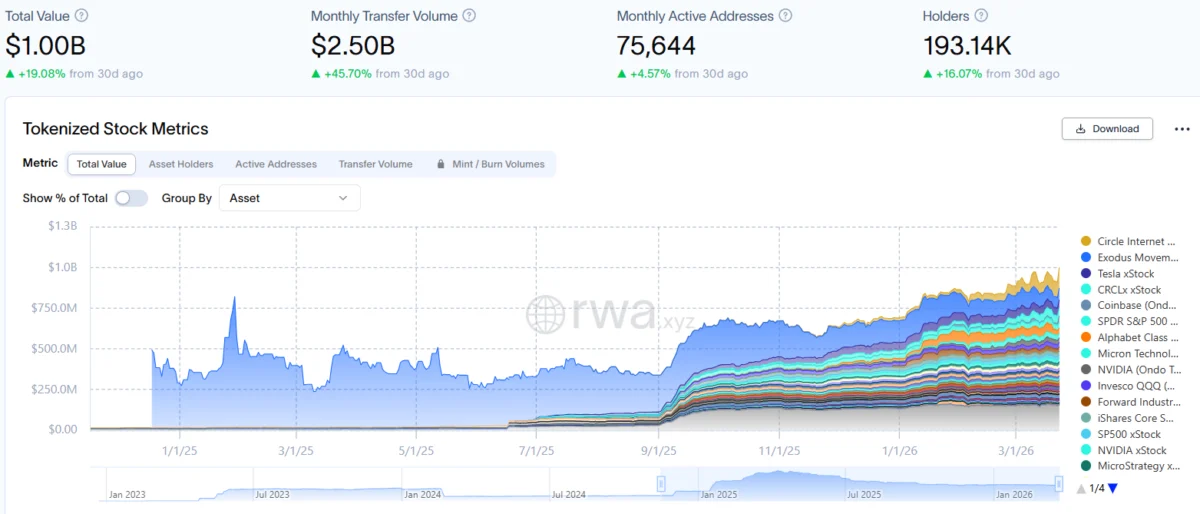
The burgeoning demand for blockchain-based tokenized stocks is a significant trend underpinning these strategic moves. The total value of tokenized stocks has recently surpassed the $1 billion mark, a notable milestone that underscores the growing traction of the real-world asset (RWA) sector within the digital asset space. Data from RWA.xyz reveals a substantial increase in investor engagement over the past 30 days. Tokenized stockholders have risen by 16% to 193,140, while the monthly transfer volume has surged by an impressive 45% to $2.5 billion. This surge in activity indicates a growing investor appetite for the efficiency, accessibility, and fractional ownership benefits that tokenized securities offer.
Despite this impressive growth, tokenized stocks currently represent the sixth-largest segment within the broader $26 billion tokenized RWA market. Tokenized treasury debt leads this category, with a valuation of $11.8 billion, followed by tokenized commodities at over $5 billion. This hierarchical positioning suggests that while tokenized stocks are gaining momentum, other RWA categories are currently commanding larger market shares. However, the rapid expansion of the tokenized stock market indicates its potential to become a dominant force in the future.
The innovation in tokenized securities is not confined to traditional exchanges. Leading cryptocurrency exchanges are also actively participating in this evolving market. Coinbase, for instance, launched 24/7 stock perpetual futures for non-U.S. traders, offering cash-settled exposure to major U.S. stocks and indices like Apple and Nvidia. Similarly, Binance and Kraken have introduced tokenized perpetual futures trading for international traders, mirroring the offerings of numerous offshore platforms. These initiatives from crypto-native firms demonstrate the competitive landscape and the diverse strategies being employed to capture market share in the tokenized securities space.
Navigating the Regulatory Landscape and Technological Evolution
The integration of tokenized securities into mainstream finance presents both immense opportunities and complex challenges, particularly concerning regulatory clarity. The U.S. Securities and Exchange Commission’s recent approval of Nasdaq’s pilot proposal for tokenized stock trading indicates a cautiously optimistic regulatory stance. However, the broader regulatory framework for tokenized public securities is still under active development. This ongoing evolution necessitates close collaboration between financial institutions, technology providers, and regulatory bodies to ensure that innovation proceeds responsibly and within established legal boundaries.
The NYSE’s partnership with Securitize, a company with deep expertise in digital asset custody and tokenization, is a testament to this need for specialized knowledge. Securitize’s role as a digital transfer agent is critical, as it will be responsible for managing the lifecycle of tokenized securities, including issuance, record-keeping, and dividend distribution. This function is analogous to the traditional role of transfer agents but adapted for the blockchain environment. The development of standardized protocols and best practices for digital transfer agents and tokenization agents, as outlined in the MoU, is essential for building a scalable and interoperable tokenized securities ecosystem.
The technical underpinnings of this transformation involve leveraging blockchain technology to create digital representations of traditional securities. Tokenized stocks, for example, are not merely digital proxies but are intended to represent ownership in a company recorded on a distributed ledger. This technology offers inherent benefits such as enhanced transparency, immutable record-keeping, and the potential for greater efficiency in post-trade processes. The ability to achieve instant settlement, for instance, could significantly reduce counterparty risk and free up capital that is currently tied up in longer settlement cycles.

Broader Implications for Capital Markets
The move by the NYSE and the broader trend towards tokenized securities have far-reaching implications for the future of capital markets. Firstly, it has the potential to increase liquidity and accessibility for a wider range of investors. Fractional ownership, enabled by tokenization, allows individuals to invest in high-value stocks with smaller capital outlays, thereby democratizing access to investment opportunities. Secondly, the 24/7 trading capability offered by some of these new platforms could significantly alter traditional trading hours and market dynamics, catering to a global investor base with varying time zone requirements.
Furthermore, the integration of blockchain technology could lead to substantial cost reductions in trading and settlement processes. By automating many of the manual tasks currently involved in post-trade reconciliation and settlement, tokenization can streamline operations and reduce overheads for financial institutions. This efficiency gain could ultimately translate into lower transaction costs for investors.
However, the transition will not be without its hurdles. The successful adoption of tokenized securities will depend on several factors, including the continued development of a clear and supportive regulatory environment, the scalability and security of blockchain networks, and the willingness of traditional market participants to embrace new technologies. The industry must also address concerns related to investor protection, cybersecurity, and the potential for market manipulation within a digitized financial system.
The partnership between the NYSE and Securitize represents a significant step in this direction. By combining the established credibility and market reach of the NYSE with the specialized expertise of Securitize in blockchain and tokenization, this collaboration aims to build a secure, compliant, and efficient infrastructure for the future of trading. The commitment to developing standards and addressing regulatory, operational, and technological requirements signals a pragmatic approach to innovation, one that prioritizes stability and investor confidence. As the financial world continues to grapple with the transformative potential of blockchain technology, this development at the heart of global finance serves as a powerful indicator of the direction in which capital markets are headed. The journey towards a fully tokenized future for securities trading is complex, but the foundational steps being taken by major players like the NYSE are paving the way for a new era of financial innovation.

