
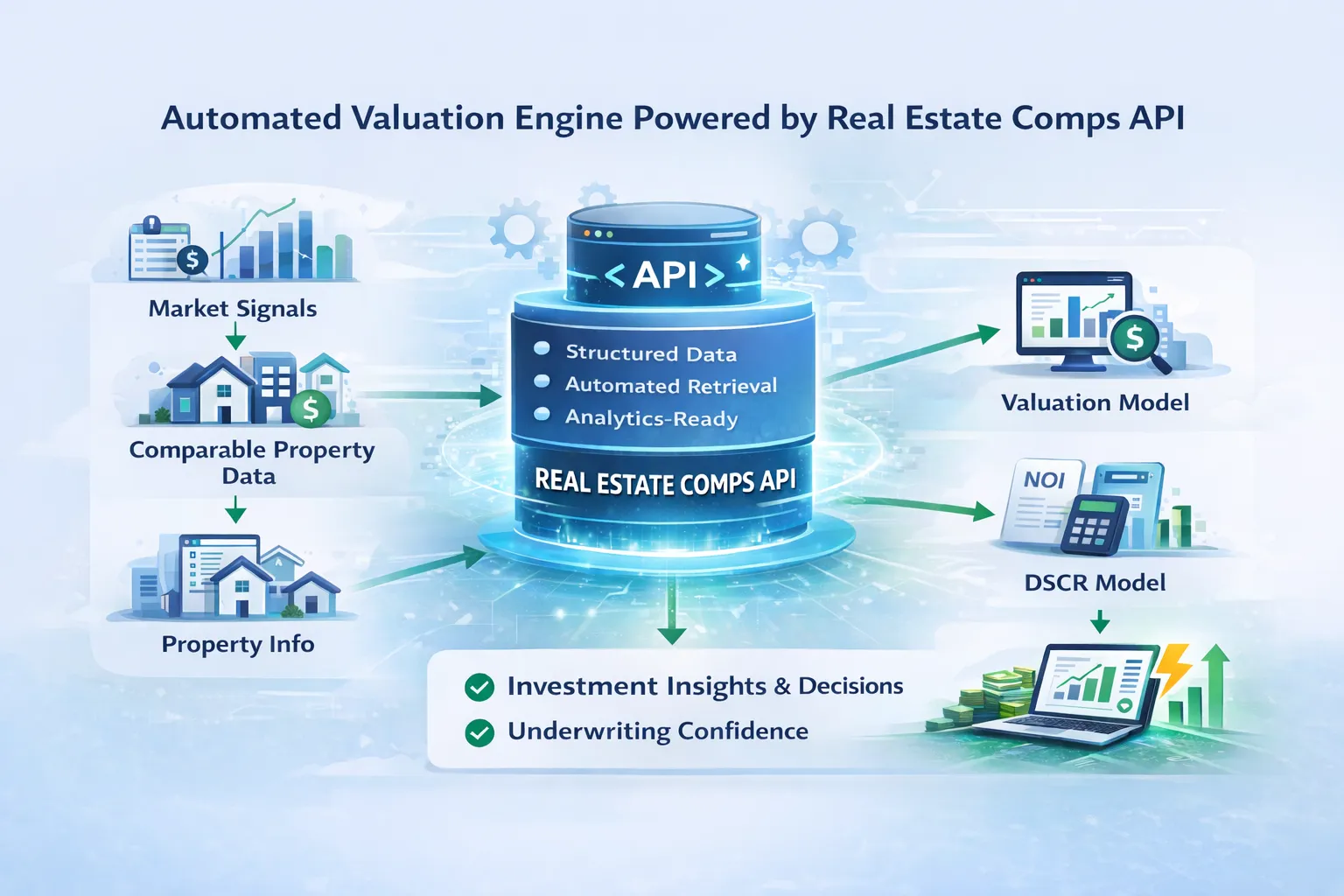
The real estate industry, long a bedrock of investment and development, is undergoing a significant technological transformation, largely driven by the need to overcome a persistent bottleneck: data. For traditional real estate valuation models, the limitations are not in the sophistication of the logic, but in the accessibility and quality of the underlying data. Even the most robust underwriting frameworks falter without timely, consistent, and accurate comparable property data. This often forces analysts to dedicate countless hours to the laborious task of gathering and reconciling fragmented datasets from disparate sources. As real estate portfolios expand and investment strategies become more complex, these manual workflows not only slow down critical decision-making processes but also introduce inconsistencies and hinder the efficient evaluation of potential deals.
In response to these challenges, the emergence of real estate comps Application Programming Interfaces (APIs) is fundamentally reshaping how property valuations and underwriting are conducted. These APIs offer a streamlined solution by automating the delivery of structured comparable sales and rental data, thereby enabling faster valuation models and more reliable Debt Service Coverage Ratio (DSCR) analysis. This technological advancement empowers investors, developers, and financial institutions to seamlessly integrate crucial market intelligence directly into their existing tools and operational workflows, fostering a more agile and data-driven approach to real estate investment. This guide delves into the mechanics of comps APIs, explores how platforms like Mashvisor are enhancing valuation and underwriting, outlines the specific data endpoints available, and illustrates how businesses can leverage automated comparable property data to construct scalable real estate analytics solutions.
The Foundation of Modern Valuation: The Power of Comparable Property Data
At its core, comparable property data is the bedrock upon which modern real estate valuation methods are built. By analyzing the sales and rental performance of similar, nearby properties, investors and analysts can derive objective estimates of a property’s fair market value (FMV) and its income-generating potential. These "comps" provide essential market-based benchmarks, allowing for a direct comparison of potential deals against established real estate trends.
Understanding Real Estate Comps:
Real estate comps, short for real estate comparables, are properties that share key characteristics with the subject property being evaluated. These characteristics typically include location, square footage, property type, number of bedrooms and bathrooms, and overall condition. Traditionally, the focus of comps has been on recent sales transactions. However, for investment property analysis, particularly in the rental market, rental comps have become equally crucial for assessing income potential.
Consequently, the two primary categories of comps are:
- Sales Comps: These are properties that have recently been sold in the same or a very similar market area. They are used to establish a property’s market value based on what buyers are willing to pay for similar assets.
- Rental Comps: These are properties that are currently being rented or have recently been rented in the vicinity. They provide insights into the potential rental income a property can generate, which is vital for income-focused investments.
The combined insights from both sales and rental comps form the indispensable foundation for robust pricing strategies, thorough underwriting processes, and sound investment analysis. This underscores the critical importance of having access to structured and reliable comparable sales data, especially for investors aiming to build repeatable valuation frameworks that can be applied consistently across multiple markets.
The Inherent Limitations of Manual Comp Analysis
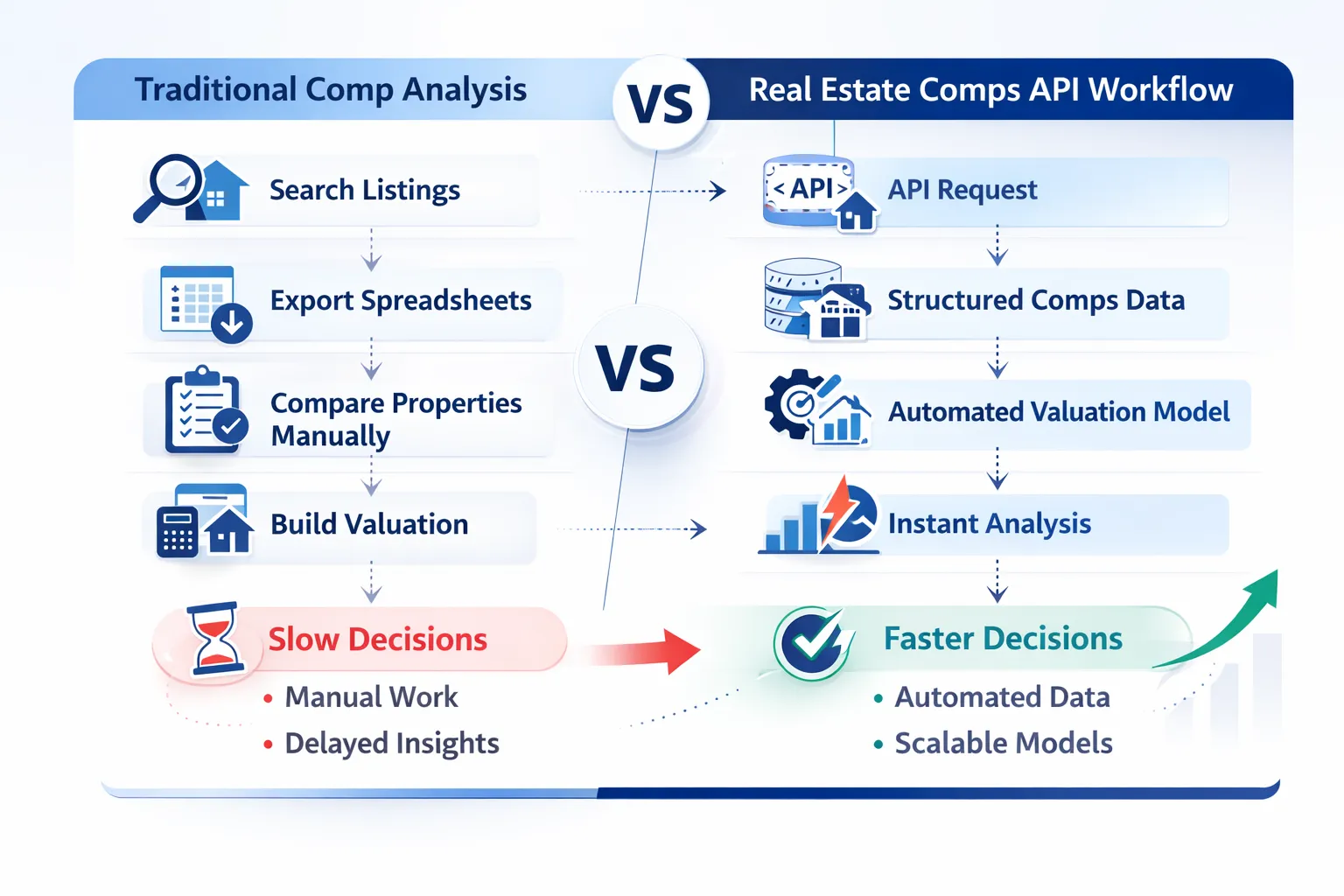
While the concept of using comps is fundamental to real estate valuation, the traditional methods of gathering this data are fraught with inefficiencies and limitations, making them inherently difficult to scale. The conventional process often involves manual searches across numerous listing platforms, local Multiple Listing Service (MLS) databases, public records, and the painstaking compilation of data into spreadsheets.
This manual approach quickly surfaces a cascade of challenges:
- Time-Intensive Data Collection: Manually sifting through various sources to find relevant comparables consumes a significant amount of an analyst’s time, diverting resources from higher-value strategic tasks.
- Data Inconsistency and Inaccuracy: Information across different platforms can vary in terms of detail, recency, and accuracy, leading to discrepancies that require extensive reconciliation. Errors in data entry or outdated information can skew valuations.
- Limited Market Coverage: Manual searches may not always capture the full spectrum of comparable properties, especially in rapidly evolving or less transparent markets, potentially leading to an incomplete or biased view of market conditions.
- Scalability Issues: As the number of properties to evaluate grows, the manual process becomes exponentially more time-consuming and prone to errors. This directly impedes the ability to analyze deals at scale, a necessity for growth-oriented investors and developers.
- Subjectivity and Bias: Without standardized data inputs, the selection of comps can inadvertently become subjective, influenced by the analyst’s experience or pre-existing biases, leading to inconsistent valuation outcomes.
- Delayed Decision-Making: The sheer time required for manual data gathering and analysis can lead to delays in deal submission and decision-making, potentially causing investors to miss out on time-sensitive opportunities.
These limitations become acutely pronounced for entities engaged in high-volume deal analysis. Consequently, modern valuation workflows are increasingly leaning towards automated data delivery mechanisms, such as APIs, which facilitate the instantaneous retrieval of comps data and its direct integration into sophisticated analytical models.
Decoding the Real Estate Comps API: Automating Market Intelligence
A real estate comps API fundamentally alters the traditional property data acquisition process by automating the delivery of crucial comparable property information. Instead of relying on manual research, users can programmatically access data points such as recent sales figures, current pricing benchmarks, and detailed property characteristics through structured requests. The process is straightforward: a user submits a query, typically based on specific location criteria or property attributes, and the API responds by returning standardized comps data that is immediately ready for integration into valuation and underwriting models.
From Static Reports to Dynamic Valuation:
Historically, comp analysis was tied to static reports or repetitive manual searches, each requiring a fresh effort for every property under consideration. A comps API, however, revolutionizes this by replacing manual underwriting with automated data retrieval and analysis.
The automated workflow, at a high level, typically follows these steps:
- Query Initiation: A user or system triggers a request to the API, specifying parameters like property address, geographic area, property type, or specific characteristics (e.g., number of bedrooms, square footage).
- Data Retrieval: The API accesses its vast database, which is continuously updated with property sales, rental listings, and market data. It identifies properties that match the query criteria and possess relevant comparable attributes.
- Data Structuring and Delivery: The retrieved data is then processed and structured into a standardized format, commonly JSON (JavaScript Object Notation). This organized data is then transmitted back to the requesting application or user.
- Integration and Analysis: The standardized comps data is directly integrated into the user’s valuation models, underwriting platforms, or dashboards, enabling immediate analysis and decision-making.
This automated approach, powered by a property comps data API, allows investors and real estate platforms to pull up-to-date datasets on demand. Because the data is delivered in a consistent, structured format, it can be immediately utilized to build repeatable valuation logic across diverse property types and geographical markets.
The Role of a Real Estate Valuation API in Modern Tech Stacks:
Increasingly, comparable property data is not treated as a standalone analytical task but is embedded directly into the fabric of software workflows. A real estate valuation API serves as a critical data layer, powering a wide array of tools and platforms used by various stakeholders in the industry:
- Real Estate Investors and Analysts: For evaluating potential acquisitions, optimizing portfolios, and refining investment strategies.
- Property Developers: For assessing site feasibility, determining optimal pricing for new developments, and understanding market demand.
- Lending Institutions: For collateral valuation, risk assessment in loan underwriting, and portfolio management.
- Real Estate Brokerages: For providing accurate pricing guidance to clients and enhancing listing presentations.
- PropTech Platforms: For building and enhancing their core valuation, analytics, and portfolio management tools.
From a technical perspective, a real estate API designed for developers eliminates the substantial burden of aggregating raw listing datasets or maintaining complex, ever-evolving data pipelines. Instead, an automated property valuation API provides pre-processed, ready-to-use comps data that can be seamlessly integrated into underwriting systems, investor dashboards, or sophisticated investment analysis platforms.
Mashvisor Real Estate Comps API: Comprehensive Data, Powerful Endpoints
The efficacy of any comparable sales data API hinges directly on the quality, breadth, and structure of the data it provides. The Mashvisor API distinguishes itself by delivering enriched comparable property datasets that go beyond basic sales figures. It integrates essential market benchmarks, detailed investment analytics, and crucial performance indicators, all unified within a single, comprehensive real estate analytics API. This holistic approach allows users to transition directly from raw comparable data to sophisticated valuation and underwriting processes without the need for extensive additional data processing or manipulation.
Key Data Points Available Through Mashvisor API:
Mashvisor provides structured comparable property data designed to support a wide range of real estate valuation models, pricing analyses, and investment decision-making processes.
Property-Level Comparable Data:
- Property Characteristics: Detailed information on comparable properties, including square footage, number of bedrooms and bathrooms, lot size, property type (e.g., single-family, condo, multi-family), year built, and architectural style.
- Sales History: A record of recent sales transactions for comparable properties, including sale date, sale price, and type of sale (e.g., arm’s length, foreclosure).
- Listing Details: Information on properties currently or recently listed for sale, including listing price, days on market, and listing status.
- Rental Data: For investment properties, this includes current and historical rental rates, occupancy rates, and rental income potential derived from similar units in the area.
- Property Condition and Features: Data points that may indicate the condition or specific features of a property, such as recent renovations, amenities (e.g., pool, garage), and lot features.
Market and Investment Context:
- Market Trends: Insights into local market dynamics, such as median home prices, price appreciation rates, and market velocity.
- Investment Metrics: Key performance indicators relevant to investors, including cash-on-cash return, capitalization rate (cap rate), and potential rental yield.
- Neighborhood Data: Information on neighborhood demographics, school ratings, crime rates, and proximity to amenities, which can influence property value and desirability.
- Foreclosure and Auction Data: Information on distressed properties that can serve as unique comparables in certain valuation scenarios.
These comprehensive data points and analytical metrics empower users to integrate a robust real estate investment analysis API directly into their acquisition or real estate underwriting pipelines, enabling a more informed and data-driven approach.
Example Mashvisor API Endpoints:
Mashvisor offers a suite of API endpoints specifically designed to facilitate the retrieval and analysis of comparable property data. These endpoints are structured to provide granular access to the necessary information for diverse valuation and analytical needs.
Common API endpoints used in comparable property analysis include:
GET /v1.1/client/property: This endpoint is typically used to retrieve detailed information about a specific property, which can serve as the subject property for comparison or as a data point within a comp set.GET /v1.1/client/property/nearby: This is a crucial endpoint for comps analysis, allowing users to request a list of properties located within a specified radius or geographic boundary of a given address. It returns data on properties that are most likely to be comparable.GET /v1.1/client/property/transactions: This endpoint provides access to historical sales transaction data for properties, allowing analysts to examine recent sales prices and terms of comparable properties.GET /v1.1/client/property/price-estimates: This endpoint offers automated price estimates for properties, often generated using sophisticated valuation algorithms that incorporate comparable data. This can serve as an initial valuation benchmark.
By leveraging these endpoints, users can construct a fully automated comps workflow that replaces laborious manual research with efficient, structured data retrieval.
Example Request: Retrieving Comparable Properties:
To illustrate the practical application of the Mashvisor API, consider how a property developer might request nearby comparable properties for valuation analysis.
A typical API request might look like this:
GET https://api.mashvisor.com/v1.1/client/property/nearby?state=AZ&city=Phoenix&address=123+Main+St
Headers:
x-api-key: YOUR_API_KEY
This request would query the API for properties located near "123 Main St" in Phoenix, Arizona. The API, upon receiving this request, would access its database to identify and return a list of relevant nearby properties that can be used as real estate comps for the valuation modeling of the subject property.
Simplified Example Response:
The API would then return structured comparable property data in a format readily integrable into valuation or underwriting models. A simplified example of such a response might appear as follows:
  "subject_property":
    "address": "123 Main St",
    "property_type": "Single Family",
    "price_estimate": 420000
  ,
  "nearby_properties": [

      "address": "118 Main St",
      "sale_price": 415000,
      "beds": 3,
      "baths": 2,
      "distance_miles": 0.3
    ,

      "address": "140 Oak Ave",
      "sale_price": 432000,
      "beds": 3,
      "baths": 2,
      "distance_miles": 0.6

  ]
This JSON structure provides the core information about the subject property and a list of nearby comparable properties, including their sale prices, key features (beds, baths), and proximity. This data can be directly ingested by valuation dashboards or automated underwriting tools without requiring manual formatting or data cleaning.
Building Smarter Valuation & DSCR Models with Mashvisor Data
The integration of comparable property data directly into analysis workflows through an API significantly enhances the accuracy and scalability of real estate valuation and DSCR models. By automating the retrieval of comps, investors and developers can standardize their assumptions, minimize manual research efforts, and ensure that properties are evaluated using consistent and reliable market benchmarks.
How to Build a Property Valuation Model Using Comparable Data
Accurate property valuation models are fundamentally reliant on comparable sales data to establish fair market value based on observable market behavior, rather than subjective pricing assumptions. The use of API-delivered comps enables this process to be repeated automatically and consistently across numerous properties and diverse markets.
A simplified workflow for building an automated real estate valuation model using comparable data might proceed as follows:
- Automated Comps Retrieval: The system automatically requests and receives comparable property data via the API for a given subject property.
- Data Normalization and Filtering: The retrieved comps data is automatically normalized (e.g., adjusting for differences in square footage, number of bedrooms) and filtered based on predefined criteria to ensure relevance.
- Valuation Algorithm Execution: A valuation algorithm, which can range from simple comparative analysis to more sophisticated regression models, processes the filtered comps data to calculate an estimated fair market value for the subject property.
- Model Output and Reporting: The calculated valuation is outputted, potentially integrated into a larger report or dashboard, and can be automatically updated as new comps data becomes available.
As comps are delivered through a real estate valuation API, the valuation model can run automatically whenever new properties are analyzed, facilitating consistent and scalable valuation practices.
Using Comps Data for DSCR Model Real Estate Analysis
The Debt Service Coverage Ratio (DSCR) model is a critical tool for assessing the financial viability of income-producing properties, particularly for lenders and investors. Its accuracy is heavily dependent on realistic income and valuation assumptions. Comparable property data plays a pivotal role in improving DSCR accuracy by grounding these projections in verified market activity.
The fundamental DSCR Calculation Formula is:
DSCR = Net Operating Income (NOI) / Total Debt Service
To calculate the DSCR for a rental property, analysts typically perform the following steps, all of which can be enhanced by API-sourced comps:
- Estimate Potential Rental Income: Using rental comps, analysts can determine a realistic market rent for the subject property based on similar units in the area.
- Project Operating Expenses: While not directly from comps, accurate market understanding derived from comps can indirectly inform expense projections (e.g., understanding typical property management fees in a given submarket).
- Calculate Net Operating Income (NOI): NOI is derived by subtracting projected operating expenses from the projected gross rental income.
- Determine Total Debt Service: This includes the annual principal and interest payments on any loans secured by the property.
- Compute DSCR: The calculated NOI is divided by the total debt service. A DSCR above 1.0 generally indicates that the property’s income is sufficient to cover its debt obligations.
Accurate comps data serves to mitigate risk by preventing the common underwriting errors of overestimated valuations or unrealistic income projections.
Automating Rental Property Underwriting Workflows
When comparable property data is delivered programmatically via an API, the underwriting process can transition from a manual, labor-intensive review to a highly automated and efficient evaluation.
A typical automated underwriting pipeline, powered by comps data, might look like this:
API → Valuation Model → DSCR Calculation → Investment Decision
This advanced form of rental property underwriting automation enables platforms to:
- Process Deals at Scale: Evaluate a significantly larger volume of potential investments in a fraction of the time.
- Enhance Consistency: Ensure that all deals are assessed using the same standardized data inputs and analytical parameters, reducing human bias.
- Accelerate Turnaround Times: Reduce the time from deal identification to decision-making, allowing for faster capital deployment.
- Improve Risk Management: Provide a more objective and data-driven assessment of property value and income potential, leading to better risk mitigation.
Instead of investing heavily in building proprietary data infrastructure from scratch, real estate teams can establish a strategic partnership with a real estate data API provider to supply standardized comps data, ready for immediate integration into their analytical and decision-making models.
Real-World Example: Automating DSCR-Based Loan Underwriting
Consider a scenario where a lending institution is evaluating a loan application for a rental property. Instead of relying on lengthy manual appraisal processes and complex spreadsheet analysis, the system can be designed to automatically pull comparable property data through an API as soon as a property is submitted for evaluation.
The automated workflow would proceed as follows:
- Loan Application Submission: Borrower submits loan application with property details.
- API Data Retrieval: The lending platform’s system automatically queries the real estate comps API for relevant sales and rental comparables for the subject property’s location and characteristics.
- Automated Valuation: The API-provided data feeds into an automated valuation model, generating an estimated market value for the property.
- Income Projection: Rental comps data is used to establish a realistic projected rental income.
- DSCR Calculation: Based on the estimated valuation, projected income, and loan terms, the DSCR is automatically calculated.
- Risk Assessment & Decision: The system flags potential risks based on the DSCR and other data points, supporting a faster and more objective underwriting decision.
In this streamlined setup, a process that previously might have taken hours or even days is transformed into a repeatable, near-instantaneous operation. More importantly, every loan application is evaluated using consistent, data-driven criteria rather than subjective assumptions, leading to more equitable and reliable lending practices. This example highlights a common underwriting workflow, but the applications of a real estate comps API extend to numerous other practical scenarios within the industry.
Real-World Use Cases for Investors, Developers, and PropTech Teams
The true value of a real estate comps API is realized when it is seamlessly integrated into core decision-making workflows, enhancing efficiency and accuracy across various operational domains.
Investors and Acquisition Teams
Real estate investors and acquisition teams leverage comparable property data through APIs to accelerate deal evaluation and ensure consistency across diverse markets.
Common applications include:
- Rapid Deal Screening: Quickly assessing the viability of potential acquisitions by obtaining immediate valuation estimates and market benchmarks.
- Portfolio Optimization: Continuously evaluating existing assets against current market conditions and identifying opportunities for repositioning or disposition.
- Accurate Offer Generation: Developing competitive yet profitable offers based on data-driven valuations rather than intuition.
- Market Trend Analysis: Gaining granular insights into specific submarkets to identify emerging investment opportunities or potential risks.
Access to a centralized, continuously updated real estate comps dataset allows investors to standardize their decision criteria and mitigate the impact of bias in deal evaluation, leading to more strategic and profitable investment decisions.
Lenders and DSCR Underwriting
Financial institutions are increasingly adopting automated data workflows to enhance the precision of borrower risk assessment and collateral valuation.
With API-delivered comparable property data, lenders can:
- Automate Collateral Valuation: Expedite the appraisal process by automatically sourcing and analyzing comparable sales data to determine accurate property values.
- Refine Loan-to-Value (LTV) Ratios: Ensure that LTV ratios are based on current market valuations derived from robust comparable data.
- Enhance Risk Modeling: Incorporate granular property-level and market data into risk models for more precise prediction of default probabilities.
- Streamline Underwriting: Significantly reduce the time required for loan underwriting by automating data collection and initial analysis steps.
This approach aligns with broader industry trends towards automated underwriting, which is being further propelled by the increasing availability and integration of historical real estate data APIs.
PropTech Platforms and Developers
For technology startups and established analytics platforms, comparable property data serves as a fundamental data layer that powers their core valuation and analytics tools.
Typical developer use cases include:
- Building Valuation Engines: Integrating comps data to power automated valuation models within their platforms.
- Developing Investment Analytics Tools: Providing users with the ability to analyze investment potential based on market comparables and performance metrics.
- Creating Portfolio Management Software: Enabling users to track and value their real estate portfolios with up-to-date market data.
- Enhancing Property Search Functionality: Offering more intelligent property search results that consider comparable market activity.
By leveraging a high-quality real estate data API, development teams can launch sophisticated valuation and analytics features without the immense cost and complexity of building and maintaining their own proprietary property data infrastructure internally.
Mashvisor API Pricing and Getting Started
Mashvisor employs a usage-based pricing model for its API, designed to offer flexibility and scalability. This approach allows companies to adjust their API access in alignment with their evolving data needs, making it suitable for a wide range of users, from nascent startups to large enterprise platforms.
Mashvisor offers both monthly and annual subscription plans, with annual subscriptions providing a cost-saving benefit equivalent to two months free. The pricing structure is tiered, catering to different stages of growth and data consumption requirements:
- Tiered Plans: These plans typically vary based on the number of API credits or calls allowed per month, the depth of data available, and the level of support provided. For instance, lower tiers might offer a set number of calls for basic comps data, while higher tiers might include access to more advanced analytics and higher call volumes.
- Custom Enterprise Solutions: For larger organizations with extensive data requirements, Mashvisor also provides custom enterprise solutions tailored to specific needs and usage patterns.
To initiate the process of integrating Mashvisor’s capabilities, potential users are encouraged to schedule a consultation call with the Mashvisor Data Team. This consultation provides an opportunity to discuss specific requirements, understand the API’s capabilities in detail, and determine the most appropriate plan.
Benefits of Using Mashvisor for Automated Property Valuation
Leveraging the Mashvisor API for comparable property analysis empowers investors and developers to transition from inefficient manual valuation workflows to scalable, data-driven decision-making processes.
The distinct advantages that users can expect include:
- Enhanced Speed and Efficiency: Dramatically reduce the time spent on data collection and analysis, enabling faster deal evaluation and execution.
- Improved Data Accuracy and Consistency: Access standardized, high-quality data that minimizes errors and ensures consistent valuation benchmarks across all analyses.
- Scalability: Effortlessly handle increasing volumes of property analysis without a proportional increase in manual labor or operational costs.
- Deeper Market Insights: Gain access to a comprehensive dataset that includes not only comparables but also crucial market trends and investment metrics.
- Reduced Operational Costs: Lower the overhead associated with manual data acquisition, data cleaning, and the maintenance of internal data infrastructure.
- Streamlined Workflows: Integrate valuation and underwriting directly into existing software and operational pipelines, creating a more cohesive and efficient business process.
- Data-Driven Decision Making: Foster a culture of objective, evidence-based decision-making by grounding analyses in reliable, quantifiable data.
By consolidating comparable property data with essential investment analytics within a single, integrated platform, Mashvisor facilitates faster, more reliable property valuation at scale.
When a Real Estate Comps API May Not Be Necessary
While the advantages of a real estate comps API are substantial, it’s important to recognize that such a tool may not be universally necessary for every use case. A comps API is most valuable when dealing with large volumes of properties or when integrating valuation directly into software workflows.
However, a comps API might be considered less critical if:
- Infrequent Analysis: An individual or small team only needs to analyze a handful of properties sporadically and the time investment for manual research is acceptable.
- Local Market Expertise Suffices: An analyst possesses deep, intimate knowledge of a very specific, stable local market and can accurately estimate values based on limited, readily available public information.
- Simple Transactional Needs: The primary need is for basic transaction data for very simple, non-investment-focused property sales where detailed market analysis is not required.
- Budgetary Constraints: Strict budgetary limitations preclude the investment in API subscriptions, and manual methods, though less efficient, are the only viable option.
In these scenarios, introducing an API might add unnecessary complexity and cost. However, the moment the need arises for faster analysis, consistent market benchmarks, or the simultaneous evaluation of multiple properties, the value proposition of an automated comps data solution becomes significantly more compelling.
Bottom Line
As the real estate sector increasingly embraces data-driven methodologies, the processes of valuation and underwriting are rapidly evolving from manual research-intensive tasks to automated intelligence-powered operations. In this transformative landscape, property comps data has shifted from being a one-time analysis performed for individual deals to a continuous input that fuels pricing models, risk evaluations, and strategic investment decisions across entire portfolios.
A real estate comps API is the pivotal enabler of this transition, delivering consistent, up-to-date market data directly into automated valuation and DSCR models. This empowers teams to analyze opportunities with unprecedented speed while maintaining standardized assumptions and rigorous analytical integrity. With scalable access to comparable properties, essential investment metrics, and analysis-ready datasets, Mashvisor provides investors, lenders, and PropTech platforms with the critical tools to shift their focus from the burdensome task of data collection to the more strategic imperative of building smarter, more profitable real estate strategies.
FAQs
What Is a Real Estate Comps API?
A real estate comps API provides programmatic access to data on similar properties within a defined geographic area. This allows applications and systems to automatically retrieve sales and market comparison data, facilitating rapid property valuation and analysis.
How Is DSCR Calculated for Rental Properties?
The Debt Service Coverage Ratio (DSCR) for rental properties is calculated by dividing the property’s Net Operating Income (NOI) by its total annual debt obligations (principal and interest payments). This ratio serves as a key metric for lenders to assess a property’s ability to generate sufficient income to cover its loan payments and indicates the associated repayment risk.
Who Uses Real Estate Comps APIs?
Real estate comps APIs are widely utilized by real estate investors, lending institutions, brokerages, and PropTech platforms that require scalable and consistent valuation data for their analytical processes, reporting functions, or automated real estate analysis systems.
What Makes Mashvisor Different from Other Real Estate APIs?
Mashvisor distinguishes itself by focusing on investment-oriented analytics. It uniquely combines detailed property information with crucial market insights and performance indicators, enabling users to evaluate investment opportunities without the need to aggregate data from multiple disparate sources.
How Do I Get Comparable Property Data Automatically?
Comparable property data can be accessed automatically by integrating analytical software tools with a data provider’s API. The API returns nearby property information and pricing benchmarks through automated requests, typically based on specific location parameters or property characteristics defined by the user.

