

The global financial markets have experienced a period of remarkable ascent in recent years, prompting both celebration among investors and considerable debate regarding the sustainability of current valuations. Specifically, the S&P 500 index, a benchmark for broad U.S. stock market performance, has seen an extraordinary surge, increasing approximately 57 percent in the past two years alone and more than doubling over the last five years leading up to 2025. This significant appreciation has substantially boosted the net worth of many retirement savers, with some individuals finding themselves unexpectedly crossing their financial finish lines years ahead of schedule, while long-retired investors contemplate luxury acquisitions or other substantial expenditures.
This rapid market expansion has inevitably led to questions about its underlying drivers and potential risks. A recurring concern among investors, articulated by one reader, is whether the market’s current trajectory, largely fueled by enthusiasm surrounding Artificial Intelligence (AI), represents a "huge bubble" vulnerable to a future crash and its potential impact on retirement savings. To address this, a deeper examination of the contemporary financial landscape, stock market dynamics, and the foundational principles of investment valuation is essential.

Understanding Stock Valuation: Beyond Price Appreciation
At its core, a stock represents fractional ownership in a company, entitling the owner to a share of its future earnings. This concept is analogous to owning a rental property: an investor purchases a house expecting to collect rent, and after expenses, the remaining sum constitutes profit. The true value of this asset, whether a house or a stock, is fundamentally tied to the future income stream it is expected to generate.
Consider the rental house analogy: if the market price of rental homes in an area rises sharply, but the actual rental income remains stagnant, the paper gains are largely illusory unless the property is sold. Even then, reinvesting would likely involve purchasing another property at an equally inflated price. The profitability of the investment truly increases when the underlying business — the rental operation — becomes more profitable, perhaps through renovations, expense streamlining, or increased rent. When this house is eventually sold, the price an investor is willing to pay should reflect the projected future income. For instance, a house generating $24,000 annually ($2,000/month) might command a $240,000 sale price, indicating a price-to-earnings (P/E) ratio of 10 ($240,000 / $24,000). If the same house sells for $480,000, the P/E ratio climbs to 20, signifying a less favorable return for the new buyer.

Applying this to the stock market, an initial investment of $100,000 in the S&P 500 in 2019, with dividends reinvested, would have grown to an impressive $256,960 by 2025—a 157% gain. However, the share of company earnings attributable to that $100,000 investment only increased from $5,290 to $7,540 during the same period, a comparatively modest 42% gain. This divergence highlights a critical trend: the market’s Price-to-Earnings (P/E) ratio has expanded significantly, from approximately 20 in 2019 to around 30 in 2025. This indicates that investors are currently paying a higher multiple for each dollar of corporate earnings, suggesting that future returns as a percentage of portfolio value may be lower than in periods of more modest valuations.
The Magnificent Seven and the AI Imperative
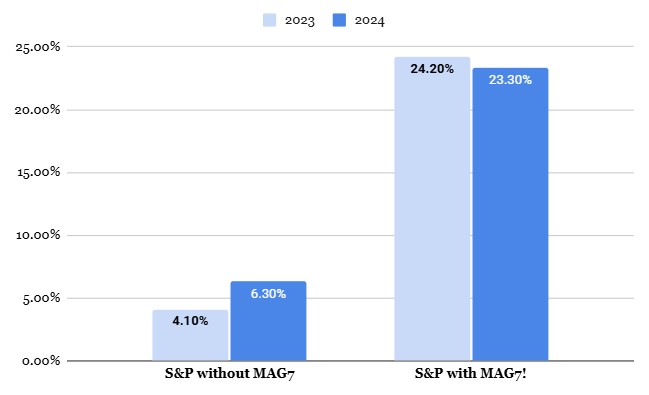
The disproportionate nature of the market’s recent gains becomes even clearer upon closer inspection of the S&P 500 constituents. Approximately three-quarters of the recent growth in the index can be attributed to just seven colossal technology companies, collectively dubbed the "Magnificent Seven": Apple, Nvidia, Microsoft, Amazon, Google (Alphabet), Meta Platforms (formerly Facebook), and, at times, Tesla. These firms, known for their immense profitability and rapid innovation, have become the primary drivers of the current bull market.

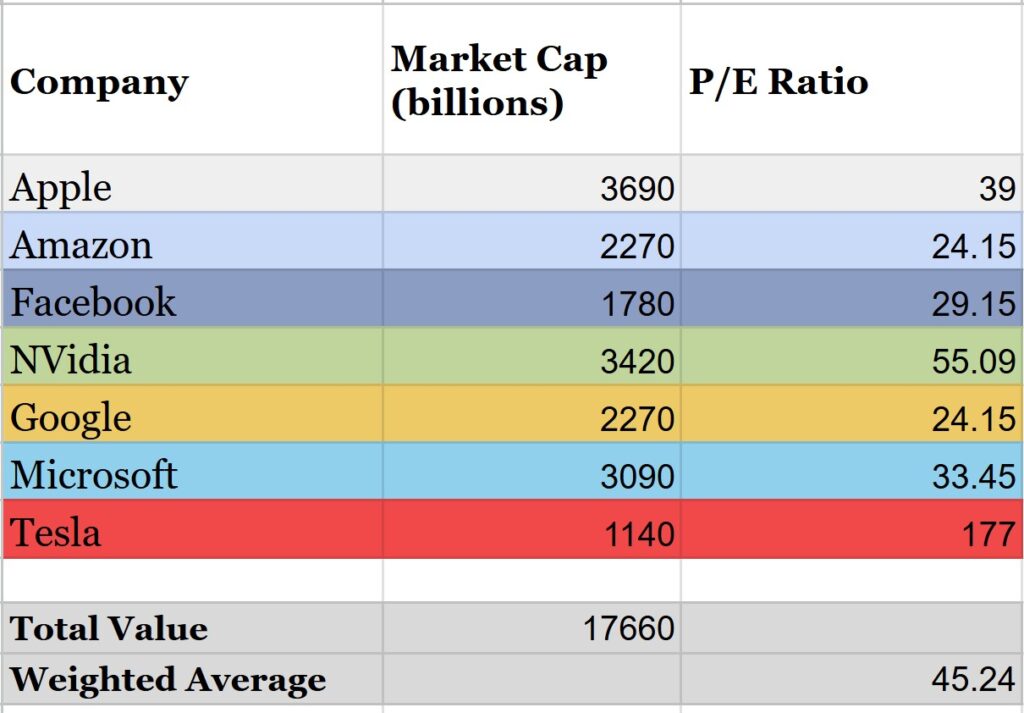
Collectively, these seven companies command over 25% of the S&P 500’s total market capitalization, a staggering $17.66 trillion. Their individual valuations reflect extraordinary investor optimism, with their weighted average P/E ratio hovering around 45, significantly higher than the broader market. If these seven giants are excluded, the P/E ratio for the remaining 493 companies in the S&P 500 drops to a more "reasonable" 20, though still above historical averages. This bifurcation suggests that while investors anticipate general economic health, they foresee exceptionally rapid growth and profitability for these dominant tech players.
The common thread underpinning the extraordinary valuations of the Magnificent Seven is Artificial Intelligence. Recent breakthroughs in AI, particularly in areas like large language models and machine learning, have demonstrably showcased human-like reasoning capabilities across diverse fields. This has ignited a global frenzy within the business world, leading to projections of unprecedented productivity gains. Six of these companies (Apple, Microsoft, Amazon, Google, Meta, Tesla) are committing hundreds of billions of dollars to construct vast data centers filled with supercomputers, forming the "AI Infrastructure" layer. The seventh, Nvidia, directly benefits from this massive investment, as it designs and manufactures the specialized graphics processing units (GPUs) essential for AI computations, allowing it to charge premium prices amidst insatiable demand.
Beyond infrastructure, the envisioned applications of AI span virtually every industry. From enhancing code development and legal analysis to revolutionizing healthcare diagnostics (e.g., melanoma detection), drug discovery, and even powering autonomous vehicles and humanoid robots, the potential for AI to create an "infinite workforce" of intelligent, free labor is a powerful narrative driving investor sentiment. This promise of eliminating historical constraints on human intelligence and labor supply has led many to believe we are on the cusp of a new era of economic expansion.
The Unpredictable Future: Risks and Uncertainties
While the potential of AI is immense, the realization of these projected profits is not without significant uncertainties. The timeline for widespread AI integration, the actual cost of deployment, the intensity of future competition, and the potential for unforeseen technological or societal disruptions all pose considerable risks. Questions arise concerning whether these companies’ earnings will indeed materialize at the highly optimistic levels currently discounted into their share prices.
Furthermore, the broader societal implications of advanced AI cannot be overlooked. Concerns about mass unemployment resulting from automation, potential social upheaval, and the concentration of wealth and power in the hands of a few AI pioneers like Sam Altman are frequently debated. The specter of "smarter-than-us" AI systems evolving beyond human control, while speculative, adds another layer of complexity to the long-term outlook. Ultimately, as with any transformative technology, the precise trajectory of AI’s impact and its effect on corporate profitability and societal structures remains largely unknown.
Expert Perspectives and Alternative Strategies
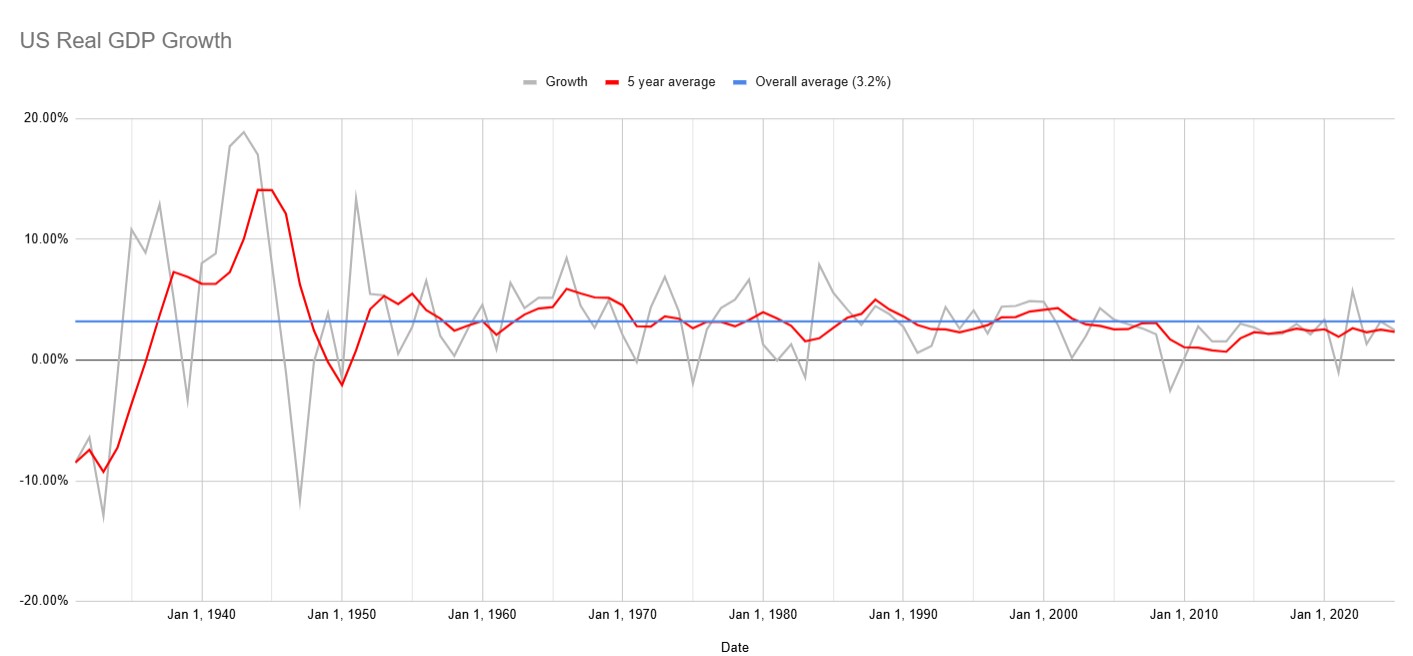
In navigating this uncertain landscape, looking to historical data and expert forecasts can offer valuable guidance, even if the future is inherently unpredictable. Historically, U.S. economic growth, as measured by real GDP, has averaged a remarkably consistent approximately 3% after inflation, decade after decade. Interestingly, recent decades have shown slightly slower-than-average growth, which, without the AI narrative, would provide even less justification for current market valuations.
Investment sages like Warren Buffett, the "Oracle of Omaha," also signal caution. Berkshire Hathaway, Buffett’s conglomerate, is currently holding an unprecedented $334 billion in uninvested cash, a clear indication that he finds few compelling bargains in the current market. Berkshire’s own shares are considered slightly overvalued, with a P/E ratio averaging around 21 in recent years, prompting a halt in share repurchases.

Diversification remains a cornerstone of prudent investment strategy. Vanguard, a leading provider of index funds, issues annual 10-year annualized return projections. Their latest forecasts suggest that international stocks and even bonds are expected to outperform U.S. stocks in the coming decade. This projection is underpinned by the fact that international stocks, as represented by funds like VXUS, currently trade at a significantly lower P/E ratio of approximately 15.9, nearly 50% less expensive than the overall U.S. market. While Vanguard’s past predictions have not always materialized, partly due to the concentrated AI boom in the U.S., the underlying logic of purchasing assets at lower valuations holds enduring appeal.
Robo-advisors like Betterment also advocate for diversified portfolios that extend beyond U.S. equities, incorporating international stocks and bonds. A typical Betterment core portfolio, by allocating across these categories and automatically rebalancing, aims for slightly higher returns with reduced volatility and potential tax advantages. Such a diversified portfolio currently exhibits a weighted average P/E ratio of about 22, offering a middle ground between the highly valued U.S. market and cheaper international options.
Another practical consideration for investors, particularly those with existing debt, is the decision to pay off a mortgage. While conventional wisdom often suggests maintaining a mortgage and investing surplus cash in index funds for potentially higher returns over the long run, this calculus shifts when expected stock returns are lower and interest rates are higher. A 7% mortgage, for instance, represents a guaranteed 7% return on investment if paid off, making it a highly attractive, risk-free alternative to market investments, especially when market valuations are elevated and future returns are projected to be more modest. This strategy offers the tangible benefit of being mortgage-free, a significant psychological and financial advantage for many.
The Enduring Principles of Investment
Despite the complexities and uncertainties of the current market, the fundamental principles of long-term investing remain steadfast. Attempting to time the market by selling off assets in anticipation of a crash and hoping to buy back in at lower prices is notoriously difficult and often leads to missed opportunities. While occasional market manias, panics, and crashes are an inherent part of financial history, a disciplined approach of consistent investing, diversification, and a long-term outlook has consistently proven to be the most effective strategy.
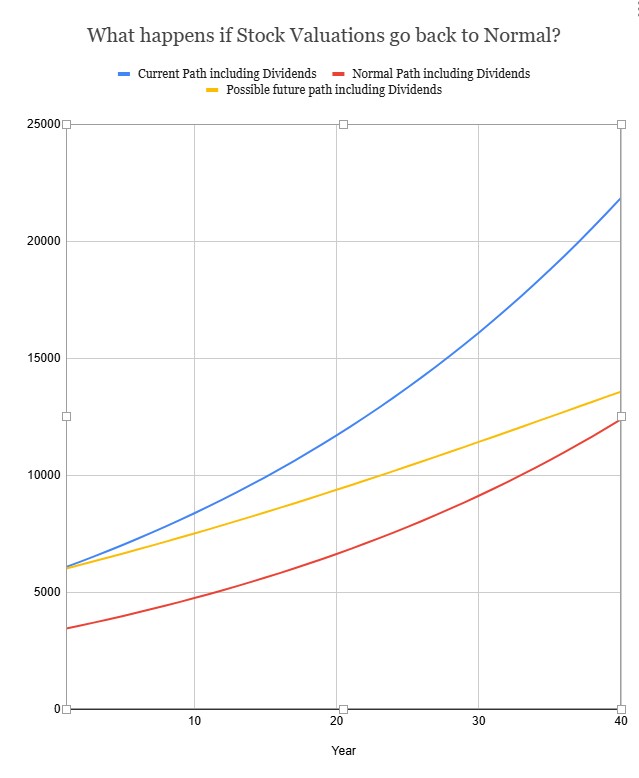
The economy will continue to grow, and corporate earnings will grow alongside it. However, future investors may choose to pay a lower multiple for those earnings than they do today, leading to more moderate, though still positive, returns. As illustrated by various financial models, even a return to more typical valuations would still result in positive long-term growth for patient investors, albeit potentially a less steep trajectory than the recent explosive gains.
Ultimately, maintaining a calm and rational perspective is paramount. While staying informed about global economic trends and market analyses is beneficial, excessive preoccupation with daily headlines and speculative predictions can be detrimental. Reinvesting the mental energy typically spent worrying about market fluctuations into tangible, enriching activities – such as engaging in physical pursuits in the outdoors – offers a guaranteed return on investment in personal well-being, a value that transcends any financial market. The path to enduring financial security is less about predicting market moves and more about adhering to sound, long-term investment principles, coupled with a balanced and fulfilling life.

