
Publicly traded Bitcoin (BTC) mining companies offloaded a staggering amount of their digital asset holdings in the first quarter of 2026, selling over 32,000 BTC. This figure surpasses the total Bitcoin sold by these same companies throughout all four quarters of 2025, signaling a significant tightening of business conditions within the cryptocurrency mining industry. The trend highlights a growing pressure on miners to liquidate assets to cover operational costs amidst a challenging market environment.
The extensive sales by major players such as MARA, CleanSpark, Riot Platforms, Cango, Core Scientific, and Bitdeer, as reported by TheEnergyMag, have set a new benchmark for miner liquidations within a single quarter. This record-breaking sale volume eclipses even the 20,000 BTC offloaded in the second quarter of 2022, a period marked by a severe crypto bear market triggered by the dramatic collapse of the Terra-Luna ecosystem. The scale of these recent sales underscores the current economic pressures facing the sector.
Declining Hashprice and Mounting Unprofitability
A primary driver behind this surge in Bitcoin sales is the precipitous decline in hashprice, a critical metric that reflects the profitability of Bitcoin mining. Hashprice, which represents the value generated per unit of computing power (measured in petahash per second per day, or PH/s/day), has fallen to record low levels, dipping below $35 PH/s/day. Data from Hashrate Index indicates that the current hashprice hovers around $33 PH/s/day.
This current price point is particularly concerning as it represents the breakeven threshold for many Bitcoin miners, especially those operating older, less efficient mining hardware. Industry analysis suggests that approximately 20% of the Bitcoin mining industry is currently operating at an unprofitable level, forcing these entities to make difficult decisions regarding their asset holdings and operational strategies. The sustained low hashprice environment directly impacts revenue streams, making it increasingly difficult for miners to cover expenses such as electricity, hardware depreciation, and personnel.

A Confluence of Challenges for the Mining Sector
The significant Bitcoin sell-off by publicly traded miners is not attributable to a single factor but rather a confluence of several persistent challenges. The industry is grappling with a rapidly increasing network hashrate, which represents the total computing power dedicated to securing the Bitcoin network. As more mining power comes online, the difficulty of mining adjusts upwards, meaning that each miner earns a smaller fraction of the block rewards for the same amount of computational effort.
Compounding this issue are the reduced block rewards, a fundamental aspect of Bitcoin’s monetary policy. Following the most recent halving event, the reward for mining a block was halved, directly impacting miners’ primary revenue source. Furthermore, broader macroeconomic headwinds, including inflation, interest rate fluctuations, and global economic uncertainty, continue to exert pressure on all industries, including the energy-intensive Bitcoin mining sector. These external factors can influence the cost of capital, operational expenses, and the overall demand for cryptocurrency.
The Long-Term Trend: Diminishing Miner Reserves
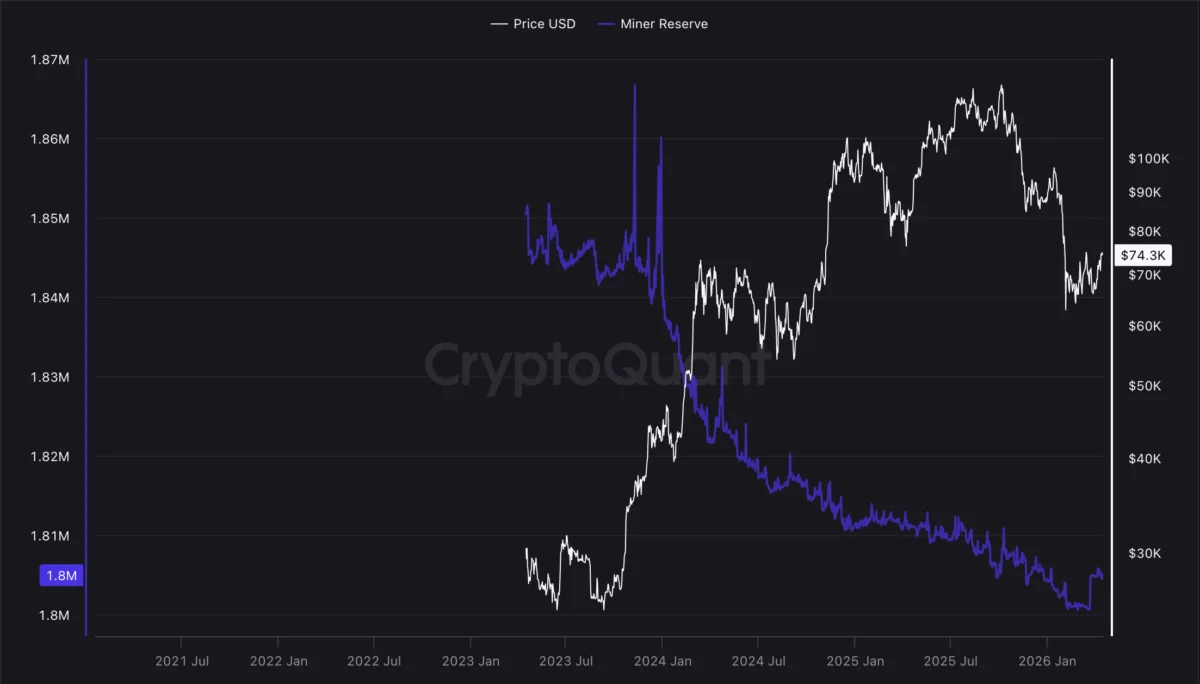
The current surge in sales aligns with a longer-term trend of declining Bitcoin reserves held by miners. According to data from CryptoQuant, the Bitcoin Miner Reserve metric, which tracks the total amount of BTC held by miners, has been on a gradual downward trajectory since the end of 2023. At the close of 2023, miners collectively held over 1.86 million BTC. As of the time of publication, this figure has dwindled to approximately 1.8 million BTC.
While miners have historically engaged in periodic sales of their Bitcoin holdings to cover operational expenses, the current economic climate has amplified the necessity and scale of these liquidations. A combination of depressed cryptocurrency prices and escalating energy costs has compelled some miners to divest assets that they might otherwise have preferred to retain in their corporate treasuries for future appreciation.
Expert Outlook: Further Capitulation Expected
Asset manager CoinShares, in its Q1 2026 Bitcoin Mining Report, expressed a cautious outlook for the sector. The firm anticipates "further capitulation among higher-cost operators in H1 2026 unless BTC’s price recovers materially." This suggests that without a significant rebound in Bitcoin’s price, more mining companies, particularly those with higher operational costs, may be forced to reduce their operations or sell assets to remain solvent. The report highlights the precarious financial position of a substantial portion of the mining industry.

The current market dynamics paint a stark contrast to the behavior of Bitcoin treasury companies, which have been actively accumulating BTC. Companies like Strategy, led by Michael Saylor, have consistently demonstrated a strategy of acquiring Bitcoin, even during periods of price volatility. Saylor himself recently signaled that Strategy is continuing its aggressive BTC acquisition strategy, even as the price retreated from recent highs exceeding $73,000. His characteristic "Think bigger" message, often accompanied by charts of Strategy’s purchase history, has become synonymous with imminent Bitcoin acquisitions, underscoring a divergent investment thesis between miners under pressure and strategic corporate accumulators.
The Impact of the Halving and Evolving Mining Landscape
The Bitcoin halving events, which occur approximately every four years, are designed to reduce the rate at which new Bitcoins are created and introduced into circulation. While this mechanism is fundamental to Bitcoin’s deflationary economics, it directly impacts miners’ revenue. Each halving effectively cuts their primary income stream in half, necessitating greater efficiency and cost management to maintain profitability. The 2024 halving, which occurred in April of that year, has continued to contribute to the pressure miners are experiencing in the subsequent periods.
The increasing difficulty of mining, driven by a rising global hashrate, further exacerbates the impact of reduced block rewards. As more sophisticated and energy-efficient mining hardware enters the market, older machines become less competitive. This creates a perpetual arms race for miners to upgrade their equipment, which requires significant capital investment. Those unable to keep pace with technological advancements and who are reliant on less efficient hardware are particularly vulnerable to the current market conditions.
Geopolitical and Regulatory Considerations
Beyond the direct economic pressures, the Bitcoin mining industry also navigates a complex landscape of geopolitical and regulatory considerations. Energy costs, a significant operational expense, can vary dramatically based on location and local energy policies. Furthermore, some jurisdictions have implemented or considered regulations that could impact mining operations, ranging from environmental restrictions to outright bans. These external factors can introduce uncertainty and affect the long-term viability of mining operations in specific regions.
The increasing decentralization of mining operations across different geographical locations is a natural response to these varied challenges. Miners seek out regions with abundant, low-cost energy and favorable regulatory environments. However, this also means that disruptions in one region can have less of an impact on the overall network security, while still posing significant challenges to individual mining companies.

The Broader Implications for the Bitcoin Ecosystem
The substantial selling pressure from publicly traded miners has several implications for the broader Bitcoin ecosystem. Firstly, it can contribute to short-term price volatility as large volumes of Bitcoin enter the market. While the overall demand from treasury companies and individual investors remains robust, such significant miner liquidations can create temporary supply imbalances.
Secondly, the financial strain on miners could lead to consolidation within the industry. As less efficient or heavily indebted companies struggle to survive, larger, more capitalized entities may acquire their assets or operations at discounted prices. This could lead to a more concentrated mining landscape, which some argue could have implications for the decentralization of the network, although the underlying protocol remains robustly decentralized.
Thirdly, the ongoing need for miners to sell Bitcoin to cover operational costs highlights the importance of Bitcoin’s price appreciation for the sustainability of the mining industry. A sustained period of low prices or high operational costs could lead to a reduction in the overall hashrate if a significant number of miners are forced to shut down their operations. However, the difficulty adjustment mechanism in Bitcoin is designed to maintain a consistent block production time, meaning that even with a reduced hashrate, blocks would still be mined, albeit at a lower network difficulty.
The current environment serves as a critical test for the resilience of the Bitcoin mining industry. The ability of miners to adapt to changing economic conditions, optimize their operations, and manage their treasuries will be crucial for their survival and continued contribution to the security and integrity of the Bitcoin network. The record-breaking sales in Q1 2026 are a clear indicator of the significant headwinds they are facing, and the coming quarters will likely reveal which companies possess the strategic foresight and financial fortitude to navigate this challenging period.

