
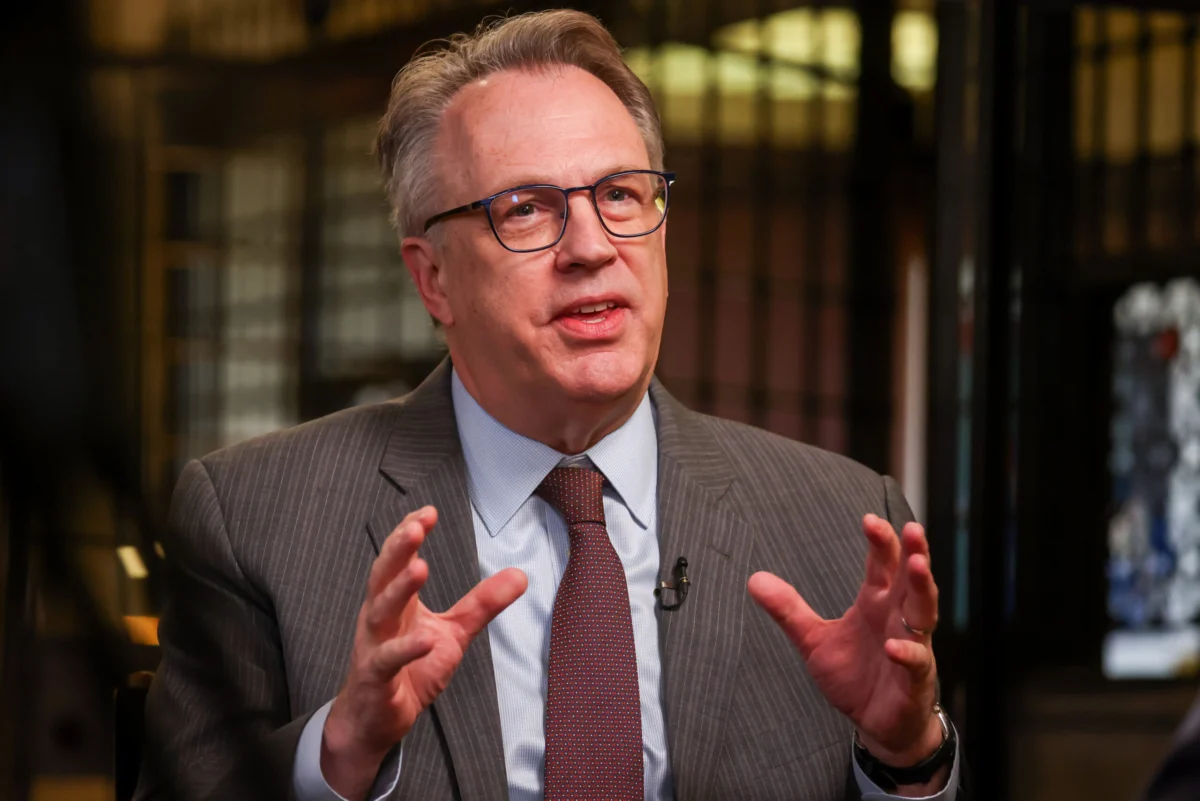
New York Federal Reserve President John Williams articulated a noteworthy perspective on the future trajectory of monetary policy on Tuesday, April 7, 2026, stating he anticipates no further interest rate increases in 2027 following one additional hike expected later this year. This forward-looking assessment, delivered during an interview with Bloomberg News, places Williams, a permanent voting member of the influential Federal Open Market Committee (FOMC), at a discernible remove from prevailing market sentiment and a segment of his central bank colleagues. His comments provide crucial insights into the evolving debate within the Federal Reserve regarding the optimal path to achieve price stability while fostering sustainable economic growth.
Williams’ Outlook on Interest Rate Trajectory
Speaking candidly, President Williams affirmed his consistent view: "I haven’t changed my view that it may be appropriate to have one more rate hike." This statement underscores the Federal Reserve’s commitment to continue its efforts to bring inflation to its mandated 2% target. However, the more striking aspect of his commentary pertained to the subsequent year. "I don’t think at this time I have any reason to believe that we would need to do more," Williams added, directly addressing the outlook for 2027. This suggests a potential capping of the current tightening cycle, with the final rate adjustment occurring before the close of 2026.
Williams’ stance is particularly significant given his role as president and chief executive officer of the Federal Reserve Bank of New York, a position that traditionally holds substantial influence within the Federal Reserve System. As a permanent voting member of the FOMC, the body responsible for setting the nation’s monetary policy, his views carry considerable weight and often reflect a broader consensus or at least a significant viewpoint within the central bank.
The Nuance of Data Dependency
Despite his clear projection, Williams injected a crucial element of flexibility, characteristic of central bank communication. He cautioned that forecasting far into the future inherently involves uncertainty, stating, "we’ll have to see" when it comes to predicting monetary policy into the new year. This caveat highlights the Federal Reserve’s deeply ingrained data-dependent approach to policy setting. "This economy is being affected by lots of different influences, and we just have to keep watching the data," Williams elaborated.
This emphasis on forthcoming economic data underscores that any future policy decisions will be contingent upon the evolution of key economic indicators, including inflation trends, labor market conditions, and broader economic growth. Should unforeseen economic shifts occur, the Fed’s policy path could, by necessity, adjust. This pragmatic approach allows the central bank to respond effectively to a dynamic economic landscape, rather than being rigidly bound by pre-set targets.
Market Discrepancy: Fed Funds Futures Signal Divergence
The market’s interpretation of future Fed policy stands in stark contrast to Williams’ relatively dovish outlook. According to CME’s FedWatch data as of Tuesday, traders in Fed funds futures contracts were largely betting on at least one additional rate hike in 2027. The latest trading data indicated approximately 90% odds that the Fed’s overnight rate would conclude 2027 at least a half percentage point higher than its current level. This robust market expectation suggests a belief that inflationary pressures might prove more persistent or that the economy’s resilience could necessitate further tightening beyond Williams’ envisioned timeline.
Fed funds futures are a critical tool for gauging market sentiment regarding future interest rate movements. These derivatives reflect the collective wisdom of investors on where the federal funds rate will be at specific points in time. The significant discrepancy between Williams’ personal forecast and the market’s collective projection highlights a fundamental disagreement about the durability of disinflationary forces and the overall economic trajectory. While Williams projects a near-term cessation of rate increases, the market appears to anticipate a more prolonged battle against inflation, possibly driven by concerns over sustained wage growth, resilient consumer demand, or potential supply-side shocks.
FOMC’s Divergent Views: The Dot Plot Context
Williams’ comments also illuminate the ongoing internal debate within the Federal Open Market Committee. While he is aligned with the majority of his colleagues regarding the immediate future, his 2027 outlook is not universally shared. The Fed’s September 2026 Summary of Economic Projections (SEP), commonly referred to as the "dot plot," showed that eight of the 18 FOMC members who provided a rate forecast for 2027 envisioned at least one more increase after an additional hike this year. This means that nearly half of the policymakers foresee a higher terminal rate or a more extended tightening cycle than Williams does.
The dot plot provides a graphical representation of each FOMC participant’s projection for the appropriate level of the federal funds rate at the end of various calendar years. It serves as a valuable indicator of the range of views and the central tendency of policy expectations within the committee. Williams’ position, while representing a significant faction, underscores that the Fed’s future actions will be the result of a deliberative process, weighing diverse perspectives on economic data and risks. The collective decision will ultimately reflect a consensus, or at least a majority vote, that balances the risks of over-tightening against the risks of under-tightening.
A Retrospective: The Fed’s Tightening Cycle (2023-2026)
To fully appreciate the context of Williams’ remarks, it is essential to recall the path of monetary policy leading up to 2026. The Federal Reserve embarked on an aggressive tightening cycle beginning in early 2023, in response to persistently high inflation rates that had surged in the wake of the COVID-19 pandemic and subsequent supply chain disruptions. Initially deemed "transitory" by some policymakers, inflation proved more entrenched, necessitating a decisive shift in policy. The Fed rapidly raised the federal funds rate from near-zero levels to a significantly restrictive stance, aiming to cool demand and bring price pressures under control.
This initial phase of tightening saw a series of rapid rate increases, designed to quickly impact borrowing costs across the economy. By late 2023, the Fed had paused its aggressive hikes, allowing time for the cumulative effects of its actions to work their way through the financial system and the broader economy. This period of pause was characterized by close monitoring of inflation and employment data, as policymakers assessed whether the restrictive stance was sufficient.
However, the Fed resumed its rate increases in September 2026, marking its first rate hike since 2023. This resumption indicated that, despite previous actions, inflation had not fully retreated to the Fed’s target, or that economic activity remained sufficiently robust to warrant further tightening. Minutes from subsequent meetings confirmed plans for another hike before the end of 2026, with the central bank scheduled to meet at the end of October and once more in December. This timeline suggests a carefully calibrated approach, seeking to achieve price stability without unduly stifling economic growth. Williams’ current projection of one more hike in 2026 and then a pause aligns with this more measured, data-dependent approach following the September resumption.
‘Disinflationary’ Trends and Inflation Outlook
A core component of Williams’ optimism for a limited number of future hikes stems from his belief in underlying "disinflationary forces" at play within the economy. He urged the Fed to look beyond transient price shocks, particularly those tied to energy and emerging technologies like artificial intelligence, and focus on these deeper trends.
While acknowledging that energy prices continued to exert upward pressure on overall inflation, Williams suggested they could provide annual relief in the future, implying that the base effects of past spikes might start to fade. He also noted that the effects of tariffs on price growth, which can initially raise import costs, have largely been absorbed by the economy.
Williams projected that overall inflation for 2027 should be "near" the Fed’s annual target of 2%. This forecast is significant when juxtaposed with recent data. The personal consumption expenditures (PCE) price index, the Fed’s favored inflation gauge, showed a 12-month increase of 3.4% in August, or 3% when stripping out volatile food and energy prices (core PCE). While a decline from peak levels, these figures remain notably above the 2% target, indicating that the battle against inflation is ongoing.
Williams’ confidence in disinflationary forces likely stems from several factors: the normalization of global supply chains post-pandemic, a potential moderation in demand as the effects of monetary tightening propagate, and possibly a belief that productivity gains could help absorb some cost pressures. His statement, "I still believe there’s disinflationary forces at play. Those I don’t think have fundamentally changed," reinforces his conviction that the underlying dynamics are moving towards lower inflation, even if headline numbers are occasionally influenced by specific shocks. He concluded by reiterating, "In fact, my forecast for inflation for next year is inflation to come down quite a bit."
The Fed’s Dual Mandate and Economic Indicators
The Federal Reserve operates under a dual mandate from Congress: to achieve maximum employment and price stability. These two objectives often require a delicate balancing act. When inflation is high, the Fed typically raises interest rates to cool the economy, which can, in turn, slow job growth. Conversely, when unemployment is high, the Fed might lower rates to stimulate economic activity, which could risk accelerating inflation.
In assessing the economic landscape, the Fed closely monitors a wide array of indicators beyond just inflation. Labor market data, including unemployment rates, job openings, and wage growth, provide insights into the "maximum employment" side of the mandate. Gross Domestic Product (GDP) figures, consumer spending, and business investment are crucial for gauging overall economic health and momentum. Williams’ data-dependent approach means that any unexpected shifts in these metrics could prompt a reassessment of the monetary policy path. For instance, a sudden weakening of the labor market or a significant deceleration in economic growth could lead the Fed to pause or even reverse its tightening efforts sooner than anticipated, even if inflation remains slightly above target.
Implications for Policy and Economy
If Williams’ projection for 2027 materializes, with no further rate hikes beyond 2026, the implications for the broader economy would be substantial. A stable interest rate environment, following a period of aggressive tightening, could provide greater certainty for businesses and consumers. Lower borrowing costs for mortgages, car loans, and business investments could stimulate economic activity, potentially averting a more severe economic slowdown or recession. This would be particularly beneficial for interest-rate-sensitive sectors such as housing and technology.
However, the risk remains that pausing too soon could allow inflationary pressures to re-ignite, necessitating a renewed tightening cycle later. The delicate balance lies in allowing the cumulative effects of past hikes to fully transmit through the economy without choking off growth entirely. A "soft landing," where inflation returns to target without a significant recession, remains the Fed’s ultimate goal. Williams’ perspective suggests a belief that the current level of monetary restrictiveness, coupled with anticipated disinflationary forces, is sufficient to achieve this objective.
Global Economic Context
It is also important to consider the global economic context. The U.S. economy does not operate in a vacuum. Global growth trends, commodity prices (especially oil), geopolitical events, and the monetary policy decisions of other major central banks can all influence the Federal Reserve’s actions. For instance, a significant slowdown in global growth could dampen demand for U.S. exports, affecting domestic economic activity. Conversely, renewed global inflationary pressures could spill over into the U.S. economy, complicating the Fed’s task. Williams, like all FOMC members, must factor these international dynamics into his outlook.
Conclusion: A Path Defined by Data and Deliberation
John Williams’ projection for a potential end to the rate hike cycle in 2026 offers a glimpse into a significant viewpoint within the Federal Reserve. His belief in underlying disinflationary forces and a return to the 2% inflation target by 2027 stands in contrast to a more hawkish market and a portion of his FOMC colleagues. The divergence underscores the ongoing debate within monetary policy circles about the future trajectory of the economy and the appropriate response from the central bank.
As the Federal Reserve approaches its final meetings of 2026, all eyes will be on incoming economic data – particularly inflation, employment, and growth figures – which will ultimately dictate the path forward. The Fed’s commitment to data dependency means that while Williams’ insights are highly informative, the final policy decisions will be the product of careful deliberation, adaptation, and a collective assessment of the evolving economic landscape. The journey toward price stability remains a complex and dynamic one, guided by prudent judgment and an unwavering focus on the dual mandate.

