
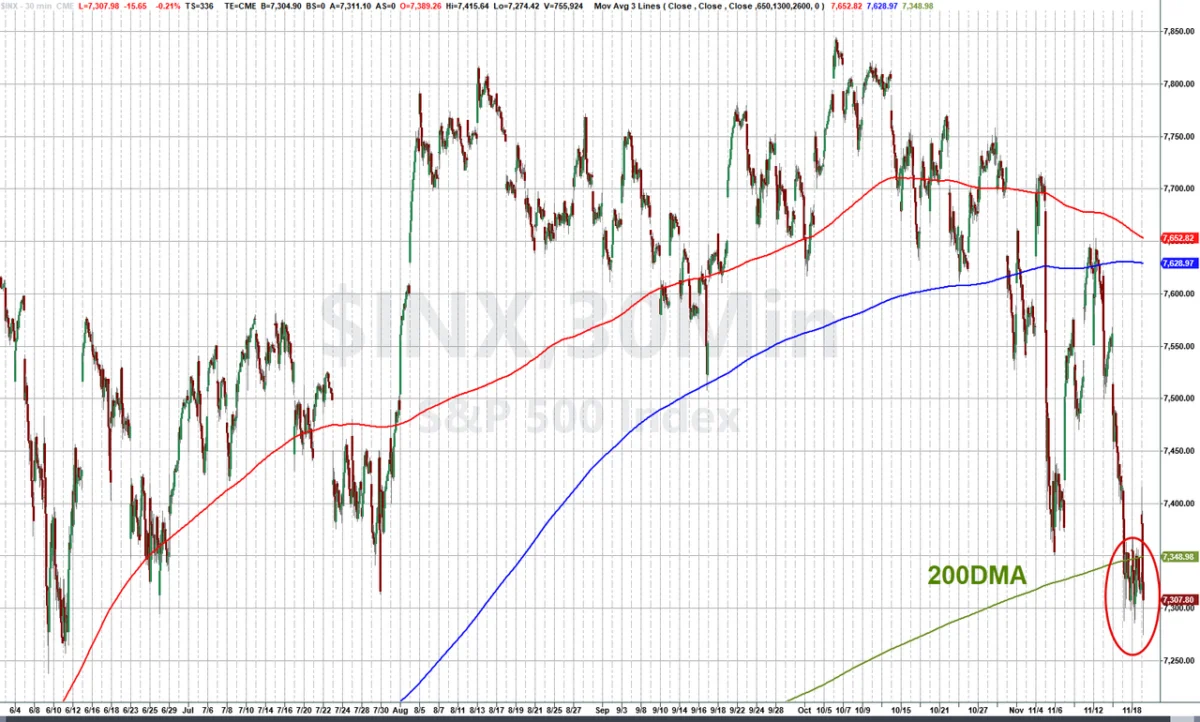
The initial surge in U.S. stock markets, buoyed by the highly anticipated initial public offering (IPO) of AI giant Anthropic, quickly evaporated today, leading to a significant downturn across major indices. While Anthropic’s indicative price soared to approximately $105, considerably above its $83 IPO price, the broader market failed to sustain early gains. By mid-morning (1045 ET), the S&P 500 (SPX) had tumbled, breaching its critical 200-day moving average (200DMA) and signaling a potential shift in market sentiment. This reversal comes despite what some market strategists had hoped would be a pivotal moment for a rebound in the technology sector, heavily underweight by hedge funds in recent months.
A Tepid Tech Rebound Fails to Materialize
The market’s performance today was a stark contrast to the optimistic pre-market indicators, particularly in the tech-heavy Nasdaq futures, which had shown gains of nearly 2%. This optimism was largely fueled by the robust pricing of Anthropic’s IPO, an event of historic proportions. Anthropic, a prominent artificial intelligence firm, priced its shares at $83, exceeding the marketed range of $70-$78, and upsized its offering to 980 million shares from an initial 825 million. This colossal offering generated $81.3 billion from the IPO alone, escalating to $107.3 billion when including a substantial $26 billion vendor placement. This figure dwarfs previous records, surpassing SpaceX’s $75 billion valuation in June and exceeding the combined value of IPOs from SK Hynix, Aramco, Alibaba, and SoftBank.
However, the enthusiasm proved fleeting. As the U.S. cash market opened, the early stock squeeze rapidly faded. The broader U.S. Majors, including the S&P 500, began a swift descent, ultimately breaking below the psychologically and technically significant 200DMA. This technical breach is often interpreted by analysts as a bearish signal, suggesting that the long-term trend for the index may be shifting downwards.
Goldman Sachs Insights: Hedge Funds Deeply Underweight Tech
Against this backdrop of market volatility, insights from Goldman Sachs’ Prime brokerage division illuminate the underlying positioning of institutional investors. According to Rich Privorotsky, Goldman’s head of EMEA Delta One trading, hedge funds have significantly reduced their exposure to the technology sector. The hedge fund book’s net weight in tech has plummeted to roughly 18%, a stark contrast to the sector’s 29% weight in benchmark indices. This represents an 11-point underweight, mirroring the deepest levels observed in the past five years. This extreme positioning marks a dramatic reversal from a period around mid-2023, when professional investors were briefly overweight the sector.
In a recent market note, Privorotsky highlighted the precarious market conditions, noting that "Today feels important. SPX precariously holding its 200d, street gamma positioning is meant to be very short but vol was soggy yesterday for the first time in a while (particularly post VIX expiry). With VIX in the mid 20s and Thanksgiving next week, there is a meaningful potential tailwind if the market can simply stabilize." This assessment suggested that the aggressive selling in tech had reached such an extent that even a period of stability, rather than further decline, could be sufficient to trigger a short squeeze. The initial pop in Nasdaq futures and Anthropic’s strong indicative pricing appeared to validate this theory, at least temporarily.
The underlying rationale from Goldman’s prime brokerage analytics team underscores this point: "two months of aggressive selling have left valuations depressed across global semis. Doesn’t take much good news to squeeze, and although the BIS implications may not be fully digested in parts of Asia supply chain, if they can be compartmentalized that’s encouraging." This implies that the potential for a rebound, or at least a stabilization, was significant due to the stretched positioning.
Global Headwinds: US Chip Curbs and Asian Market Pressure
Despite the domestic market’s initial optimism surrounding Anthropic, global factors presented significant headwinds. Privorotsky observed that while America had "absorbed plenty of bad news yesterday," Asia was "struggling." This struggle was particularly evident in Goldman’s basket of TSMC-exposed stocks, which saw an 8% decline, and broader pressure on Asian data center names.
The primary culprit for this regional weakness was the U.S. Commerce Department’s new Bureau of Industry and Security (BIS) rule. This regulation mandates licenses for advanced chip shipments to several Southeast Asian nations, including Indonesia, Malaysia, Singapore, Thailand, and Brazil. Crucially, it also requires licenses for any data center globally that sells more than 12 million TPP (tera operations per second) of compute power to China-parented customers. Existing offshore operators are granted a 90-day grace period to secure a license or cease operations.
The implications of these BIS rules are profound. As Privorotsky articulated, they signal "delayed projects, displaced demand and excess infrastructure capacity. Hard to quantify, but clearly was not fully priced in Asia." Essentially, the booming data center industry in regions like Johor and Singapore, which had thrived in part by providing GPU compute services to Chinese customers unable to procure chips directly, has now lost its most significant client base. The immediate fallout was already observed with a frozen $480 million loan linked to China’s ByteDance, widely seen as a "first domino" in the tightening U.S. AI chip crackdown.
The Enigma of the Bond Market: Resilience Amid Hawkish Signals

Adding another layer of complexity to the market narrative was the unexpected resilience of the bond market. Wednesday saw a barrage of hawkish signals, including Federal Reserve Governor Christopher Waller’s reiteration of a potential 50 basis point interest rate hike, and the release of Federal Open Market Committee (FOMC) minutes indicating that "almost all" members foresaw the need for further rate increases. European Central Bank (ECB) regulatory noise further contributed to a potentially negative environment for bonds.
Yet, contrary to expectations, bonds rallied. The back end of the yield curve was well bid, leading to a bull flattening, while the front end remained largely unchanged. This counterintuitive response suggested that the market was increasingly pricing in weaker economic growth, potentially doing the Fed’s work for it.
A particularly striking indicator came from Australia, where a "big jobs miss" underscored the growing economic fragility. The Australian Bureau of Statistics reported a loss of 43,500 jobs in October, significantly worse than the anticipated gain of 25,000, and following a loss of 39,300 jobs in September. This pushed the unemployment rate to 4.9%, its highest level since 2021. Two consecutive months of job losses, occurring after a series of rate hikes by the Reserve Bank of Australia (RBA), strongly suggested that the "soft landing" scenario Down Under was not materializing and that the hiking cycle might be nearing its end.
Privorotsky drew parallels to the end of 2018, noting, "Market is increasingly pricing weaker growth as capex expectations come down, commodities roll over and inflationary pressures appear to be fading. Feels like a lot of parallels to end of 2018. Same late cycle slowdown, very different policy implications." This assessment implies that rates are finally aligning with the slowdown that equities have been signaling for weeks, a significant shift from earlier periods where equities priced a slowdown while rates priced inflation.
Commodities Signal Disinflation: The Unraveling of the Reflation Trade
The commodity sector provided some of the most compelling evidence of a broad disinflationary impulse, effectively writing an obituary for the reflation trade. A strong U.S. dollar, elevated real interest rates, and attractive credit yields were cited as factors diverting capital away from traditional safe havens like gold and other precious metals.
Privorotsky characterized the current economic environment not as a "savings glut" but as a "spending glut," a less supportive backdrop for precious metals and inflated asset multiples, particularly with the Fed actively tightening monetary policy. China’s economic struggles—marked by weak growth, Shanghai equities trading near their lows, and limited signs of recovery—compounded these pressures, with potential restrictions on AI and data center investment adding further headwinds.

Copper, often viewed as a bellwether for global economic health and a proxy for the reflation theme, demonstrated this trend acutely. LME copper prices plunged 5% on Wednesday, reaching their lowest levels since early April. This decline was attributed to significant market movements, including renowned investor Stanley Druckenmiller reportedly being short, Commodity Trading Advisors (CTAs) actively dumping positions, with only actual copper users showing buying interest. While acknowledging "nuances around physical inventories, regional premiums and Chinese stockpiling," Privorotsky’s conclusion was unequivocal: "Precious and industrial metals, grains, gasoline and diesel all under pressure. A broad disinflationary impulse that could materially change the rates narrative."
Gold, traditionally a safe-haven asset, also experienced significant pressure, crashing below $3,800 on Wednesday and seeing liquidation alongside cryptocurrencies as the dollar and bonds caught a bid. This broad unwinding across the debasement trade (gold, crypto), the AI trade (tech stocks), and the China trade, all occurring within the same week, pointed to a significant shift in market liquidity and investor priorities.
Anthropic’s Record IPO: A Liquidity Drain and Its Aftermath
The massive scale of Anthropic’s IPO played a crucial role in shaping market dynamics. With the deal priced at $83 and upsized to 980 million shares, the total capital raised was unprecedented. The $81.3 billion from the IPO, combined with the $26 billion vendor placement, created a record-setting $107.3 billion valuation, significantly larger than any prior IPO. This colossal capital raise was widely anticipated to impact market liquidity.
Market chatter throughout the week preceding the IPO suggested that much of the liquidation seen in assets like gold, crypto, copper, and even some Nvidia shares, was directly related to institutional investors raising cash for allocations into Anthropic. This confirms Privorotsky’s observation that the "heavy tech selling" and the record IPO were effectively "two sides of the same trade"—a massive reallocation of capital.
The immediate post-IPO outlook for Anthropic itself appeared bullish. The offering was reportedly six times oversubscribed, with up to 20% of the deal allocated to retail investors. Vanda Research projected approximately $250 million of net retail buying on day one. Pre-IPO perpetual contracts on platforms like Hyperliquid traded near $99, about 19% above the offer price, suggesting strong initial demand. Chipmaker Broadcom (AVGO), an Anthropic partner, saw a 2.8% gain in pre-market trading, reflecting optimism surrounding the AI sector.
However, questions linger regarding Anthropic’s long-term valuation and sustainability. At $83 per share, buyers are paying approximately 18 times an estimated $81 billion run rate, fully diluted. This valuation comes despite a reported halving of the company’s Q3 growth. Furthermore, the company carries nearly $900 billion of committed spend, primarily on compute resources. A notable aspect is that $26 billion of Anthropic’s own stock is held by the vendors who supply this compute power, raising questions about the arms-length nature of price discovery when suppliers also hold significant equity. The initial market reaction to the high pricing, as reflected in social media commentary, suggested skepticism about the stock’s ability to maintain its initial gains, with some predicting a swift decline post-IPO.

Navigating the 200-Day Moving Average: A Pivotal Market Juncture
The S&P 500’s breach of the 200-day moving average is a significant technical development. The index had entered the week with dealers reportedly holding the most short gamma positions since 2019, exacerbating potential volatility. The drop below this long-term moving average, a level not seen since earlier in the year, signals heightened caution among market participants.
Despite the immediate market turmoil, Privorotsky’s closing argument in his note presented a cautiously optimistic perspective, arguably his most bullish in weeks: "I get the issues in AI… there are a myriad of them. But an awful lot is now reflected in price. If rates can play ball, there is a very real and legitimate bull case for equities. In hindsight the whole market changed when the Fed changed its posture… and it may well end the same way." This suggests that much of the negative news and risks associated with the AI sector may already be priced into current valuations, paving the way for a potential rebound if monetary policy provides a more supportive environment.
The analogy to 2018 is particularly relevant here. That period also featured a late-cycle slowdown that ultimately led to a nearly 20% market crash by Christmas Eve before the Federal Reserve, under Chairman Jerome Powell, pivoted its policy stance. While the current market dynamics share similarities with that late-cycle slowdown, a crucial distinction exists: the emergence of a substantial "AI debt bubble," a factor entirely absent in 2018. This massive accumulation of debt related to AI infrastructure and development could introduce new and unprecedented risks if the market downturn were to deepen.
In conclusion, the current market juncture is marked by a complex interplay of factors: the fading enthusiasm from a record-breaking IPO, significant institutional underweighting in the tech sector, escalating geopolitical tensions impacting global supply chains, and a bond market that appears to be pricing in a disinflationary slowdown. While the technical setup and investor positioning might hint at the potential for a short-term squeeze, the broader economic landscape, coupled with the unique risks posed by the burgeoning AI debt, underscores the fragility of the current market environment. Stability may beget stability, but the path forward remains fraught with challenges, particularly once the initial post-IPO lockup periods expire, potentially unleashing further selling pressure.

