

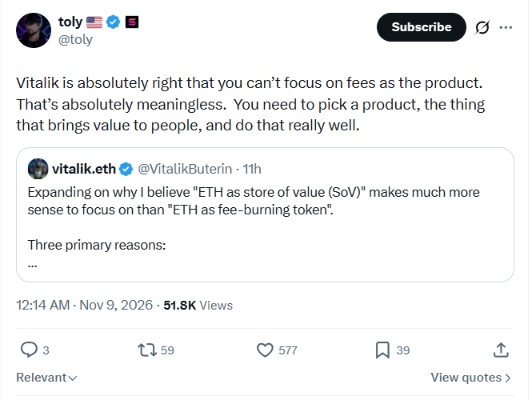
Ethereum co-founder Vitalik Buterin has proposed a strategic reorientation for the network, advocating for Ether (ETH) to be primarily recognized and promoted as a store of value (SoV) rather than an asset whose value is intrinsically tied to the burning of transaction fees. This perspective shift, articulated in a recent online thread, challenges the prevailing narrative that has gained traction, particularly following the EIP-1559 upgrade. Buterin’s argument centers on the belief that an overemphasis on fee burning could compromise Ethereum’s core tenets of decentralization and resistance to censorship and capture.
The discourse around Ethereum’s value proposition has evolved significantly since the implementation of EIP-1559 in August 2021. This upgrade introduced a mechanism that burns a portion of transaction fees, aiming to make ETH a deflationary asset, especially during periods of high network activity. This led to the popularization of the "ultrasound money" narrative, championed by various community members and media outlets, including the Bankless podcast. The concept suggested that by reducing the total supply of ETH, its scarcity would drive up its value, akin to a digital gold.
However, the sustainability of this narrative has been questioned as network usage patterns and fee structures have shifted. Data indicates a notable decline in median transaction fees. From January to October of the current year, the median transaction fee on Ethereum reportedly fell from $0.35 to $0.035, despite an increase in daily transactions exceeding 50%. This decrease in fees directly impacts the amount of ETH burned, consequently diminishing the deflationary pressure and weakening the "ultrasound money" argument.
Buterin’s proposed alternative frames Ethereum’s value through the lens of "decentralization and CROPS," an acronym representing Censorship and Capture Resistance, Open Source, Privacy, and Security. He posits that these fundamental attributes will become increasingly valuable in an era marked by rapid technological advancements, particularly artificial intelligence (AI). The stability and inherent trust derived from these characteristics, he argues, offer a more robust and enduring foundation for ETH’s valuation as a store of value. This vision aligns ETH more closely with the perceived long-term stability and security sought by investors looking for digital assets that can withstand economic and technological volatility.

The implications of this strategic pivot are significant. By emphasizing decentralization and security, Buterin is steering Ethereum towards a narrative that resonates with traditional notions of value preservation, similar to gold. This approach seeks to de-emphasize short-term transactional utility and fee dynamics in favor of long-term asset holding and network integrity. The "CROPS" framework suggests a commitment to building a resilient and trustworthy digital infrastructure, which could attract a different class of investors and users who prioritize stability and security over speculative trading opportunities driven by fee mechanics.
Reactions to Buterin’s stance have been varied, reflecting the diverse perspectives within the cryptocurrency community. Some Bitcoin proponents, who staunchly uphold Bitcoin’s status as the preeminent store of value, have expressed skepticism. Dan Held, founder of Held Media, criticized Buterin’s comments, interpreting them as an attempt by Ethereum to adopt Bitcoin’s store-of-value narrative after its previous propositions have faltered. Held questioned the feasibility of a protocol with a "constantly changing monetary policy," drawing a parallel to fiat currencies, as a sound money asset. However, supporters of Ethereum have countered this by pointing out that the network’s monetary policy has remained consistent since The Merge in 2022, and that past changes have consistently led to reduced ETH issuance rather than increased inflation.
Within the Ethereum ecosystem, Buterin’s articulation of a clear narrative direction has been largely welcomed. Gabriel Shapiro, an attorney at MetaLeX, described the development as a "nature is healing moment" and expressed confidence in Ethereum’s potential to serve as a superior store of value compared to both Zcash (ZEC) and Bitcoin (BTC), based on fundamental strengths. Even Anatoly Yakovenko, co-founder of Solana, acknowledged the validity of Buterin’s point that focusing solely on fees as the primary product is unsustainable, although he offered a subtle critique of Ethereum’s current "product" offering.
The broader implications of this debate extend to how digital assets are perceived and valued by the global financial market. If Ethereum successfully positions itself as a robust store of value based on its decentralization and security principles, it could attract significant institutional investment and further solidify its position as a foundational asset in the digital economy. This shift could also influence the development trajectory of the Ethereum network, prioritizing upgrades and features that enhance its CROPS characteristics.
The Evolving Narrative of Ethereum’s Value
The initial post-EIP-1559 enthusiasm surrounding Ethereum’s potential deflationary nature was fueled by a period of exceptionally high gas fees. This led to widespread adoption of the "ultrasound money" meme, symbolizing a digital asset that inherently appreciates due to supply reduction. The logic was straightforward: as more ETH is burned through transaction fees, the total supply shrinks, creating scarcity and, theoretically, driving up the price. This narrative was particularly appealing to long-term holders and investors seeking an asset with a predictable and deflationary supply schedule, akin to digital gold.
However, the reality of network usage has proven more nuanced. The development of Layer 2 scaling solutions, such as Optimistic Rollups and ZK-Rollups, has significantly reduced the demand for block space on the Ethereum mainnet. As more transactions are processed off-chain or on these scaled layers, the volume of transactions directly incurring high fees on the Ethereum mainnet has decreased. This reduction in fee revenue has directly impacted the amount of ETH burned, consequently lessening the deflationary pressure. For instance, the average transaction fee on Ethereum, a key metric for fee burning, has seen a dramatic decline, as previously noted, from $0.35 in January to $0.035 by October of the current year. This trend challenges the notion that fee burning alone can sustain ETH’s value proposition.
Buterin’s intervention aims to provide a more stable and less volatile foundation for ETH’s value. By emphasizing "decentralization and CROPS" – Censorship and Capture Resistance, Open Source, Privacy, and Security – he is highlighting the intrinsic qualities of the Ethereum protocol itself. This framework suggests that the true value of Ethereum lies not in its transactional throughput or fee-burning mechanisms, but in its robust infrastructure as a censorship-resistant, open, and secure platform. In an era increasingly defined by data privacy concerns and the potential for centralized control in emerging technologies like AI, these attributes become paramount.
The "CROPS" Framework: A New Foundation for Value
The "CROPS" framework represents a comprehensive approach to defining Ethereum’s long-term value proposition. Let’s break down each component:
- Censorship and Capture Resistance: This is arguably the most critical aspect of decentralized networks. Ethereum’s distributed nature, with thousands of nodes operating globally, makes it exceptionally difficult for any single entity or government to censor transactions or capture control of the network. This resilience is a significant draw for individuals and organizations seeking to operate outside of traditional, potentially restrictive financial systems.
- Open Source: The open-source nature of Ethereum’s code means it is transparent, auditable, and community-driven. This fosters trust and allows for continuous innovation and improvement by a global developer community. It also reduces the risk of hidden backdoors or vulnerabilities.
- Privacy: While Ethereum transactions are pseudonymous, ongoing developments in privacy-enhancing technologies, such as Zero-Knowledge proofs, aim to further bolster privacy on the network. This is becoming increasingly important as awareness of data surveillance and the need for digital privacy grows.
- Security: Ethereum’s Proof-of-Stake (PoS) consensus mechanism, secured by a vast amount of staked ETH, provides a robust defense against attacks. The ongoing research and development into post-quantum cryptography also signal a proactive approach to future security threats.
Buterin’s argument is that these fundamental characteristics will be increasingly valued in a future where AI and other emerging technologies could lead to greater centralization and potential for misuse of power. By investing in and upholding these principles, Ethereum can position itself as a safe haven and a foundational layer for the future digital economy.
Contrasting Views and Community Reactions
The debate over ETH’s valuation narrative has ignited discussions across the cryptocurrency landscape. Bitcoin maximalists, who often view Bitcoin as the undisputed benchmark for digital gold and a store of value, have been particularly vocal. Dan Held’s critique, suggesting Ethereum is merely pivoting to Bitcoin’s narrative after its own has failed, highlights a long-standing rivalry and differing philosophies on the purpose of blockchain technology. The assertion that a "constantly changing monetary policy" disqualifies ETH as sound money overlooks the fact that Ethereum’s monetary policy has become more predictable since The Merge, with a focus on reducing issuance rather than increasing it.

Conversely, within the Ethereum community, Buterin’s guidance has been largely embraced as a clarifying and strategic move. Figures like Gabriel Shapiro see it as a return to core principles, suggesting that Ethereum’s fundamental strengths make it a superior store of value compared to both Bitcoin and other privacy-focused cryptocurrencies like Zcash. The endorsement from Anatoly Yakovenko, a prominent figure in a competing blockchain ecosystem, lends further weight to the idea that focusing on core network attributes over short-term transactional incentives is a more sustainable strategy.
Broader Market Implications and Regulatory Landscape
The shift in Ethereum’s narrative also has implications for the broader cryptocurrency market and its interaction with regulators. If ETH is increasingly viewed as a stable store of value, it could attract more institutional capital seeking uncorrelated assets with long-term growth potential. This could lead to greater adoption and integration of Ethereum into traditional financial products and services.
The political landscape surrounding cryptocurrency regulation remains dynamic. The recent US midterm elections, despite significant spending by crypto-focused super PACs, have resulted in a Congress with a mix of pro- and anti-crypto sentiment. While a majority of legislators may hold favorable views, influential figures poised to chair key committees, such as Senator Elizabeth Warren on the Banking Committee, are expected to drive increased scrutiny. This heightened regulatory attention underscores the importance of robust security, transparency, and ethical practices across the industry. The debate over Ethereum’s value proposition, emphasizing security and decentralization, could potentially align with regulatory interests in fostering a stable and trustworthy digital asset ecosystem.
Security Incidents and Network Development
Recent events have also highlighted the critical importance of robust security measures within the crypto space. The sophisticated $6.34 billion hack of Binance, orchestrated by North Korean hackers through a multi-stage social engineering attack involving fake job interviews and compromised AI tools, serves as a stark reminder of the evolving threat landscape. This incident, which spanned several months, demonstrates the lengths to which malicious actors will go to compromise exchanges and steal digital assets. Binance co-CEO Richard Teng emphasized that this was not a single breach but a prolonged campaign, underscoring the need for continuous vigilance and advanced threat detection capabilities.
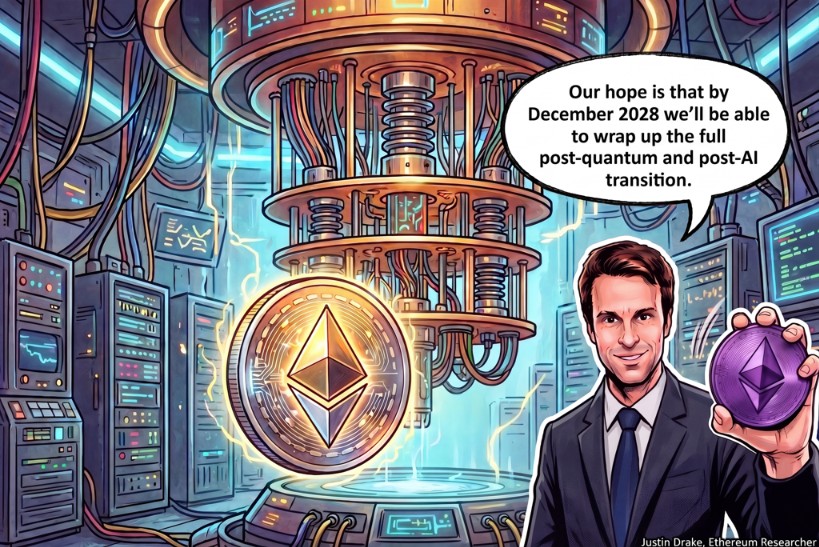
In parallel, the Ethereum Foundation is actively working on future-proofing the network against emerging technological threats. Researcher Justin Drake has proposed accelerating the timeline for achieving post-quantum and post-AI resistance on Ethereum, targeting December 2028, a year earlier than the previously planned deadline. This ambitious goal requires the successful implementation of three additional network upgrades within a tight timeframe. However, the roadmap faces challenges, with the indefinite delay of the Glamsterdam upgrade due to unresolved security concerns related to smart contract invariants. This highlights the ongoing complexities and trade-offs involved in developing a cutting-edge blockchain network.

Decentralized Protocols and Regulatory Challenges
The resilience of decentralized protocols is being tested in real-time. THORChain’s decision to restart trading operations despite explicit FBI warnings against processing funds from the Binance hack underscores the inherent nature of permissionless networks. By continuing to operate, THORChain’s co-founder JPThor argued that the protocol’s ability to ignore external directives validates its decentralization. The protocol has reportedly processed over $46 million from the hack within its first 72 hours, generating significant fees. This event raises complex questions about the intersection of decentralized finance, law enforcement, and the traceability of illicit funds in the digital realm.
Market Performance and Key Industry Developments
The broader cryptocurrency market has experienced fluctuations. Bitcoin (BTC) saw a decline of 4.5% to trade around $74,302, while Ethereum (ETH) dipped 6.3% to $2,117, and XRP (XRP) fell 5% to $1.11. The total market capitalization stood at approximately $2.49 trillion. Among the top 100 cryptocurrencies, Pieverse (PIEVERSE) emerged as a top performer with a 39.2% gain, followed by Injective (INJ) at 11.1% and Tether Gold (XAUt) at 4.2%. Conversely, the OFFICIAL TRUMP token registered a significant loss of 32.8%, with Worldcoin (WLD) down 20.8% and Ethena (ENA) down 19%.
Grayscale’s head of research, Zach Pandl, suggested that while the Binance hack might cause temporary confidence issues, it could ultimately lead to improved security practices across exchanges and highlight the importance of institutional custody solutions. Meanwhile, Binance France announced the closure of its user accounts by December 31st, with assets left on the platform incurring monthly fees starting November 29th, signaling further regulatory pressures and operational adjustments for major exchanges in key markets.
In a concerning development, Gnosis Pay, a provider of crypto-linked Visa debit cards, disclosed a security breach that exposed customer payment card details, home addresses, and cryptocurrency wallet addresses. While the company stated that customer funds and its enterprise platform remained unaffected, this incident underscores the persistent vulnerabilities in consumer-facing crypto services.
The week also saw suspicious activity on prediction markets preceding the release of New York Times/Siena political polls, raising questions about potential insider trading or advanced market insight. Researchers noted significant bets placed shortly before poll results were made public, with one user reportedly winning over $77,000 from a nearly $200,000 bet on Senator Pete Ricketts’ re-election.
These developments, from strategic narrative shifts to security breaches and regulatory hurdles, paint a complex and evolving picture of the cryptocurrency industry. The focus on Ethereum’s potential as a store of value, underpinned by its core decentralized principles, represents a significant philosophical and strategic direction that could shape its future trajectory and broader market perception.

