
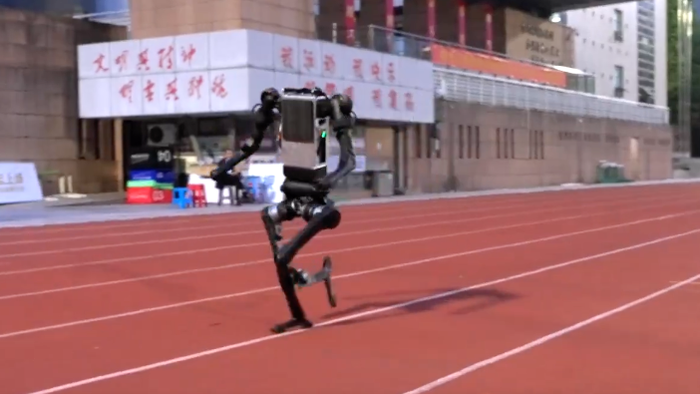
Chinese robotics firm Unitree has announced a significant breakthrough in humanoid robot locomotion, with its H1 model achieving an unprecedented sprint speed of 10 meters per second (approximately 22.4 miles per hour). This remarkable feat, detailed in a recent video posted by the company, positions Unitree at the forefront of the race for physically capable bipedal robots, a domain previously dominated by advancements in artificial intelligence and cognitive functions. The achievement marks a pivotal moment, narrowing the gap between human and robotic physical performance and raising profound questions about the future applications and societal implications of advanced humanoid technology.
A New Benchmark in Robotic Locomotion
The announcement, made by Unitree on its official X (formerly Twitter) account on April 11, 2026, showcased the H1 robot in full sprint, accompanied by the bold declaration, "Unitree Breaks the World Record Again." The company emphasized that the robot possesses the "physique of an ordinary person," yet runs "at a world champion’s speed." Specific details provided with the announcement highlighted the H1’s physical attributes: a leg length of 0.8 meters (0.4m upper leg + 0.4m lower leg) and a body weight of approximately 62 kilograms. These specifications underscore the engineering prowess required to achieve such agility and speed with a human-like form factor.
To contextualize this achievement, the fastest human sprint speed ever recorded belongs to Jamaican Olympian Usain Bolt, who reached a peak speed of 27.8 mph (approximately 12.42 meters per second) during his 100-meter world record run at the 2009 World Championships in Athletics. While the H1’s 22.4 mph still trails Bolt’s absolute peak, it places the robot in an elite category, surpassing the average sprint speed of many professional human athletes and certainly exceeding the capabilities of most non-elite runners. For instance, an average fit human might sustain a sprint speed of around 15-18 mph for short bursts, making the H1’s sustained 22.4 mph a significant engineering marvel. The ability of a bipedal machine to maintain balance, generate sufficient power, and execute complex gait cycles at such velocities represents a monumental leap in robotics.
Unitree Robotics: A Contender in the Global Race
Unitree Robotics, based in Hangzhou, China, has steadily emerged as a prominent player in the global robotics landscape. Known initially for its agile quadruped robots, such as the Go1 and B2 series, the company has consistently pushed the boundaries of robotic mobility and cost-effectiveness. Their transition into humanoid robotics with the H1 model signifies an ambitious expansion, leveraging their expertise in motor control, power systems, and real-time balance algorithms developed over years of work with four-legged platforms.
The "race" for bipedal humanoid robot intelligence has garnered significant media attention in recent years. Major players like Boston Dynamics with its Atlas robot, Agility Robotics with Digit, Tesla with Optimus, and Figure AI, among others, have demonstrated increasingly sophisticated capabilities, particularly in navigating complex environments and performing intricate manipulation tasks. These robots are receiving advanced "AI brains," enabling them to learn, adapt, and operate autonomously, qualities that have already seen them deployed on factory floors and are expected to make them more visible in public spaces in the coming years. Investment bank UBS, for instance, has closely tracked the deployment of humanoid robots in manufacturing, projecting a rapid acceleration in their integration into industrial operations.
Unitree’s H1, while still under active development, appears to be carving out a niche focusing on raw physical performance, particularly speed and dynamic motion. This emphasis complements the cognitive advancements seen elsewhere, suggesting a future where humanoid robots will not only think and learn but also move with unparalleled athleticism.
The Engineering Behind the Speed
Achieving bipedal locomotion at high speeds presents a myriad of engineering challenges. Unlike wheeled robots, bipedal humanoids must constantly maintain dynamic balance, shifting their center of gravity with each step to avoid falling. This requires sophisticated sensor fusion, real-time feedback loops, and powerful actuators capable of rapid and precise movements. The H1’s ability to sprint at 10 m/s implies:
- Advanced Actuators and Motors: High-torque, high-speed motors in the joints, particularly in the hips, knees, and ankles, are essential for generating the necessary force and rapid articulation. These motors must be compact and efficient to keep the robot’s weight manageable.
- Lightweight and Durable Materials: The stated body weight of 62kg for a robot of its size suggests the use of advanced lightweight materials, likely composites or high-strength alloys, to maximize power-to-weight ratio and reduce inertia.
- Sophisticated Control Algorithms: The core of any agile robot is its control system. Unitree’s achievement points to highly advanced algorithms for gait generation, balance control, and trajectory planning, allowing the H1 to adapt to dynamic forces and maintain stability at high velocities. This likely involves reinforcement learning or model predictive control techniques.
- Efficient Power Systems: Sustaining high-speed movement demands significant power. The H1 must be equipped with a robust battery system and efficient power management to deliver the necessary energy for sprints.
The leg length of 0.8 meters (split into 0.4m segments) is comparable to that of an average human, suggesting that Unitree is designing the H1 with biomechanical principles in mind, seeking to emulate human efficiency in movement.
Implications Across Industries and Society
The acceleration of humanoid robot capabilities, particularly the combination of increasing intelligence with impressive physical prowess, carries profound implications across various sectors:
- Manufacturing and Logistics: Robots like the H1, if equipped with advanced manipulation skills, could revolutionize factory floors and warehouses. Their speed could significantly enhance throughput in tasks requiring rapid movement between workstations or efficient retrieval of items. Imagine a robot quickly navigating a large distribution center to pick and pack orders, or moving swiftly across an assembly line. This aligns with projections from firms like UBS, which foresee widespread adoption of humanoid robots in industrial settings.
- Search and Rescue Operations: The ability to traverse difficult terrain at high speeds could make humanoid robots invaluable in disaster zones. They could quickly reach victims in hazardous environments where human rescuers face immense risks, carrying supplies or even evacuating individuals.
- Healthcare and Elder Care: While speed isn’t the primary requirement here, the underlying mobility technology could lead to robots capable of assisting patients with ambulation, performing quick errands within medical facilities, or responding rapidly to emergencies.
- Security and Surveillance: A robot capable of patrolling large areas at 22.4 mph could transform security operations, covering ground much faster than human guards and responding to incidents with unprecedented speed.
- Defense and Military Applications: The original article subtly hints at the potential for humanoid robots on the battlefield. A robot combining advanced AI with the ability to move at high speeds could be deployed for reconnaissance, logistics in dangerous zones, or even as autonomous combat units. This "dual-use" nature of robotics technology, where advancements for civilian purposes can also be adapted for military use, is a significant area of ethical and geopolitical concern. The prospect of robots that could "chase down a human" is no longer confined to science fiction but is becoming a tangible engineering reality, necessitating urgent discussions on international regulations and ethical guidelines.
Ethical and Societal Considerations
The rapid advancement of humanoid robots, especially in areas like speed and agility, raises several critical ethical and societal questions:
- Job Displacement: As robots become more capable across a wider range of physical and cognitive tasks, concerns about their impact on human employment will intensify. While proponents argue that robots will create new jobs and augment human capabilities, the speed and efficiency of models like the H1 could lead to significant automation in physically demanding roles.
- Safety and Regulation: Fast-moving, powerful robots operating in public spaces or alongside humans present new safety challenges. Robust regulatory frameworks, testing standards, and fail-safe mechanisms will be crucial to prevent accidents and ensure responsible deployment.
- Autonomous Decision-Making: When combining speed with advanced AI, the question of autonomous decision-making, particularly in high-stakes situations, becomes paramount. Establishing clear ethical guidelines for how these robots interact with humans and make choices is essential.
- The "Humanoid" Factor: The human-like form factor of these robots, combined with their increasing capabilities, blurs the lines between human and machine. This could lead to complex psychological and social reactions, from fascination to fear, as society grapples with the presence of increasingly capable artificial entities.
- Military Ethics: The most profound ethical dilemma surrounds military applications. The development of autonomous weapons systems (AWS) featuring humanoid forms and high mobility raises fears of an arms race, reduced human accountability in warfare, and potentially indiscriminate harm. The global community is already engaged in debates about banning or regulating such systems.
The Road Ahead
Unitree’s H1 speed record is not merely an isolated technical achievement; it is a powerful indicator of the trajectory of robotics development. The confluence of advanced AI, sophisticated mechanics, and a relentless pursuit of human-level (or superhuman) physical capabilities is propelling humanoid robots from experimental prototypes to practical, versatile machines.
The next phases of development will likely focus on refining the H1’s endurance, integrating more advanced manipulation capabilities, and enhancing its onboard intelligence to navigate dynamic, unstructured environments more effectively. Furthermore, reducing the cost of these complex machines will be crucial for widespread adoption.
As the world races towards a future populated by increasingly intelligent and physically capable robots, the imperative for proactive governance, ethical frameworks, and public discourse becomes more urgent than ever. Unitree’s latest record serves as a vivid reminder that the future of human-robot interaction is not a distant concept but an unfolding reality, challenging us to consider both the immense potential and the profound responsibilities that come with creating machines that can run at a champion’s speed. The question is no longer if robots will integrate into every facet of our lives, but how we will ensure this integration benefits humanity as a whole, rather than exacerbating existing challenges.

