
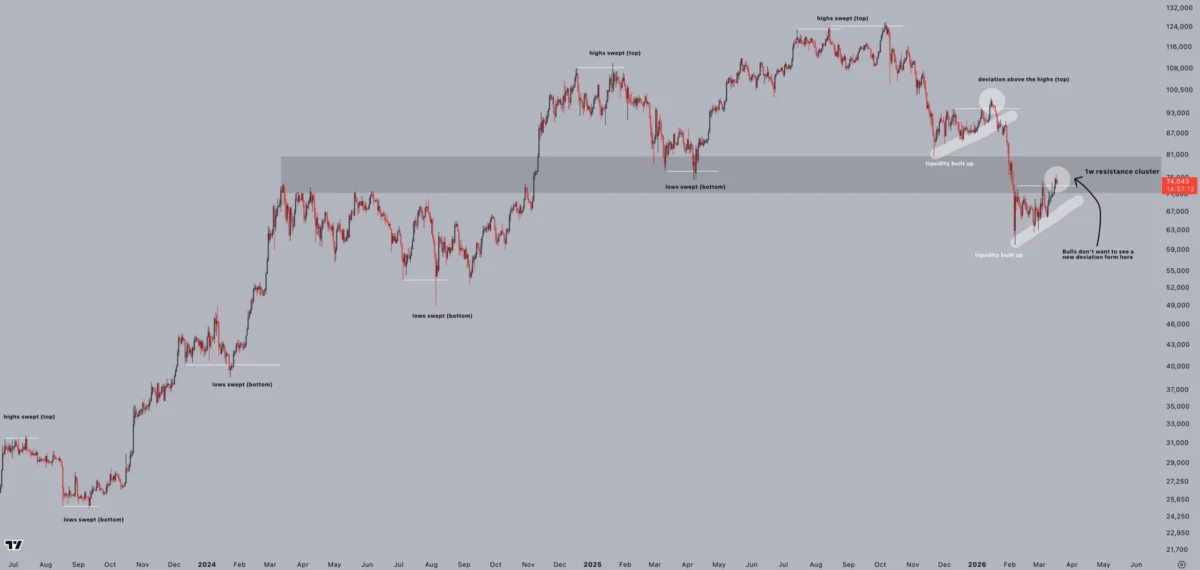
Bitcoin (BTC) experienced a significant downturn, shedding 2.5% in value around the Wednesday Wall Street open, as a fresh surge in US inflation figures unsettled global financial markets. The digital asset’s price action, which had been hovering near the $72,000 mark, faced renewed downward pressure following the release of the February Producer Price Index (PPI), a key indicator of wholesale inflation. This economic data point, exceeding market expectations, has cast a shadow over anticipated Federal Reserve monetary policy, potentially making interest rate environments less conducive for risk assets like cryptocurrencies.
The February Producer Price Index (PPI) report, released by the U.S. Bureau of Labor Statistics (BLS), revealed a more persistent inflationary trend than economists had forecast. The index for final demand rose by 0.7% on a month-on-month basis, a notable acceleration from previous months and significantly higher than the anticipated 0.3%. On an annual basis, the PPI climbed by 3.4% year-on-year, also surpassing the projected 3% and marking the largest 12-month advance since February 2025, when it also registered a 3.4% increase. This sustained uptick in producer prices signals that inflationary pressures may not be receding as quickly as hoped, potentially impacting consumer prices down the line.
The timing of the PPI release was particularly significant, occurring mere hours before the Federal Reserve’s Federal Open Market Committee (FOMC) was scheduled to announce its latest decision on interest rates. While market participants had largely priced in a scenario where the Fed would neither raise nor cut rates at this particular meeting, the implications of the inflation data on the central bank’s future policy trajectory and forward guidance remained a critical point of concern. Any hints of a more hawkish stance from the Fed, or a delayed timeline for potential rate cuts, could have a direct and pronounced effect on the valuation of risk assets.

Macroeconomic Factors Dominate Market Sentiment
The prevailing sentiment across financial markets, particularly for cryptocurrencies, has been heavily influenced by macroeconomic trends and the anticipated actions of major central banks. QCP Capital, a prominent trading firm, highlighted in its recent "Market Color" analysis that the current week represents a pivotal moment for central bank policy decisions. The firm noted that markets have significantly recalibrated their expectations for monetary easing in response to elevated oil prices, which are complicating the disinflationary process, even amidst softening growth and labor market data.
"For crypto, the implication is straightforward: the rates backdrop is becoming less supportive, not more," QCP Capital stated in its analysis. This sentiment underscores a fundamental principle in asset valuation: lower interest rates generally translate to increased liquidity and a more favorable environment for risk assets, including Bitcoin and other cryptocurrencies. Conversely, a persistently high-interest-rate environment, or a central bank signaling a hawkish stance, tends to exert downward pressure on these asset classes. The recent inflation data suggests that the path to lower interest rates might be longer and more arduous than previously anticipated.
The FOMC meeting, and specifically the accompanying statement and press conference led by Federal Reserve Chair Jerome Powell, were closely watched for any shifts in tone or emphasis. While a rate change was improbable, the market’s interpretation of Powell’s remarks could significantly influence short-term market movements. Investors and analysts would be scrutinizing the Fed’s assessment of the current economic landscape, its outlook on inflation, and its potential plans for future monetary policy adjustments. The prospect of sustained higher interest rates, driven by stubborn inflation, creates a less hospitable environment for speculative assets.

Market Reactions and Analyst Perspectives
In the immediate aftermath of the PPI data, Bitcoin traders adopted a notably risk-averse posture. The cryptocurrency’s retreat from higher levels suggested a shift in sentiment, with many anticipating a period of consolidation or further downside. Jelle, a prominent trader, advised caution heading into the FOMC announcement, noting that Bitcoin was trading below key weekly resistance levels. "I think caution pays here," Jelle commented on X, accompanied by a chart illustrating the potential for a breakdown in Bitcoin’s price support. Some analysts, including Jelle, have reiterated their view that Bitcoin remains within a broader bear market, despite previous rallies, and that current price action could indicate a bear flag pattern with a retest of lower levels.
The visual representation of market sentiment on X showed a bearish outlook, with indicators suggesting a reset of oversold conditions and the potential for further price depreciation. This technical analysis, coupled with the macroeconomic headwinds, contributed to a cautious and in some cases, pessimistic, outlook among certain market participants. The potential for a breakdown in support levels, as suggested by some chart patterns, indicated that $72,000 might not be the floor for Bitcoin’s current price correction.
However, not all market observers shared the same degree of pessimism. Michaël van de Poppe, a cryptocurrency analyst, maintained a more optimistic outlook, suggesting that a retest of the $80,000 level remained a possibility. Van de Poppe acknowledged the current consolidation phase for Bitcoin following a strong monthly performance, viewing it as a healthy part of the price discovery process. He expressed his belief that Bitcoin was likely to continue testing higher levels, with significant resistances still lying ahead.

"Very strong move on $BTC this month, and now it’s consolidating. Nothing wrong with that, the opposite actually," van de Poppe stated on X, sharing a chart that depicted potential upward momentum. He further elaborated, "It’s very likely that we’ll continue to test higher, as resistances are still above us." Despite his optimism for an upward trajectory, van de Poppe also conceded that a test of the range lows would not be entirely unexpected, indicating a degree of uncertainty even among those with a generally bullish disposition. This divergence in analyst sentiment underscores the complex and often unpredictable nature of the cryptocurrency market, particularly when influenced by broader economic forces.
Historical Context and Broader Implications
The current market dynamics echo periods in the past where macroeconomic shifts have significantly impacted digital asset valuations. Following a period of historically low interest rates and quantitative easing, which fueled a surge in risk assets, the recent pivot by central banks towards monetary tightening to combat inflation has presented a new set of challenges. Bitcoin, as a relatively nascent and highly volatile asset class, is particularly sensitive to changes in global liquidity and investor risk appetite.
The Producer Price Index (PPI) serves as a leading indicator for the Consumer Price Index (CPI), which is the more commonly cited measure of inflation. A persistently high PPI can signal future inflationary pressures on consumers, potentially leading to a prolonged period of higher interest rates. This scenario would likely dampen demand for speculative investments and could put further downward pressure on Bitcoin and other cryptocurrencies. The Federal Reserve’s dual mandate of price stability and maximum employment means that any indication of inflation proving more entrenched than anticipated could lead to a more hawkish policy stance, delaying any potential pivot towards monetary easing.

The interconnectedness of global financial markets means that events in the U.S. economy, particularly those related to inflation and monetary policy, have ripple effects worldwide. For Bitcoin, which operates on a global, 24/7 market, these influences can manifest in rapid price swings. The current environment suggests a period of heightened volatility as markets digest new economic data and await further clarity from central bankers.
The implications of a less supportive interest rate environment for crypto are substantial. Lower rates typically reduce the opportunity cost of holding non-yielding assets like Bitcoin, making them more attractive. Conversely, higher rates increase the attractiveness of traditional, interest-bearing investments, drawing capital away from riskier assets. The current inflationary data suggests that the era of ultra-low interest rates may be drawing to a close, or at least pausing, which could temper the speculative fervor that has characterized parts of the cryptocurrency market in recent years.
Looking ahead, market participants will be closely monitoring not only the Federal Reserve’s decisions but also the economic data releases from other major central banks, as well as geopolitical developments that could influence commodity prices and inflation trends. The path forward for Bitcoin and the broader cryptocurrency market will likely be shaped by the interplay between these macroeconomic forces and the evolving technological landscape of digital assets. The current juncture underscores the importance of a nuanced understanding of both cryptocurrency-specific dynamics and the wider economic context in which these assets operate. The resilience of inflation, as evidenced by the latest PPI figures, has introduced a significant degree of uncertainty, forcing investors to reassess their strategies and risk exposure in a rapidly changing financial world.

